👻 HAUNTED PLACE · EXP. Nº9477
ACTIVE
Avilla, Missouri
Avilla is a town of about a hundred people on old Route 66 in Jasper County, Missouri, and its ghost story has an unusually well-documented birthday.
Where is Avilla, Missouri?
- Location
- Missouri, United States
- Type
- Village / settlement
- Coordinates
- 37.194, -94.13
- Last updated
LOCATION
Why is Avilla, Missouri said to be haunted?
Websites describe a headless Confederate revenant called "Rotten Johnny Reb" haunting an Avilla "Death Tree", and a population of "Shadow Folk" drifting through the village. None of those names can be traced back beyond Wikipedia. The skull-in-a-tree paragraph was added to Wikipedia's Avilla article on 30 October 2009 by an anonymous editor; "Rotten Johnny Reb" was coined there on 10 June 2012; and Avilla's "Shadow Folk" appeared the following day, 11 June 2012, in a single sentence added by the same editor to a list of haunted American places. Behind the invention sits a real and far grimmer war. The 1883 History of Jasper County records that Dr. Jaquillian M. Stemmons, a slave owner who declared for the Union and raised one of the first militia companies in southwest Missouri, was shot dead by guerrillas two and a half miles northeast of Avilla in 1862, his body falling outside his burning house. That book names Avilla ninety-two times. It says nothing about any skull, and nothing about any tree.
What is the history of Avilla, Missouri?
Avilla sits on the old Carthage Road in eastern Jasper County, about twelve miles east of Carthage. It was platted in 1858, and by 1861 it was a new town of a hundred-odd people in a county where the Civil War was not a distant event but a neighbourhood one.
The man at the centre of its war is Dr. Jaquillian M. Stemmons. The 1883 History of Jasper County — the earliest full account of the county, compiled twenty-one years after the events — records that he came from Kentucky to Jasper County in 1853, settled near Avilla, and practised medicine alongside farming and stock-raising. It also records, without softening it, what he was and what he chose: "At the breaking out of the civil war, though a slave owner, he espoused the cause of the Union and organized one of the first military companies in southwest Missouri." The book names Stemmons dozens of times. It never names the people he held in slavery.
What happened next is set down twice in the same volume, in two different registers. In the county's flat list of the war dead: "Jaquilian M. Stemmons, killed by the rebels, two and a half miles northeast of Avilla in 1862", followed a few lines earlier by "Latham Duncan, killed at the same time that J. M. Stemmons was killed, and by the same party." And in the biography of the militiaman Miles Overton, who was there: Overton "was present with several others at the house of Dr. Stemmons when the attack was made upon his residence, when Dr. Stemmons and Lathan Duncan were killed and the house burned." The book's own summary of the doctor's death is a single sentence that needs no embellishment: "His house was attacked by bushwhackers at night, and burned to the ground, and himself shot dead, his body falling outside the burning home."
The same Overton biography carries two details that rarely survive the retellings. His daughter Mariette, then eight years old, was shot through the shoulder during a raid and seriously wounded. And in July 1864 Overton and one P. Dyer were the only two men to get away from a squad of twenty from Captain Stemmons's company that surrendered near Carthage: eight were killed and the rest stripped and paroled.
One thing worth correcting, because it is repeated everywhere: the emptying of the Missouri border counties did not touch Avilla. The 1883 history prints General Thomas Ewing's General Order No. 11 of 25 August 1863 in full, and its first paragraph names the ground it clears — "Cass, Jackson and Bates counties, Missouri, and in that part of Vernon included in this district". Jasper County is not in it. Avilla's survival was not an exemption from Order No. 11; it was simply survival. Carthage, ten miles west, did not manage it. The same book states plainly that "at the close of the war the town of Carthage had left standing only three or four buildings, the rest having been burned and destroyed by the ravages of war."
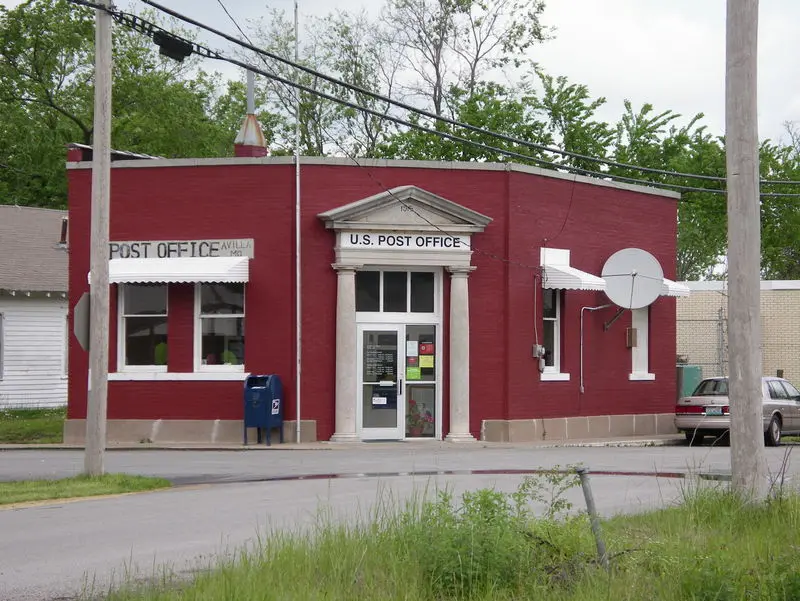
Avilla's afterwards is a long, ordinary decline. Captain Thomas Jefferson Stemmons, the doctor's son, came home and opened the first business in town after the war with his partner D. B. Rives. Campbell's Gazetteer of Missouri put the population at about five hundred in 1874, with a few stores, a hotel, two churches and a school. Then the railroad went elsewhere and the town stopped growing. The Bank of Avilla — organised on 18 September 1914 and open by January 1915 — was the only bank the town ever had; it was robbed at least four times, most famously on 18 May 1932, when the cashier was taken hostage and thrown out of a car on a road outside town. The bank closed in 1944, and in 1952 the Postal Service moved into the building, where it still is. The Old Carthage Road through the middle of town had become part of U.S. Route 66 in the late 1920s; when the interstate took the traffic, the businesses followed it out.
Timeline: the documented record of Avilla, Missouri
- 1853 Dr. Jaquillian M. Stemmons, a physician from Logan County, Kentucky, arrives in Jasper County and settles near Avilla, combining medicine with farming and stock-raising.
- 1858 Avilla is platted, the fourth-oldest village in Jasper County. Three years later it holds a hundred-odd people in a county already at war with itself.
- 1861 Stemmons, himself a slave owner, declares for the Union and raises one of the first militia companies in southwest Missouri. The 1883 county history states both facts in the same sentence and names none of the people he held in slavery.
- 1862 Guerrillas attack Stemmons's house by night two and a half miles northeast of Avilla, burn it to the ground and shoot him dead outside it. The militiaman Latham Duncan is killed in the same attack. The county history gives the year and no day, and names no leader.
- 25 August 1863 General Thomas Ewing issues General Order No. 11 at Kansas City, emptying Cass, Jackson and Bates counties and part of Vernon. Jasper County is not named in it: Avilla was never covered by the order it is often said to have survived.
- 1865 At the end of the war Carthage, ten miles west, is left with "only three or four buildings" standing. Avilla comes through largely intact and briefly becomes the county's busiest town.
- January 1915 The Bank of Avilla opens, organised the previous September. It is the only bank the town will ever have, and it will be robbed at least four times before it closes.
- 18 May 1932 The bank is robbed of $3,000 and the cashier is taken hostage, bound and thrown from a car on a road outside town. The Carthage Evening Press reports it the next day; a member of the Irish O'Malley gang is later convicted and sentenced to seventy-five years.
- 30 October 2009 An anonymous editor adds to Wikipedia's Avilla article a paragraph about a rebel's skull hung from a tree limb, calling it "the hanging skull apple tree legend". This is the earliest appearance of the story that we have been able to date.
- 10 June 2012 A Wikipedia editor signing as Traveler7 creates a section titled "Legend of the Avilla Death Tree" and names the phantom "Rotten Johnny Reb", describing a headless figure in a long duster carrying an antique firearm and most active in autumn because "it is thought that he had been killed on All Hallow's Eve".
- 11 June 2012 The next day, the same editor adds a single sentence about Avilla's "Shadow Folk" to Wikipedia's list of reportedly haunted locations in the United States. That sentence remains the whole documentary basis for the Shadow Folk; it has never appeared in Avilla's own article.
- 7 March 2022 The Bank of Avilla building, the town's post office since 1952, is listed on the National Register of Historic Places. It is the only protected structure in Avilla and the only thing in town a visitor can properly go and look at.
Is there a rational explanation for Avilla, Missouri?
This is one of the rare cases where a ghost story can be dated to the day, because it was born on a website with a revision history.
The legend circulating today has three named pieces: a "Death Tree", a headless revenant called "Rotten Johnny Reb", and a population of "Shadow Folk". None of the three appears in any nineteenth-century source. All three can be found entering Wikipedia. On 30 October 2009 — the day before Halloween — an anonymous editor added to Wikipedia's Avilla article a paragraph about a rebel's skull hung from a tree limb, and called it "the hanging skull apple tree legend". On 10 June 2012 an editor writing as Traveler7 created a section headed "Legend of the Avilla Death Tree", named the phantom "Rotten Johnny Reb", and supplied material that no folklorist collected: a headless figure "wearing a long duster and carrying an antique firearm", most active in autumn, because "it is thought that he had been killed on All Hallow's Eve". On 11 June 2012, the following day, the same editor added Avilla's "Shadow Folk" to the English Wikipedia's list of reportedly haunted American locations, in a single sentence. That sentence is the entire documentary basis for the Shadow Folk. It has never appeared in Avilla's own article.
The historical anchor is no better attested than the ghost. The claim can be tested, because Jasper County is unusually well documented for its size. The 1883 History of Jasper County runs to 3.5 MB of scanned text and names Avilla 92 times, Stemmons 39 times, Carthage 1,086 times and Sarcoxie 348 times; it uses the word "bushwhacker" 14 times. It contains no "Death Tree", no "Johnny Reb", and exactly one instance each of "skull" and "skeleton", both about unrelated deaths elsewhere in the county. Joel Livingston's two-volume county history of 1912 gives the same result: Avilla 26 times across both volumes, Stemmons 30, and no Death Tree at all. The "Dunlap apple orchard" where the skull is supposed to have hung cannot be found either; every Dunlap in the 1883 book belongs to Carthage, Medoc or Galesburg. A search of the Official Records of the Union and Confederate Armies, Series I, volume XXII — the volume covering 1863 operations in Missouri, Arkansas and Kansas — returns no mention of Avilla at all, against 56 for Carthage, 119 for Neosho and 210 uses of "bushwhack", so the absence is not an artefact of a bad search.
A note on how it reached the wider web, and how it reached us. Legends of America published its Avilla page — a sober town history that repeats the skull incident but contains no ghost — around 2019, a decade after the Wikipedia paragraph, and lists Wikipedia among its sources. Enigma Atlas's own earlier text then added back the ghost, dated the skull to 1862 (no source dates it at all), moved the tree from the town to "south of town", turned a found skull into a hanged corpse, and explained the Shadow Folk as "impressions left by people who once lived" there — an explanation that appears in no source we have been able to find, including the Wikipedia sentence it came from. All of that has been removed.
Can you visit Avilla, Missouri?
Avilla is an inhabited village in Jasper County, Missouri, on Missouri Route 96 — the old US 66 alignment — about twelve miles (19 km) east of Carthage; the ZIP code is 64833. The Census Bureau's subcounty estimates give it 99 residents in 2020 and 100 in 2024, and the Avilla R-13 school district still runs a school there. The buildings that photographers frame as abandoned stand on streets where people live, and the ground on either side of them is private property.
Nothing in the sources consulted for this file locates a Death Tree or names an owner for one, and the orchard the story places it in does not appear in the county record. Avilla has never had a marker for the legend or a guided tour of it.
The one listed building is the Bank of Avilla at 205 Greenfield Street, a flat-roofed brick commercial block put up in 1914 and opened as a bank in January 1915. It has housed the village post office since 1952, and it entered the National Register of Historic Places with effect from 7 March 2022. Of the inside, the nomination records that "its interior still retains the vault, shelving, part of the lobby wall and lobby area"; the outside can be seen and photographed from the public street. The counter is open only part of the day. The commercial postal directories that publish its hours contradicted one another when they were read on 9 September 2026, and the office telephone is 417-246-5760.
The nearest fuel and lodging are in Carthage.
Sources consulted
- Mills & Co., «The History of Jasper County, Missouri, including a condensed history of the state, a complete history of Carthage and Joplin, other towns and townships» — Mills & Co., Des Moines, 1883 book
- Joel Thomas Livingston, «A History of Jasper County, Missouri, and Its People, vols. 1-2» — Lewis Publishing Company, 1912 book
- Nancy L. Johnson and Michelle Diedriech, «National Register of Historic Places Registration Form: Bank of Avilla / United States Post Office, Avilla, Missouri» — National Park Service / Missouri State Parks, 2021 report
- United States War Department, «The War of the Rebellion: A Compilation of the Official Records of the Union and Confederate Armies, Series I, vol. XXII» — Government Printing Office, Washington, 1888 archive
- Anonymous editor 96.254.112.195, «Avilla, Missouri — Wikipedia, revision of 30 October 2009 (oldid 322950093)» — English Wikipedia, 2009 archive
- Editor Traveler7, «Avilla, Missouri — Wikipedia, revision of 10 June 2012 (oldid 496847733)» — English Wikipedia, 2012 archive
- Editor Traveler7, «List of reportedly haunted locations in the United States — Wikipedia, revision of 11 June 2012 (oldid 497021859)» — English Wikipedia, 2012 archive
- U.S. Census Bureau, Population Division, «Subcounty Resident Population Estimates: April 1, 2020 to July 1, 2024 (SUB-EST2024), Avilla town, Jasper County, Missouri» — U.S. Census Bureau, 2025 report
- Kathy Alexander, «Avilla, Missouri — Capitol 66 Ghost Town» — Legends of America, 2025 web
- Ron Warnick, «Bank of Avilla building in Avilla, Missouri, added to National Register of Historic Places» — Route 66 News, 2022 web
Reviewed by V. Serrano on 2026-08-11 · How we verify our content
💬 Field testimonies (0)
No testimonies yet. Add the first.
Add your testimony
🔒 Log in to add a testimony