👻 HAUNTED PLACE · EXP. Nº9477
ACTIVE
Bachelor's Grove Cemetery
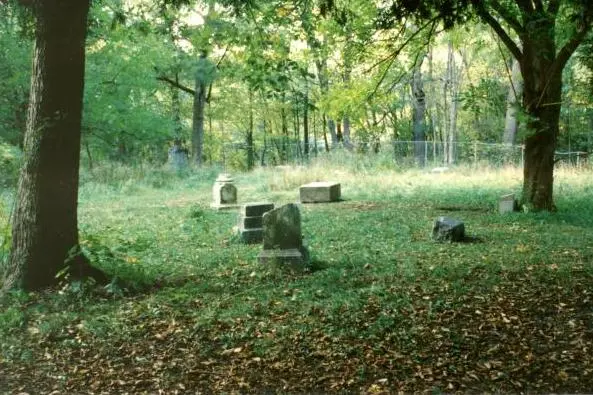
Hidden inside the Rubio Woods forest preserve in Bremen Township, Cook County, Illinois, Bachelor's Grove Cemetery has been called the most haunted graveyard in America since ghost-hunting groups began documenting it in the 1970s.
Where is Bachelor's Grove Cemetery?
- Location
- Illinois, United States
- Type
- Cemetery
- Coordinates
- 41.631, -87.771
- Last updated
LOCATION
Why is Bachelor's Grove Cemetery said to be haunted?
Burials ran from the 1840s to 1965, with a last cremation burial in 1989, but the small, overgrown plot is best known for the "Madonna of Bachelor's Grove," a photograph taken by the Ghost Research Society on August 10, 1991, that appears to show a translucent woman seated among the headstones. Visitors have also reported a phantom farmhouse that appears and vanishes, glowing orbs over the old quarry pond, where by one rumour gangsters dumped bodies during Prohibition, and a spectral car with no driver seen barreling down the access road late at night.
What is the history of Bachelor's Grove Cemetery?
Bachelor's Grove is a small cemetery in Bremen Township, Cook County, Illinois, in Chicago's south-western suburbs between Midlothian and Oak Forest. Its legal description is one acre in Section 8, Township 36 North, Range 13 East of the Third Principal Meridian; it lies across from the Rubio Woods Forest Preserve on 143rd Street, just east of Ridgeland Avenue, down a trail that was once part of the old Midlothian Turnpike.
The settlement it served goes back to the late 1820s. The second edition of J. M. Peck's Gazetteer of Illinois, of 1837, already lists "Bachelder's Grove, in Cook County, eighteen miles southwest of Chicago", with "a large settlement". The settler Stephen Rexford said the name came from four single men, himself among them; Brad Bettenhausen, president of the Tinley Park Historical Society, thinks it more likely comes from the Batchelder family, recorded in the area by 1845, because the name was in use before Rexford arrived.
Ferdinand Schapper's manuscript of 1917 gives the first burial as that of Eliza Scott in November 1844, and an article in the Blue Island Sun-Standard of 16 August 1935 records an earlier death date, that of William B. Nobles in 1838. The first legal record of the ground is a sale of 1864 in which Edward M. Everden set aside one acre for a graveyard. An estimated 200 people are buried there. The last burials are believed to be those of Laura M. McGhee in 1965 and of Robert E. Shields, cremated and buried in the family plot, in 1989. Some families moved their dead to other cemeteries from the late 1880s onwards, and the isolation and the vandalism of later years led others to do the same.
The site was already a lovers' lane and a place for drinking parties before the road changed. In the 1960s the stretch of the old Midlothian Turnpike in front of the cemetery was closed to vehicle traffic; a drawing kept by the Fulton family shows a plan for a new entrance from 143rd Street that was never built, presumably because no easement could be had through the surrounding forest preserve. Once the road was closed, the historical society's account says, vandalism accelerated, with evidence of satanic rituals and attempts to open graves particularly in the 1960s and 1970s, and a peak in the 1970s. Stones were broken, spray-painted and stolen; Clarence Fulton, the last independent trustee, said markers turned up at the Cook County Sheriff's Police headquarters in Maywood, in Evergreen Park and at Chicago Police headquarters.
Fulton asked Bremen Township for help with the upkeep in 1967 and was turned down. In the autumn of 1975 he asked the Cook County Board, and after clearing the title through condemnation proceedings the county took responsibility for the cemetery in about 1976. Its maintenance is now shared with the Forest Preserve District of Cook County.
Timeline: the documented record of Bachelor's Grove Cemetery
- 1840s The cemetery is established as the burial ground of a rural settler community in Bremen Township, Cook County.
- 1960s In the 1960s the stretch of the old Midlothian Turnpike in front of the cemetery is closed to vehicle traffic, and a planned new entrance from 143rd Street is never built. The site, already a lovers' lane, is left more isolated.
- 1965 Laura M. McGhee is buried, one of the last two burials believed to have taken place in the cemetery; the other, Robert E. Shields, cremated and buried in the family plot, follows in 1989.
- 1960s–1970s Sustained vandalism: headstones toppled and smashed, graffiti, thefts, desecrations and rituals. The historical society's account places the peak of the vandalism in the 1970s.
- 10 August 1991 During a Ghost Research Society investigation, Jude Huff-Felz photographs on black-and-white infrared film a young woman seated on a tombstone; many later books credit the picture to her sister, Mari Huff. In his Field Guide to Spirit Photography (2002), the society's founder writes that an expert consulted at Kodak for a Discovery Channel documentary believed it showed a real person, because the figure casts a shadow.
Is there a rational explanation for Bachelor's Grove Cemetery?
Whether the ghost stories caused the damage is argued by two people who know the cemetery well, and they disagree. Brad Bettenhausen, president of the Tinley Park Historical Society, told WBEZ in May 2024 that the stories have become an invitation for people to come in and vandalize the cemetery, and that rowdy visitors are still known to steal headstones and throw them into the lagoon. Dale Kaczmarek, who founded the Ghost Research Society in 1977, told the same programme that the stories have helped, because some ghost hunters became volunteers who "rake, they get rid of tree limbs and so forth"; he also admitted that some people disturb the grounds on purpose, hoping to experience something paranormal.
The dates in the historical society's account bear on both views. The cemetery was a lovers' lane before the road in front of it closed in the 1960s, the vandalism peaked in the 1970s, and a Chicago Sun-Times story of 29 October 1982 was already repeating the legend of a two-headed ghost in the lagoon, nine years before the photograph that put the cemetery on the map nationally. The society's history says the stories of a floating blue light, a phantom house and phantom cars have "greater basis in local folklore than in verifiable occurrences", and a local cemetery history site of 2017 records the explanation residents give for the blue ghost: ground fog.
The photograph was taken on 10 August 1991 during a Ghost Research Society investigation, on black-and-white infrared film, in an area where members had noticed something unusual with their equipment. It shows a young woman in an old-fashioned dress sitting on a tombstone, with parts of her body semi-transparent. The society's own photo page credits it to Jude Huff-Felz; many later books give the name of her sister, Mari Huff, also a member. In his Field Guide to Spirit Photography (2002), Kaczmarek writes that for the Discovery Channel documentary "Phantom Photographs" the picture was submitted to "alleged" experts at Kodak, and that one of them, whom he does not name, believed it showed a real person, because the figure casts a shadow on the ground around the tombstone and on the stone itself. Kaczmarek replies that there are shadows all around the gravestone, and that he has "full faith" in Huff-Felz and in the development of the infrared film.
Can you visit Bachelor's Grove Cemetery?
The cemetery lies on 143rd Street in Bremen Township, Cook County, Illinois. Brad L. Bettenhausen of the Tinley Park Historical Society, whose history of the settlement is published by the Bachelors Grove Cemetery & Settlement Research Center, places it "across from what is now called the Rubio Woods Forest Preserve on 143rd Street just east of Ridgeland Avenue". The Forest Preserves of Cook County apply the name Bachelors Grove to their own holding at "143rd Street and Justamere Road". The burial ground itself is tiny: Bettenhausen gives it as "1 acre in the East 1/2 of the Northwest 1/4 of Section 8, Township 36 North, Range 13".
Arrival is on foot because the roads were taken away. The trail that now reaches the cemetery "has been closed to vehicle traffic since the 1960s", and "the last remaining section of roadway known as Bachelors Grove Road" was "closed in December 1994". What is left of the old Midlothian Turnpike alignment is a broken asphalt path through trees, and the surface itself is among the more striking things on the site.
The condition of the stones is the record of what was done to them. Through the peak years of the 1960s and 1970s, Bettenhausen writes, "many stones were maliciously broken, defaced, spray painted, and stolen". Markers taken from the site turned up later in Maywood and in Evergreen Park, and one was recovered at Chicago Police Headquarters. The distances are the measure of how far the traffic in them reached.
People are buried here, and the graves are those of the settler families of the grove; the burial ground is the one their descendants can still name, and the stones standing today are the survivors of that campaign of breakage and theft rather than a set dressed for the legend. Bettenhausen's history, which is the fullest account of the settlement and of what happened to its cemetery, is published in full and free on the research centre's site; it was consulted on 9 September 2026.
Sources consulted
- Brad L. Bettenhausen (Tinley Park Historical Society), «The History of Batchelors Grove — historia del cementerio, cierre del antiguo trazado de la Midlothian Turnpike y vandalismo documentado» — Bachelors Grove Cemetery & Settlement Research Center, 2026 web
- The Black Vault, «Madonna of Bachelor's Grove — expediente de la fotografía de 1991» — The Black Vault Case Files, 2022 archive
- WBEZ Chicago, «Bachelor's Grove Cemetery ghost stories» — WBEZ Curious City, 2024 newspaper archive
- Chicago and Cook County Cemeteries, «Bachelors Grove — struggling to survive: estado de conservación del camposanto» — Registro de cementerios, 2017 report
- Dale Kaczmarek / Ghost Research Society, «Ghost Photographs — the Bachelor's Grove picture of 10 August 1991, "an enlarged black and white infrared shot", credited to Jude Huff-Felz» — ghostresearch.org, 2000 web
- Dale D. Kaczmarek, «A Field Guide to Spirit Photography — the Bachelor's Grove photograph, its submission to Kodak experts for the Discovery Channel documentary "Phantom Photographs" and the author's reply» — Whitechapel Productions / Ghost Research Society, 2002 book
- J. M. Peck, «A Gazetteer of Illinois, second edition, entirely revised, corrected and enlarged — entry 'Bachelder's Grove, in Cook county, eighteen miles south-west of Chicago… and a large settlement'» — Grigg & Elliot, Philadelphia, 1837 (Internet Archive), 1837 book
Reviewed by V. Serrano on 2026-07-28 · How we verify our content
💬 Field testimonies (0)
No testimonies yet. Add the first.
Add your testimony
🔒 Log in to add a testimony