👻 HAUNTED PLACE · EXP. Nº9478
ACTIVE
Belasco Theatre
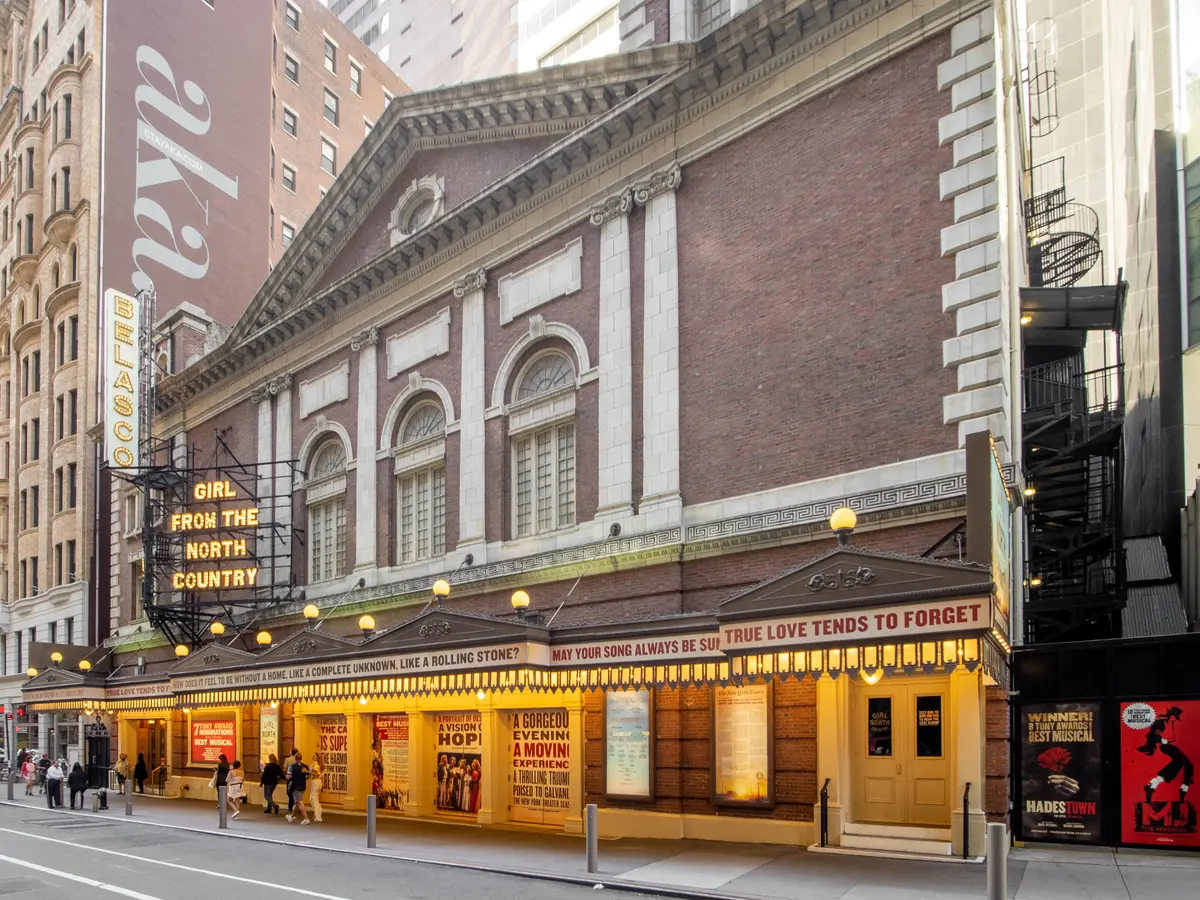
David Belasco opened this Broadway house at 111 West 44th Street on 16 October 1907 as the Stuyvesant, and he built it to feel like a home: neo-Georgian brick, an auditorium he called his living room, and 4,500 lamps worked from the largest switchboard in the world.
Where is Belasco Theatre?
- Location
- New York, United States
- Type
- Theater
- Coordinates
- 40.757, -73.984
- Last updated
LOCATION
Why is Belasco Theatre said to be haunted?
He renamed it after himself in 1910 and ran it for 24 years and 47 shows. In 1909 he added a ten-room duplex on the roof, reached by a private lift, with a Napoleonic museum and a Gothic room lit by hidden switches; he worked there at night and rang an electric bell every hour so the staff would know he was all right. In 1911 he staged here his own play about a dead man who comes back, The Return of Peter Grimm, after reading the psychical researchers and cutting a seance because in rehearsal it struck him as ridiculous. He died on 14 May 1931 — not in the theatre but at the Hotel Gladstone — and Broadway has said ever since that he never left. In the trade press of his own profession that story cannot be found at all: the earliest printed appearance we can date is 1984. The theatre is still working; the duplex has been shut since 1931.
What is the history of Belasco Theatre?
David Belasco laid the cornerstone of this house on 5 December 1906, and he did it as a piece of theatre. The cast of his current hit, The Rose of the Rancho, stood and watched while its leading lady, Blanche Bates, spread the mortar and said she hoped "Mr. Belasco will stick to all of us, and that we and all his friends will stick to Mr. Belasco, as this mortar will eternally stick to this stone."
The architect was George Keister, but the Landmarks Preservation Commission is blunt about who was really designing: Belasco "had input into every aspect of its planning", from the seating to the stage elevator to the lighting. Keister gave him neo-Georgian brick — an idiom for houses, not for playhouses — because the point was domesticity. Belasco wanted a theatre that felt like his home, "where guests would visit his 'living room' for an evening's entertainment", and he wanted it small: "I like a moderate sized, even small theater for most plays," he said, "because of the intimacy, the close contact which permits the closest observation, so that the most delicate and subtle touches, intonations and glances — the fluttering of an eyelid, the trembling of a lip, the tense tremor of nervous fingers shall not be obscured."
It opened on 16 October 1907 as the Stuyvesant, with a play by amateurs, A Grand Army Man, which ran 149 performances. His own house paper announced the "Opening of Belasco's New Stuyvesant". He renamed it the Belasco in 1910, when his first theatre reverted to Hammerstein's Republic, and he ran it for 24 years and 47 productions.
What he spent the money on was light. The house carried 4,500 electric lamps worked from what was then the largest and most flexible switchboard in the world; the ceiling was ground glass lit from behind "to give the impression of 'real daylight'", set with 22 stained-glass panels; the fixtures were by Tiffany Studios; and eighteen mural panels by Everett Shinn ringed the auditorium in what the commission calls "an arc of atmospheric intimacy". In 1917 he abolished the footlights altogether and threw all the light from above, "as in nature".
Then he moved in. Two alteration permits of 1909 — numbers 928-09 and 2552-09 — record the ten-room duplex he built on the roof, above the office wing, reached by a private lift from backstage. Inside were a crypt-like case for his ancient glass, a Napoleonic museum with a much-prized lock of the emperor's hair, a Japanese bedroom, a library, a dining room, and the Gothic Room, where medieval art and erotica sat together under hidden switches. He worked there at night. At the memorial after his death a friend remembered the electric bell in the studio that Belasco rang every hour so the staff downstairs would know he was all right.
He kept rebuilding the auditorium too: new orchestra boxes and eastern balcony stairs in 1919, another rooftop room in 1920, extra seats in 1928. That same year, for Molnár's Mima, he sheathed his own orchestra boxes and balcony in metal and turned the "living room" into something closer to the engine room of a battleship. He was 73 and lost a quarter of a million dollars on it.
Four years after opening he staged, in this theatre, the most famous American stage ghost of his generation. The Return of Peter Grimm opened on 17 October 1911 and ran 231 performances, with David Warfield playing a dead man who comes back. Belasco explained in 1919 how he prepared it: he read "standard books on psychic phenomena", naming James H. Hyslop's Psychical Research and the Resurrection and Fremont Rider's Are the Dead Alive?, and "had several long talks with Professor James". He first wrote a séance with a woman medium and cut it — "in rehearsals it impressed me as ridiculous" — and gave the sight of the ghost to a child instead.
The end came slowly. In October 1930, out of town in Baltimore with Tonight or Never, he was put to bed with what local doctors called a cold; back in New York it was pneumonia, and a lung had to be tapped. He missed the Broadway opening — the only premiere he ever missed in 24 years — and when he came back in March 1931 the company gave the show a second opening for his benefit. It was the last one he attended.
He died on 14 May 1931 of a coronary embolism, and not in the theatre. Variety reported that at the bedside in the Hotel Gladstone were his surviving daughter Reina, wife of the producer Morris Gest, and his doctor; Belasco knew he was going and asked for his daughter to be sent for. The performance at the Belasco that night was not interrupted. President Herbert Hoover's message of regret was read on a half-hour memorial broadcast from WOR; Margaret Anglin read Robert Louis Stevenson's "Requiem", having asked which verse he had loved; messages came from Mrs. Leslie Carter, Frances Starr and Blanche Bates, who had laid the mortar in 1906.
The apartment was emptied by order of Reina Belasco Gest. From 8 to 12 December 1931, in five afternoon sessions, the American Art Association·Anderson Galleries sold 1,179 lots of it — glass, porcelain, ivories, arms and armour, tapestries, the Belasco Napoleonic Collection, and an Italian chair whose back panel carried an inscription claiming it was "made from an old carved pew taken from the church in which Shakespeare is buried in Stratford-on-Avon". Five truckloads of curios went out of the building; his books went to the New York Public Library and some of the panelling to the "Belasco Room" at Sardi's. The theatre itself was left alone.
Katharine Cornell leased it from 21 September 1931 and staged six productions with her husband Guthrie McClintic. After that it went from hand to hand: sold in 1934 to Mrs. Elmer Rice, foreclosed and bought back by the Belasco estate in 1936, sold in 1944 and again in 1948, and then stripped of its orchestra seats to serve from 1949 to 1953 as an NBC radio playhouse broadcasting Eddie Cantor's quiz show Take It or Leave It. It returned to the legitimate stage in 1953. In 1975 the seats came out again for a cabaret staging of The Rocky Horror Show, which lasted 45 performances. Facade and interior were both designated New York City landmarks on 4 November 1987, and the Shubert Organization, which says the house came under its ownership in 1948 and restored it in 2010, runs it today.
Timeline: the documented record of Belasco Theatre
- 5 December 1906 The cornerstone is laid while the cast of The Rose of the Rancho looks on; Blanche Bates spreads the mortar and hopes aloud that Belasco and his friends will stick to one another as the mortar sticks to the stone.
- 16 October 1907 The house opens as the Stuyvesant with A Grand Army Man, a play by two amateurs and Belasco himself; it runs 149 performances. Belasco's own house paper announces the “Opening of Belasco's New Stuyvesant” a week later.
- 1909 Alteration permits 928-09 and 2552-09 record the ten-room duplex Belasco builds on the roof above his office wing, reached from backstage by a private lift.
- 1910 Belasco renames the Stuyvesant after himself, his first theatre having reverted to Hammerstein's Republic.
- 17 October 1911 The Return of Peter Grimm opens here, 231 performances, with David Warfield as a dead man who comes back. Belasco later writes that he prepared it by reading Hyslop and Rider on psychic phenomena and talking at length with Professor James, and that he cut a séance scene because in rehearsal it struck him as ridiculous.
- 12 December 1928 For Molnár's Mima, Belasco sheathes his own orchestra boxes and balcony in metal, turning the “living room” into something closer to a battleship engine room. He is 73 and loses a quarter of a million dollars on the production.
- November 1930 Pneumonia keeps Belasco from the Broadway opening of Tonight or Never — the only premiere he misses in 24 years. He had been put to bed in Baltimore in October with what local doctors called a cold; a lung had to be tapped.
- March 1931 Apparently recovered, Belasco returns to Broadway and the company gives Tonight or Never a second opening for his benefit. It is the last opening night he attends.
- 14 May 1931 Belasco dies of a coronary embolism — not in the theatre, but at the Hotel Gladstone, with his surviving daughter Reina, wife of the producer Morris Gest, and his doctor at the bedside. The performance at the Belasco that night is not interrupted.
- Friday after his death, May 1931 A half-hour memorial is broadcast from WOR, New York: President Herbert Hoover's message of regret is read out, Margaret Anglin recites Stevenson's “Requiem” after asking which verse Belasco had loved, and messages arrive from Mrs. Leslie Carter, Frances Starr and Blanche Bates.
- 8–12 December 1931 By order of Mrs. Morris Gest, the American Art Association·Anderson Galleries sells the collection of the late David Belasco in five afternoon sessions: 1,179 lots, including the Belasco Napoleonic Collection and a chair inscribed as having been made from a pew taken from the church where Shakespeare is buried. Five truckloads of curios leave the building; the theatre itself is untouched.
- 25 February 1971 Oh! Calcutta!, the nude revue devised by Kenneth Tynan, transfers from the off-Broadway Eden Theater and gives 606 of its 1,316 performances at the Belasco. The story that it drove Belasco's ghost away is dated by later accounts to 1972.
- 21 August 1984 The Daily News publishes “A Ghost in Belasco's Theater” (p. 57), cited three years later in the designation reports' footnote on the duplex. It is the earliest printed appearance of the haunting we have been able to date — 53 years after Belasco's death.
- 4 November 1987 The Landmarks Preservation Commission designates both the facade (LP-1317) and the interior (LP-1318). Neither report uses the words ghost, haunt or legend about the building; both record that only four of the original eight boxes survive.
- July 1995 The New York Times reports that the cast of the Ralph Fiennes Hamlet, led by Terence Rigby — who was playing the Ghost — toured the boarded-up duplex by flashlight, the power having been cut off. The noise that stopped them beneath the Tiffany skylight was a pigeon.
- July 2006 The New Yorker joins a negotiated flashlight tour of the apartment. The actor Pablo Schreiber presents an “open-faced confession booth” where Belasco supposedly heard chorus girls; a call to the Shubert Archive establishes that it had probably been his telephone booth.
- 19 June 2022 Girl from the North Country, the Conor McPherson–Bob Dylan musical whose Broadway run was broken twice by the pandemic, plays its last performance at the Belasco. The photograph on this page was taken outside the theatre that afternoon, with the marquee still lit for it.
Is there a rational explanation for Belasco Theatre?
The most interesting thing about the Belasco ghost is what is missing from the record of Belasco's own trade.
Searched on 17 August 2026, the digitised American theatrical and film trade press indexed by Lantern (Media History Digital Library — Variety, The Billboard, Theatre, The Film Daily and others) returns 8,879 pages for the phrase "David Belasco", 2,074 for "Belasco Theatre" and 237 for "Stuyvesant Theatre". In the same corpus, on the same day, "Belasco's ghost", "ghost of David Belasco", "ghost of Belasco", "ghost of the Belasco", "haunted the Belasco", "Belasco is haunted", "Belasco's shade" and "shade of David Belasco" return zero pages between them. The corpus is not blind to the subject: "haunted theatre" and "haunted theater" bring back sixteen pages, none of them about this house. The two near-misses are figurative — a 1934 magazine praising John Barrymore for catching "the spirit of David Belasco", and a 1940 Variety review saying the same of Claude Rains. Neither designation report of 1987 uses the words ghost, haunt, apparition or legend about the building either; the only "ghost" in their 30,000 words is the title of a 1949 magazine piece, "The Belasco Gives Up the Ghost", which is about the house being converted into a radio studio.
The earliest datable printed appearance of the story that we have been able to fix is late: a Daily News article of 21 August 1984, "A Ghost in Belasco's Theater", cited in the designation reports' footnote on the duplex. Fifty-three years after his death.
The details of the story do not agree with each other. The New York Times in 1995 put the figure in "his box"; The New Yorker in 2006 put him in "his customary seat, in the balcony". Neither can be checked against the room, because the room keeps changing: Belasco installed new orchestra boxes in 1919, encased the boxes and the balcony in sheet metal in 1928, and by 1987 the commission recorded that only four of the original eight boxes survived, the orchestra-level box area and the first-balcony boxes having been removed altogether. The surviving pair on each side is at second-balcony level.
The reason usually given for his departure was rejected in print, twice, by the two best-reported accounts. The Shubert Organization's own history says the house "was rumored to be haunted by his ghost, until it was banished by the risqué production, Oh Calcutta!" — but the Times in 1995 called the moral-outrage reading "revisionism at its most absurd", and The New Yorker in 2006 said it "hardly seems likely", both for the same reason: the man collected erotica and used the apartment for seductions, a point the 1987 interior report corroborates when it lists the Gothic Room's "curious combination of medieval art and erotica".
Both of the documented searches of the apartment failed, and both were reported honestly. In July 1995 the cast of the Ralph Fiennes Hamlet — led by Terence Rigby, who was playing the Ghost — went up with flashlights because the electricity had been cut off; the noise that stopped them under the Tiffany skylight turned out to be a pigeon. In 2006 the actor Pablo Schreiber showed The New Yorker an "open-faced confession booth" where Belasco supposedly had chorus girls confess to him; a call to the Shubert Archive established that it had probably been his telephone booth, and that the "steam room" was the Grotto, a water feature.
Two ordinary things sit under the two strangest details. The elevator said to run by itself is real: Variety in 1931 described the private lift by which Belasco reached his studio. And the man himself left the best available explanation of how a Belasco apparition is made. Describing a stage effect in 1919, he wrote that a workman "happened to pass between the curtain and a light at the back. Seen through the folds of the curtain his movements were almost ghostly. I saw at once that the effect for which I had been striving had come to me ready-made."
The second ghost is thinner still. The "Blue Lady", said to be a showgirl killed in a lift shaft, rests on an actress who told Playbill about a blue glow in her dressing room and asked not to be named.
None of this is a verdict on whether anyone saw anything. It is a statement about the paper: the story is not attested in the press of Belasco's own profession while that press was reading it, the earliest print appearance we can date is 1984, and the two occasions on which people actually went looking are both on record as having found something else. What Belasco left instead was a refusal to decide. In his programme note for The Return of Peter Grimm he wrote: "I do not intend to advance any theory as to the probability of the return of the main character of this play. For the many, it may be said that he could exist only in the mind of the characters grouped about him — in their subconscious memories. For the few, his presence will embody the theory of the survival of persistent personal energy. The character has, so far as possible, been treated to accord with either thought."
Can you visit Belasco Theatre?
The Belasco is a working Broadway house at 111 West 44th Street between Sixth and Seventh Avenues. The Shubert Organization owns and runs it, and tickets are sold through Telecharge. On 22 September 2026 the tenant was the musical Maybe Happy Ending, playing open-ended. Nothing about the haunting is on sale. The Shubert house page gives the rumour one sentence of its history and leaves it there, and the theatre stages no ghost tour and no paranormal event.
The interior is a designated New York City landmark, LP-1318, adopted together with the facade on 4 November 1987, and the commission's own criterion was that it is "customarily open and accessible to the public" — which is to say that a performance ticket is the way in. It admits the ticket-holder to Everett Shinn's murals around the proscenium and above the surviving boxes, the ground-glass ceiling with its twenty-two stained-glass panels and their shields of dramatists, the stained-glass column capitals and the Tiffany fixtures. The 1987 report describes an auditorium in poor repair: Tiffany pieces taken down against theft, air-conditioning grilles cut through the murals above the boxes, paint that flattened the ornament. It describes the house as it stood before the restoration of 2009-2010: the Belasco closed in mid-season and reopened on 2 October 2010 with the stained glass cleaned, the Tiffany fittings returned from the Shubert Archive and the grey overpaint stripped from the mezzanine murals.
Belasco's rooftop duplex is on no tour and never has been. It has been shut and largely empty since 1931, and the two documented entries, by the Hamlet company in 1995 and by The New Yorker in 2006, both required the Shubert Organization's permission and were made by flashlight for want of power; both accounts in print describe a climb over debris past a dead pigeon.
The Shubert Organization's page for the house counts 1,059 places: 527 in the orchestra, 283 in the mezzanine, 200 in the balcony, 24 in the boxes and 25 standing. The main entrance has two small steps, and a step-free side entrance is opened on request at arrival. There are no lifts and no escalators. The orchestra is step-free and holds eight wheelchair locations and five transfer seats, with four more transfer seats in the mezzanine, which is one flight up; the balcony is another flight above that, and its rows sit about two steps apart, with a handrail. One accessible toilet is provided, and the others are a flight below the orchestra and on the upper levels. The house has induction loops for T-coil hearing aids. Infrared assisted-listening and neck-loop receivers are lent by reservation at the Shubert Audience Services kiosk. Closed captioning and audio description run through the GalaPro app on a personal phone. Times Square–42nd Street and 42nd Street–Bryant Park are both two blocks south.
Sources consulted
- Landmarks Preservation Commission, City of New York, «Belasco Theater (LP-1317): Designation Report» — LP-1317, adopted 4 November 1987, 1987 report
- Landmarks Preservation Commission, City of New York, «Belasco Theater Interior (LP-1318): Designation Report» — LP-1318, adopted 4 November 1987, 1987 report
- David Belasco (ed. Louis V. Defoe), «The Theatre Through Its Stage Door» — Harper & Brothers, New York and London, 1919 book
- Variety, «David Belasco obituary and memorial report» — Variety, 20 May 1931, 1931 newspaper archive
- American Art Association · Anderson Galleries, Inc., «The Collection of the Late David Belasco (sale no. 3931, 8–12 December 1931)» — Auction catalogue, New York, 1931 archive
- Adam Green, «Theater; The Phantom of the Belasco: A Tale» — The New York Times, 16 July 1995, 1995 newspaper archive
- Nick Paumgarten, «A Broadway Haunt» — The New Yorker, 3 July 2006, 2006 newspaper archive
- The Shubert Organization, «Belasco Theatre: history, specifications and accessibility» — shubert.nyc, 2026 web
- Playbill, «Girl From the North Country Ends Broadway Run June 19» — Playbill, 2022 newspaper archive
- Museum of the City of New York, «Belasco's Ghost» — MCNY Blog: New York Stories, 8 November 2011, 2011 web
- Media History Digital Library, «Lantern full-text search of the Media History Digital Library (measured 17 August 2026)» — lantern.mediahist.org, 2026 archive
Reviewed by V. Serrano on 2026-08-17 · How we verify our content
💬 Field testimonies (0)
No testimonies yet. Add the first.
Add your testimony
🔒 Log in to add a testimony