👻 HAUNTED PLACE · EXP. Nº9478
ACTIVE
Bell Witch Cave
The Bell Witch remains the most famous haunting in the United States, notable for having a named family, a specific time span (1817-1821), and a precise location: the Bell farm at Adams, Robertson County, Tennessee, on the Red River.
Where is Bell Witch Cave?
- Location
- Tennessee, United States
- Type
- Forest / nature
- Coordinates
- 36.591, -87.056
- Last updated
LOCATION
Why is Bell Witch Cave said to be haunted?
The disturbances began with knocking and escalated to voices, physical aggression against the youngest daughter Betsy, and were blamed for John Bell's death. The legend records the visit of General Andrew Jackson, though this lacks independent contemporary corroboration. The Bell Witch Cave, a genuine limestone system on the former property, was incorporated into the tradition later, not in the original accounts. The first printed account is a paragraph in Goodspeed's History of Tennessee (1886); the first full-length one is Martin Van Buren Ingram's book of 1894, whose central document he dated to 1846 and which Joe Nickell (2014) argues Ingram wrote himself. The cave does not appear in Ingram's book; the earliest dated pictures of it are postcards of 1908-1909.
What is the history of Bell Witch Cave?
The Bell Witch is the closest thing the United States has to a national haunting, and it is unusual among such cases in having a named family, a dated span and a location on the map: the Bell farm at Adams, Robertson County, Tennessee, on the Red River.
The story covers 1817 to 1821. According to the tradition, a hostile presence began to trouble the household of John Bell, first as knocking on walls and windows and then as scratching, voices and finally physical violence, directed above all at the youngest daughter, Betsy Bell, who was said to be slapped, pinched and have her hair pulled. The entity was said to speak at length and articulately, holding conversations with visitors. It was blamed for the death of John Bell himself, on 20 December 1820.
A detail repeated in nearly every telling is the visit of General Andrew Jackson, the future president, who is said to have come to the farm with a party of men to see the phenomenon for himself and to have left the following morning.
The cave now known as the Bell Witch Cave sits on the former Bell property above the Red River. It is a genuine limestone cave, recorded by the Tennessee Division of Archaeology in 1972 with points and scrapers from the slopes above it, and listed on the National Register of Historic Places in 2008 for its place in tourism. The earliest dated pictures of it that the nomination lists are postcards of 1908-1909.
The crucial fact about the whole case is its bibliography. The first printed account is a single paragraph in Goodspeed's History of Tennessee of 1886. The first full-length one, Martin Van Buren Ingram's An Authenticated History of the Famous Bell Witch, was published in 1894, seventy-three years after the events. Practically every later version of the story descends from that book.
Timeline: the documented record of Bell Witch Cave
- 1817 According to tradition, disturbances begin at John Bell's farm in Adams, Tennessee: knocking on walls and windows, later escalating to voices and physical violence against the youngest daughter, Betsy.
- c. 1819 This is where the visit of General Andrew Jackson, the future president, is placed — said to have come to the farm with a party of men. It is not documented in any independent contemporary source.
- 1821 The period of the events ends. John Bell's death is attributed to the entity.
- 1894 The newspaper editor Martin Van Buren Ingram publishes An Authenticated History of the Famous Bell Witch, seventy-three years later. It includes Our Family Troubles, presented as an account written in 1846 by Richard Williams Bell.
- Modern scholarship Joe Nickell argues in Skeptical Inquirer that Ingram himself wrote the narrative he attributed to Richard Williams Bell. Since practically every later version descends from it, the case loses its earliest narrative, which even Ingram dated to 1846, a quarter of a century after the events.
Is there a rational explanation for Bell Witch Cave?
The Bell Witch case rests on one book, and that book is the problem.
Martin Van Buren Ingram (1832-1909) was a Clarksville newspaperman, editor of the Progress-Democrat. He published An Authenticated History of the Famous Bell Witch in 1894, seventy-three years after the end of the period the story covers. The word "authenticated" in the title is Ingram's own and reports no examination by anyone else.
Its central document is Our Family Trouble, which Ingram presents as the account of Richard Williams Bell, a son of the family. By Ingram's own dating it was written "during the Fall and Winter of 1846", by a man born in 1811 who died in 1857: a boy of six to ten when the disturbances began, writing about twenty-five years later. Taken at Ingram's word, then, it is a recollection. Joe Nickell, writing in Skeptical Inquirer in 2014, went further. He found that the manuscript "has no proven existence before about 1891", that nobody has produced it for an examination of paper, ink or handwriting, and that the text has a character introduce himself as "a professional detective" although the earliest known American use of that noun is from about 1853. The same readability formula put both texts at 14.3 and 14.4 years of schooling, and Nickell concluded that Ingram wrote the narrative he attributed to Bell.
Andrew Jackson's visit reaches the book through a story told by a Tennessee lawyer, on pages 229 to 238, and Nickell found no historical source that supports it. The National Register nomination for the cave, prepared in 2007, calls it a "well documented legend" on the strength of an e-mail from The Hermitage, and prints two different sayings for Jackson: one from an 1894 New Orleans review of Ingram's book, the other from Harriet Parks Miller's later pamphlet and a 2006 rack card for the cave.
The cave enters the record later still. The scanned 1894 edition on the Internet Archive, about 131,000 words, does not contain the word cave, against 804 occurrences of witch, 137 of Betsy and 12 of Jackson (counted on 1 October 2026). Goodspeed's county history of 1886 tells a haunted-cave story in the paragraph just before its Bell Witch, about another farm and another cave, and gives the Bell story without one. The National Register nomination states that "there is no known date for opening the Bell Witch Cave", and the earliest dated items it lists for the cave are postcards of 1908-1909.
What the record does support is a tradition older than Ingram. Eight years before his book, Goodspeed's History of Tennessee described an invisible spirit "having the voice and attributes of a woman" that held conversations, shook hands, took the sugar from the bowls and slapped and pinched the children, and that drew people "from hundreds of miles around"; its author printed the story "merely ... as an example of superstition". Ingram himself mentions "the story set afloat by parties failing in their investigations, charging her with the authorship of the mystery", meaning Betsy Bell. Between that local story and a talking entity that killed John Bell stands one author, writing in 1894.
Can you visit Bell Witch Cave?
The Historic Bell Witch Cave, Inc. is at 430 Keysburg Road, Adams, Tennessee 37010, telephone (615) 696-3055. The pin of this file, 36.5914° N 87.0556° W, is the coordinate of the National Register listing. It lies about 1.4 km north-east of the centre of Adams and 54 km (33.5 miles) north-north-west of downtown Nashville in a straight line; the operator's home page speaks of "a 40-minute drive from Nashville".
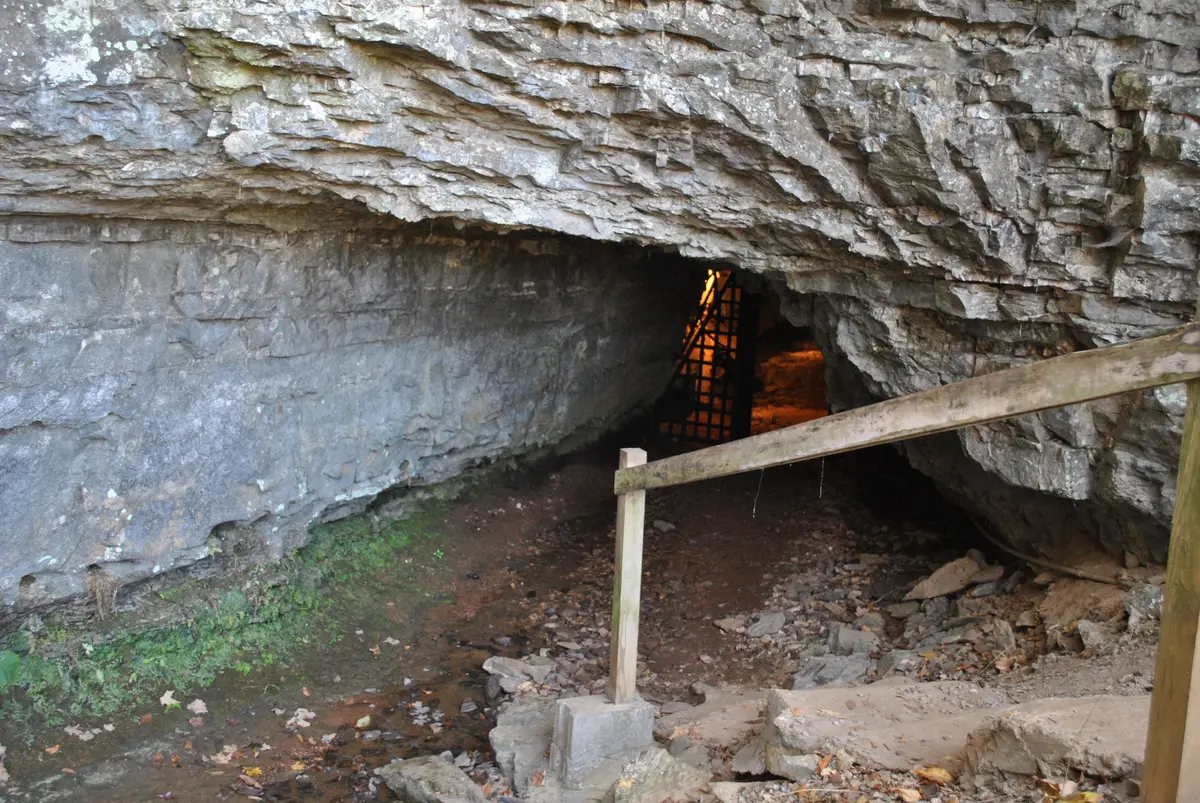
The cave was entered in the National Register of Historic Places on 21 March 2008 under reference 08000237, with site number 40RB18, for its significance in entertainment and recreation. The nomination, prepared by Claudette Stager of the Tennessee Historical Commission, covers only the cave, on about 2.4 acres, within a 101-acre parcel beside the Red River with "several modern buildings and historic buildings moved onto the property". Quoting Thomas C. Barr's Caves of Tennessee (1961), it describes the mouth as "a half-shell 60 feet wide and 30 feet high", with rooms 125 and 330 feet from the entrance, and a passage that "ends in breakdown". It records that W. M. Eden, who bought the farm in 1964, put electric lights in the cave, and it estimated about 17,000 visitors a year.
The pricing page, consulted on 24 September 2026, gives a season from May to October: weekends in May, Wednesday to Sunday in June and July, Friday to Sunday in August and September, from 10 am to 5 pm. Hours from 2 October to 1 November are published separately. In November the site opens on the 7th and 8th from noon to 5 pm and then on weekends, and it is "Closed December-April 2027". Tickets are bought on site without reservation, and each covers a guided tour of the cave of about 40 minutes plus a 30-minute tour of the cabin. The prices appear only as an image on that page, whose file is dated July 2022: adults aged 13 and over pay $19 from Wednesday to Thursday and $23 from Friday to Sunday, youths aged 4 to 12 pay $12 or $15, and military personnel or seniors $17 or $19. The page adds that the site closes "during and after heavy rain because of flooding".
The waiver page states that every visitor signs a waiver, that the cave and cabin "are not ADA accessible", that pets are not admitted and that children aged 3 and under are not allowed in the cave; feet "may get wet", and boots can be rented. The cabin is described as "a replica of the Bell Family home" in hand-hewn logs, and the home page says it keeps a chimney stone and an iron kettle from the original Bell cabin.
Sources consulted
- William T. Turner, «Bell Witch — el caso y su cronología en la enciclopedia de la Tennessee Historical Society» — Tennessee Encyclopedia, 2018 academic
- Martin Van Buren Ingram, «An Authenticated History of the Famous Bell Witch» — Setliff & Co., Nashville (printed by W. P. Titus, Clarksville), 1894 book
- Alex Hall, «The Bell Witch of Tennessee: legend, history and memory» — Appalachian Historian, 2025 web
- Joe Nickell, «The 'Bell Witch' Poltergeist — análisis de la autoría del supuesto diario de Richard Williams Bell» — Skeptical Inquirer, 2014 academic
- Claudette Stager, Tennessee Historical Commission, «Bell Witch Cave — National Register of Historic Places registration form and supplementary listing record (NRIS 08000237, listed 21 March 2008)» — National Park Service, NPGallery, 2008 archive
- Historic Bell Witch Cave, Inc., «Pricing & Tours — season, hours, admission (as an image) and tour lengths» — Operator's official site (consulted 24 September 2026), 2026 web
- Historic Bell Witch Cave, Inc., «Waiver and Restrictions — waiver, accessibility, pets and age limits» — Operator's official site (consulted 24 September 2026), 2026 web
- Goodspeed Publishing Co., «History of Tennessee: Robertson County — the Bell Witch paragraph (pp. 832-833), eight years before Ingram» — Goodspeed Publishing Co., Nashville (TNGenWeb transcription), 1886 book
Reviewed by V. Serrano on 2026-07-28 · How we verify our content
💬 Field testimonies (0)
No testimonies yet. Add the first.
Add your testimony
🔒 Log in to add a testimony