👻 HAUNTED PLACE · EXP. Nº9477
ACTIVE
Big Bay Point Light
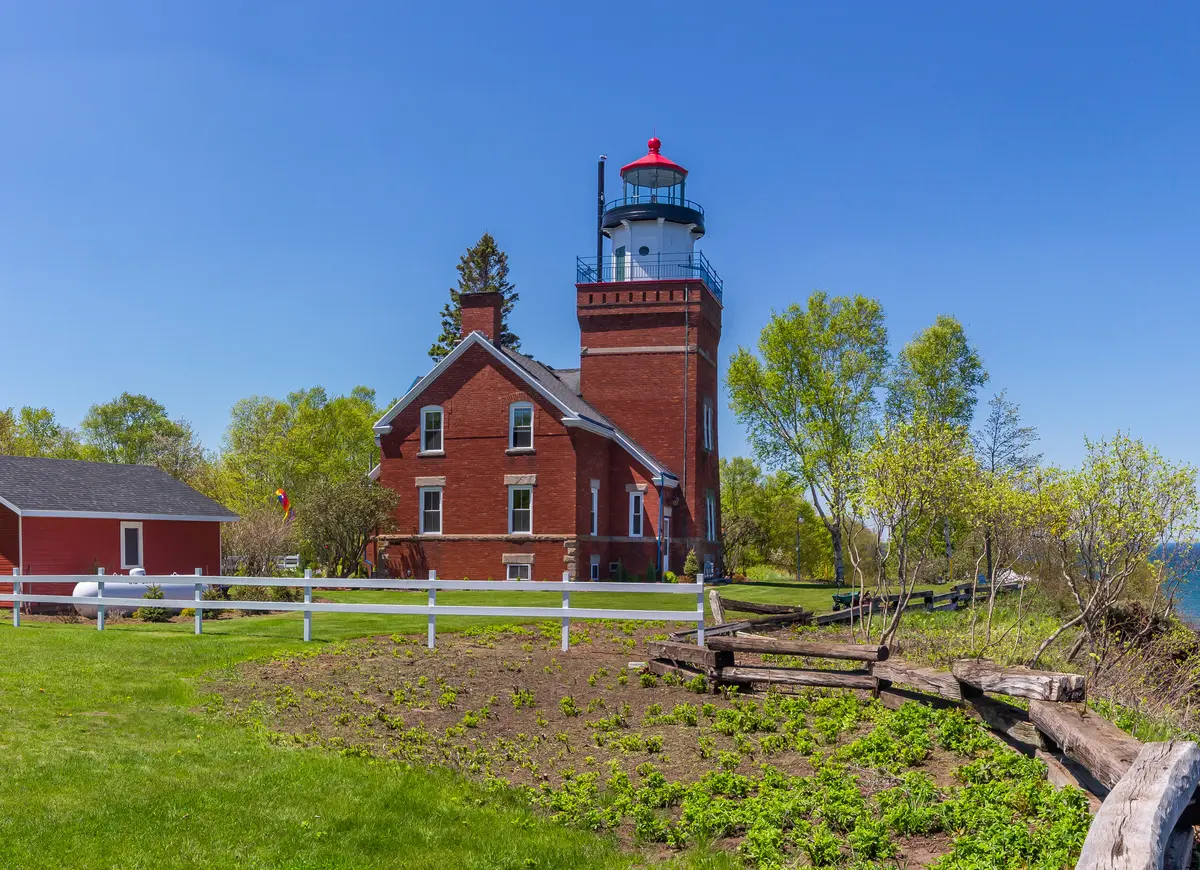
Big Bay Point Light has stood on a bluff over Lake Superior, about 25 miles northwest of Marquette, since its third-order Fresnel lens was first lit on 20 October 1896.
Where is Big Bay Point Light?
- Location
- Michigan, United States
- Type
- Lighthouse
- Coordinates
- 46.842, -87.679
- Last updated
LOCATION
Why is Big Bay Point Light said to be haunted?
It was built to close an unlit gap where, in the Light-House Board's words, a number of vessels had been wrecked. Its ghost story belongs to the first head keeper — and unusually, the tragedy behind it is documented in the station's own logbook rather than in folklore. William H. Prior, whom the Marquette Mining Journal called Harry, watched his son and assistant keeper George E. Prior die on 13 June 1901 of an injury from a fall on the station's landing crib. On 28 June he walked into the woods with his gun and a supply of strychnine. Searches found nothing. Seventeen months later a hunter reported a skeleton hanging from a tree a mile and a half south of the light, and the log recorded that the clothing tallied with the missing keeper. Footsteps and a presence have been attributed to Prior since the building became a bed and breakfast in 1986 — though the lighthouse's own website, then and now, never mentions him.
What is the history of Big Bay Point Light?
Big Bay Point Light exists because of a gap in the dark. In its report recommending the station, the United States Light-House Board pointed out that the point sat midway between Granite Island and the Huron Islands, fifteen to eighteen miles from each, that the two existing lights were invisible from one another, and that the stretch between them was unlit. Every passenger and package steamer running the south shore of Lake Superior between Duluth, Buffalo and Chicago had to change course off the point. The Board added the sentence that settled the argument: quite a number of vessels had in past years been wrecked on Big Bay Point.
Congress authorised the light and fog signal on 15 February 1893 and appropriated $25,000 for it on 18 August 1894. A parcel on the headland was bought in 1895, and construction began in May 1896 with a landing crib and a barn — the barn housed the work crew and the supplies. What went up over the following five months was not a tower with a cottage attached but a two-storey, eighteen-room red brick duplex, a square brick tower rising from its lakeward face. One half of the house was for the head keeper and his family, the other for the assistant and his. On 20 October 1896 the third-order Fresnel lens, made in Paris by Henry-Lepaute, went into service, its bull's-eye panels turning on a weight that had to be wound every five hours; a ten-inch steam whistle in the fog signal building started the same day.
The first head keeper was William H. Prior, transferred in from Stannard Rock, the notorious crib light twenty-five miles out in the lake. He reached Big Bay at half past ten on the night of 15 August 1896 and, as the service required, kept the station log. That log is why this place has a story at all. On 18 November 1897, back from walking the thirty-odd miles to Marquette to bury his only sister, he recorded of his assistant: "I can not see that the assistant has done any work around the station since I left. He has not the energy to carry him down the hill and if I speak to him about it he makes no answer, but goes on just as if he did not hear me." Twelve days later the man was transferred to Granite Island. The next assistant was no better. In the spring of 1898 that assistant, George Beamer, left for the Spanish-American War, and his wife Jennie was appointed acting assistant keeper from 12 May to 26 August 1898 — the only woman known to have served at Big Bay, and one of the Michigan keepers' wives catalogued by Patricia Majher in her history of women in the U.S. Lighthouse Service.
In November 1898 Prior hired his own son as a labourer. George E. Prior took the oath of office as assistant keeper on 18 January 1900, and for the first time the keeper had help he trusted. It lasted fifteen months. On 16 April 1901 Prior wrote that George was "very lame today" and that he would take him to Marquette; on 18 April, that his son would have to stay in hospital, "having been hurt by falling on steps on crib". George died on 13 June 1901, and the log entry is the father's: "Keeper summoned to Marquette to bury his son who died this morning."
The last entry in what appears to be Prior's handwriting is dated 27 June 1901 and reads, in full, "general work". The next day he walked into the woods carrying his gun and a quantity of strychnine. A long search found nothing. On 22 October 1901 the new keeper, James Bergan, recorded that Mrs Prior and her four children — the youngest three, the eldest fifteen — had left on a launch to live in Marquette. Then, on 14 November 1902, Bergan wrote that a man named Fred Babcock had come to the station at half past twelve: while hunting a mile and a half south of the light he had found the skeleton of a man hanging in a tree, and the clothing tallied with the former keeper, missing seventeen months. The Mining Journal of Marquette carried the notice under the headline "HIS BODY FOUND", calling him Harry W. Prior and describing the find as a gruesome one.
The station kept working long after him. The illuminant was changed to incandescent oil vapour in 1913, the steam whistles gave way to a diaphone in 1928, and in 1941 the light was automated and the last keeper left. In 1951 and 1952 the buildings were leased to the U.S. Army, which quartered National Guard and regular troops there in two-week rotations for anti-aircraft gunnery practice on the cliff. On 31 July 1952 an Army lieutenant, Coleman A. Peterson, shot and killed Maurice "Mike" Chenoweth at the Lumberjack Tavern in the village of Big Bay. His defence lawyer was the Marquette attorney John D. Voelker, who turned the case into the novel Anatomy of a Murder under the name Robert Traver; Otto Preminger filmed it in 1959 in Big Bay, Marquette, Ishpeming and Michigamme, using the real tavern. Both standard histories of the light — Terry Pepper's and Kraig Anderson's — state that Peterson was one of the soldiers billeted at the lighthouse.
Decommissioned and stripped, the property was sold by sealed bid in 1961 to a Chicago plastic surgeon, Jon Pick, for $40,000; it passed to Dan Hitchens in 1979, and in 1986 Norman "Buck" Gotschall opened it as a bed and breakfast. It was listed on the National Register of Historic Places in 1988 (reference 88001837). Three preservationists from the Chicago area — John Gale and Linda and Jeff Gamble — bought it in March 1992, and Nick Korstad, who had previously restored Borden Flats Lighthouse in Massachusetts, took over on 11 May 2018.
Timeline: the documented record of Big Bay Point Light
- 15 February 1893 Congress authorises a light and fog signal station at Big Bay Point after the Light-House Board reports that the unlit stretch between Granite Island and the Huron Islands has already claimed a number of vessels; $25,000 is appropriated on 18 August 1894.
- 20 October 1896 The third-order Henry-Lepaute Fresnel lens and the ten-inch steam fog whistle enter service. William H. Prior, transferred from Stannard Rock, had arrived as first head keeper at 10.30 p.m. on 15 August.
- 18 November 1897 Back from walking to Marquette to bury his only sister, Prior writes the log entry that has been quoted ever since: "I can not see that the assistant has done any work around the station since I left." The man was transferred twelve days later.
- 12 May – 26 August 1898 With assistant keeper George Beamer away at the Spanish-American War, his wife Jennie Beamer serves as acting assistant keeper — the only woman known to have held a post at Big Bay Point.
- 18 April 1901 Prior records that his son and assistant keeper George E. Prior, sworn in on 18 January 1900, must stay in hospital in Marquette "having been hurt by falling on steps on crib". George dies on 13 June; the entry that day is his father's.
- 28 June 1901 A day after writing a last log entry that reads only "general work", Prior walks into the woods with his gun and a quantity of strychnine. A long search fails. On 22 October the new keeper records that Mrs Prior and her four children, aged three to fifteen, have left for Marquette.
- 14 November 1902 Keeper James Bergan logs that Fred Babcock, hunting a mile and a half south of the station, has found a skeleton hanging in a tree and that the clothing tallies with the keeper missing seventeen months. The Mining Journal of 27 November reports it as "HIS BODY FOUND", naming him Harry W. Prior.
- 1941 After the fog signal is discontinued and the station electrified, the light is automated and the last keeper leaves. Half the dwelling is rented out, first to a Big Bay schoolteacher and her husband.
- 31 July 1952 During the 1951–52 U.S. Army lease of the station, Lieutenant Coleman A. Peterson shoots Maurice Chenoweth at the Lumberjack Tavern in Big Bay. His lawyer, John D. Voelker, writes it up as "Anatomy of a Murder" under the name Robert Traver; Otto Preminger films it on location in 1959.
- 1986 Norman "Buck" Gotschall opens the lighthouse as a bed and breakfast, twenty-five years after it was sold out of federal hands by sealed bid for $40,000.
- 1988 Big Bay Point Light Station is listed on the National Register of Historic Places, reference number 88001837, for architecture and maritime history.
- 1997 Frederick Stonehouse's "Haunted Lakes" calls Big Bay "perhaps the most haunted light on the Great Lakes" and dates the first report of a haunting to the opening of the inn. The earliest printed claim found is five years older, in Eric Freedman's guide of 1992.
- 2023 The current owner, Nick Korstad, who bought the station on 11 May 2018, closes the grounds to the public: access is now only for inn guests or booked tours, on insurance grounds.
Is there a rational explanation for Big Bay Point Light?
The unusual thing about Big Bay Point is that the tragedy is not in doubt. The death at the bottom of this story is written down in a federal logbook, entry by entry, in the hand of the man it happened to. What can be examined is everything that has been built on top of it.
The ghost has a printed history, and it is short. A full-text search of the Internet Archive's library on 28 September 2026 finds it first in 1992, in Eric Freedman's guide On the Water, Michigan (East Lansing: Huron-Superior-Michigan Press): "As legend tells, the structure is haunted by the ghost of the first lighthouse keeper, William Pryor, who hanged himself in the early 1900s." The next sentence gives the sightings: "One guest reported seeing Pryor, garbed in his blue uniform, at the foot of her bed, and others have spotted his spectral form roaming the cliffs." Bob Puhala's 52 Michigan Weekends (1994) has "the lighthouse's ghost, said to be that of the first lighthouse keeper". Frederick Stonehouse's Haunted Lakes (1997) raised it to "perhaps the most haunted light on the Great Lakes", a superlative of his own, and dated its source himself: "The initial report of a haunting apparently surfaced when Gotschall opened up the B&B." Norma Elizabeth and Bruce Roberts gave it a chapter in Lighthouse Ghosts (1999) under the heading "Head Keeper William Prior Still Wants Things Done His Way"; Brad Steiger's chapter in Real Ghosts, Restless Spirits, and Haunted Places (2003) is titled "'Willie' Haunts Big Bay Point Lighthouse"; Dianna Higgs Stampfler covered it in Michigan's Haunted Lighthouses (2019). The first dated print comes ninety-one years after the keeper's death and six after the bed and breakfast opened in 1986.
The owners' own pages point the other way. A sweep on 28 September 2026 of the fifteen pages linked from the current home page finds "ghost", "haunt" and "apparition" zero times, against 356 hits for "lighthouse", 189 for "breakfast" and 16 for "keeper"; the one "spirit" is the Lumberjack Inn's "Food & Spirits". An earlier sweep, on 11 August 2026, of twenty-nine pages of the previous owners' site as archived by the Wayback Machine around 2010 gave the same zero for the three words, against 239 hits for "lighthouse", 121 for "breakfast" and 73 for "keeper". The rooms are named for real station staff — Keeper Bergan, Keeper McDonald, Keeper Dufrain, Assistant Beamer, Assistant Temple, Helper Fleury and Helper Brown, two of them now marked as retired from service — and none is named for Prior.
The most useful sceptical remark on record comes from an innkeeper. Describing a noise in the building, Linda or Jeff Gamble told Stampfler that they "thought it was a drunk coming back from the (nearby) Lumberjack (Tavern)". That is what a person who lives in a house does with a sound at night, and it is the correct first hypothesis for a brick duplex with wooden tower stairs standing on an exposed bluff over Lake Superior, four miles from a village with a bar in it.
Two documentary wrinkles sit in the primary sources themselves. First, the date the body was found does not settle: the station log entry transcribed by Terry Pepper is dated 14 November 1902, but the Mining Journal notice of 27 November says the remains were found "Monday", which would be 24 November — and the same notice says Prior "disappeared last June", a year off from the documented June 1901. Second, the keeper's own name wobbles across the record: the Lighthouse Service roster gives William H. Prior, the Mining Journal called him Harry W. Prior, and Pepper heads his transcription "H. William Prior". None of that makes him legendary — he is on a federal payroll list with dates of service — but it does show how quickly detail decays even close to the source.
The red hair also has a printed origin. In Stonehouse's 1997 chapter a guest sees "a man in a beard and hat" at the foot of her bed, and "the description the woman provided closely matched that of the enigmatic old light keeper". The red hair first appears, in the same search, in Larry Wright's Bright Lights, Dark Nights (Boston Mills Press, 1999): "the red-haired ghost of Will Prior has been seen in mirrors", and the hunter of 1902 finds "a red-haired corpse in a keeper's uniform". The log that the story rests on records a skeleton whose clothing tallied with the missing keeper's. It also settles two other widely copied details: it names George as the keeper's son, and it records his injury as a fall "on steps on crib", the station's own landing, where some versions put a sawmill accident.
Can you visit Big Bay Point Light?
Big Bay Point Light Station is a privately owned residence run as a bed and breakfast. Its tours page, read on 24 September 2026, states that since 2023 its insurance policy has not allowed public access to the property except for guests of the inn and people who have paid for a lighthouse tour. The same page says the driveway belongs to the private Big Bay Point subdivision and asks visitors to drive in only at tour times.
The inn gives its address as 4674 County Road KCB, PO Box 3, Big Bay, Michigan. Lighthousefriends.com puts the light roughly thirty miles north of Marquette and four miles east of the village of Big Bay, reached by about 25 miles on County Road 550 from Marquette and then the lighthouse signs. The 2025 Coast Guard Light List, entry 14705, places the light at 46°50′31.15″ N, 87°40′45.32″ W and describes it as a red square tower showing a white flash every five seconds.
Tours are by appointment from June to September at $10 a person. Each takes up to five people for about twenty-five minutes through the keepers' house to the lantern area, and is open to anyone aged ten or over. Overnight guests must be 21 or older. The accommodation page speaks of seven guest rooms with private bathrooms, named after keepers, assistants and helpers of the station; on 24 September 2026 two of them, Keeper Dufrain and Helper Fleury, were marked as retired from service. Several rooms have gas fireplaces, breakfast is served, and the rooms have no televisions or telephones but do have wireless internet. Several room descriptions give guests access to the light tower.
On 24 September 2026 the inn announced itself open for the 2026 season from 8 May to 5 November. It takes reservations only through its website. Enquiries go to [email protected] or by text to 906-236-4322, answered from 10:00 to 17:00 Eastern time. Lighthousefriends.com still gives an older telephone number, (906) 345-9957.
Sources consulted
- Terry Pepper, «The story of H. William Prior — transcriptions from the Big Bay Point keeper's logbook» — Seeing the Light, 2003 archive
- The Mining Journal, «His Body Found» — The Mining Journal (Marquette, Michigan), 1902 newspaper archive
- U.S. Coast Guard, «Light List, Volume VII — Great Lakes (COMDTPUB P16502.7), entry 14705 Big Bay Point Light» — U.S. Department of Homeland Security, 2025 report
- U.S. National Archives and Records Administration, «Maps and Plans for the Big Bay Point Light Station, Michigan (National Archives Identifier 1253263, Record Group 26)» — Records of the U.S. Coast Guard, 1925 archive
- National Park Service, «Michigan SP Big Bay Point Light Station — National Register of Historic Places reference 88001837 (National Archives Identifier 25340071)» — National Register of Historic Places Program Records, 1988 archive
- Kraig Anderson, «Big Bay Point Lighthouse — history, Lighthouse Board quotations and full keeper roster» — Lighthousefriends.com, 2024 web
- Elinor De Wire, «Guardians of the Lights: Stories of U.S. Lighthouse Keepers» — Pineapple Press, 1995 book
- Patricia Majher, «Ladies of the Lights: Michigan Women in the U.S. Lighthouse Service» — University of Michigan Press, 2010 book
- Frederick Stonehouse, «Haunted Lakes: Great Lakes Ghost Stories, Superstitions and Sea Serpents» — Lake Superior Port Cities, 1997 book
- Brad Steiger, «Real Ghosts, Restless Spirits, and Haunted Places — chapter “'Willie' Haunts Big Bay Point Lighthouse”» — Visible Ink Press (the linked copy is the Fall River Press reprint, New York, 2012), 2003 book
- Dianna Higgs Stampfler, «Michigan's Haunted Lighthouses» — The History Press, 2019 book
- Big Bay Point Lighthouse Bed and Breakfast, «Big Bay Point Lighthouse Bed and Breakfast — official site (rooms, tours and 2026 season dates), consulted 11 August 2026» — bigbaylighthouse.com, 2026 web
- Eric Freedman, «On the Water, Michigan: your comprehensive guide to water recreation in the Great Lake State — Big Bay Point Lighthouse B&B: «As legend tells, the structure is haunted by the ghost of the first lighthouse keeper, William Pryor» (earliest dated printed ghost claim found)» — Huron-Superior-Michigan Press, East Lansing, 1992 book
- Bob Puhala, «52 Michigan Weekends — Big Bay Point Lighthouse: «the lighthouse's ghost, said to be that of the first lighthouse keeper»» — Country Roads Press, Castine, Maine, 1994 book
- Larry Wright, «Bright Lights, Dark Nights: Great Lakes Lighthouses — Big Bay Point: «the red-haired ghost of Will Prior has been seen in mirrors» (earliest printed red hair found)» — Boston Mills Press, Erin, Ontario, 1999 book
Reviewed by V. Serrano on 2026-08-11 · How we verify our content
💬 Field testimonies (0)
No testimonies yet. Add the first.
Add your testimony
🔒 Log in to add a testimony