👻 HAUNTED PLACE · EXP. Nº9477
ACTIVE
Bird Cage Theatre
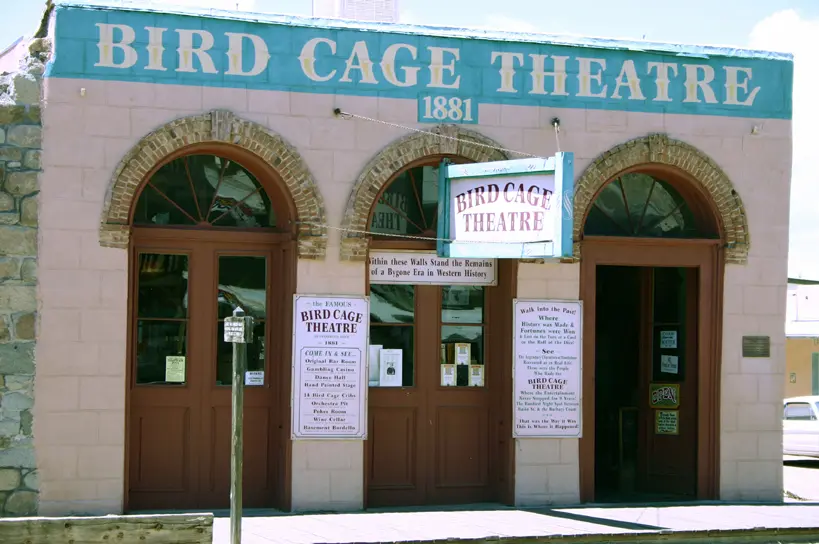
The Bird Cage Theatre is a variety theatre and dance hall on Allen Street in Tombstone, Arizona, which opened on 26 December 1881, closed in 1892 and is now a museum.
Where is Bird Cage Theatre?
- Location
- Arizona, United States
- Type
- Theater
- Coordinates
- 31.712, -110.065
- Last updated
LOCATION
Why is Bird Cage Theatre said to be haunted?
The National Park Service's 1978 landmark documentation describes it as a combination theater and dance hall named, presumably, after the curtained boxes hung from the roof in which the women of the house worked between acts. Much of its legend comes from the museum itself: a basement poker game said on one page of its website to have run from 1881 to 1889 and on another for eight years, five months and three days; bullet holes counted at over 120 on its home page in 2011 and at more than 140 today; 26 deaths that the same 2011 page called a legend; and the line "the wildest, wickedest night spot between Basin Street and the Barbary Coast", which that page credited to the New York Times of 1882. A Boothill marker reads "Margarita, Stabbed by Gold Dollar", and tradition places the killing in the theatre. The museum runs ghost tours inside the building, where visitors and staff report the spirits of former prostitutes and men in cowboy hats.
What is the history of Bird Cage Theatre?
The Bird Cage Theatre opened on Allen Street in Tombstone on 26 December 1881, according to the museum that now occupies the building. Its owners were Lottie and William "Billy" Hutchinson, a variety performer who, the museum says, first meant to stage the respectable family shows he had seen draw crowds in San Francisco and offered a free Ladies' Night for the women of the town, then turned to rougher entertainment for the mining crowd when that did not pay. The National Park Service's National Historic Landmark documentation for Tombstone, prepared by the historian Marilyn Larew in February 1978, describes a three-bay building that "once hosted the less reputable stage presentations, as a combination theater and dance hall", and adds: "Presumably it took its name from the curtained boxes suspended from the roof in which the girls plied their trade between acts." The museum counts twelve of those boxes. Larew sets it against Schieffelin Hall, which gave the town "all the respectable stage shows", while the Bird Cage provided the stage for the disreputable ones.
The museum's history page names the early acts: Mademoiselle De Granville, billed as the "Female Hercules", who lifted heavy objects with her teeth; the Irish comic duo Burns and Trayers; the comic singer Irene Baker; the opera singer Carrie Delmar; and the comedian Nola Forest. It also lists Cornish wrestling, magic shows and masquerade balls. A later manager, Bignon, who had run the Theatre Comique in San Francisco, refurbished the building and renamed it the Elite Theatre.
Tombstone's boom was short: in March 1882, the museum says, miners in the Grand Central Mine struck water at 620 feet; on 26 May 1886 the Grand Central hoist and pumping plant burned, and when silver fell to 90 cents an ounce a few months later the remaining mines laid off their workers, and the Bird Cage closed in 1892. According to the museum, the building was "sealed up after the mines closed and left untouched for decades", and when it reopened as a museum the bullet holes in its woodwork were still there.
Of the killings attached to the building, one has a physical trace: a marker in Tombstone's Boothill Graveyard reads "Margarita / Stabbed by Gold Dollar"; John Myers Myers printed it in The Last Chance (1950), and Roger Bruns quotes it in his 2000 history of the theatre, Desert Honkytonk. Local tradition makes Margarita a dance-hall woman killed in the building by a rival known as Gold Dollar in a quarrel over a gambler.
Tombstone was declared a National Historic Landmark in 1961, and Larew's documentation lists the Bird Cage, "now a museum", among the district's principal buildings. The ghost stories told today, of voices, an unplayed piano and cold spots in the cellar, are the museum's: it runs its own ghost tours inside the building.
Timeline: the documented record of Bird Cage Theatre
- December 1881 The Bird Cage Theatre opens on Allen Street in the silver boomtown of Tombstone, combining stage shows, gambling and twelve curtained boxes hung from the ceiling.
- 26 October 1881 The Gunfight at the O.K. Corral takes place three blocks away, weeks before the theatre opens; the two events are often conflated in later retellings but are unrelated.
- September 1882 The theatre hosts the Democratic county convention, which nominates candidates for the coming territorial elections.
- 1883 Lillian Russell performs at the Bird Cage during her southwestern tour according to local tradition; the museum's own history page, which names the theatre's early acts, does not mention her.
- May 1886 The Grand Central Mine hoist and pumping plant burns on 26 May 1886; within months the remaining mines lay off workers and many residents leave Tombstone.
- May 1887 The Sonora earthquake damages buildings across Tombstone; the Bird Cage survives structurally intact.
- 1892 With the boom over, the Bird Cage Theatre closes for good and is sealed with its original furnishings still inside.
- 1934 The Hunley family reopens the Bird Cage as a tourist attraction, keeping the original fixtures and furnishings in place.
- 1961 The Tombstone Historic District is designated a National Historic Landmark; the National Park Service documentation prepared in 1978 describes the Bird Cage as the town's combined theatre and dance hall.
- 15 October 1966 The district is listed on the National Register of Historic Places at its creation, securing federal recognition for the surviving boomtown fabric.
Is there a rational explanation for Bird Cage Theatre?
Most of the numbers repeated about the Bird Cage come from the museum's own website, and the website does not keep them steady.
The basement poker game is given two durations on two pages of the same site, both read on 10 October 2026. The history page says it "continued from 1881 to 1889 for a total of eight years"; the page on the gambling rooms says it ran "for 8 years, 5 months, and 3 days". Counted from the opening night of 26 December 1881, the second figure would end on 29 May 1890. The history page also names the players, among them George Hearst, Diamond Jim Brady, Adolphus Busch, Doc Holliday, Bat Masterson and Wyatt Earp, and puts the money that changed hands at about $10 million, without citing a source for either.
The bullet holes have grown. The museum's home page as captured by the Wayback Machine on 1 January 2011 said: "Over a Hundred and Twenty bullet holes remain in the building." Its page on the building's construction now says: "More than 140 bullet holes remain today." Neither page says who counted them or how.
The 26 deaths come from the same 2011 page, which presents them as a legend: "Legend has it that 26 people were killed in The Bird Cage", during what it calls the theatre's reputed eight years. That page also carries the line usually quoted as a press verdict, "The Wildest, Wickedest night spot between Basin Street and the Barbary Coast", credited to "New York Times - 1882". Roger Bruns's history of the theatre introduces the same phrase as a boast ("Touted as the 'wickedest night spot between Basin Street and the Barbary Coast'") without naming a newspaper.
Lillian Russell, who appears in many guidebook accounts of the Bird Cage, is not among the performers the museum's history page names.
The killing of Margarita rests on a grave marker and on tradition. The marker gives a name and an assailant, and the place of the quarrel comes from local tradition.
The paranormal material is sold on the premises. The museum's ghost-tour page, read on 10 October 2026, offers tours inside the building every evening from 6:15 pm at $35 a person, and says that visitors and employees "have reported seeing the spirits of former Prostitutes and Men in Cowboy hats". Its page on the Black Moriah, the hearse displayed inside, says the nightly tours are based in that part of the building "due to the High amount of Paranormal Activity". The building that tells these stories is also the business that sells the tickets to hear them.
Can you visit Bird Cage Theatre?
The Bird Cage Theatre stands at 535 East Allen Street in Tombstone, Arizona. The National Park Service form that documents the Tombstone Historic District, prepared by the historian Marilyn Larew in February 1978, places the town 23 miles south-east of Benson on U.S. 80, now State Route 80. It describes the Bird Cage as a three-bay building with recessed round-arched doorways that "is now a museum". In a straight line Tombstone is about 99 km (62 miles) south-east of downtown Tucson. The same form notes that Allen Street was the town's main commercial street, and that Boot Hill was left outside the landmark boundary because of its lack of historic integrity.
The museum's own site, read on 24 September 2026, gives daily hours of 9 a.m. to 6 p.m. for self-guided visits. General admission was listed at $19. Children aged 8 to 18 and seniors over 60 paid $17, a family pack cost $55, and the telephone number given is 520-457-3421. The self-guided route takes in the theatre floor and the saloon as well as the gambling rooms and the balcony boxes; the exhibits listed include original poker tables, costumes and photographs.
The museum also runs its own ghost tours, which by its account are the only ones in Tombstone held inside the building. Tickets cost $35 a head and are not refundable. The 6:15 p.m. tour is the family tour, which children aged seven and over may join with a parent; the 8 p.m. tour admits guests aged 13 and over; and a 9:30 p.m. adults-only tour runs mainly on certain holidays, Fridays and Saturdays. The site gives an average of twenty guests per tour.
The museum's pages do not agree with each other on two dates. Its history page gives the opening as 26 December 1881 and the closure as 1892, while the self-guided tour page gives the opening as 24 December 1881 and describes the rooms as preserved as they were when the doors closed in 1889.
Sources consulted
- Bird Cage Theatre Museum, «Bird Cage Theatre — official site» — Official website, 2026 web
- Marilyn Larew, Historian, Historic Sites Survey Division, National Park Service, «Tombstone Historic District — National Historic Landmark Nomination» — NPS NHL documentation, 1978 archive
- Roger A. Bruns, «Desert Honkytonk: The Story of Tombstone's Bird Cage Theatre» — Fulcrum Publishing, Golden (Colorado), 2000 book
- Jeff Guinn, «The Last Gunfight: The Real Story of the Shootout at the O.K. Corral — and How It Changed the American West» — Simon & Schuster, New York, 2011 book
- The Tombstone Epitaph, «The Tombstone Epitaph — website of the present-day newspaper and museum (sells historical editions)» — Tombstone Epitaph, 2026 web
- Internet Archive, «Wayback Machine captures of tombstonebirdcage.com — home page of 1 January 2011: "Legend has it that 26 people were killed", "Over a Hundred and Twenty bullet holes" and the quotation credited to "New York Times - 1882"» — archive.org, 2015 archive
- John Myers Myers, «The Last Chance: Tombstone's Early Years — the Boothill marker "Margarita / Stabbed by Gold Dollar"» — E. P. Dutton, New York, 1950 book
- Kathy Alexander, «Old West Saloon Descriptions — the Bird Cage Theatre: 'In 1934, the Hunley family reopened the Bird Cage Theatre as a tourist attraction, keeping all the original fixtures and furnishings in place'» — Legends of America, updated August 2026, 2026 web
Reviewed by V. Serrano on 2026-08-26 · How we verify our content
💬 Field testimonies (0)
No testimonies yet. Add the first.
Add your testimony
🔒 Log in to add a testimony