👻 HAUNTED PLACE · EXP. Nº9477
ACTIVE
Brown Grand Theatre
A 1907 opera house in Concordia, Kansas, built by Colonel Napoleon Bonaparte Brown and opened with his son's gift of a Napoleon at Austerlitz drop curtain.
Where is Brown Grand Theatre?
- Location
- Kansas, United States
- Type
- Theater
- Coordinates
- 39.571, -97.664
- Last updated
LOCATION
Why is Brown Grand Theatre said to be haunted?
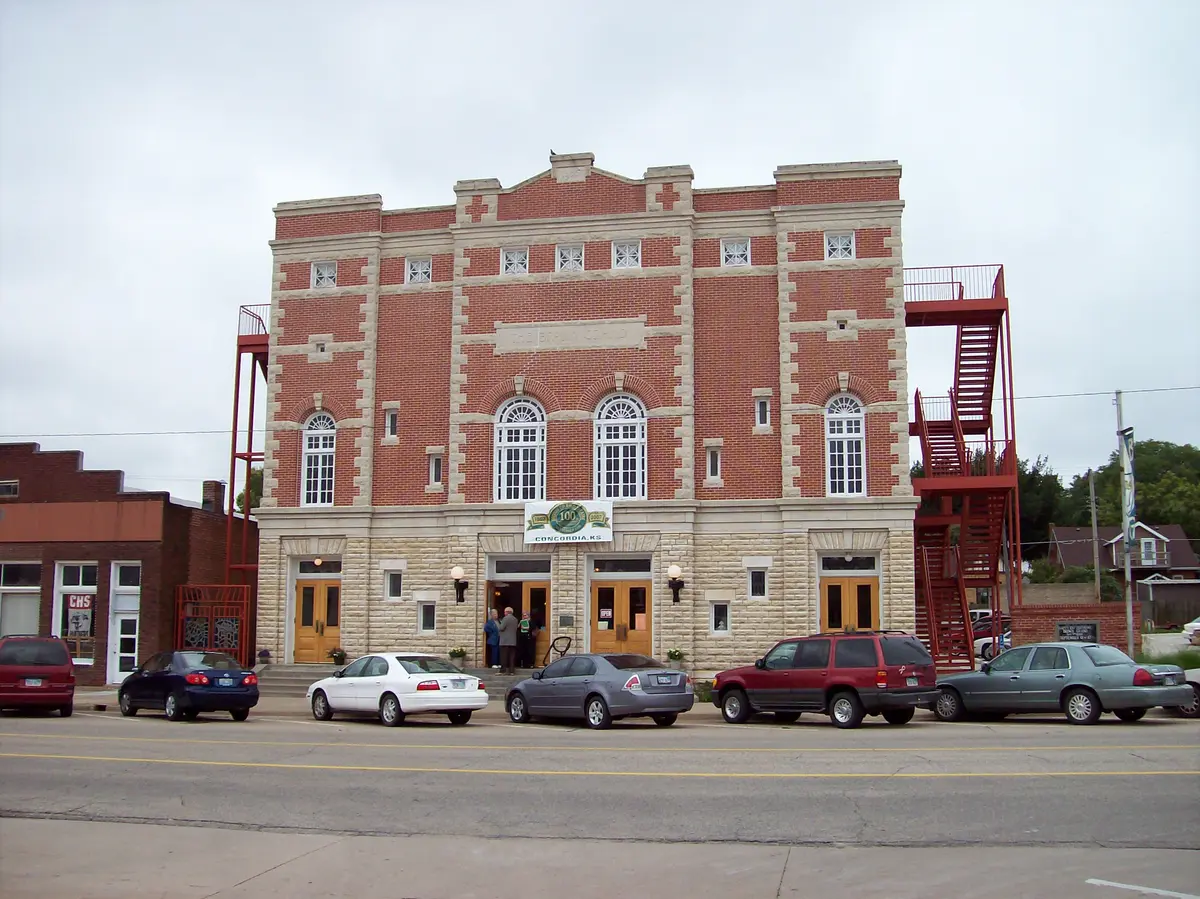
Converted to a movie house in 1925 and closed after the last screening in 1974, it was restored by community effort to its original splendor by 1980 and listed on the National Register of Historic Places since 1973. Theater lore attributes hauntings to the ghost of Earl Brown, who died months after his father in 1910.
What is the history of Brown Grand Theatre?
The Brown Grand Theatre stands at 310 West 6th Street in Concordia, Kansas, a town of roughly five thousand people in the north-central part of the state.
Its story begins in November 1905, when Colonel Napoleon Bonaparte Brown, a local banker, announced to the townspeople his intention to build a fully outfitted opera house for Concordia. Brown hired Carl Boller of the Kansas City firm Boller Brothers, among the most prolific theatre architects in the American Midwest, to prepare the design drawings and blueprints. Construction was directed by Brown's son, Earl Van Dom Brown, who researched the project by touring more than thirty opera houses across Kansas and Missouri before work began. W.T. Short, a native of Concordia already known for his work on the Brown family home and other area buildings, served as construction supervisor. Ground was broken on April 3, 1906.
At completion the building stood sixty feet high and spanned one hundred twenty feet in length. Renaissance in style, the structure cost around forty thousand dollars, an enormous sum for a small prairie town at the start of the twentieth century. The formal opening took place on September 17, 1907, with a production of The Vanderbilt Cup, a comedy set against the backdrop of the automobile race of the same name. A witness later recalled that firemen stood at the doors in full uniform and ushers wore white gloves, and that society, as he put it, sort of quivered that night.
That opening night also saw Earl Brown unveil his personal gift to his father: a drop curtain reproducing a painting by Horace Vernet, known at the theatre as Napoleon at Austerlitz. The Library of Congress profile calls it "Napoleon at Wagram", and the replacement curtain unveiled on 7 January 1979 was painted from a photograph of Vernet's Battle of Wagram, which hangs at Versailles. The curtain hung above the stage as a tribute from son to father, in recognition of the Colonel's contribution to the community through what he considered his crowning achievement.
The theatre prospered for only a short period under the family's watch. Colonel Brown died in 1910, and his popular son Earl followed him just four months later. In the words of the Library of Congress profile, "according to theater lore, Earl's ghost haunts the theater, especially during the 'opening' season." The house operated under various managers until 1925, when it was sold to the Concordia Amusement Company and converted to show motion pictures, first silent films and then talkies. Over nearly five decades as a movie house it was remodeled repeatedly, gaining air conditioning, a concession stand, and other updates that chipped away at its original elegance.
A 1967 tornado damaged the roof over the stage, and the rain that came with it permanently stained the already faded Napoleon curtain, which had seen little use during the picture years. The last film screened was the world premiere of The Devil and LeRoy Bassett, written and directed by Concordia native Robert E. Pearson, in 1974. After the doors closed, a grassroots community effort raised funds for an extensive restoration that returned the theatre to its original 1907 appearance; it reopened on 17 September 1980 with a community restaging of The Vanderbilt Cup. Boller's blueprints had been for a 650-seat house. On September 17, 2007, exactly one century after opening night, the Brown Grand celebrated its centennial with several days of community events.
Timeline: the documented record of Brown Grand Theatre
- November 1905 Colonel Napoleon Bonaparte Brown announces to the townspeople his plan to build a fully outfitted opera house for Concordia.
- 3 April 1906 Groundbreaking ceremonies take place for the new theatre, designed by Carl Boller of Boller Brothers under the supervision of Earl Van Dom Brown and builder W.T. Short.
- 17 September 1907 Formal opening night with a production of The Vanderbilt Cup; Earl Brown unveils his gift to his father, the drop curtain Napoleon at Austerlitz after Horace Vernet.
- 1910 Colonel N.B. Brown dies; his son Earl follows four months later, giving rise to the legend that Earl's ghost haunts the theatre especially during the opening season.
- 1925 After years under various managers, the theatre is sold to the Concordia Amusement Company and begins operating as a motion picture house.
- 1967 A tornado damages the roof over the stage; rain permanently stains the already faded Napoleon at Austerlitz drop curtain.
- 26 July 1973 The Brown Grand Theatre is added to the National Register of Historic Places (reference 73000747).
- 1974 The last movie shown is the world premiere of The Devil and LeRoy Bassett, written and directed by Concordia native Robert E. Pearson; the theatre closes shortly afterwards.
- 1980 A grassroots community restoration returns the theatre to its original 1907 splendor with around 650 seats.
- 17 September 2007 The theatre celebrates its centenary with several days of community events coinciding with the opening of the National Orphan Train Museum in Concordia.
Is there a rational explanation for Brown Grand Theatre?
The haunting rests on one piece of lore, which the Library of Congress profile of the theatre gives in a single sentence: "According to theater lore, Earl's ghost haunts the theater, especially during the 'opening' season." Earl Van Dom Brown, who had directed the construction, died in 1910, four months after his father. The theatre opened on 17 September 1907 and reopened after its restoration on 17 September 1980. In between, according to the theatre's own history page, the house was refitted for films in 1925 and for talking pictures in 1929, acquired a marquee, air conditioning, a projection booth and a wide screen, lost its Ladies Lounge to a concession stand and in 1955 was repainted pink and blue with silver accents; the restoration of 1976-1980 put back the original colour scheme, working from Carl Boller's original blueprints, which Jack Roney had tracked down.
The profile was submitted to the Library of Congress's Local Legacies project by Representative Jerry Moran, with documentation that included an 11-page project history, newspaper clippings, the reopening programme and fifteen photographs; the Internet Archive's earliest capture of it is from October 2004. Its ghost sentence names no witness and gives no date. The fullest list of phenomena is on Harland J. Schuster's Kansas Photo Tour page, as the Internet Archive captured it in 2003: "Doors left shut are found opened, shadowy figures have been seen standing at the window, electric circuit breakers trip without cause, and cold drafts are felt in certain places for no apparent reason." Schuster gives no names or dates either, and adds: "The Flatlander puts little stock in these stories."
The theatre's own history page, in its capture of April 2008, tells the building's story from the first touring troupes of 1876 to the reopening night of 1980, including both Brown deaths, and does not mention a ghost. Schuster's four phenomena are also the everyday complaints of a building of this age, and neither source records a dated incident or a named witness that would set them apart.
Can you visit Brown Grand Theatre?
The Brown Grand Theatre sits at 310 West 6th Street, Concordia, Kansas 66901, on the corner of Sixth and Washington streets in the town's small downtown grid. There is no paid admission to enter for most events; the theatre operates as a nonprofit community venue funded by donations, memberships and event tickets, so check the schedule at browngrand.org or call ahead for tour availability, since the building is not open for walk-in visits outside scheduled events and volunteer-staffed hours.
Guided tours can usually be arranged by appointment through the theatre's board, and local volunteers will often point out the drop curtain reproduction of Napoleon at Austerlitz hanging over the stage, the restored ladies' parlor, and the box seats favored by the Brown family themselves. Photography inside is generally permitted during public events, though flash may be restricted during performances.
Concordia lies about two hours west of Topeka along US-81, and roughly an hour north of Salina. Parking is free street parking within a block of the entrance. The building has a stepped entry and historic restrooms, so wheelchair users should call ahead to confirm accessible arrangements rather than assume step-free access throughout. Evening events in winter can be very cold; dress accordingly. Combine a visit with the National Orphan Train Complex a few blocks away, which opened the same year the theatre turned one hundred.
Sources consulted
- Jerry Moran, «Historic Performing Theatre - The Brown Grand Theatre» — The American Folklife Center, Library of Congress, 2000 archive
- National Park Service, «National Register of Historic Places Inventory - Nomination Form, Brown Grand Theatre (73000747)» — U.S. Department of the Interior, 1973 report
- Jenny Acree, «Happy 100th Birthday Brown Grand Theatre» — Inside Cloud (Twin Lakes Thunderbird Times), 2007 newspaper archive
- Brown Grand Theatre, «History of the Brown Grand Theatre in Concordia, Kansas» — browngrand.org (archived), 2008 web
- Pam Grout, «Kansas Curiosities: Quirky Characters, Roadside Oddities and Other Offbeat Stuff» — Globe Pequot, 2007 book
- Salina Journal staff, «Brown Grand Receives a Special Valentine» — Salina Journal, 2008 newspaper archive
- Harland J. Schuster, «Kansas Photo Tour - Brown Grand Theatre» — kansasphototour.com, 2003 web
- Janet Pease Emery, «It Takes People to Make a Town: The Story of Concordia, Kansas, 1871-1971» — Arrow Printing Co., Concordia (Internet Archive, préstamo), 1970 book
Reviewed by V. Serrano on 2026-08-26 · How we verify our content
💬 Field testimonies (0)
No testimonies yet. Add the first.
Add your testimony
🔒 Log in to add a testimony