👻 HAUNTED PLACE · EXP. Nº9478
ACTIVE
Butterworth Building
Seattle's undertakers had worked out of borrowed premises until Edgar R. Butterworth had a building put up for the trade alone.
Where is Butterworth Building?
- Location
- Washington, United States
- Type
- Other
- Coordinates
- 47.611, -122.342
- Last updated
LOCATION
Why is Butterworth Building said to be haunted?
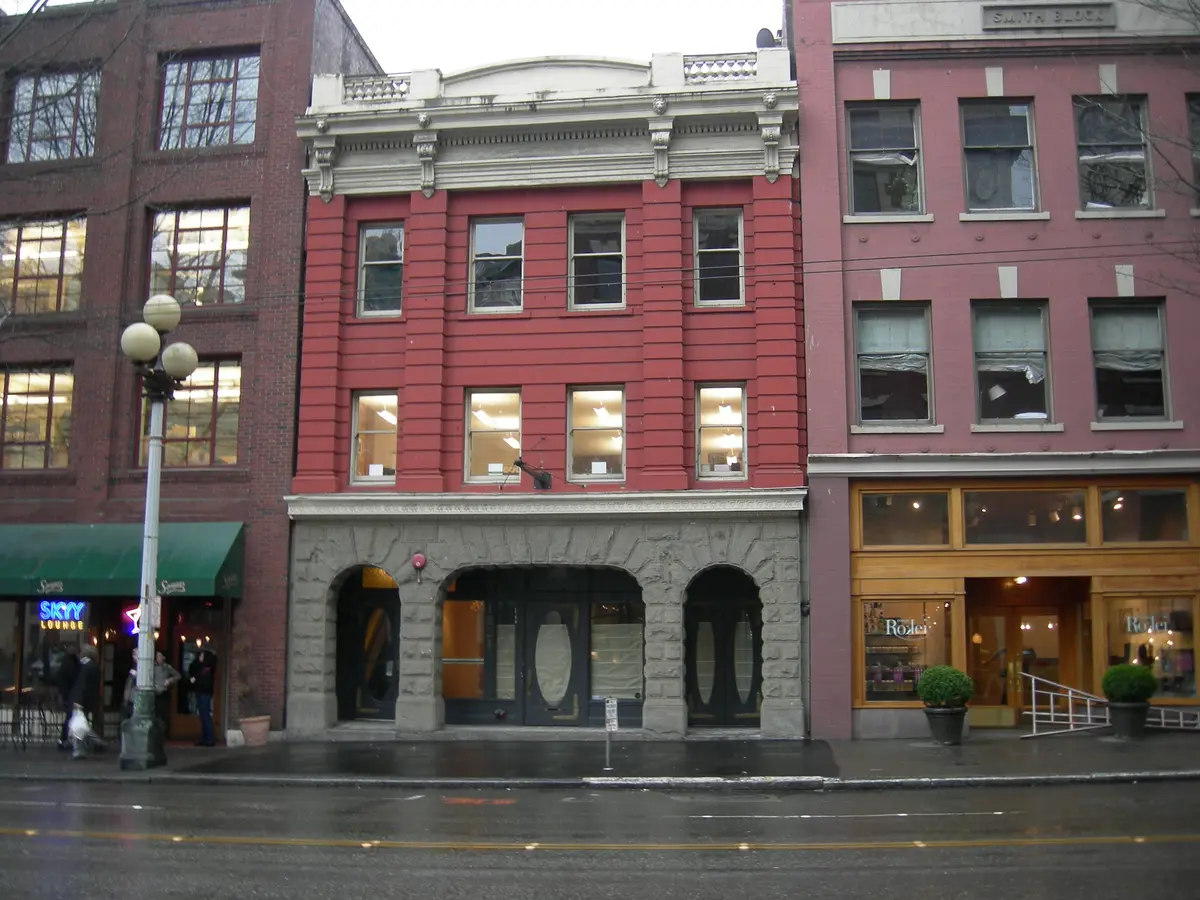
E. R. Butterworth & Sons moved into 1921 First Avenue on 1 October 1903; the architect was John Graham Sr., and the nomination that later placed the block on the National Register calls it his first commercial commission in Seattle and the city's first modern mortuary designed for one firm's exclusive use. It steps down a steep hillside: three storeys on First Avenue, and by the account of the Seattle Mail and Herald in August 1904 five levels reaching Post Alley at the back. That 1904 inventory also settles the story most often told here. Kells Irish Restaurant & Pub, in the lowest levels since 1983, is not in the old embalming room and crematorium — the embalming room was upstairs and there was no crematorium — but in the basement that held the stables and funeral wagons, and in the stock room of fireproof vaults where bodies really were kept. The apparitions have named witnesses, all of them from 2008 or later; the building's ghost economy is younger still than the pub.
What is the history of Butterworth Building?
Edgar Ray Butterworth (1847-1921) did not set out to bury anybody. Born at Newton Upper Falls, Massachusetts, he worked as a hatter, studied law on his own and was admitted to the Massachusetts bar just after turning twenty-one. He then drifted west: Minnesota, Saint Louis, Fort Scott, and by 1876 the rangelands of southwest Kansas, where he ran cattle and hauled bison bones 125 miles to the nearest railroad for ten dollars a ton. Travelling with his wagon on the Kansas plains he came upon a settler grieving in front of a dugout home for a wife and newborn who had both just died. There was no lumber on the grassland, so Butterworth broke up his own wagon box and made them a coffin. That was the first one.
The family reached Chehalis, Washington Territory, in August 1881. He built the first steam-powered flour mill west of the Cascades, then moved a few miles to Centerville — later Centralia — and opened a furniture shop. He sat on the town's first city council, served as its mayor and did two terms in the state legislature. When an epidemic of what the records call "black diphtheria" swept the region he was asked to make coffins, began stocking a ready-made line from Olympia, and by 1892 had moved to Seattle and bought a controlling interest in the undertaking firm of Cross & Co., then in the Masonic Temple at Second and Pike.
E. R. Butterworth & Sons — five of his sons joined him — outgrew two more addresses, 1425 Second Avenue and 1426-28 Third Avenue, before the firm moved on 1 October 1903 into a building put up for it alone at 1921 First Avenue. The architect was John Graham Sr., and the nomination that later placed the block on the National Register calls it Graham's first commercial commission in Seattle and "unquestionably the first modern mortuary in the city, owned and specially designed for the exclusive use of the family business. Cost was of little or no importance."
The fullest description of what was inside is a trade account in the Seattle Mail and Herald of 13 August 1904, ten months after the doors opened. It is not digitised; what survives in reach is the detailed summary an identified Wikipedia editor, Joe Mabel, made from the Seattle Public Library microfilm in November 2009, and it describes five levels stepping down the hillside. On top were three flats for employees, reached by their own door at the south end of the First Avenue façade. Below that, coffin showrooms: thirty-five caskets on display that August at twenty-five to two hundred dollars, a separate showroom of child-sized coffins, a room of women's burial garments from a four-dollar robe up to garments at a hundred and twenty-five, and a "best show room" with caskets as high as eight hundred and ninety. The main floor, level with First Avenue, held the offices, the morgues, the embalming room, a "utensil room" for canopies and laying-out beds, and a funeral chapel seating a hundred and fifty with a fifty-seat balcony and a separate choir balcony. The floor beneath it — below First Avenue but still above the alley — was a "stock room" of fireproof vaults where bodies could be kept indefinitely, something the 1904 writer called "so much needed in Seattle when people are undecided as to the disposition of the dead". Only the bottom level, flush with Post Alley, held the heating plant, the stables and the store for the funeral wagons.
One documented episode from those years is worse than any ghost story. In the summer of 1911, Margaret Conway, childhood nanny to the English heiresses Claire and Dorothea Williamson, sailed from Sydney after a cryptic telegram and landed in Seattle on 1 June. She was met, taken to the Seattle office of the fasting practitioner Linda Burfield Hazzard, told that Claire was dead and Dorothea insane, and then brought to E. R. Butterworth & Sons and shown an embalmed body she did not recognise as Claire. Claire's will had been altered days before her death with a codicil asking that her body be cremated under Hazzard's direction. Hazzard was arrested that August and convicted; Dorothea, by then weighing sixty pounds, was ransomed out of Olalla by an uncle.
In March 1923 the firm moved to Melrose Avenue and Pine Street on Capitol Hill and the block was sold to the Volunteers of America. The 1969 nomination form contradicts itself about this — its description page says the sale happened in 1923, its significance page says the business outgrew its quarters "in 1925" — but 1923 is what Clarence Bagley recorded in 1929 and what the Seattle Times reported in 2008. The building then "slowly degenerated from its first-class appearance", in the form's words, until 1967, when the Volunteers of America sold it to Ralph D. Anderson and William P. Graves, who began a rehabilitation; in 1969 a consulting engineering firm had its office there.
The timing of the listing is the part usually left out. On 17 June 1969 the Seattle City Council voted for urban renewal of the Pike Place Market area. Two weeks later, on 1 July 1969, Lloyd Graves of the Seattle Historical Society signed the nomination form for the Butterworth Building. It was stamped in at the National Register on 23 February 1971 and the building was listed, at local level of significance, on 14 May 1971 — five and a half months before Seattle voters passed Initiative No. 1 on 2 November 1971 by 76,369 to 53,264 and created the seven-acre Pike Place Market Historical District that saved the whole neighbourhood.
Since 1983 the bottom level and the old vault stock room, now a private banquet room, have housed the McAleese family's Kells Irish Restaurant & Pub, entered from Post Alley. The First Avenue level, the old chapel and offices, ran through Café Sophie until 1997, Avenue One from 1997 to 2002 and a Starlite Lounge whose fittings were still sitting there in 2008. Patrick and Ethna McAleese bought the building in September 2005.
Timeline: the documented record of Butterworth Building
- 1892 Edgar R. Butterworth, former mayor of Centralia and a state legislator who entered the trade making coffins during a diphtheria epidemic, moves to Seattle and buys a controlling interest in the undertaking firm of Cross & Co., in the Masonic Temple at Second and Pike.
- 1 October 1903 E. R. Butterworth & Sons moves into 1921 First Avenue, a block built for the firm alone by John Graham Sr. The National Register nomination later calls it Graham's first commercial commission in Seattle and the city's first modern mortuary designed for a funeral firm's exclusive use.
- 13 August 1904 A trade account in the Seattle Mail and Herald describes the interior floor by floor: employees' flats on top, coffin showrooms below, the chapel, offices, morgues and embalming room on the First Avenue floor, a stock room of fireproof body vaults beneath it, and the heating plant, stables and funeral wagons at Post Alley level. It is the source that contradicts the modern claim about the basement.
- 1 June 1911 Margaret Conway, nanny to the Williamson sisters, lands in Seattle from Sydney and is taken to E. R. Butterworth & Sons, where she is shown an embalmed body she does not recognise as Claire Williamson, a patient of the fasting practitioner Linda Burfield Hazzard. Hazzard is arrested that August and convicted.
- March 1923 The firm moves to larger quarters at Melrose Avenue and Pine Street on Capitol Hill — where Bagley later describes a crematory and columbarium — and 1921 First Avenue is sold to the Volunteers of America. The 1969 nomination form gives 1923 on one page and 1925 on another.
- 1 July 1969 Two weeks after the Seattle City Council votes for urban renewal of the Pike Place Market area, Lloyd Graves of the Seattle Historical Society signs the National Register nomination form for the Butterworth Building. Its front-elevation storey count is struck out and corrected by hand from two to three.
- 14 May 1971 The Butterworth Building is listed individually on the National Register of Historic Places, ref. 71000873, at local level of significance — five and a half months before Seattle voters pass Initiative No. 1 on 2 November, by 76,369 to 53,264, and create the Pike Place Market Historical District.
- 1983 The McAleese family opens Kells Irish Restaurant & Pub in the bottom level and the old vault stock room, entered from Post Alley. The Market's ghost tours begin three years later, in 1986, started by Michael Yaeger with Shelia Lyon of the Market Magic Shop.
- 1 January 2003 The earliest datable printed mention of the building's ghosts appears in Walt Crowley's HistoryLink survey of Seattle apparitions — a single clause, with no witness and no detail: "odd apparitions in Belltown's Butterworth Building — previously a mortuary".
- September 2005 Patrick and Ethna McAleese buy 1921 First Avenue and begin restoring the old chapel on the First Avenue level, which had run through Café Sophie, Avenue One and the Starlite Lounge. That November the ghost tour costs ten dollars and already teases the building on its front page.
- 13 June 2008 The Seattle Times publishes the fullest account of the building's ghost stories, with named witnesses — and its own photo caption resolves the footsteps Karen McAleese hears overhead as "a building contractor working upstairs". In the same article the tour operator urges the McAleeses to make the hauntings "a selling point... The hokier, the better."
- November-December 2010 A paid Darkness Radio event is held in the old chapel on 11-14 November and the Ghost Adventures episode filmed there airs on 17 December. On 15 November an account named Waghosthunters adds both to the Wikipedia article; an editor removes it as promotion twenty-seven minutes later. By October 2011 the chapel is a separately ticketed twenty-dollar tour sold on the overnight.
- 16 September 2016 An unsigned first-person note that had stood in the Wikipedia article for a year — a 1980s employee of the engineering firm Kramer, Chin & Mayo saying they often worked in the building until midnight and "did not once ever encounter anything ghostly" — is struck out as original research. It is the only account on record from somebody who worked nights there.
Is there a rational explanation for Butterworth Building?
The claim you will hear on any Seattle ghost walk is that Kells sits in the old embalming room and crematorium. The earliest detailed description of the building says otherwise. Per the Seattle Mail and Herald of August 1904, the embalming room and the morgues were upstairs on the First Avenue floor; the level flush with Post Alley held the heating plant, the stables and the funeral wagons, which is also all the 1969 nomination form records of it — "Stables and hay storage were on the alley level." No crematorium appears in that 1904 inventory at all; the crematory and columbarium Bagley described in 1929 belonged to the firm's next premises, the 1923 building on Melrose and Pine. What Kells does occupy, besides that basement, is the old "stock room" of fireproof vaults where bodies were in fact stored — a real connection to the dead, and a different one from the one that gets sold.
Dating the story is more useful than arguing with it. Kells opened in 1983. The Market ghost tours are older than the tourist boom suggests and younger than the pub: on its own website in November 2005 the operator, Mercedes Yaeger, wrote that "it was my father, Michael Yaeger, who first started these tours with Shelia Lyon of the Market Magic Shop in 1986." The earliest printed mention of this building's ghosts that can be dated is 1 January 2003, and it is a single clause with no witness and no detail, in Walt Crowley's HistoryLink survey of Seattle apparitions: "odd apparitions in Belltown's Butterworth Building — previously a mortuary". Alongside it runs a price ladder, taken from the tour company's own archived pages: ten dollars in November 2005, when the building was already a teaser on the front page ("Do you know where Seattle's first mortuary is located? How many ghosts inhabit it?"); fifteen in July 2008; seventeen in October 2011, when the old chapel had become a separately ticketed twenty-dollar product sold on a single line — "Go in the old Mortuary and see the Chapel as it is being restored. GAC did an overnight in the building." The tour's co-guide in 2005 was a horror-puppet and prosthetics maker who described himself on the same page as a "ghost magnet". Market Ghost Tours stopped being archived after February 2012; on 17 August 2026 marketghost.com was a parked page offering the domain for $3,895.
The mundane explanations are not something a sceptic has to supply. They are printed inside the same articles that carry the stories. The photograph that opens the Seattle Times feature of 13 June 2008 shows Karen McAleese startled by footsteps overhead, and the caption resolves them: "The footsteps? A building contractor working upstairs." Scott Craig, who ran Café Sophie at street level, described the chunk of ceiling plaster that fell near the table his customers had christened the "haunted booth" and then explained it himself — "It turns out there was a problem with the ceiling." Arnie Millan, who ran Avenue One there from 1997 to 2002, was blunter: "They didn't have an effect on our business except we had Halloween parties every year."
And the incentive does not sit where you would expect. In 2008 it was the tour operator urging the tenants to monetise, not the other way round: "These ghosts want to be heard, so [the McAleeses] should make the hauntings a selling point... They need to promote the crazy activity that has happened there. The hokier, the better." Her suggestion was a goth nightclub called "The Mortuary". Patrick McAleese, described in the same article as undeterred by ghosts, was planning to ask a priest friend to bless the chapel before opening it. Eighteen years later the pub still has not taken the advice. Its website was measured on 17 August 2026 — six pages, 3,425 words — and returned zero occurrences each of ghost, ghosts, haunt, haunted, haunting, spirit, apparition and paranormal, against Kells 193, Irish 42, Guinness 2, mortuary 1, Butterworth 1, McAleese 1 and 1983 once in the same pass. The one line it does sell is "the Butterworth Building, Seattle's first mortuary".
That superlative is worth following, because it degrades in three steps. Bagley in 1929 and the nomination in 1969 make a narrow, defensible claim: the city's first purpose-built modern mortuary, designed for one firm's exclusive use. In March 2008 the photographer of the picture on this page, Joe Mabel, noted on Wikimedia Commons that the Halloween listings of the alt-weekly The Stranger were calling it "Seattle's first" and added that he suspected "it is merely the oldest surviving". The pub's flat version, "Seattle's first mortuary", is refuted by Butterworth's own career: he was in the undertaking business in Seattle from 1892, at three addresses before this one.
Two further claims should be attributed and left there. Yaeger told the Seattle Times that a shaman had counted nineteen fully formed ghosts inside the old mortuary and that the building stands on a Suquamish burial ground; no documentary support has been located for either. Her third claim has a real anchor: she attributed the emaciated apparitions to the patients of a Seattle doctor who starved people on tomato broth and enemas, and that is Linda Burfield Hazzard, whose case did pass through this building in 1911.
Finally, the record of what has been added to and taken out of the public account of this building is itself instructive. On 15 November 2010 an account calling itself Waghosthunters added to the Wikipedia article a paid Darkness Radio event held in the old chapel on 11-14 November with its list of celebrity guests, and the news that an episode of Ghost Adventures would air on 17 December; an editor removed it as promotion twenty-seven minutes later. The episode did air on that date. In April 2012 an anonymous editor added that the crew "found evidence" supporting the haunting, and was reverted the next day. Running the other way, on 6 September 2015 an anonymous editor wrote into the article: "In the 1980s, as an employee of Kramer, Chin & Mayo, Inc., in the Marketing Dept., I would often work late, sometimes as late as midnight, and I did not once ever encounter anything ghostly." It stood for a year and ten days and was struck out on 16 September 2016 as original research. It is unsigned and unverifiable, and it remains the only account on record from somebody who worked nights in the building.
Can you visit Butterworth Building?
The building stands at 1921 First Avenue in Seattle and entered the National Register on 14 May 1971 under reference 71000873. It also lies inside the Pike Place Public Market Historic District and inside the city's own Pike Place Market Historical District. The hillside does the rest: the Wikipedia article describes a structure with "only three stories on the First Avenue side, but five on Post Alley".
The pub in the basement has a different address from the building above it. Kells Irish Restaurant and Pub answers at 1916 Post Alley, Seattle WA 98101, on (206) 728-1916. The pub places itself "half a block West of 1st Avenue, between Stewart and Virginia streets, in Post Alley". Hours published on 9 September 2026 ran from 11.30am to midnight on Monday to Wednesday; noon to 1am on Thursday; 10am to 2am on Friday and on Saturday; 10am to midnight on Sunday. The McAleese family have held the building since 2005 and the pub since 1983, when they took the basement together with the stock room that is now the private banquet room. A second-floor private room seats 62 at banquet rounds and is reached by lift or by stairs from either street.
The chapel level on First Avenue has no public opening. The ticketed "Chapel Tour" that Market Ghost Tours once sold has gone with the company: on 9 September 2026 the domain marketghost.com redirected to a page offering it for sale.
The outside is free and shows the hillside better than the inside does. First Avenue gives a rusticated stone arcade at street level under two floors of brick with a heavy cornice. Post Alley runs narrow and steep behind the building. It drops two levels further and carries the Market's gum wall a short way along.
Sources consulted
- Lloyd Graves, «National Register of Historic Places Inventory - Nomination Form: Butterworth Building (ref. 71000873)» — Seattle Historical Society / National Park Service, 1969 report
- Stuart Eskenazi, «Ghost stories haunt Pike Place Market» — The Seattle Times, 2008 newspaper archive
- Wikipedia contributors, «Butterworth Building: article and complete revision history (revisions 323643525 to 1280874718)» — English Wikipedia, 2026 archive
- Mercedes Yaeger, «Market Ghost Tours: own website, archived captures of 2004, 2005, 2008 and 2011» — Internet Archive Wayback Machine, 2005 archive
- Walt Crowley, «Burnley Ghost and Other Seattle Apparitions (Essay 2023)» — HistoryLink.org, 2003 web
- Kathrine Beck, «Hazzard, Linda Burfield (1867-1938) (Essay 7955)» — HistoryLink.org, 2006 web
- Jeannie Yandel, «Seattle's Coziest Embalming Room (programme page)» — KUOW-FM, 2009 web
- Kells Inc., «Kells Irish Restaurant & Pub: official website, consulted 17 August 2026» — kellsseattle.com, 2026 web
- Joe Mabel, «File:Seattle 1921 First Avenue 03.jpg - photograph and author's description» — Wikimedia Commons, 2008 web
Reviewed by V. Serrano on 2026-08-17 · How we verify our content
💬 Field testimonies (0)
No testimonies yet. Add the first.
Add your testimony
🔒 Log in to add a testimony