👻 HAUNTED PLACE · EXP. Nº9477
ACTIVE
Cahaba, Alabama
Cahaba - Cahawba on the older maps - was Alabama's first permanent state capital, laid out on empty ground where the Cahaba river meets the Alabama and abandoned within a lifetime.
Where is Cahaba, Alabama?
- Location
- Alabama, United States
- Type
- Ruin / ancient site
- Coordinates
- 32.317, -87.101
- Last updated
LOCATION
Why is Cahaba, Alabama said to be haunted?
It has one ghost story with a traceable origin, and it is smaller and better documented than the version usually told. In the spring of 1862 a young couple walking into the cedar maze of Colonel C. C. Pegues's garden saw a large white luminous ball floating a few feet above the path; it dodged the man's hand and vanished. Anna M. Gayle Fry printed the account in 1908 and recorded what the town concluded: a will-o'-the-wisp. The colonel was alive when it appeared, and was mortally wounded at Gaines's Mill that June. The lights in the ruins and the voices in the empty streets belong to the ghost tours the Alabama Historical Commission has co-run for seventeen years, not to the record. What the record does hold is a Confederate prison flooded to the roosts in March 1865, survivors who died on the Sultana seven weeks later, and a Black community that turned the ruined courthouse into a Reconstruction stronghold.
What is the history of Cahaba, Alabama?
Cahaba was not a town that grew into a capital. It was a capital ordered into existence on an empty point of land, and everything that happened afterwards followed from that decision.
In 1818 the territorial assembly fixed Alabama's seat of government at the confluence of the Alabama and Cahaba rivers, before there was a city there. Linda Derry, the site's director and senior archaeologist, describes what Governor William Wyatt Bibb then did with it: "He got this land, free of charge from the federal government, was given to the new state of Alabama on which to build their capital city. He designed it, he surveyed it, he auctioned it off and all the money went in to create Alabama's state treasury. So really, the state of Alabama owes Cahawba a big debt because it financed our government."
The boom was violent and short. Anna M. Gayle Fry, who grew up in the town and published her memoir of it in 1908, records that by 1820 Cahaba had two newspapers, a land office, a state bank, stores, boarding houses, hotels and schools. In 1822 public land around the town went under the hammer at $1.25 an acre and was worth $60 to $70 an acre within weeks; unimproved lots in the centre reportedly reached $5,025, and the sale of 184 lots brought in more than $120,000, which was added to the money the legislature had set aside for public buildings. The capitol itself was a square two-storey brick block under a dome, with the executive and state offices either side of a broad central hall and the Senate and House in two large rooms upstairs.
Why the capital left is genuinely disputed, and the dispute matters more than the answer. Fry gives the story every later account repeats: in 1825 "the largest flood ever known in the history of this country" swept down both rivers and inundated the town; according to tradition, she says, the legislature was in session and members had to be rowed in boats and landed on the second storey of the capitol; part of the Statehouse fell, and the next legislature, meeting in January 1826, moved the capital to Tuscaloosa. The Encyclopedia of Alabama dates the removal effective 1 February 1826 and notes that its proponents cited flooding and health. Derry, who has excavated the place for decades, rejects the flood outright: "1825 was a drought year, there was some high water, but the town was never inundated. Those stories were blown out of proportion by the press, in the newspapers, editors of the newspapers of the Tuscaloosa, Montgomery and Huntsville newspapers. And of course we know why they did that, it's because they were competing for the state capital."
Losing the capital did not kill Cahaba. Cotton and the river rebuilt it: by 1860 the town had, according to Alabama Public Radio's account of the site, the fourth-highest per capita wealth in the United States, and that wealth was cotton and slavery. The Alabama Historical Commission's own account is blunter still: by 1860, 64 per cent of Cahawba's population was African American, and the surviving records overwhelmingly reflect the white minority who owned the newspapers and held the offices.
In 1863 a cotton warehouse in the middle of the town was turned into the Cahaba Federal Prison, known unofficially as Castle Morgan. It was built for roughly 500 men and at its peak held more than 3,000; about 5,000 passed through it and 147 died, a rate just under three per cent against more than thirty per cent at Andersonville. Its worst week is dated precisely because a prisoner wrote it down: Jesse Hawes, a Union surgeon held there, records that on the early afternoon of 1 March 1865 the river entered the stockade, that by midnight there was no dry spot anywhere, and that on the morning of Monday 2 March he and several sergeants asked the commander, Colonel Sam Jones, to march the men to higher ground. Jones answered: "Not so long as there is a G-d d-d Yankee's head above water can you come out of that stockade." Hawes prints a fellow prisoner's account, by Ira F. Collins, of how it ended: the water began to fall on the fifth day, drained on the seventh, and normal conditions were restored on the tenth.
Freedom killed many of the survivors. Former Cahaba prisoners boarded the steamboat Sultana at Vicksburg on 24 April 1865; her boilers exploded near Memphis on 27 April, and around 800 of the 1,700 to 1,800 dead were men who had come out of Castle Morgan.
The town's civil death came in 1866, when, in Fry's words, "by a vote of the people of the county, the courthouse was removed to Selma" and Cahaba ceased for the first time to be the seat of Dallas County. What happened next is the part our own file had omitted entirely. The half-ruined courthouse became a meeting place for freedmen consolidating the gains of Reconstruction, and Selma coined a nickname for the place in derision: the "Mecca of the Radical Republican Party". Cahawba's Black residents supplied Jordan Hatcher, the town's postmaster and a delegate to the constitutional convention; Tom Walker, one of Alabama's first Black state legislators, later a lawyer in Washington and a trustee of Howard University; and Jeremiah Haralson, born in 1846, the only African American to sit in the Alabama House, the Alabama Senate and the United States House of Representatives. Ezekel Arthur, a freedman, bought the Fambro House, which his family kept until the state acquired it. By 1870 the whole town numbered 431 people, 302 of them Black.
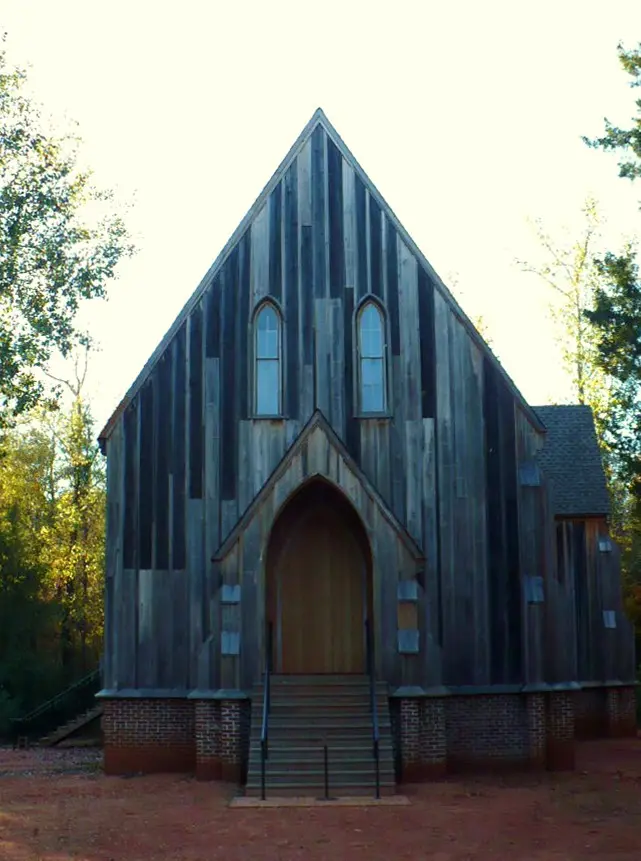
After that it emptied for good. Fry, looking back from 1908, writes that in the eighteen-seventies "for the third time within the memory of man, the town became a deserted village", with the business houses locked and grass in the principal streets. By 1900 most of the buildings had burned, rotted or been dismantled and carried away. The site was listed on the National Register of Historic Places in 1973 and passed to the Alabama Historical Commission in 1975, which runs it today as Old Cahawba Archaeological Park. Some of what was carried off has come back: St Luke's Episcopal Church, a Carpenter Gothic building put up on Vine Street in 1854 and moved to Martin's Station in 1878, was returned to Cahaba in 2006-2007 and restored by 2010. It is the building in the photograph on this file.
Timeline: the documented record of Cahaba, Alabama
- 1818 The territorial assembly fixes Alabama's seat of government at the confluence of the Alabama and Cahaba rivers, on land Governor William Wyatt Bibb had obtained free from the federal government and then surveyed and auctioned, the proceeds founding the state treasury.
- 1820 Anna M. Gayle Fry records that the new capital already has two newspapers, a land office, a state bank, stores, boarding houses, hotels and schools.
- 1822 Public land near the town is auctioned at $1.25 an acre and is worth $60 to $70 within weeks. Fry reports central lots reaching $5,025 and 184 lots sold for over $120,000, added to the fund for public buildings.
- 1825 (disputed) Fry, writing in 1908 and citing tradition, says the largest flood then known inundated the town, that legislators were rowed to the second storey of the capitol and that part of the Statehouse fell. Site archaeologist Linda Derry rejects it: "1825 was a drought year, there was some high water, but the town was never inundated."
- 1 February 1826 The removal of the capital to Tuscaloosa takes effect after six years, its proponents citing flooding and health. Fry says the decision was taken by the legislature meeting that January.
- 1854 St Luke's Episcopal Church, a Carpenter Gothic building, is put up on Vine Street. It will be moved away to Martin's Station in 1878 and brought back to Cahaba in 2006-2007.
- 1860 Sixty-four per cent of Cahawba's population is African American, according to the Alabama Historical Commission, and the town has the fourth-highest per capita wealth in the United States - cotton wealth, built on slavery.
- Spring 1862 A young lady and gentleman walking in the cedar maze of Colonel C. C. Pegues's garden see a large white luminous ball floating a few feet above the path, which evades the man's hand and disappears. Fry prints the account in 1908 and reports the town's conclusion: a will-o'-the-wisp.
- 27 June - 15 July 1862 Colonel Christopher C. Pegues is mortally wounded at Gaines's Mill and dies three weeks later, as recorded in the company roll compiled by his brother, Captain Charles Irby Pegues, and printed by Fry. The light his name was attached to had been seen before this, not after.
- 1863 A cotton warehouse becomes the Cahaba Federal Prison, known unofficially as Castle Morgan. Built for around 500 men, it holds more than 3,000 at its peak; of some 5,000 prisoners, 147 die.
- 1-10 March 1865 The Alabama enters the prison stockade on the afternoon of 1 March; by midnight there is no dry ground. Jesse Hawes, a prisoner, asks Colonel Sam Jones on 2 March to move the men to high ground and is refused. Ira F. Collins, quoted by Hawes, dates the return to normal conditions to the tenth.
- 24-27 April 1865 Former Cahaba prisoners board the steamboat Sultana at Vicksburg on 24 April. Her boilers explode near Memphis on 27 April; around 800 of the 1,700 to 1,800 dead had been held at Castle Morgan.
- 1866 By a vote of the people of Dallas County the courthouse is removed to Selma and Cahaba ceases, for the first time, to be the county seat. Fry calls it the town's death knell.
- 1870 The town is down to 431 people, 302 of them Black. Freedmen use the half-ruined courthouse as a rallying point and Selma nicknames the place, in derision, the "Mecca of the Radical Republican Party".
- 1908 Anna M. Gayle Fry publishes Memories of Old Cahaba in Nashville. It is the oldest printed version of the Pegues light I have been able to read, and in 30,932 words it records no other supernatural episode in the town.
- 1973-1975 The site is listed on the National Register of Historic Places and is transferred to the Alabama Historical Commission, which develops it as Old Cahawba Archaeological Park.
- October 2011 Alabama Public Radio records a Haunted History Tour and interviews site director Linda Derry, who dismisses the flood that supposedly cost Cahaba the capital. The broadcast describes the tour as "a little sugar coating" to fund preservation.
- 18 and 25 October 2025 The seventeenth Old Cahawba Haunted History Tours run at $25 a head, five departures a night, with a paranormal investigation at Castle Morgan led by the Webb Paranormal Group, plus a $5 children's ride.
Is there a rational explanation for Cahaba, Alabama?
Cahawba has exactly one ghost story with a traceable origin, it is far smaller than the version usually told, and the sceptical explanation of it is not modern: it is the town's own, from the 1860s.
The oldest printed account I have been able to read is on pages 46 and 47 of Anna M. Gayle Fry's Memories of Old Cahaba (1908). In the spring of 1862, on a bright moonlit night, a young lady and gentleman walking into the cedar maze behind Colonel C. C. Pegues's house saw "a large white, luminous ball moving a few feet above the ground in front of them, apparently floating in air". It darted from one side of the walk to the other, came close enough to touch, vanished into the shrubbery and reappeared beside them; when the man tried to grasp it, it moved beyond his reach and was seen no more that night. Fry adds that it appeared to other parties on several occasions and became known as the "Pegues Ghost", and then she closes the case herself: "No one could ever definitely explain what it was, but general opinion finally concluded it to be one of those strange phosphorescent phenomena so often read of but rarely seen, known as 'will-o'-the-wisp' or 'Jack-o'-lantern.'" A drifting light a few feet above wet ground at a river confluence, on a night bright enough to throw moon shadows, is what the people who saw it decided it was.
Note what the account does not contain: no footsteps, no voices, no lights in the streets, no ruins. The garden was the property of a living family in a working town, and the maze is gone.
How thin the rest of the record is can be measured. Fry's book runs to 30,932 words of local memory and contains three instances of "ghost" - one of them the Pegues Ghost, the other two in verse and a song title - two of "apparition", both inside that same paragraph, and zero of "spectre", "phantom" and "legend". The control in the same file is unambiguous: "Pegues" appears 149 times, "capitol" 26, "Selma" 23. She wrote a whole book of remembering and recorded a single uncanny episode, which she then explained away.
The second measurement is stronger, because it comes from the building that now hosts the paranormal investigation. Jesse Hawes's Cahaba: A Story of Captive Boys in Blue (1888) is 123,216 words by a man who was a prisoner in Castle Morgan and nearly died there. It contains zero instances of "ghost", "haunt", "apparition", "phantom", "supernatural" and "superstition". "Spectre" appears once, and it is a simile about morale: "melancholy hung over us like a spectre from the realms of Pluto". The controls in the same file are large - "Cahaba" 352, "Morgan" 107, "stockade" 95, "Henderson" 32, "roost" 22, "Sultana" 14 - so the text is intact and searchable. The prison produced 147 deaths and no ghost.
The story grew later, and one link in the chain can be shown to be broken. The park's own website prints the tale twice, labelled "Version One" and "Version Two": Version One is Fry's paragraph reproduced almost word for word, and Version Two is a modern retelling that reads the light as an omen, noting correctly that Pegues was fatally wounded at Gaines's Mill on 27 June 1862 and died two weeks later. Fry's own book confirms the dates in the muster roll compiled by the colonel's brother, Captain Charles Irby Pegues: "mortally wounded in battle of Gaines' Mills, June 27, 1862; died July 15, 1862." The version most widely copied elsewhere, on ExploreSouthernHistory.com, gets both halves wrong in a single sentence: it says the light was named for the colonel because he "had been mortally wounded a short time before at the Battle of Seven Pines, Virginia". Wrong battle, and wrong order - when the couple saw the light, Pegues was alive and in the field.
The commercial frame is easy to document and is not a scandal, only a fact to be weighed. The Alabama Historical Commission's property page uses the word "ghost" once - "Old Cahawba is Alabama's most famous ghost town" - where it means empty, not haunted, and its rules for visitors state that "no visitors are allowed on the grounds at night except for special events". The special events are the tours. The same agency co-presents the Old Cahawba Haunted History Tours, whose seventeenth edition ran on 18 and 25 October 2025 with five departures a night at $25 a head, ninety minutes, mostly by wagon, with the Webb Paranormal Group's equipment deployed at Castle Morgan and a $5 "Ghost Stories for Kids" ride at dusk. Assistant site director Jonathan Matthews told the Selma Times-Journal in 2024: "If there's any place in Alabama that's haunted, it's going to be Old Cahawba. It's a ghost town that's built on top of a Native American burial site. One of the most overcrowded prisons was built here. It checks all the boxes." Alabama Public Radio said what the money is for: the ride is "a little sugar coating to help preserve what's considered to be one of the most historic spots in Alabama", and "the Cahawba ghost tour is part of the preservation effort". A site that needs $25 tickets to survive has a reason to keep its stories in circulation, and stories in circulation acquire detail.
Finally, the sober-sounding half of the story is not safe either. The sentence everybody repeats - that flooding drove the capital away in 1826 - is rejected by the archaeologist who runs the site. Derry's version is that 1825 was a drought year, that the town was never inundated, and that the flood stories were amplified by newspaper editors in three rival cities who wanted the capital for themselves. Fry, writing in 1908 and flagging her own source as "tradition", says the opposite. We print both and date both, because on this point there is no neutral account to fall back on.
Can you visit Cahaba, Alabama?
Old Cahawba Archaeological Park is run by the Alabama Historical Commission at 9518 Cahaba Road, Orrville, Alabama 36767, telephone 334-872-8058. The Commission's own site refused connections on 24 September 2026, so the figures below come from the Wayback Machine captures of its property page (14 August 2026) and of its "Plan Your Visit" page (17 April 2026). The directions read: from Selma take AL-22 west for 9 miles (14.5 km), turn left on County Road 9 for 5 miles (8 km), then left on County Road 2 into the park. Measured between coordinates, the pin on this file lies about 12.6 km south-west of the centre of Selma.
The park is open daily from 9:00 am to 5:00 pm, and the visitor centre from 10:00 am to 4:30 pm, Thursday to Monday; both close on Thanksgiving, Christmas and New Year's Day. Admission is $2 for adults and $1 for children aged 6 to 18 with a parent, with annual passes at $25 for an individual and $35 for a family. Active-duty military personnel and their families enter free between Armed Forces Day and Labor Day under the Blue Star Museum scheme. The published tariff lists walking tours and step-on bus tours at $8, a basic two-hour group wagon tour at $10 for adults and $8 for under-18s, an extended tour at $15 and workshops or classes at $25 a day. Guided tours are offered by appointment only and must be booked two weeks in advance.
Most of the site is covered on foot or by bicycle: the Commission describes five miles of smooth level roads and a limited number of cruiser bikes lent free with paid admission, first come first served, against a valid driver's licence. The visitor centre and restrooms are accessible, there are wheelchair-accessible picnic tables, and the Clear Creek nature trail is described as fully accessible. The site rules state that Old Cahawba "is an archaeological preserve - no metal detecting or digging", that "no visitors are allowed on the grounds at night except for special events" and that pets must be on a leash.
The night event is the Haunted History Tours. The Selma Times-Journal of 10 October 2025, in a report by Scott Mims, described the seventeenth edition on 18 and 25 October 2025, with departures at 7:00, 7:30, 8:00, 8:30 and 9:00 pm, each tour lasting 90 minutes. Tickets cost $25, had to be bought in advance, and the tour was recommended for ages 12 and up; it ran mostly by wagon with some walking. The site director, Dr William Henry, said that visitors would hear historic stories at the new cemetery and join a paranormal investigation at Castle Morgan, the Civil War prison site, with the Webb Paranormal Group. A half-hour Ghost Stories for Kids wagon ride at 5:00 and 5:30 pm cost $5.
The ghost that Anna Gayle Fry recorded in 1908 belongs to the home of Colonel C. C. Pegues, which fronted on Pine Street and occupied the block between Pine and Chestnut. Fry says the brick building had been the jail in the capital years before it was remodelled as a house, with a maze of cedars in its grounds.
Sources consulted
- Anna M. Gayle Fry, «Memories of Old Cahaba (the Pegues Ghost on pp. 46-47; the 1825 flood and the 1826 removal on pp. 13-14; the 1866 loss of the courthouse; the Cahaba Rifles roll compiled by Capt. Charles Irby Pegues, giving Col. C. C. Pegues mortally wounded at Gaines' Mills 27 June 1862, died 15 July 1862)» — Printed for the author, Publishing House of the M.E. Church, South, Nashville. Full text read in the Internet Archive scan (30,932 words), 1908 book
- Jesse Hawes, M.D., «Cahaba: A Story of Captive Boys in Blue (the great flood of Castle Morgan, 1-10 March 1865, and Colonel Sam Jones's refusal)» — Burr Printing House, New York. Full text read in the Internet Archive scan (123,216 words; zero occurrences of ghost, haunt, apparition, phantom, supernatural or superstition), 1888 book
- Alabama Public Radio (unsigned on the page), «Alabama Ghost Trail III: Old Cahawba (interviews with site director Linda Derry, assistant site director Jonathan Matthews and Cahawba Advisory Committee member Menzo Driskell)» — Alabama Public Radio; first broadcast October 2011, republished 31 October 2017, 2017 interview
- Brent Maze, «Old Cahawba Haunted History Tour kicks off Saturday (quotes assistant site director Jonathan Matthews; $25 tickets, advance booking, ages 12 and up)» — The Selma Times-Journal, 18 October 2024, 2024 newspaper archive
- Scott Mims, «Old Cahawba Haunted History Tours set for Oct. 18, 25 (seventeenth annual edition; five departures a night; Webb Paranormal Group at Castle Morgan; quotes site director Dr William Henry)» — The Selma Times-Journal, 10 October 2025, 2025 newspaper archive
- Cahawba Advisory Committee / Alabama Historical Commission, «Pegue's Ghost - Version One (Fry's 1908 text reproduced) and Version Two (modern retelling reading the light as an omen of the colonel's death at Gaines's Mill)» — cahawba.com; the live site returned a Cloudflare block, so this was read in the Wayback Machine snapshot of 12 November 2018, 2018 web
- Alabama Historical Commission, «Old Cahawba - property page ("Old Cahawba is Alabama's most famous ghost town"; admission $2/$1, annual passes, tour and rental tariff; site director Linda Derry; directions)» — ahc.alabama.gov; read in the Wayback Machine snapshot of 24 July 2024 because the live host refused connections, 2024 web
- Alabama Historical Commission, «Old Cahawba: Plan Your Visit (hours, accessibility, free loan bicycles, and the rule that "no visitors are allowed on the grounds at night except for special events")» — ahc.alabama.gov; read in the Wayback Machine snapshot of 22 May 2025, 2025 web
- W. Jayson Hill, Auburn University, «Cahaba Federal Prison (dates of operation, capacity, 147 deaths, and the Sultana explosion of 27 April 1865)» — Encyclopedia of Alabama; published 13 October 2015, updated 27 March 2025, 2015 web
- Encyclopedia of Alabama and the Cahawba Advisory Committee, «Cahaba (capital removal effective 1 February 1826; county seat lost to Selma in 1866; National Register listing 1973 and transfer to the Alabama Historical Commission in 1975) and Cahawba's Black Community (64% African American in 1860; Jordan Hatcher, Tom Walker, Jeremiah Haralson, Ezekel Arthur; 431 residents in 1870)» — encyclopediaofalabama.org and cahawba.com, the latter read in the Wayback Machine, 2019 web
- Jeffrey Reed (Altairisfar), «St. Luke's Church at Cahaba - file description page (built on Vine Street 1854, moved to Martin's Station 1878, returned to Cahaba 2006-2007, restoration completed 2010; photograph taken 17 October 2010)» — Wikimedia Commons, 2010 web
Reviewed by V. Serrano on 2026-08-17 · How we verify our content
💬 Field testimonies (0)
No testimonies yet. Add the first.
Add your testimony
🔒 Log in to add a testimony