👻 HAUNTED PLACE · EXP. Nº9475
ACTIVE
Camp Chase
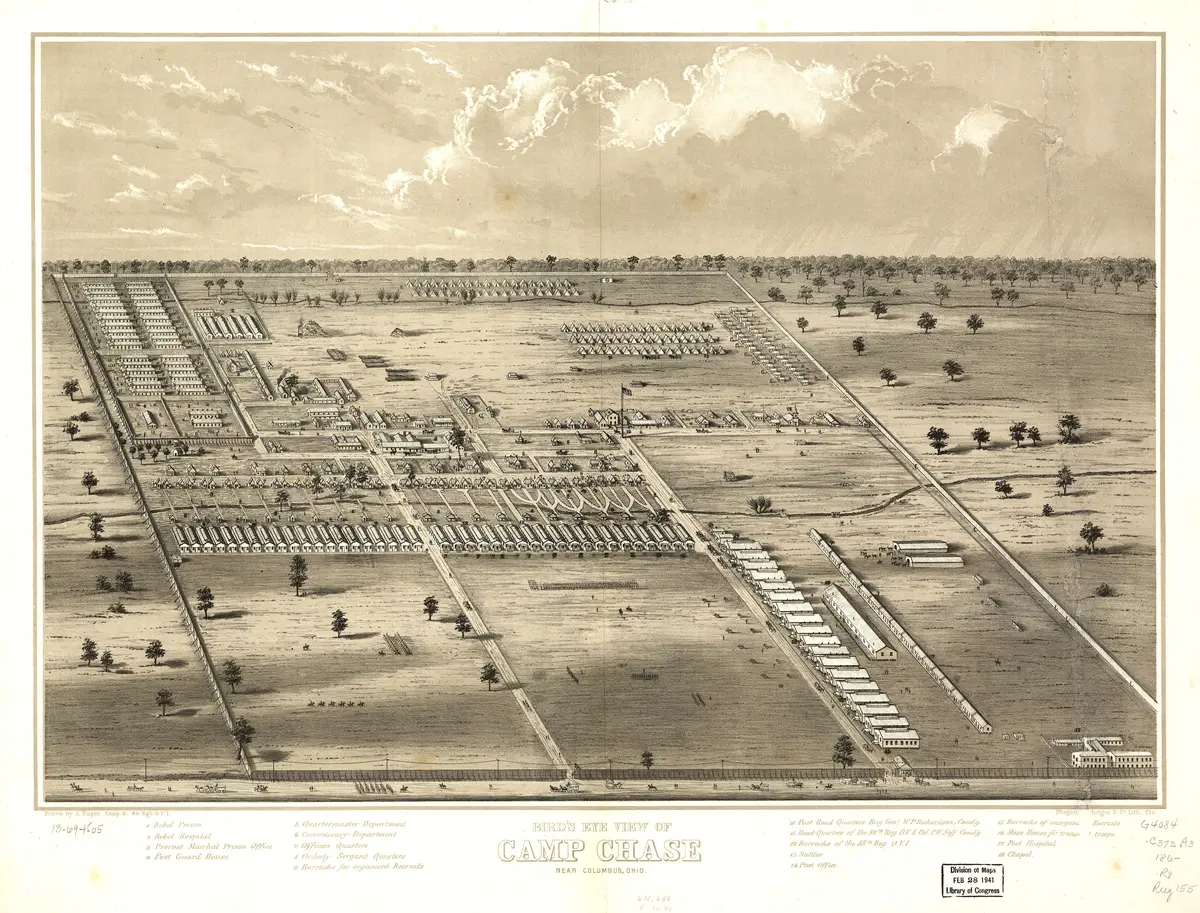
Camp Chase, the Union training camp and prison that stood four miles west of Columbus, Ohio, from 1861 to 1865, is gone; houses cover it.
Where is Camp Chase?
- Location
- Ohio, United States
- Type
- Cemetery
- Coordinates
- 39.944, -83.076
- Last updated
LOCATION
Why is Camp Chase said to be haunted?
What remains is its Confederate cemetery on Sullivant Avenue, a walled rectangle of pointed-top marble headstones under a granite arch inscribed with one word, AMERICANS. Its ghost story is the Lady in Grey, a veiled woman said to weep among the graves and leave flowers on them. The woman existed. She was Louisiana Ransburgh Briggs, raised on a Missouri plantation, married to a Union veteran, and she went veiled because her Columbus neighbours disapproved. A Richmond newspaper reported in 1900 that a watch had been set at the cemetery and 'the identity of the veiled woman was discovered'; in June 1917 the United Confederate Veterans presented her to their Washington convention and resolved that she be known as the 'Confederate angel of Camp Chase'. She died in 1950, aged one hundred, and is buried on the other side of the city. Everything the ghost is said to do, a living woman was documented doing first — and neither the 1906 history of this cemetery nor the government that owns it has ever mentioned an apparition.
What is the history of Camp Chase?
Camp Chase was not built for prisoners. When Ohio's volunteers overwhelmed Camp Jackson, hastily set up in a Columbus city park in the spring of 1861, the authorities opened a larger camp four miles west of town on leased farmland beside the National Road and named it after Salmon P. Chase, former governor of Ohio and Lincoln's Secretary of the Treasury. It stayed a training camp all through the war, but the first prisoner arrived in June 1861, and by November it held nearly three hundred men, many of them Northern civilians charged with aiding the Confederacy.
The surrender of Fort Donelson on 16 February 1862 changed its character. Faced with fifteen thousand prisoners, the federal government turned several training camps into prisons, Camp Chase among them. When exchanges stopped in the summer of 1863 the population passed two thousand; on 31 January 1865 it reached 9,423, its peak. Smallpox swept the barracks that last winter. By July 1865 the surviving prisoners had been released, the camp was dismantled, and the ground it stood on was eventually built over. It is now the Hilltop neighbourhood of Columbus, and of the camp itself nothing is left.
What is left is the burial ground. Each grave was marked with a wooden headboard giving the name, company, state and date of burial; the government later replaced these with a substantial plank carrying the same inscription, and, Knauss wrote, "in a few years all decayed". The barracks were torn down at the end of the war and the old lumber used to fence the cemetery. After the war families and friends removed 126 bodies, and Confederates who had been buried in the Columbus city cemetery and at Camp Dennison near Cincinnati were brought here. On 23 April 1879 the federal government bought the property, described in the deed as the Confederate cemetery formerly occupied by the Camp Chase rebel prison. Henry Briggs, who farmed the land opposite the gate, was hired under Governor Rutherford B. Hayes to keep the place cut back for twenty-five dollars a year out of the state contingent fund; when Governor Bishop stopped the payment, the cemetery went back to brambles.
The man who changed that was William H. Knauss, a wounded Union veteran who moved from New Jersey to Columbus in 1893 and found the burial ground with its gate and gateposts down, "overrun with briers, bramble bushes, and weeds, and it had become a resort for animals". He arranged with Henry Briggs to clear it. A first, small memorial service followed in 1895 — three days beforehand every announced speaker withdrew, "concluding that it would be unpopular and injure them as professional men", so Knauss paid for the day himself and about fifty people came. He held it again on 5 June 1896 with Captain W. B. Allbright, an ex-Confederate who had lived quietly in Columbus for years without letting himself be known as one. In 1897 General John B. Gordon undertook to have the South send flowers, and between one thousand and fifteen hundred people attended. That year a sixteen-ton boulder was set in the ground, inscribed "2260 Confederate soldiers of the war 1861-1865 buried in this enclosure", and Knauss put a wooden arch over it painted with the single word AMERICANS. On 7 June 1902 the wooden arch was replaced by the granite one that stands today, topped by a soldier facing south. In 1908 the Commission for Marking Graves of Confederate Dead set the marble headstones, ran metal fencing along the top of the wall and built the decorative entrance gate. The stone wall was rebuilt in 1921.
And there was a woman. Louisiana Ransburgh Briggs, born in December 1849, was sent north from her father's plantation at New Madrid, Missouri, when the war reached it in 1862; she married Joseph Briggs, a Union veteran and a prosperous farmer of the same family that owned the land across the road, and lived at Briggsdale, west of Columbus. Heavily veiled, she drove the six miles to the cemetery to scatter flowers on the neglected graves, sometimes taking her two small children with her. She was reported in the Southern press before Knauss's campaign made the cemetery respectable: in June 1900 the Richmond Times told its readers that "a watch was set at Camp Chase, and the identity of the veiled woman was discovered", that Mrs Gay Ide, née Caskey, formerly of Richmond, had joined her, and that when threats were made against them for Decoration Day, Captain Allbright came out to the cemetery and stood guard. On 5 June 1917, at the twenty-seventh reunion of the United Confederate Veterans in Washington, she was presented to the convention by General Bennett H. Young and the delegates answered with rebel yells. The resolution adopted that day is printed in the proceedings: she was "hereafter in the history of this association" to "be honored and known as the 'Confederate angel of Camp Chase'". The wire services that carried the story used a different title, and it is the one that stuck: "The Veiled Lady of Camp Chase". She died on 26 February 1950, aged one hundred, and is buried not here but in Green Lawn Cemetery, Columbus.
Timeline: the documented record of Camp Chase
- May–June 1861 Camp Chase opens four miles west of Columbus as an Ohio training camp, named after Salmon P. Chase. The first prisoner arrives in June; by November it holds nearly three hundred, many of them Northern civilians accused of aiding the Confederacy.
- 16 February 1862 Fort Donelson surrenders and the federal government, facing fifteen thousand prisoners, converts Camp Chase and other training camps into prison camps.
- 8–9 September 1864 The prisoner buried in grave 233 dies. Knauss's 1906 roll of the dead prints him as "Allen, B. L., Co. D, 50th Tenn. Inf., died September 9, '64"; the campchase.us research project, working from compiled service and prison records, gives Private Benjamin F. Allen, dead of pneumonia on 8 September.
- 31 January 1865 The prison population peaks at 9,423. Smallpox is running through the barracks; by July the last prisoners have been released and the camp is dismantled.
- 23 April 1879 The federal government buys the burial ground, described in the deed as the Confederate cemetery formerly occupied by the Camp Chase rebel prison. Maintenance stays intermittent: Henry Briggs, who farms opposite the gate, is paid twenty-five dollars a year under Governor Hayes, and the payment is later stopped.
- Decoration Day, 1885 According to the Richmond Times of 10 June 1900, threats were made against the two women who decorated the graves, and Captain W. B. Allbright, an ex-Confederate living quietly in Columbus, came out to the cemetery to protect them. The digitised page prints the year as "1SS5"; 1885 is the reading consistent with the sequence the same article gives.
- 1893 William H. Knauss, a wounded Union veteran newly arrived from New Jersey, finds the cemetery with its gate down and "overrun with briers, bramble bushes, and weeds", and arranges with Henry Briggs to have it cleared.
- 5 June 1896 The first full memorial service is held, a year after a small one in 1895 for which every announced speaker had withdrawn three days beforehand. Captain Allbright takes part; about a hundred people attend.
- 1897 General John B. Gordon has the South send flowers and between one thousand and fifteen hundred people attend. A sixteen-ton boulder is set in the ground, inscribed "2260 Confederate soldiers of the war 1861-1865 buried in this enclosure", with a wooden arch over it painted AMERICANS.
- 10 June 1900 The Richmond Times prints the earliest account of the veiled woman that can be dated: "a watch was set at Camp Chase, and the identity of the veiled woman was discovered". It names Mrs Gay Ide, née Caskey, as her companion and Henry Briggs as the man who supplied Allbright with the Adjutant-General's report on the camp.
- 7 June 1902 The granite memorial arch is unveiled, replacing the wooden one, seventeen feet high with a soldier on the keystone facing south and the single word AMERICANS.
- 1906 Knauss publishes The Story of Camp Chase, about 176,700 words including the full burial roll. It uses the word "grave" 313 times and "ghost" none.
- 1908 The Commission for Marking Graves of Confederate Dead sets the marble headstones, adds metal fencing along the top of the wall and builds the decorative entrance gate — the gate on which the modern legend places a plaque about the ghost.
- 5 June 1917 At the twenty-seventh reunion of the United Confederate Veterans in Washington, General Bennett H. Young presents Louisiana Ransburgh Briggs to the convention and the delegates answer with rebel yells. The adopted resolution rules that she be "honored and known as the 'Confederate angel of Camp Chase'"; the wire services call her "The Veiled Lady of Camp Chase" and report that she had gone to the cemetery heavily veiled for ten years, driving six miles with her two small children.
- 26 February 1950 Louisiana Ransburgh Briggs dies at the age of one hundred. She is buried in Green Lawn Cemetery, Columbus, not at Camp Chase; her headstone there was destroyed by vandals in December 2016.
- 1973 The Camp Chase site, including the Confederate cemetery, is listed on the National Register of Historic Places.
- 1988 The Ghosts of Ohio dates the best-known cluster of reports — many people hearing a woman weeping — to a Civil War re-enactment held near the cemetery this year. It is the earliest specific date the ghost version can be given, and it is seventy-one years after the living woman was named in Washington.
Is there a rational explanation for Camp Chase?
The Lady in Grey is not an invention. She is a real woman with a name, a husband, an address and a documented practice, converted after her death into an apparition. What can be measured is when the conversion happened, and how little of the modern telling survives contact with the record.
The first thing that fails is the mystery itself. The modern story has a figure who vanishes when approached; the contemporary sources say the opposite. In June 1900 the Richmond Times reported, in the middle of an article about Knauss's memorial campaign, that "a watch was set at Camp Chase, and the identity of the veiled woman was discovered". Seventeen years later she stood on a platform in Washington and was named out loud to seven thousand veterans. The veil was not a shroud, it was social cover: her husband was a Union veteran and a Franklin County commissioner, and the Southern sympathies of a woman in that household were, in the words of the 1917 wire copy, met by neighbours "who often expressed their disapproval".
The second thing that fails is the antiquity. Enigma Atlas's own earlier text claimed the story had been told "since at least the early twentieth century". That period is unusually well covered by the digitised American press, and Camp Chase was national news in it: in the Library of Congress's Chronicling America corpus, "camp chase" and "confederate cemetery" occur together on 131 pages, "camp chase" and "memorial arch" on 69, and "knauss" and "camp chase" on 178. The phrase "lady in gray" appears on 2,755 pages of the same corpus and "lady in grey" on 4,600. Put together, "camp chase" and "lady in gray" give zero pages, and "camp chase" and "lady in grey" give two, neither of them about this cemetery. As a control on the query itself, "camp chase" paired with a nonsense string also gives zero, and "camp chase" paired with "veiled lady" gives twelve, which is how the 1917 story was found. The ghost is not in the press of the period the legend claims.
The third is the silence of the one man who should have told it. William H. Knauss's The Story of Camp Chase (1906) runs to about 176,700 words and is the history of this cemetery: "cemetery" occurs 135 times in it, "grave" 313, "flower" 91, "prisoner" 360, "woman" 35. "Ghost", "haunt", "apparition", "phantom", "spectre" and "superstition" occur zero times. The single exception is a figure of speech at the 1899 service — "if the souls dwelling in God's eternal somewhere revisit earth, two thousand spectral forms stood reverent as the sweet, fresh, young voices of the children sang" — offered as a conditional, not a report. Knauss also names Henry Briggs seven times and Captain Allbright by name, so he knew the family and the cast; he simply had no ghost to tell.
The grave is real and the connection to it is not. Knauss printed the full burial roll: entry 233 reads "Allen, B. L., Co. D, 50th Tenn. Inf., died September 9, '64". The research project at campchase.us, working from Confederate compiled service records and prison records, identifies him as Private Benjamin F. Allen, captured wounded at Missionary Ridge in November 1863 and dead of pneumonia on 8 September 1864 — a day earlier than the 1906 roll, and with a different middle initial. Some retellings give the grave number as 223 rather than 233. But nothing in 1900, 1906 or 1917 attaches Louisiana Briggs to any individual grave: every account describes her scattering flowers over all of them. She was fourteen years old and living in Ohio when Allen died. The story that she was engaged to him has no documentary basis, and the Pennsylvania Rambler, which repeats it, says as much.
The flowers explain themselves. Camp Chase Confederate Cemetery is a federal soldiers' lot open every day from sunrise to sunset with no admission and no attendant, and the Department of Veterans Affairs's own floral policy states that "natural, fresh-cut flowers may be placed on graves at any time of the year". No visitor register exists, so "flowers with no visitor recorded" describes every bouquet ever left there. The Hilltop Historical Society, the Sons of Confederate Veterans and the United Daughters of the Confederacy all hold observances at the site. The Ghosts of Ohio, a research group that is sympathetic to the legend, notes that it has never found flowers on Allen's grave during its own visits, and dates the best-known cluster of reports of weeping to a Civil War re-enactment held near the cemetery in 1988.
As for the plaque: there is none. The Department of Veterans Affairs lists exactly two monuments in the cemetery, the 1897 boulder and the 1902 arch, and the interpretive sign the VA itself installed at the site runs to 598 words in which "cemetery" appears eight times, "grave" twelve, "Knauss" three and "Briggs" once, while "ghost", "haunt", "lady", "gray", "grey" and "legend" appear not at all. The decorative gate that the legend says carries the plaque was built in 1908 by the Commission for Marking Graves of Confederate Dead, for security. Neither the VA nor the National Park Service, which has published a full teaching unit on this cemetery, mentions an apparition anywhere. Unlike most haunted sites there is not even a second, commercial voice contradicting the official one: the cemetery is federal property, free to enter, and no operator sells a ghost tour of it.
One detail worth keeping is the colour. Every contemporary source describes a veil, and later accounts of Louisiana Briggs specify a heavy black one. Grey arrives with the ghost, and it is a very well-worn costume: Enigma Atlas's own catalogue carries the grey or white lady motif in twenty of its files. What was taken from her was not only her name but her mourning.
Even the count on the boulder is contested. It reads 2,260; the 1917 resolution of the United Confederate Veterans says 2,460; the National Park Service gives 2,229 deaths and 2,199 graves; and the VA states that "officially, there is an estimate of 2,168 remains in 2,122 gravesites", adding, in its own words, that this "does not match the inscription on the Boulder monument".
Can you visit Camp Chase?
Camp Chase Confederate Cemetery is at 2900 Sullivant Avenue, Columbus, Ohio 43204, on a residential street in the Hilltop neighbourhood. Measured from the Ohio Statehouse it lies 6.8 km (4.2 miles) west-south-west in a straight line, while the Department of Veterans Affairs describes it as six miles west of downtown Columbus. The federal government bought the ground in 1879. It is one of the 33 soldiers' lots and Confederate cemeteries maintained by the National Cemetery Administration, and it is administered from Dayton National Cemetery on 937-268-2221. The lot is closed to interments, admission is free, and the grounds are open daily from sunrise to sunset.
What stands there is a walled rectangle of under two acres filled with pointed-top marble headstones in numbered rows. Three counts of the dead disagree with one another. The boulder placed in 1897 is carved "2260 confederate soldiers of the war 1861-1865 buried in this enclosure"; the National Park Service records that the wall built in 1921 encloses 2,199 graves; the Veterans Affairs account says more than 2,200 men are buried there. The granite arch unveiled in 1902 stands 75 feet inside the Sullivant Avenue entrance, with AMERICANS cut into its keystone. A bronze Confederate soldier stands on top of it facing south. The decorative entrance gate dates from 1908, and the cemetery was listed on the National Register of Historic Places in 1973.
The camp itself is gone under housing. What records its outline is Ohio historical marker 27-25, at the corner of Sullivant Avenue and Chestershire Road: present-day Broad Street on the north, Hague Avenue on the east, Sullivant Avenue on the south, and the western edge near Westgate Avenue. The marker was erected in 1999 by the Ohio Bicentennial Commission with the Longaberger Company, the Hilltop Historical Society, Blue & Gray Magazine, the Dixie Chapter of the United Daughters of the Confederacy, the Sons of Confederate Veterans and the Ohio Historical Society. Those four streets are where the camp survives as a shape on the map.
Veterans Affairs floral rules allow fresh-cut flowers on the graves at any time of year, and artificial flowers only between 10 October and 15 April. One small American flag per grave is permitted. Nothing may be fastened to a headstone or set on top of it.
Memorial observances are held at the cemetery through the year. The best known is the June service that the Hilltop Historical Society has sponsored for decades, and the Sons of Confederate Veterans and the United Daughters of the Confederacy also mark Memorial Day at the site. The cemetery has no parking of its own and fronts directly onto Sullivant Avenue. Louisiana Ransburgh Briggs, the woman at the centre of the Lady in Grey story, is buried elsewhere: her grave is in Green Lawn Cemetery, on the other side of Columbus, and her headstone was destroyed by vandals in December 2016.
Sources consulted
- William H. Knauss, «The Story of Camp Chase: A History of the Prison and Its Cemetery, Together with Other Cemeteries Where Confederate Prisoners Are Buried» — Publishing House of the M.E. Church, South, Nashville, 1906 book
- unsigned, «Camp Chase: the veiled woman identified and Captain Allbright's guard on Decoration Day» — The Times (Richmond, Va.), 10 June 1900, p. 17, 1900 newspaper archive
- United Confederate Veterans, «Proceedings of the Twenty-Seventh Annual Reunion of the United Confederate Veterans, Washington, D.C., June 4–7, 1917 (resolution on Mrs. Briggs, p. 61)» — United Confederate Veterans, 1917 report
- wire report, «"The Veiled Lady of Camp Chase" presented to the Confederate reunion» — Evening Star (Washington, D.C.), 6 June 1917, p. 13, 1917 newspaper archive
- wire report, «General Young names Louisiana Ransburgh Briggs "The Veiled Lady of Camp Chase"» — The Washington Times, 6 June 1917, p. 2, 1917 newspaper archive
- wire report, «Mrs. Briggs drove six miles each Decoration Day to strew flowers on the graves» — The Montgomery Advertiser, 6 June 1917, p. 2, 1917 newspaper archive
- National Cemetery Administration, «Camp Chase Confederate Cemetery: hours, floral policy, historical information and monuments» — U.S. Department of Veterans Affairs, 2025 web
- National Cemetery Administration, «Camp Chase Confederate Cemetery interpretive sign (Civil War Sesquicentennial wayside)» — U.S. Department of Veterans Affairs, 2015 report
- National Park Service, «Not to Be Forgotten: Camp Chase Confederate Cemetery (Teaching with Historic Places)» — U.S. Department of the Interior, 2020 report
- Camp Chase Confederate Cemetery research project, «The soldier behind the legend of the "Lady in Grey" and The Lady Behind the Veil: the life of Louisiana Ransburgh Briggs» — campchase.us, 2021 web
- James A. Willis / The Ghosts of Ohio, «Camp Chase Cemetery (Ohio lore and legends)» — ghostsofohio.org, 2015 web
Reviewed by V. Serrano on 2026-08-17 · How we verify our content
💬 Field testimonies (0)
No testimonies yet. Add the first.
Add your testimony
🔒 Log in to add a testimony