👻 HAUNTED PLACE · EXP. Nº9478
ACTIVE
Chateau Laroche
Harry Delos Andrews was officially dead. A cerebrospinal meningitis outbreak at Camp Dix in 1918 sent his records to Washington marked "deceased", a doctor restarted his heart with adrenaline, and it took six months to correct the paperwork.
Where is Chateau Laroche?
- Location
- Ohio, United States
- Type
- Castle
- Coordinates
- 39.283, -84.266
- Last updated
LOCATION
Why is Chateau Laroche said to be haunted?
Posted afterwards to an army hospital installed in the Château La Roche in the Dordogne, he came home to Ohio, bought two riverside lots that a failing Cincinnati newspaper had given away with six-month subscriptions, and on 5 June 1929 began building a castle for his Sunday school and scout troop. He worked on it for the rest of his life, hauling an estimated 56,000 pails of stone up from the Little Miami and moulding concrete bricks in quart milk cartons once the river stone ran out. A trash fire on 14 March 1981 burned him badly and he died a month later, aged 91. The Knights of the Golden Trail, the troop that named itself after chivalry, inherited the castle and still run it. Its ghosts are published on their own website and signed: Andrews wrote about a poltergeist he called Casper and noted that no one had ever seen him, and four members added accounts dated 1987, 1989 and 2001.
What is the history of Chateau Laroche?
Chateau Laroche is the work of one Ohio army medic who had been officially declared dead in 1918.
Harry Delos Andrews was born on 5 April 1890 in Oneonta, New York, and graduated from Colgate University in the class of 1916, having studied architecture. Drafted into the US Army Medical Corps, he rose to sergeant-major. The order he later founded says he enlisted as a nurse because of the weapons of modern war, "killing at a distance"; in its words, "He didn't object to war itself".
He never reached the front in the way he expected. He was one of some 7,000 soldiers at Camp Dix, New Jersey, struck down by an outbreak of cerebrospinal meningitis. His body was moved to the morgue and his records were marked "deceased" and sent to Washington. In the account Lori E. Jareo published in 1996, drawn from Andrews' own booklet and from the Cincinnati Enquirer, the body was taken back to the hospital for dissection, a doctor proposed trying "this new stuff" — adrenaline — a needle was pushed into his heart, and it started again. He came out of it blind and paralysed, weighing 89 pounds; his sight returned behind glasses, and his blood was later drawn to harvest meningococcus antibodies. Jareo records that only one other Camp Dix soldier survived the initial outbreak. Six months passed before the paperwork was corrected, and by then his fiancée had married another man.
The castle's name comes from what happened next. Andrews was posted to an army hospital installed in the Château La Roche, near Razac-sur-l'Isle in the Dordogne, in south-western France, where he served as hospital administrator and taught French to American soldiers. Jareo, Colgate's magazine and the Knights' own site all place him there on the staff, as hospital administrator. After the armistice he stayed on in Europe, visited castles, and studied architecture at Toulouse.
The land came out of a newspaper's desperation. Greg Hand, writing in Cincinnati Magazine in June 2025 from the property record, describes how the Cincinnati Commercial Tribune — a Republican daily that had been controlled since 1911 by the owner of the rival Enquirer — bought the former Apgar farm outside Loveland, cut it into thousands of parcels 20 feet wide by 100 feet long, and in 1924 handed one out with every six-month subscription, which cost $58.50. The lots were too small to build on; the paper sold the idea as a summer resort where a subscriber could pitch a tent and walk to the river. One of the original buyers was Lillie Gegner, and on 12 June 1929 she sold two adjacent plots to Harry D. Andrews.
The boys were already camping there by then. The Knights of the Golden Trail — the name Andrews' Sunday school and scout troop gave itself, in the way troops name themselves Bears or Lions — celebrated its 75th anniversary in February 2002, which puts its founding in February 1927. A dozen or so boys kept losing their kit on the riverbank to weather, animals and passers-by, so Andrews built them two small stone rooms he called a "stone tent". Then, in the order's own telling, the knights decided they could not be real knights without a castle, and he made them an offer: fetch stone up from the river and he would build one. The Knights and Colgate both date the groundbreaking to 5 June 1929, and Jareo records that the castle was dedicated in 1930.
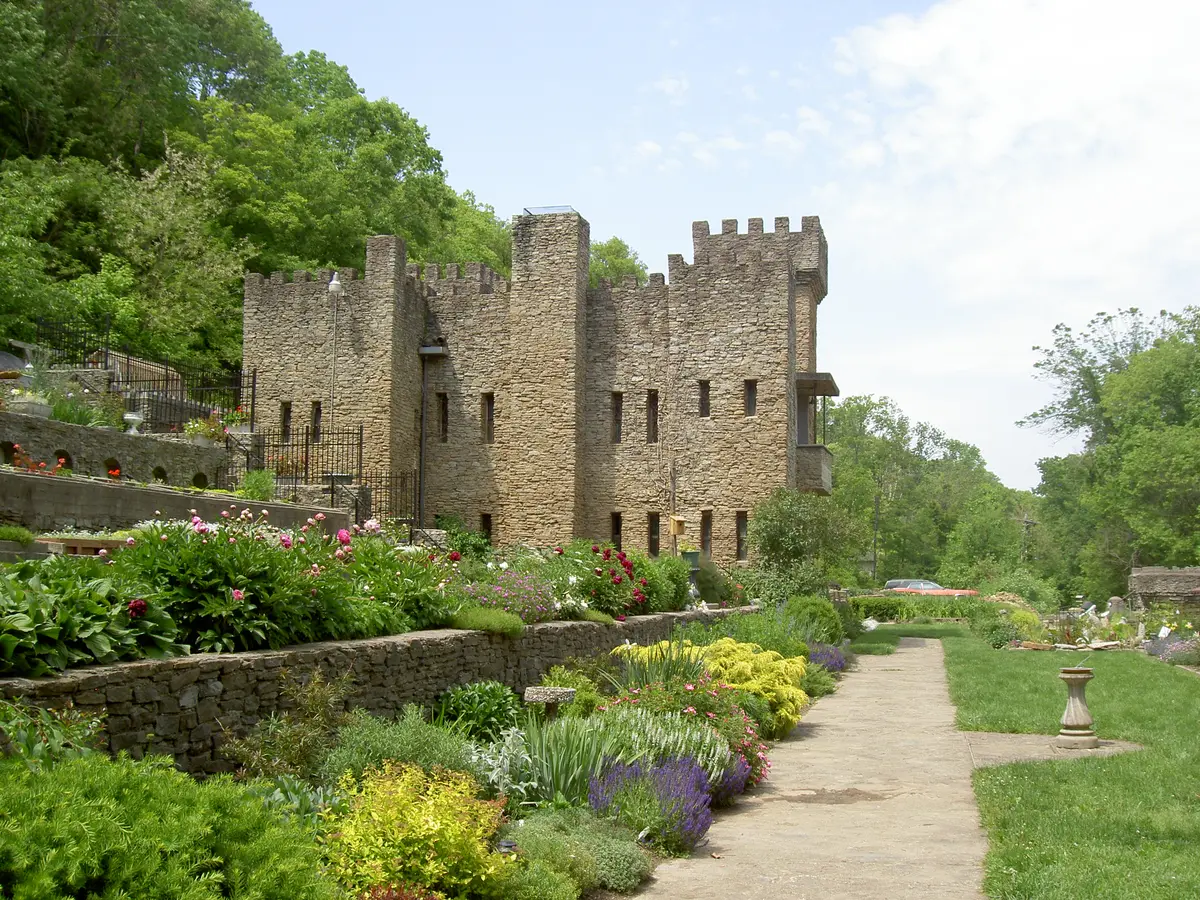
Then it almost stopped. Between the Depression and the Second World War, Jareo writes, Andrews did not work in earnest until he retired from the mailroom of the Standard Publishing Company; he moved into the castle on Memorial Day 1955 with a few rooms finished and a few services installed. Jareo's measurements give an acre and a half of ground, a footprint of 96 by 56 feet and 36 feet of height at the eastern face; the building mixes German, French and English detail with four kinds of tower, a dry moat, a dungeon and hand-tiled ceilings. He carried an estimated 56,000 five-gallon pails of river stone up the bank by hand, 65 pounds each; when the river stone ran out he moulded concrete bricks in quart paper milk cartons, using more than 2,600 sacks of cement, and packed some of them with light bulbs and tin cans for thrift and insulation. Jareo's figures for the whole job are 8,000 tons of material, 23,000 hours of labour and $12,000, with Andrews doing 98 per cent of the work himself. He turned down, he said, more than fifty proposals of marriage from "widows and old maids who wanted to live in a castle".
The state never quite believed he was alive. He had to convince the Pentagon he was not dead in order to draw his army pension, received it for 23 years, and saw it stop in 1979; his last years were spent on Social Security.
On the morning of 14 March 1981 Andrews lit a trash fire on the castle grounds. As he tried to stamp it out his trousers caught, and then his sleeves; visitors at the castle smothered the flames with a blanket. The skin grafts at a nearby hospital went well, but he died of his injuries on 16 April 1981, having turned 91 in hospital eleven days earlier, and left the castle to the Knights.
The Knights of the Golden Trail still run it, and their FAQ, read on 6 October 2026, describes the visit as self-guided, with two video interviews and a short documentary on his time in boot camp during the First World War.
Timeline: the documented record of Chateau Laroche
- 5 April 1890 Harry Delos Andrews is born in Oneonta, New York. He later studies architecture at Colgate University, class of 1916.
- 1918, Camp Dix A cerebrospinal meningitis outbreak at Camp Dix, New Jersey, hits some 7,000 soldiers. Andrews, a sergeant-major in the Army Medical Corps, is declared dead and his records sent to Washington marked "deceased"; a doctor restarts his heart with adrenaline. Six months pass before the paperwork is corrected.
- 1918-1919, Dordogne Andrews is posted as hospital administrator to an army hospital installed in the Château La Roche, near Razac-sur-l'Isle in the Dordogne, and teaches French to American soldiers. The castle he later builds takes its name from that building.
- 1924 The Cincinnati Commercial Tribune, a failing Republican daily, subdivides the former Apgar farm outside Loveland into parcels 20 by 100 feet and gives one away with every six-month subscription, priced at $58.50. Greg Hand traced the promotion in 2025; the lots were too small to build on.
- February 1927 Andrews' Sunday school and scout troop names itself the Knights of the Golden Trail. The date is fixed by the order's own announcement of its 75th anniversary in February 2002.
- 5 June 1929 Ground is broken on the castle, according to both the Knights and Colgate's own magazine. Andrews had promised the boys a tenth-century keep if they hauled stone up from the Little Miami.
- 12 June 1929 Lillie Gegner, one of the original subscribers, sells two adjacent riverside plots to Harry D. Andrews. The date comes from the property record; it falls a week after the groundbreaking the owners give, and Jareo's 1996 account instead dates his purchase of land to 1927.
- 1930 The castle is dedicated, according to Jareo. Work then stalls for a quarter of a century through the Depression and the Second World War.
- Memorial Day 1955 Andrews retires from the mailroom of the Standard Publishing Company, moves into the castle with a few rooms finished, and only then begins to build in earnest.
- 1979 His army pension stops after 23 years of payments he had to convince the Pentagon he was alive to receive. He lives out his last years on Social Security.
- 14 March 1981 Andrews lights a trash fire on the castle grounds; his trousers and sleeves catch and visitors smother the flames with a blanket. He suffers severe burns to legs and arms. He dies of his injuries on 16 April 1981, eleven days after turning 91 in hospital, and leaves the castle to the Knights.
- 1983 First edition of the Haunted Castle Knight Tour, dated by the Knights' own advertisement for its 25th annual staging in 2007. The paid haunted attraction begins two years after Andrews' death and twenty before the ghost stories appear on the website.
- Winter 1987 Lady Christie describes seeing "a huge shadow" the size of a person climb the spiral staircase while she waited in the French ballroom with Sir Ron Irvin. She notes that the lighting ruled out a moth, which would have fluttered.
- May 1989 Lady Donna Jean, supervising a scout overnight, reports a transparent, flowing figure walking up from the portable toilets towards the gardens between 11.00 and 11.30 p.m. She links it to a story Andrews told about a moonshiner's wife killed by an explosion downriver.
- 2001 Sir Joe and Sir Tim hear the ballroom bathroom door slam three times with nobody in the building. The next morning Sir Joe checks the pipes and finds the septic tank about to overflow.
- 5 April 2003 Earliest archived copy of the Knights' ghost-stories page, carrying Andrews' own text on Casper the poltergeist — "No one has ever seen him" — alongside the four signed members' accounts.
Is there a rational explanation for Chateau Laroche?
The ghost stories of Chateau Laroche are unusually easy to trace, because the owners publish them and sign them. The page the Knights of the Golden Trail kept on their site — archived on 5 April 2003 — carries five accounts: Andrews' own, and one each from Sir Joe, Sir Bill, Lady Donna Jean and Lady Christie. What is striking is how much of the scepticism is already inside them.
Andrews wrote that the castle's resident poltergeist, whom he called Casper, had never been seen: "No one has ever seen him. They say that is because he died a natural death. It is only the ghosts of murdered people whose ghosts can be seen." He also explained that "Casper comes from the funny papers, and his last name is the German for friendly ghost" — which is wrong, since German poltern means to make a racket, and which is a fair guide to the register he was writing in. In the same text he describes a girl in a long dress who used to walk across the river and sit on top of the garage, and then adds: "Now that we have a streetlight in front she has not returned." An egg-shaped, transparent shape lived by a weeping willow for sixteen years and left when the willow died. A tall Viking with a spiked helmet appeared by the north round part of the addition, and of him Andrews wrote: "You could watch him as long as you wished, but if you glanced away, he would disappear."
The members' accounts do the same work on themselves. Lady Christie's story, dated to the winter of 1987, is of "a huge shadow" the size of a person moving up the spiral staircase — and she says herself that the lighting ruled out a moth or an insect, because one would have fluttered about. Sir Joe's slamming bathroom door, in 2001, ends with him checking the pipes the next morning and finding the septic tank about to overflow. Lady Donna Jean's figure, in May 1989, was outdoors, walking up from the portable toilets towards the gardens at about eleven at night, and she connects it to a story Andrews told about a moonshiner's wife killed by an explosion in a cabin downriver.
The commercial timeline runs alongside them: Andrews' own stories are the only ones that predate the ticket. By 2007 the Knights were advertising "The 25th Annual Haunted Castle Knight Tour", which puts the first edition in 1983 — two years after Andrews died — and Cincinnati CityBeat listed it in October 2002 at $5 for evenings from seven to eleven. Every dated story by a member falls inside that run. The Halloween attraction is absent from the Internet Archive's captures of their home page of October 2019, October 2021, September 2023 and October 2025, while the 2007 page for it is still there; their offer on 6 October 2026 is private paranormal investigations at $300 for up to fifteen people — which the 2016 contract makes plain are a lease of the building to a "Tenant" — and by a $50 wine tasting in the gardens.
The house history moves too, and that is the best reason to attribute rather than assert. Jareo in 1996 and a CityBeat listing in October 1997 both describe a one-fifth-scale medieval castle; the owners' FAQ today says it is full scale except for the ballroom. Andrews' IQ was 181 on their 2002 page and is 189 on the current one. Their account of the land has changed newspaper, subscription term and mode of transfer between those two versions of the same page. And "Sir" Harry's knighthood — pulling an English nobleman's son off the battlefield, and being knighted by the grateful father — was flagged as legend by Jareo in 1996 in the same breath as she told it.
Can you visit Chateau Laroche?
Chateau Laroche is open, cheap, and still run by the order that inherited it. It stands at 12025 Shore Drive, in Symmes Township just north of Loveland, Hamilton County, Ohio 45140. One caution on the address: the Knights' current page prints 12075, but their 1996 contact details, their 2003 site, their 2016 ghost-hunt contract and a 1997 CityBeat listing all print 12025.
As of August 2026 the museum opens 11:00 to 17:00 — seven days a week from 1 April to 30 September, weekends only from 1 October to 31 March, closed Thanksgiving, Christmas and New Year's Eve. Admission is $5 a head, free for children of five and under. Cards are accepted; $100 notes are not. Special-event prices vary. The telephone number, 513-683-4686, gives a recorded message. For comparison, CityBeat listed admission at $1 in October 1997.
The visit is self-guided. The Knights state plainly that there are no tour guides, although the knight on duty may give a short history of Andrews and the castle, and there are two filmed interviews and a short documentary about his time in boot camp. Nothing is sold to eat or drink: there are picnic tables, benches, walls, towers and gardens, and visitors are asked to bring their own food and take their rubbish away. There are two portable toilets at the south end of the car park and no more than forty parking spaces. Dogs are welcome on a lead and owners must clean up. The road down to the castle is the one Andrews built, and coaches still cannot use it.
Paranormal investigations are by appointment and by contract only, and the contract is a lease: the Knights rent the premises to a "Tenant" for a fixed number of hours, starting no earlier than seven in the evening and ending no later than ten the following morning, at $300 for up to fifteen guests, with a non-refundable deposit of $250 and $50 due on arrival. The owners insist it is not a sleepover, and ghost hunters get free museum admission on the day. The castle takes no bookings for weddings, showers, birthdays, graduations or private overnight stays, and does not close during opening hours for any reason. Wine tastings in the gardens, with live music and a charcuterie board, are sold separately at $50 for over-21s.
One last thing, from their own FAQ: they invite visitors to ask the knight on duty about the castle ghosts "and the Loveland Frogman" — the local cryptid reported in the 1970s on the road beside the same river.
Sources consulted
- Harry D. Andrews and members of the Knights of the Golden Trail, «Ghost stories of the Historic Loveland Castle Museum (Sir Harry, Sir Joe, Sir Bill, Lady Donna Jean, Lady Christie)» — lovelandcastle.com/ghosts.html, archived by the Internet Archive, 2003 archive
- Lori E. Jareo, «Harry Andrews and the Legend of Chateau La Roche» — Trenches on the Web (worldwar1.com); cites The Cincinnati Enquirer of 18 Nov 1979, 17 Mar 1981 and 17 Apr 1981 and Andrews' own booklet and pamphlet, 1996 report
- Greg Hand, «The Further Adventures of Cincinnati's Curious Real Estate Investors and Scoundrels» — Cincinnati Magazine, 2025 newspaper archive
- Knights of the Golden Trail, «All About the Knights of the Golden Trail (kogt.html)» — lovelandcastle.com, archived by the Internet Archive on 2 June 2002, 2002 archive
- Knights of the Golden Trail, «Historic Loveland Castle & Museum: About Sir Harry, the KOGT, FAQ, hours and prices» — lovelandcastle.com, consulted 17 August 2026, 2026 web
- Knights of the Golden Trail, «The 25th Annual Haunted Castle Knight Tour (haunted_castle.html)» — lovelandcastle.com, archived by the Internet Archive on 27 February 2008, 2007 archive
- Knights of the Golden Trail, «Paranormal Investigation: Agreement of Lease between K.O.G.T and Tenant» — lovelandcastle.com/pdf/GhostHunt.pdf, archived by the Internet Archive on 6 June 2016, 2016 archive
- Cincinnati CityBeat, «Museums listing: "CHATEAU LAROCHE - Take a tour of this one-fifth scale medieval castle... $1. 12025 Shore Drive, Loveland"» — Cincinnati CityBeat, 2 October 1997, digitised by the Public Library of Cincinnati and Hamilton County, 1997 newspaper archive
- Cincinnati CityBeat, «Events listing: "LOVELAND CASTLE HAUNTED TOUR - The Scary Haunted Tours are back, courtesy of the Knights of the Golden Trail... $5"» — Cincinnati CityBeat, 3 October 2002, digitised by the Public Library of Cincinnati and Hamilton County, 2002 newspaper archive
- Phoebe Sklansky, «Flashback: The Man in the High Castle» — Colgate Magazine, 2020 web
- Library of Congress, «The Commercial Tribune (Cincinnati, Ohio) 1898-1930: catalogue record, vol. 2 no. 245 (14 Feb 1898) to vol. 35 no. 172 (3 Dec 1930)» — Chronicling America newspaper directory, 1930 archive
- Dorothy Chapman, «Chateau Laroche, Loveland, Ohio: eight slides, Dorothy Chapman Slide Collection, Box 04» — Genealogy & Local History Department, Public Library of Cincinnati and Hamilton County, 2021 archive
- Wikipedia contributors, «Chateau Laroche (article and revision history)» — English Wikipedia, 2026 web
Reviewed by V. Serrano on 2026-08-17 · How we verify our content
💬 Field testimonies (0)
No testimonies yet. Add the first.
Add your testimony
🔒 Log in to add a testimony