👻 HAUNTED PLACE · EXP. Nº9478
ACTIVE
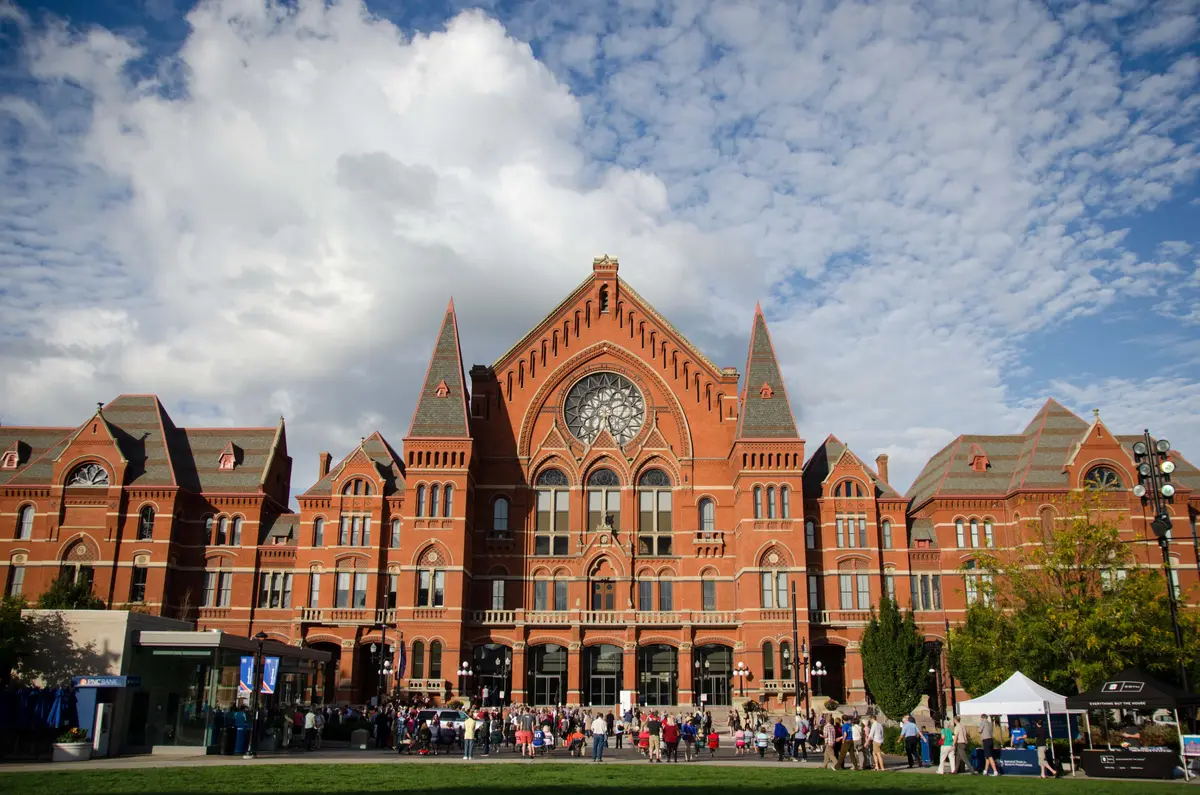
Cincinnati Music Hall
Cincinnati Music Hall opened on 14 May 1878 over ground the young city had used as its public burying ground: an 1830 map puts the potter's field under the south part of the building, and bones have surfaced ever since — boxes of skeletons during construction in 1876–77, coffins and a 65-grave "Valley of Death" in 1927, some 200 pounds of commingled bone when the freight-elevator shaft was deepened in May 1988, and remains of about four adults under the orchestra pit during the 2016–17 renovation.
Where is Cincinnati Music Hall?
- Location
- Ohio, United States
- Type
- Theater
- Coordinates
- 39.109, -84.519
- Last updated
LOCATION
Why is Cincinnati Music Hall said to be haunted?
The ghost stories are older than the hall itself: reporter Lafcadio Hearn was printing night watchmen's accounts from the wooden Exposition Hall on this site in 1875, and observed that the ghosts only appeared once the digging began. Today the National Historic Landmark is home to the Cincinnati Symphony, Pops, Opera and Ballet; its preservation group publishes testimony with names attached — security guard John G. Engst dated his unexplained elevator music to 22 February 1987, fifteen months before bones were found beneath that same elevator — and its $45 ghost tours sell out, while 25-year volunteer guide Marie Gallagher counters flatly: "I don't believe in ghosts."
What is the history of Cincinnati Music Hall?
On 23 September 1818 — the printed page of Greve's 1904 centennial history is unambiguous on the date, though "13 September" circulates online — the young city of Cincinnati paid Jesse Embree $3,200 for out-lot 53, on the west side of Elm Street beyond 12th. The lot became the city's public burying ground: the potter's field where paupers, strangers and the unclaimed dead were interred, and the University of Cincinnati anthropologists who curate bones recovered from the site date its use to 1818–1837. An 1830 map places the burial ground under what is today the south part of Music Hall, and it stretched west beyond the line of the Miami & Erie Canal: when the canal was cut through, the journalist Lafcadio Hearn reported in 1875, about a hundred skeletons had to be moved. Hearn also wrote that when the steamboat Moselle blew up in April 1838, unidentified victims were buried "in a spot now covered by the south end of Horticultural Hall" — a claim the building's own historians note rests on that single source.
Burials stopped in the late 1830s; writing in 1875, Hearn said the field had been "abandoned to other uses about thirty-five years ago". The lot passed to the township in exchange for the land that became Lincoln Park, and for some three decades the four-storey Cincinnati Orphan Asylum stood on its northern part. On 29 January 1859 the city bought the property back for $150,000 and made it Elm Street Park; in 1870 the German singing societies raised the Saengerhalle there, a huge tin-roofed wooden hall used for song festivals and industrial expositions. After rain on that tin roof drowned out the 1875 May Festival, the merchant Reuben Springer offered $125,000 towards a permanent hall. The wooden building came down and Samuel Hannaford's red-brick pile went up between 1876 and 1878, opening on 14 May 1878 with Gluck's Alceste; the exposition wings followed in 1879. The building was listed on the National Register of Historic Places in January 1970 and designated a National Historic Landmark on 2 December 1974.
The ghost stories are older than Music Hall itself. On 29 August 1875 the Cincinnati Commercial ran "The Restless Dead: Concerning Haunted Houses" — the clipping survives in the Public Library's Lafcadio Hearn collection — in which Hearn wrote that the Exposition Hall had been rumoured a headquarters for ghosts for nearly four years, that "not a foot of ground lies under the Exposition Building unoccupied by mouldering bones", and that when an elevator was erected in Power Hall "more than a barrel full of skulls and bones" had been dug up and simply placed under the floor in another part of the building. He let the night watchman speak for himself: rappings on ceiling, floor, doors and windows; stealthy footfalls behind him; knocking at the door on a snowed-in winter night with no footprints outside. Fourteen months later, in "Gossip About City Ghosts" (22 October 1876), Hearn covered the excavations for Music Hall itself — "small Golgothas" of skulls and thigh-bones, and the medical students who came by night to steal them — and observed that the ghosts did not seem to have troubled anybody until after the yellow bones had been dug up; his set piece is an exhibitor who approached a tall, pale young woman in long-forgotten fashion at his booth and watched her turn diaphanous and vanish. When the foundation crews kept filling boxes with remains, W. H. Harrison — a Music Hall Association board member who also sat on the board of Spring Grove Cemetery — arranged a plot there for their reburial.
The dead kept resurfacing. In February 1927 workers digging a tunnel foundation struck three coffins, one under a headstone reading George Pollock, native of Scotland, died 29 October 1831, aged 52; the remains were sealed in a four-foot cement vault in the pit of a new elevator shaft. A trench along the south wing that same year cut through some 65 graves — newspapers dubbed it the "Valley of Death", and watchmen could not stop souvenir hunters stealing skulls. The 1969–1975 renovation found the vault again and reburied it once more. In May 1988, deepening the freight-elevator shaft broke into the communal crypt a third time: roughly 200 pounds of commingled bone — a 1998 CityBeat retrospective counted 19 skulls — went first to the coroner and then to the University of Cincinnati's physical-anthropology laboratory, where Elizabeth Murray's analysis identified partial remains of at least 30 and possibly as many as 70 individuals. The collection is still curated there and was re-studied in a 2025 master's thesis. During the $143-million renovation of 2016–17, contractors testing soil for asbestos found arm and leg bones of about four adults under the orchestra pit on 29 March 2016, plus six grave shafts with wooden coffins in the north carriageway; archaeologists from Gray & Pape removed the remains, which joined earlier boxes taken to Spring Grove.
Unusually for a haunted landmark, the testimony comes with names attached. In the 2005 CET documentary Music Hall: Cincinnati Finds Its Voice, opera CEO Patricia K. Beggs allowed: "Ghosts? Um, yes. Indeed, there are Music Hall ghosts", and Pops conductor Erich Kunzel said the presences he met while working through the night were friendly. Kitty Love, on the hall's private police force for 21 years, told the author John Kachuba: "I hear them when I'm on duty alone at night. Footsteps, doors slamming, and music playing, and I know I was the only one in the building" — always, she noted, on the south side, over the old cemetery. And the preservation group Friends of Music Hall publishes the handwritten account of security guard John G. Engst, who on 22 February 1987, escorting caterers down from Corbett Tower after midnight, heard a music-box tune he took for "Let Me Call You Sweetheart" playing around the freight elevator at every level, found no source, and for nearly two weeks could not approach the shaft on the first floor late at night "without my whole body tingling". Fifteen months later, workers deepening that same shaft found the crypt.
Timeline: the documented record of Cincinnati Music Hall
- 23 September 1818 Cincinnati buys out-lot 53, west of Elm Street beyond 12th, from Jesse Embree for $3,200; the tract becomes the city's public burying ground, in use until about 1837.
- 1830 A map of the tract shows the potter's field lying under what is now the south part of Music Hall.
- 25 April 1838 The steamboat Moselle explodes; Hearn later reports that unidentified victims were buried on ground now covered by the south end of the exposition buildings — a detail resting on his account alone.
- 29 January 1859 The city buys the lot back for $150,000 — the Cincinnati Orphan Asylum had occupied its north part for some three decades — and turns it into Elm Street Park.
- 1870 The Saengerbund raises the Saengerhalle, a huge tin-roofed wooden hall for song festivals and expositions, on the park; an elevator dig in Power Hall turns up "more than a barrel full of skulls and bones".
- 29 August 1875 Lafcadio Hearn's "The Restless Dead" in the Cincinnati Commercial prints the night watchman's first-person account of rappings and footfalls at the Exposition Hall and notes the ghost rumours are already nearly four years old.
- 22 October 1876 In "Gossip About City Ghosts" Hearn covers the Music Hall excavations — open bone heaps, night thefts by medical students — and observes that the ghosts only began once the bones were dug up.
- 14 May 1878 Music Hall opens with Gluck's Alceste; during construction, board member W. H. Harrison — also on the Spring Grove Cemetery board — had arranged reburial there for the skeletons the foundation crews kept finding.
- February 1927 Tunnel work strikes three coffins, one under the headstone of George Pollock (d. 29 October 1831); a south-wing trench cuts some 65 graves — the press's "Valley of Death" — and the remains are sealed in a cement vault in a new elevator pit.
- 2 December 1974 Music Hall is designated a National Historic Landmark; it had been listed on the National Register of Historic Places (ref. 70000496) on 26 January 1970.
- 22 February 1987 Security guard John G. Engst hears an unexplained music-box tune around the freight elevator after midnight and writes the experience down; his handwritten account is later published by Friends of Music Hall.
- May 1988 Deepening that freight-elevator shaft breaks into the communal crypt: some 200 pounds of commingled bone go to the coroner and then to the University of Cincinnati, where Elizabeth Murray identifies remains of at least 30 and up to 70 individuals.
- 29 March 2016 During the $143-million renovation, asbestos testing uncovers bones of about four adults under the orchestra pit and six grave shafts with wooden coffins in the north carriageway; Gray & Pape archaeologists remove them for reburial at Spring Grove.
- 6–7 October 2017 Music Hall reopens with a weekend of performances and public tours after 16 months of work.
Is there a rational explanation for Cincinnati Music Hall?
The bones are documented fact; the question is what follows from them. The ghost narrative was born as newspaper entertainment: Hearn's 1875 and 1876 pieces are literary gossip columns, and Hearn himself supplied the key observation — nobody reported ghosts until the digging exposed bones, which describes suggestion at least as well as haunting. Even his 1875 night watchman relayed the mundane explanation being offered at the time: "They talk about the noises caused by contraction and expansion, the settling of the building" — a fair account of a huge tin-roofed wooden shed. The present building has a sound peculiarity of its own: facilities engineer Ed Vignale Jr., 34 years on the job, told John Kachuba that a person in the gallery of the empty Springer Auditorium can hear someone speaking behind the stage as though 20 feet away — acoustics that can carry footsteps, slamming doors and music far from their source, which is Kachuba's own suggested explanation for some of the sounds. The longest-serving voices are also the calmest: Marie Gallagher, a volunteer guide for 25 years, said flatly, "I haven't seen or heard anything unusual in Music Hall and I don't believe in ghosts." There is a commercial layer too, worn openly: the reputation funds preservation. Friends of Music Hall and the Cincinnati Arts Association sell 90-minute ghost tours at $45 that sell out well in advance, and the hall has featured on the Travel Channel's Most Terrifying Places in America and SYFY's Ghost Hunters. None of that dates a single apparition. What can be dated is the pattern: every documented surge of stories — 1875–76, 1927, 1988, 2016 — follows a documented appearance of bones, and the best-known testimony, John Engst's elevator music of February 1987, was recorded before the 1988 discovery beneath that elevator; the connection between the two was drawn afterwards.
Can you visit Cincinnati Music Hall?
Music Hall is at 1241 Elm Street, Cincinnati, Ohio 45202, in Over-the-Rhine, with Washington Park across Elm Street. The Cincinnati Arts Association's directions page, consulted on 24 September 2026, places the streetcar's Music Hall Station at the corner of Elm and 14th Streets and a Red Bike dock in the park in front of the building; the park's underground garage, at 1230 Elm Street, has 450 spaces. The hall is the home of the Cincinnati Symphony Orchestra, the Cincinnati Pops, the May Festival, Cincinnati Opera and Cincinnati Ballet, the five resident companies named by the developer 3CDC when the building reopened on 6 and 7 October 2017 after a 16-month renovation costing $143 million. Springer Auditorium seats 2,289 for symphony concerts. Besides performance tickets, the interior can be seen on tours that Friends of Music Hall, the building's preservation group, runs with the Cincinnati Arts Association. The 2026 Ghost Tours of Music Hall are listed from 27 August to 30 October at $45, about 90 minutes long, and on 24 September 2026 the ticket page showed them as sold out. According to that page, participants under 18 must be accompanied by a parent or guardian, and the route involves significant walking and stairs, with special accommodations available. Video and audio recording of the tour is not permitted.
Sources consulted
- Lafcadio Hearn, «The Restless Dead: Concerning Haunted Houses» — Cincinnati Commercial, 1875 newspaper archive
- Wikipedia contributors, «Cincinnati Music Hall, Paranormal section (citing "Gossip About City Ghosts", Cincinnati Commercial, 22 October 1876)» — Wikipedia, 2026 web
- Charles Theodore Greve, «Centennial History of Cincinnati and Representative Citizens, Vol. I (p. 983)» — Biographical Publishing Company, 1904 book
- John B. Kachuba, «Ghosthunting Ohio (Music Hall chapter, excerpted by the author)» — Emmis Books / America's Haunted Roadtrip, 2004 book
- Samantha Ward, «Transition Analysis 3: Age Estimation on the Cincinnati Music Hall Skeletal Collection (MA thesis)» — University of Cincinnati, 2025 academic
- CityBeat staff, «Ohio: The Haunt of It All (Best of Cincinnati 1998, p. 26)» — Cincinnati CityBeat, 1998 newspaper archive
- Greg Hand, «How Did Cincinnati's Music Hall Get So Haunted?» — Cincinnati Magazine, 2015 web
- Friends of Music Hall, «Bones Discovered Under Music Hall» — friendsofmusichall.org, 2018 web
- Marais Jacon-Duffy, «Human bones found under Music Hall» — WCPO Cincinnati, 2016 newspaper archive
- Cincinnati Arts Association / Friends of Music Hall, «Ghost Tours of Music Hall» — cincinnatiarts.org, 2026 web
- National Park Service, «Cincinnati Music Hall, NRIS ref. 70000496» — NPGallery / National Register of Historic Places, 1970 report
Reviewed by V. Serrano on 2026-08-17 · How we verify our content
💬 Field testimonies (0)
No testimonies yet. Add the first.
Add your testimony
🔒 Log in to add a testimony