👻 HAUNTED PLACE · EXP. Nº9478
ACTIVE
Colross
Colross is a haunted house whose ghosts were left behind. Built on Oronoco Street in Alexandria, Virginia, from 1800 and enlarged by Thomson Francis Mason — grandson of George Mason, and the man who walled the whole block in brick — it was wrecked by a tornado in 1927 and never lived in again.
Where is Colross?
- Location
- New Jersey, United States
- Type
- House / mansion
- Coordinates
- 40.362, -74.688
- Last updated
LOCATION
Why is Colross said to be haunted?
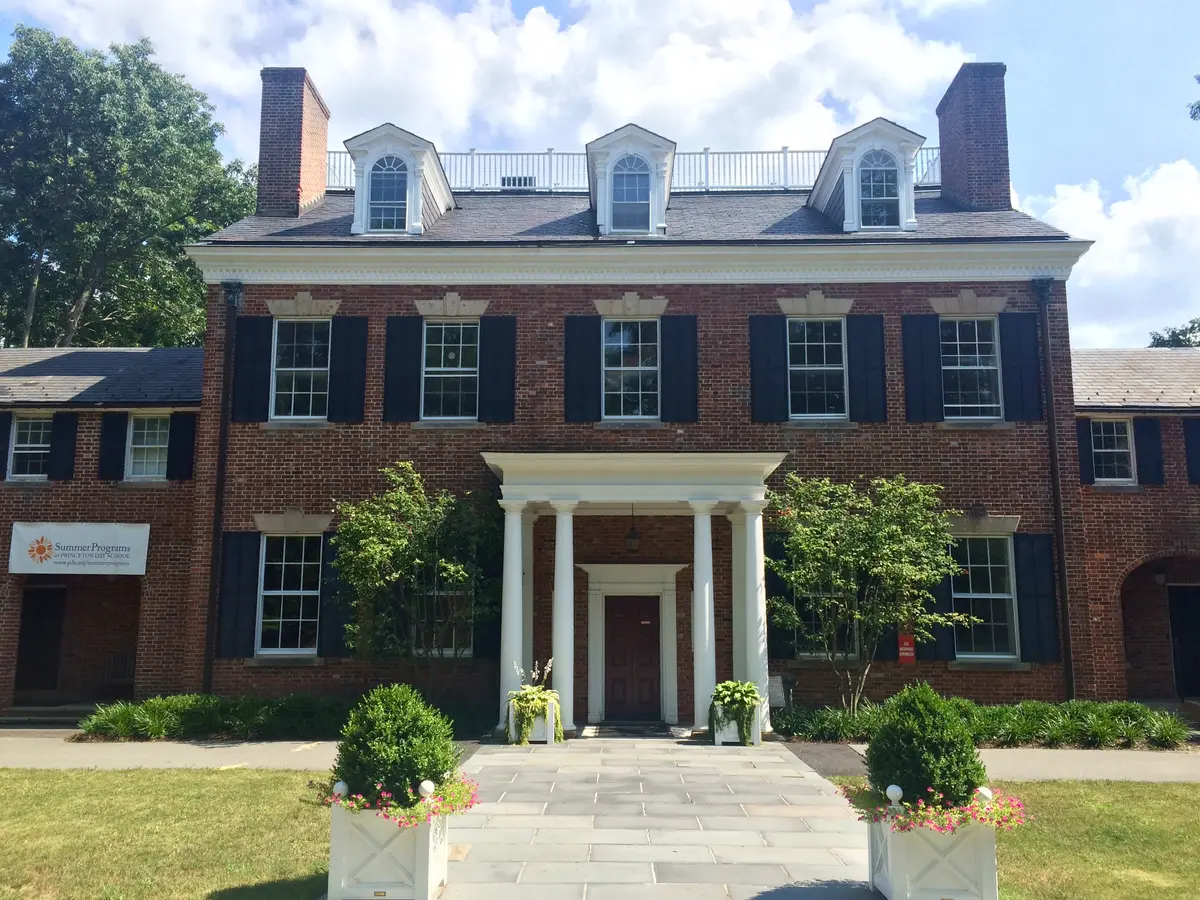
John Munn bought the ruin, had it dismantled brick by brick and rebuilt it in Princeton, New Jersey, where it has been a school building since the 1950s. The stories stayed in Virginia. Marguerite du Pont Lee printed them in 1930, in the very years the house was being taken apart: two Union deserters shot with their backs against the estate wall, remembered by an Alexandria man who had watched as a boy; a bounty jumper called Downey shot at the same wall; two Mason children dead in the garden vault whose lock, the family said, would never stay shut more than three days. The wall is gone. The vault was excavated in 2005 and held no remains. And the house is three hundred and fifty kilometres away.
What is the history of Colross?
Colross is the only house in this file that changed states. Everything its ghost stories describe happened in Alexandria, Virginia; the building those stories are attached to has stood in Princeton, New Jersey, since about 1929, some 350 kilometres to the north.
The estate began as a speculation that failed. John Potts, an Alexandria merchant, started a brick house on the block bounded by Oronoco, North Fayette, Pendleton and North Henry streets in 1800, ran out of money, and advertised the unfinished shell for sale in 1801. The eventual buyer was another merchant and Freemason, Jonathan Swift, who called the place variously "Belle Air" and "Grasshopper Hall". A sketch attached to a Declaration of Assurance of 1803 records exactly what stood there: a two-storey brick dwelling with its kitchen in the stone basement, a smoke house, and a stable of one and a half storeys.
Swift died at Colross in 1824 and was probably buried in a vault on the grounds. The archaeologists who dug the site in 2005 were careful to write "probably", because they had not been able to confirm it. The Alexander family, who owned the estate briefly afterwards, gave the house the Scottish name it has carried ever since.
Then came the Masons. Thomson Francis Mason was born at Gunston Hall in 1785, son of General Thomson Mason and grandson of George Mason, author of the Virginia Declaration of Rights. The 1972 National Register nomination for his country villa at Huntley calls Colross "his chief homestead". He was a judge of the Criminal Court of the District of Columbia and mayor of Alexandria from 1827 to 1830, he enlarged the house, and he enclosed the whole block with the high brick wall that the ghost stories would later need. In 1851 a young Orlando B. Willcox, later a Union general, visited and noted a "fine house and ground".
Mason died in 1838 and was interred in a vault in the garden together with two of his children. Later owners had the remains taken out and reburied elsewhere.
What followed is the ordinary, unromantic death of an urban estate. During the Civil War the property was seized by Federal authorities. William Smoot, a lumber merchant who became mayor, lived there with his family from 1885 to 1917; then another lumber man, William Hoge, bought it, and the northern half of the block filled with the warehouses of the Alexandria Hay and Grain Company. When Virginia's heritage authorities described the block a century later, they recorded that Colross had become "a storage facility within a lumber yard". In 1916 The Brickbuilder still thought it worth photographing and measuring for its collection of Early American Architectural Details — Plate Twenty-Seven, "The Colross Mansion, Oronoco Street, Alexandria, Va." — and even that caption got the history wrong, crediting the house to Jonathan Swift in 1799.
The end came from the weather. In 1927 a tornado tore through the block, wrecking both the mansion and the warehouses and leaving the house uninhabitable. That single fact is the hinge of the whole story, and it is what our previous version of this file never mentioned. John Munn bought the ruin, had it taken apart brick by brick and rebuilt it in Princeton. The Virginia Department of Historic Resources and the school itself date the move to 1929; the archaeologists' 2005 account says Munn bought the house in 1932. The dismantling and the rebuilding straddle those years, and no source I could reach settles the purchase date.
Munn died in 1956. After a brief ownership by Dr Geoffrey W. Rake the house passed to the school that still uses it. In Alexandria the cellars stayed sealed under a concrete slab beneath a fifty-truck garage, a car wash, an electricity substation and a printing works, until 2005, when the city's archaeological protection code forced a full excavation before the block was turned into flats.
Timeline: the documented record of Colross
- 1799-1800 The Alexandria merchant John Potts begins a brick house on the block bounded by Oronoco, North Fayette, Pendleton and North Henry streets. He runs into financial trouble and offers the unfinished house for sale in 1801.
- 1803 Jonathan Swift, merchant and Freemason, is the eventual buyer. A sketch attached to a Declaration of Assurance of this year records a two-storey brick dwelling with a basement kitchen, a smoke house and a stable. Swift calls the estate "Belle Air" and "Grasshopper Hall".
- 1824 Swift dies at the house and, according to the 2005 archaeological account, was "probably" buried in a vault on the property — the team could not confirm it. The Alexander family, brief owners after him, rename the estate Colross.
- 1827-1830 Thomson Francis Mason — born at Gunston Hall in 1785, grandson of George Mason and judge of the Criminal Court of the District of Columbia — serves as mayor of Alexandria. The 1972 Huntley nomination calls Colross his chief homestead. He enlarges the house and encloses the block with a high brick wall.
- 1838 Mason dies and is interred in a vault in the Colross garden along with two of his children; later owners have the remains removed and reburied elsewhere. The archaeologists' 2005 summary gives his death as 1837, the Washington Post as 1838.
- c. 1851 Orlando B. Willcox, later a Union general, visits Colross and records in his journal a "fine house and ground", the chief residence of the Masons of Alexandria.
- 1861-1865 Colross is seized by Federal authorities during the Civil War. The alleged executions of Union deserters against the estate wall belong to this period; the archaeologists who later dug the site describe them only as something "tradition has it".
- 1885-1917 William Smoot, lumber merchant and later mayor, lives at Colross with his family. The family recollection printed by Lee says the vault in the garden was "locked with a large iron lock, and would never stay locked more than three days".
- 1916 The Brickbuilder publishes Colross as Plate Twenty-Seven of its Collection of Early American Architectural Details, with a photograph, a porch detail and measured drawings. The caption already misattributes the house, crediting it to Jonathan Swift in 1799.
- 1917 The lumber merchant William Hoge acquires the estate and the northern half of the block fills with the warehouses of the Alexandria Hay and Grain Company. Virginia's heritage documentation later records that the mansion became "a storage facility within a lumber yard".
- 1927 A tornado wrecks the mansion and the adjoining warehouses, leaving the house uninhabitable. This is the event that causes the move, and the one our earlier version of this entry left out.
- c. 1929-1932 John Munn buys the ruin, has it dismantled brick by brick and rebuilt in Princeton, New Jersey. The Virginia Department of Historic Resources and the school both date the move to 1929; the archaeologists' 2005 account puts Munn's purchase in 1932.
- 1930 Marguerite du Pont Lee publishes Virginia Ghosts in Richmond. Her Colross chapter is the first and, so far, the only printed source for the deserters at the wall, the bounty jumper Downey and the Mason children in the vault — printed in the very years the house was leaving Virginia.
- 1956-1958 Munn dies and the rebuilt house, after a brief ownership by Dr Geoffrey W. Rake, becomes the central building of Princeton Day School, which still uses it for its admission and advancement offices.
- March-June 2005 Alexandria's archaeological protection code forces a full excavation of the block before construction. The team finds the basement floor, brick walks, outbuilding foundations, a domed filtration cistern and the foundation of a rectangular burial vault — with no human remains at all.
- 8 September 2005 The Washington Post reports the end of the dig and of the site: what was left of Colross would be "dug up and disposed of to make way for the condo complex".
Is there a rational explanation for Colross?
The ghost stories have a single traceable source, and it can be named.
Every version now in circulation — the two Union deserters shot against the wall, the bounty jumper, the Mason children in the vault, the lock that would not stay locked — descends from one chapter of Virginia Ghosts, by Marguerite du Pont Lee, published in Richmond in 1930. That is a measurement, not an impression. In the full-text corpus of the Internet Archive, 155 books contain the word "Colross"; the phrases "Colross wall" and "backs against the Colross" appear in exactly one of them, Lee's. As controls in the same corpus and on the same day, "Julian Taylor" returns 422 books and "executed for desertion" returns 1,082. The story is not rare because the archive is thin. It is rare because there is one witness to it.
What Lee actually wrote is narrower than what this file used to say. She quotes an unnamed correspondent for the claim that it was "against this wall that the famous 'bounty jumper' Downey was shot after his capture in Alexandria, by his own troops", and then adds, separately, that "the late Julian Taylor, of Alexandria, long connected with the diplomatic bureau", said that as a boy during the Civil War "he saw two deserters shot standing with their backs against the Colross wall". Taylor is therefore not the recorder of anything. He is a childhood witness, already dead when Lee printed him, at a distance of some sixty-five years from the event, and no document written by him has ever been produced.
The retellings then drift, and the drift is documented. Lee writes that of the two Mason children who died, "one was drowned while in the bathtub, one was killed while playing in the yard by a heavy coop falling upon her". Eighty years later, L. B. Taylor's popular version supplies names, a storm and a swap of sexes: a boy called William shelters in the chicken coop and is crushed, and his sister Ann drowns afterwards. The same chain carries a plain genealogical error as well. Lee calls Thomson Francis Mason "the son of George Mason of Gunston Hall"; Taylor repeats "son of the colonial patriot George Mason". He was the grandson, as the 1972 Huntley nomination states plainly.
The professionals are more careful than the popular books. The archaeological team's own account of the 2005 excavation, published in The Metro Herald, says only that "tradition has it that several Union deserters were executed against a brick wall on the estate". That same excavation found the foundation of a rectangular burial vault in the north-west corner of the block, and no human remains at all: every interment had been removed during the twentieth century.
One check remains open, and it should be stated rather than glossed. The federal court-martial files and the Alexandria wartime press have not been searched for this entry, so the executions are neither confirmed nor refuted by military record. What can be said is that outside Lee's 1930 book they are unattested.
Two physical facts close the file. The wall the deserters were supposedly shot against went with the rest of the estate, and the vault survives only as a hole in an archaeological plan. And the house those ghosts are said to inhabit has been in New Jersey since about 1929. In the century since it was reassembled in Princeton, nobody has published an account of anything happening inside it.
Can you visit Colross?
Colross is a working school building and has to be treated as one.
The house stands at Princeton Day School, 650 Great Road, Princeton, New Jersey 08540, an independent co-educational school running from pre-kindergarten to grade twelve. Coming in at the main entrance, Colross is the first building on the left: red brick, with visitor parking in front of it. That is how the school's own directions describe it. Inside are the admission and advancement offices. It is not a museum, there are no tours of the house and there is no ghost tour, and during term time the campus is full of children. The school requires every visitor to check in at reception and wear a visitor's badge. Turning up to look at a school building without doing that is not acceptable, and this entry is not an invitation to try.
There are legitimate ways in. Families considering the school can book a personal tour with a member of the admission team or a student guide, or register for one of the Open Campus Day events held separately for the Lower, Middle and Upper Schools; registration is required for all of them, and there is a virtual tour for everyone else. The Anne Reid '72 Art Gallery on the same campus invites the whole community to its exhibitions, openings and gallery talks, which is the one route in that does not depend on being a prospective parent. School events are held in Colross itself, and the lawn in front of it is where the youngest pupils dance the maypole each spring.
The Alexandria site is the opposite problem: entirely public, and there is nothing left. The estate filled the whole 1100 block of Oronoco Street, bounded by North Fayette, Oronoco, North Henry and Pendleton streets, roughly 38.810 N, 77.051 W. The house left around 1929, the perimeter wall went with the rest of the estate, and the excavated foundations, vault included, were removed in 2005 to make way for a condominium development — The Washington Post reported at the time that the remains would be "dug up and disposed of" for the flats. The block is ordinary streetscape today, inside the area later documented as the Uptown/Parker-Gray historic district. There is no marker, and nothing to visit.
Sources consulted
- Marguerite du Pont Lee, «Virginia Ghosts» — The William Byrd Press, Richmond (reprinted Virginia Book Co., 1966), 1930 book
- R. Christopher Goodwin & Associates / Alexandria Archaeology, «Archaeologists at Colross Site Unearth Alexandria History» — The Metro Herald, Alexandria, 2005 newspaper archive
- Leef Smith, «Search for History Clears Way for Future» — The Washington Post, 2005 newspaper archive
- Terry A. Necciai, R.A., «Preliminary Information Form: Uptown/Parker-Gray Alexandria Historic District» — Virginia Department of Historic Resources / City of Alexandria, 2008 report
- Virginia Historic Landmarks Commission, «National Register of Historic Places Inventory - Nomination Form: Huntley» — Virginia Department of Historic Resources, 1972 report
- Rogers and Manson Company, «The Brickbuilder Collection of Early American Architectural Details, Plate 27: The Colross Mansion, Oronoco Street, Alexandria, Va.» — The Brickbuilder, vol. 25, 1916 book
- Orlando B. Willcox, ed. Robert Garth Scott, «Forgotten Valor: The Memoirs, Journals and Civil War Letters of Orlando B. Willcox» — Kent State University Press, 1999 book
- Princeton Day School, «Only at Princeton Day School: PDS A to Z (entry for Colross)» — Institutional website, archived, 2015 archive
- Princeton Day School, «How to Find Us / Admission visits and Open Campus Days» — pds.org, 2026 web
- L. B. Taylor Jr., «The Big Book of Virginia Ghost Stories» — Stackpole Books, Mechanicsburg, 2010 book
Reviewed by V. Serrano on 2026-08-11 · How we verify our content
💬 Field testimonies (0)
No testimonies yet. Add the first.
Add your testimony
🔒 Log in to add a testimony