👻 HAUNTED PLACE · EXP. Nº1189
ACTIVE
Donaldina Cameron House
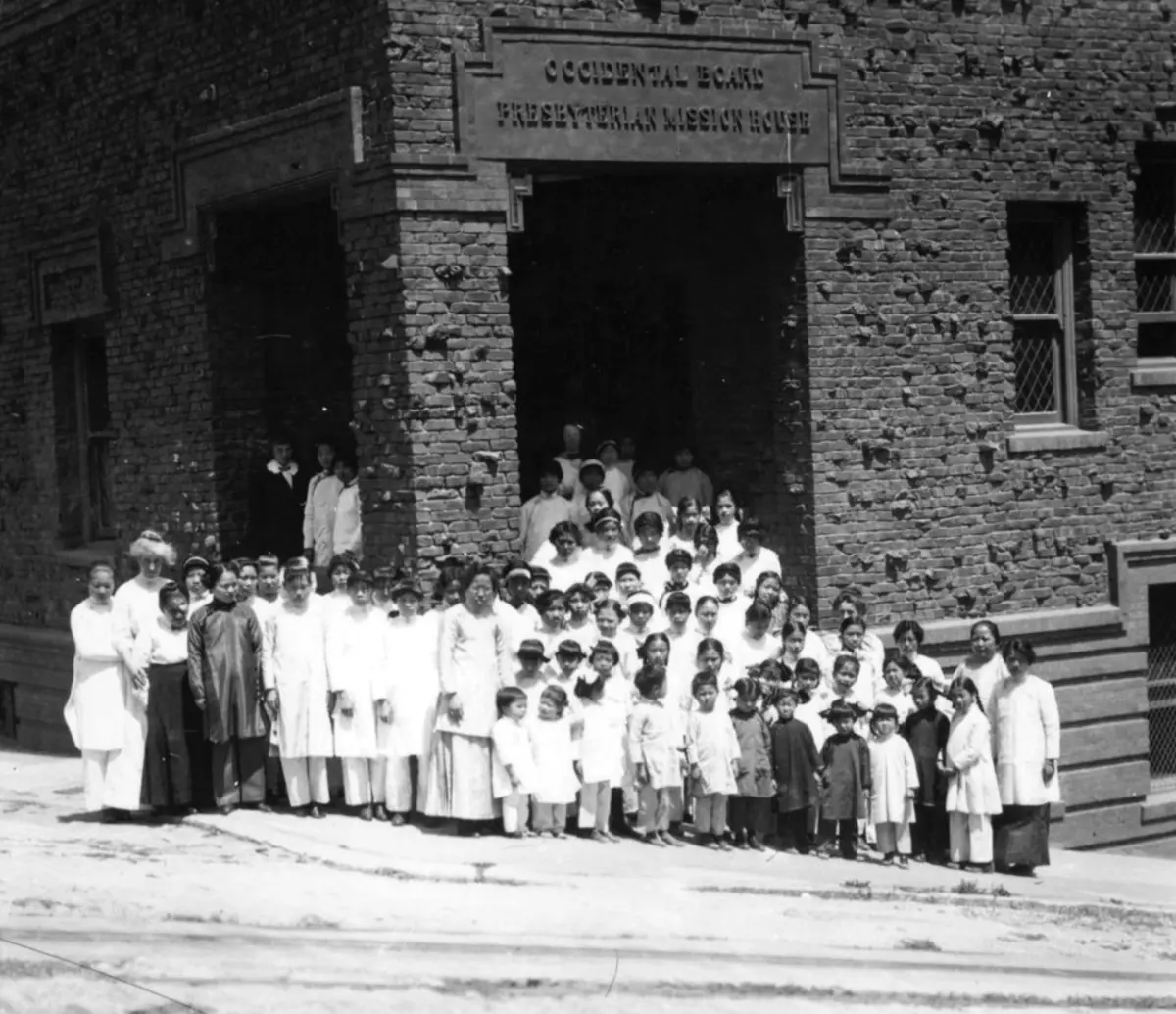
The Donaldina Cameron House at 920 Sacramento Street in San Francisco's Chinatown is the 1908 Julia Morgan building of the Occidental Board Presbyterian Mission House, founded in 1874 as a refuge for Chinese girls and women escaping trafficking, where Donaldina Cameron, working with her Chinese aide Tien Fuh Wu, is credited by Cameron House with rescuing up to 3,000 of them.
Where is Donaldina Cameron House?
- Location
- San Francisco, California, United States
- Type
- House / mansion
- Coordinates
- 37.793, -122.408
- Last updated
LOCATION
Why is Donaldina Cameron House said to be haunted?
The earlier building on the site was dynamited by firemen during the 1906 fire, and the house was rebuilt with bricks salvaged from it. From 1947 to 1977 it was a youth centre run by the Reverend F. S. "Dick" Wichman, who abused boys in its programmes for decades; a Healing Task Force reported on the abuse in 2003, and the institution formally acknowledged it and apologised in 2004. It is San Francisco Landmark No. 44, and today the nonprofit Cameron House serves Asian immigrant and low-income families; Joice Street beside it has been commemoratively renamed Tien Fuh Wu Way. Julia Flynn Siler wrote in 2021 that some still consider it a haunted house, in an article about the abuse the institution had long left unaddressed.
What is the history of Donaldina Cameron House?
The Donaldina Cameron House at 920 Sacramento Street in San Francisco's Chinatown is the building of the Occidental Board Presbyterian Mission House, a refuge for Chinese girls and women escaping trafficking, forced prostitution and indentured servitude. Cameron House's own timeline dates the founding to 1874, in a small apartment, and the move to a newly built house at 920 Sacramento Street to 1894; the NoeHill landmark page gives 1873 and the same address.
Donaldina Cameron arrived from New Zealand in April 1895, aged 25, to teach sewing under the superintendent, Margaret Culbertson. FoundSF's 2021 profile by Annie Cameron Reller says that Culbertson died two years later and left Cameron in charge; Cameron House's timeline dates her appointment as superintendent to 1899 and credits her with rescuing "up to 3000 young women during 34 years of service". NoeHill describes nighttime raids "assisted by policemen with axes and sledgehammers" and the "physical and legal protection" she gave the girls against the tongs, who called her Fahn Quai, white devil, while the girls called her Lo Mo, old mother. Much of that work was done with Tien Fuh Wu, rescued from a gambling den in 1894 as a child, who became Cameron's interpreter and fellow rescuer and retired in 1951, according to KQED's 2020 profile.
As Chinatown burned after the 1906 earthquake, firemen dynamited the mission house in an unsuccessful attempt to make a firebreak. It was rebuilt on the same site in 1908 to a design by Julia Morgan, using bricks salvaged from the old building. The house was renamed Donaldina Cameron House in 1942, and the original Presbyterian Mission House lettering still stands over the main entrance. Cameron House dates her retirement to 1934; Julia Flynn Siler, writing in Alta Journal in 2021, puts it in the late 1930s and says the church then turned the building into a language school.
From 1947 to 1977 the house's executive director was the Reverend F. S. "Dick" Wichman, who turned it into a youth centre and, Siler reports, abused boys in its programmes over decades: "By one count, there are 40 known victims of Wichman." In 1987 a former staff member, Elaine Chan-Scherer, took what she had heard to the pastor of the Presbyterian Church in Chinatown; nine men testified under oath to a church disciplinary committee, and Wichman left the Presbyterian Church in November 1988 before a church trial could begin. A Healing Task Force delivered a 53-page report to the board in November 2003, and in 2004 Cameron House and the Presbyterian Church formally acknowledged the abuse and apologised. Wichman died on 19 June 2007 without apologising.
The building is San Francisco Landmark No. 44. Today the nonprofit Cameron House offers counselling, domestic-violence intervention, food distribution and youth programmes to low-income and immigrant Asian families. The block of Joice Street beside it has been commemoratively renamed Tien Fuh Wu Way.
Timeline: the documented record of Donaldina Cameron House
- 1874 Presbyterian Women's Occidental Board of Foreign Missions founds the Occidental Mission Home in a small apartment as a refuge for Chinese girls and women escaping trafficking and forced prostitution.
- 1895 Donaldina Cameron, aged 25, arrives from New Zealand to teach sewing at the Mission House under superintendent Margaret Culbertson.
- 1897 Margaret Culbertson dies and leaves Cameron in charge of the Mission House, according to FoundSF; Cameron House's own timeline dates her appointment as superintendent to 1899.
- March 1900 The "Palo Alto Kidnapping": Cameron prevents the forced removal of a rescued girl, Kum Quai, by brothel associates posing as police; the resulting public uproar leads to criminal indictments and increases support for the Mission House.
- April 1906 The 1906 earthquake and fire destroy the original Mission House when firefighters dynamite it to create a firebreak. Cameron re-enters the burning city to retrieve the guardianship logbook protecting her wards.
- 1908 The current building at 920 Sacramento Street, designed by Julia Morgan using salvaged clinker bricks, is completed and occupied. Girls and mui tsai hide in the basement from captors.
- 1934 Cameron retires, in 1934 according to NoeHill. Cameron House's timeline, which dates her superintendency 1899-1934, credits her with rescuing "up to 3000 young women during 34 years of service".
- 1942 The Mission House is renamed Donaldina Cameron House in her honor. Cameron moves to Palo Alto.
- 1947 Rev. F.S. "Dick" Wichman becomes executive director, reorienting Cameron House to youth programs. His tenure (1947–1977) later emerges as a period of systematic sexual abuse of boys.
- 10 October 1971 Designated San Francisco Landmark #44.
- December 1987 Elaine Chan-Scherer, former staffer, blows the whistle on Wichman's abuse; San Francisco Presbytery investigates; nine men testify under oath. Wichman demits from the Presbyterian Church in November 1988 before trial.
- 2004 The Cameron House Healing Task Force delivers a 53-page report to the board in November 2003, with first-person accounts by 12 of Wichman's primary and secondary victims; 18 victims had come forward by then. In 2004 Cameron House and the Presbyterian Church formally acknowledge the abuse and apologise.
- 26 March 2007 Therapist Satsuki Ina and Presbytery executive Craig Palmer confront Wichman at his Oregon retirement home; he denies wrongdoing, reframes the abuse: "I wanted these boys to experience freedom." Wichman dies June 19, 2007, never apologizing.
- March 2026 Joice Street between Sacramento and Clay is commemoratively renamed "Tien Fuh Wu Way" honoring Cameron's Chinese aide, translator, and co-rescuer Tien Fuh Wu (1886–1975), herself a rescued mui tsai.
Is there a rational explanation for Donaldina Cameron House?
The description of Cameron House as a haunted house appears in Julia Flynn Siler's 2021 article in Alta Journal, in this sentence: "There is no doubt that Cameron House, rebuilt after the 1906 earthquake with salvaged clinker bricks, has long had a deeply unsettled atmosphere, stretching back to the 19th century, when desperate girls would hide in its basement to elude their captors. To this day, some consider it a haunted house." Siler names no one who has seen or heard anything, and gives no date or description of a phenomenon.
The words that follow in the article place the remark. Greg Chan, then chair of the board, is quoted as saying that "we had not cleaned up the shrouded energy", and the paragraph goes straight on to the proposal by Chan and the executive director, Doreen Der-McLeod, to set up a Healing Task Force to confront the decades of abuse under Wichman. In the article, the unsettled atmosphere is what the institution had left unaddressed about its own past.
Cameron House's own "Our Story" timeline and its Tien Fuh Wu Way page, the NoeHill landmark page, KQED's 2020 profile of Tien Fuh Wu and FoundSF's 2021 profile of Cameron tell the history of the house without any mention of ghosts or a haunting.
What happened in the building is documented in detail. Girls hid in its basement from the men who claimed them; the house was dynamited in 1906; and the basement is also where one of Wichman's victims, Buddy Tate Choy, recalled being taken to a room called the Log Cabin, "whose wooden walls were hung with deer antlers". Siler's article puts the number of known victims at 40, by one count, and says some estimate hundreds.
Can you visit Donaldina Cameron House?
Cameron House is an active nonprofit at 920 Sacramento Street (at Joice Street), San Francisco, CA 94108, in the heart of Chinatown. It is not a museum and does not offer regular public tours. The building houses offices, program spaces, and a chapel; visits are by appointment for services, events, or scheduled group visits. Contact: (415) 781-0401 ext. 101 or [email protected]. The exterior and the original "Presbyterian Mission House" brick sign over the main entrance are visible from the sidewalk. The commemorative "Tien Fuh Wu Way" street sign on Joice Street (between Sacramento and Clay) was installed in 2026. Public transit: Muni lines 1-California, 30-Stockton, and 45-Union/Stockton stop within two blocks; the Powell Street BART/Muni station is a 10-minute walk. Street parking is extremely limited; the nearest garage is Portsmouth Square Garage (733 Kearny St). The building has ADA-accessible entry via the Joice Street side. Photography of the exterior is permitted; interior access requires staff permission. The organization's annual gala (typically March) and Tien Fuh Wu Day of Service (May 30) are public events. For current programs, counseling, or youth services, see cameronhouse.org.
Sources consulted
- Julia Flynn Siler, «The Safe Place That Became Unsafe» — Alta Journal, 2021 newspaper archive
- Julia Flynn Siler, «The White Devil's Daughters: The Women Who Fought Slavery in San Francisco's Chinatown» — Alfred A. Knopf, 2019 book
- Annie Cameron Reller, «Donaldina Cameron: The Person Behind the Legend» — FoundSF, 2021 archive
- NoeHill in San Francisco, «San Francisco Landmark #44: Donaldina Cameron House» — noehill.com, 2004 archive
- Cameron House, «Cameron House: Our Story / Historical Timeline» — Official website, 2026 archive
- Cameron House, «Tien Fuh Wu Way» — Official website, 2026 archive
- Rae Alexandra, «The Child Slave Who Helped Rescue Thousands of Women in Chinatown» — KQED, 2020 newspaper archive
- Stellman, Louis J. (Louis John), 1877–1961, «Donaldina Cameron House (Wikimedia Commons photo)» — California State Library / Wikimedia Commons, 1908 archive
- San Francisco Planning Department, «San Francisco Preservation Bulletin No. 9: San Francisco Landmarks — list of Article 10 landmarks with designation dates (no. 44, Donaldina Cameron House, 920 Sacramento, 10/10/71)» — sf-planning.org, archived by the Internet Archive on 25 March 2014, 2003 report
Reviewed by V. Serrano on 2026-08-21 · How we verify our content
💬 Field testimonies (0)
No testimonies yet. Add the first.
Add your testimony
🔒 Log in to add a testimony