👻 HAUNTED PLACE · EXP. Nº9478
ACTIVE
Epperson House
Kansas City's Epperson House was never a wedding gift, and the woman whose ghost is said to haunt it was not a bride.
Where is Epperson House?
- Location
- Missouri, United States
- Type
- House / mansion
- Coordinates
- 39.031, -94.581
- Last updated
LOCATION
Why is Epperson House said to be haunted?
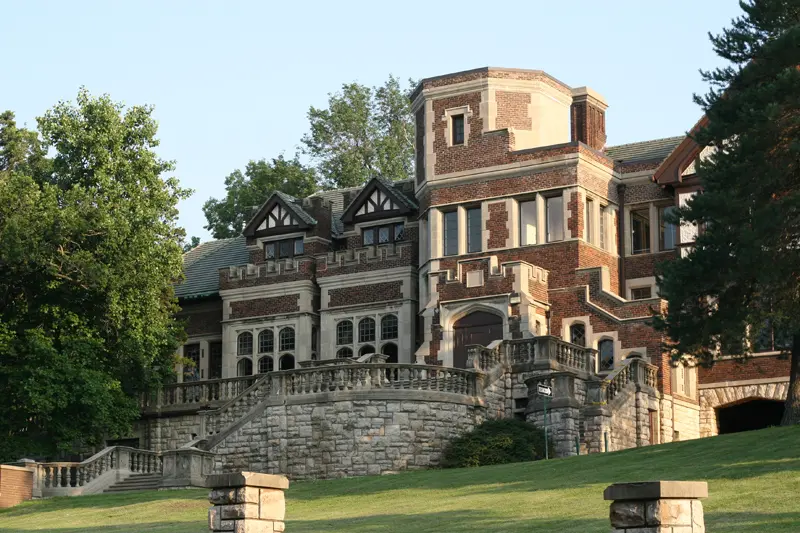
The insurance underwriter Uriah Spray Epperson and his wife Mary Elizabeth completed this fifty-four-room Tudor-Gothic mansion, then called Hawthorn Hall, in 1923, and built an organ loft into its Great Hall for Harriet Evelyn Barse, a professional organist and childless friend of the family in her late forties whom newspapers politely called their "adopted daughter". Barse chose the instrument's specification herself at the Reuter Organ Company in Lawrence, Kansas, then died of a perforated gallbladder on 20 December 1922, before it was finished. The Eppersons covered the console with a tapestry and left it silent until a memorial recital on 29 November 1925. Since the 1970s, students and campus security at the University of Missouri-Kansas City have reported organ music, footsteps and a woman in an evening gown inside the empty house. The difficulty is straightforward: the organ was sold and broken up in 1943, and the loft has stood empty ever since. The mansion has been closed since 2010, awaiting a restoration meant to turn it into a hotel.
What is the history of Epperson House?
Uriah Spray Epperson (1861-1927) made his money in fire insurance and meat packing, not timber. His father, William, founded one of the first meat-packing plants in the Kansas City region shortly after the Civil War, and Uriah — who preferred to be called "U. S." — turned that inheritance into a succession of businesses and finally into the U. S. Epperson Underwriting Company, which wrote fire risks for grain elevators and lumberyards. That last detail appears to be the whole basis of the widely repeated claim that he was a lumber baron.
In 1919 the Eppersons began building an English-style manor on what was then the south-eastern edge of Kansas City. They hired the French-born architect Horace LaPierre, and by 1923 they had a four-storey, fifty-four-room, roughly 24,000-square-foot Tudor-Gothic house that cost somewhere between $450,000 and $500,000: elevators, a swimming pool, a billiard room, a barbershop, a tunnel linking the east and west wings, and a Great Hall with a stage and an organ loft built into its western end. Mary Elizabeth Epperson (1855-1939) called the project "Epperson's Folly" while it went up. Finished, it was named Hawthorn Hall.
It was not a wedding gift, and there was no bride. The Eppersons were childless. Through their work with the Kansas City Art Institute and the city's musical life they had become close to Harriet Evelyn Barse (1871-1922), an organist who had studied at the Kansas City Conservatory of Music and had held posts in several leading Kansas City churches, including eight years at the First Church of Christ, Scientist. When Harriet's mother died in 1921 she moved into the Epperson household. Newspapers of the day called her their "adopted daughter". No adoption was ever made, and the arithmetic shows how figurative the label was: Harriet was ten years younger than Uriah and sixteen years younger than Mary Elizabeth, who was then in her sixties. It reads as a polite period formula for a friendship that had no other convenient name.
Harriet's playing is what put an organ in the house. She travelled repeatedly to the Reuter Organ Company in Lawrence, Kansas, selected the equipment, wrote the specification and later superintended the installation. Reuter's Opus 74 was a two-manual, twenty-rank instrument with electro-pneumatic action, contracted in May 1922 for $9,800 "cash" and shipped on 22 May 1923. The main organ spoke through a grille in the great living room, with an echo division and chimes on the third floor and an eighty-eight-note player mechanism.
She never heard a note of it. On 20 December 1922 Harriet Barse died of a perforated gallbladder at forty-seven, with the instrument still unfinished. The Eppersons shrouded the oak console and its ivory keyboards in an antique tapestry and left it silent for three years. On 29 November 1925 they finally gathered Harriet's friends and admirers in the Great Hall for a memorial dedication: Powell Weaver, her friend and mentor and later conductor of the Kansas City Philharmonic, played, assisted by the soprano Winifrede Repp Railey. The Kansas City Times reported the following morning that the two-manual "proved to be an instrument of fine quality" and that the programme "revealed a particularly sweet tone of the lighter passages".
Uriah died in the house on 3 June 1927, four years after moving in. He left Hawthorn Hall not to his widow but to his friend and business partner James Jesse Lynn, on condition that Mary Elizabeth could remain there for the rest of her life on a generous income. She did, and died in the same house on 22 October 1939 at eighty-four. Lynn first considered moving the underwriting company's offices in; the neighbours objected, so in 1942 he gave the mansion to the University of Kansas City, today UMKC. Short accounts — including Wikipedia's — usually say the widow donated it. She had been dead three years.
The war finished the organ. Converted into a dormitory for Navy flyer cadets, the house was altered heavily, and in 1943 the organist and organ dealer Walmer August Heinrich Brummer (1905-1995) bought Opus 74 and broke it up for a market starved of organ parts. Some of it is believed to have gone into the organ at Trinity United Methodist Church in Granite City, Illinois. The loft at the west end of the Great Hall has been empty ever since — more than eighty years.
The house served as a dormitory until 1956, then housed the School of Education and finally the Department of Architecture, Urban Planning and Design; in the 1980s the Conservatory of Music was based there. Staircases, split levels and the impossibility of cheap accessibility compliance gradually squeezed the building out of use. It has stood vacant since 2010.
One caution for anyone reading around the subject: there are two Epperson buildings and two Epperson organs. Mary Elizabeth paid for the U. S. Epperson Memorial Hall at the Kansas City Art Institute, dedicated in 1928, and for a second Reuter instrument there, Opus 335 of 1929. That hall caught fire on 24 April 1967 and that organ was lost. It had nothing to do with the house on Cherry Street, but accounts routinely merge the two.
Timeline: the documented record of Epperson House
- 1919 Uriah and Mary Elizabeth Epperson begin building an English-style manor on the south-eastern edge of Kansas City to designs by the French-born architect Horace LaPierre. Mary Elizabeth calls the project "Epperson's Folly".
- 1921 After her mother's death, the organist Harriet Evelyn Barse moves into the Epperson household. The childless couple, and the newspapers, describe her as their "adopted daughter"; no adoption is ever made.
- May 1922 The Reuter Organ Company of Lawrence, Kansas, contracts to build Opus 74 for the house at $9,800 "cash". Barse travelled to Lawrence herself to select the equipment and write the specification.
- 20 December 1922 Harriet Barse dies of a perforated gallbladder at the age of forty-seven, with the organ still unfinished. She never played it.
- 22 May 1923 Reuter ships Opus 74 to Kansas City. The house is completed the same year and named Hawthorn Hall; the console is shrouded in an antique tapestry and left silent during the Eppersons' mourning.
- 29 November 1925 The organ is dedicated to Harriet Barse's memory before her friends and fellow musicians. Powell Weaver plays, assisted by the soprano Winifrede Repp Railey. The Kansas City Times reports the next morning that the programme "revealed a particularly sweet tone of the lighter passages".
- 3 June 1927 Uriah Epperson dies in the house. He leaves it to his business partner James Jesse Lynn, with a life tenancy and income for his widow.
- 22 October 1939 Mary Elizabeth Epperson dies in the same house at eighty-four, twelve years after her husband. The legend that he murdered her and then killed himself is therefore impossible.
- 1942 J. J. Lynn gives the mansion to the University of Kansas City, today UMKC, after neighbours object to his plan to move company offices into it. It is converted into a dormitory for Navy flyer cadets.
- 1943 The organist and organ dealer Walmer August Heinrich Brummer buys Opus 74 and dismantles it amid wartime shortages of organ parts. Some of it is believed to have gone into the organ at Trinity United Methodist Church, Granite City, Illinois. The loft has been empty ever since.
- 1978 Weekend guards report footsteps in the empty building, and a campus police officer on a 2 a.m. patrol reports seeing an arm in a blue suit coat reach out and claw at a light switch. The account is first known from a student-newspaper feature published twenty-four years later.
- May 1979 A patrol officer parked near the house reports feeling his car struck from behind and hearing breaking glass, then finding no other vehicle, no damage and no glass — but his car eight inches from where it had been, with fresh skid marks. No police report has ever been produced.
- 25 October 2004 The University News reprints Emily Iorg's feature on the house, first published in October 2002. It is the earliest known source for the 1978 and 1979 incidents, and remains the only one.
- 2010 The last university departments move out and the mansion is left vacant. Break-ins and weather damage follow; the tower is boarded up and restoration is costed at $12-15 million.
- 15 January 2025 UMKC selects Sunflower Development Group, with the hospitality operator Jen Gulvik and the architects Generator Studio, to turn the house into a fourteen-room boutique hotel with a spa, restaurant and library bar. No opening date has been set.
Is there a rational explanation for Epperson House?
The strongest argument against the Epperson House organ ghost is that there has been no organ in the Epperson House since 1943. Reuter's Opus 74 was bought and dismantled by Walmer Brummer during the wartime shortage of organ parts and its pipework was dispersed. Every report of organ music from the building — students in the 1970s, campus security at night, the accounts still repeated today — describes an instrument that had left the house decades before the witnesses arrived. The commonest version of the story, as UMKC's bookstore manager and unofficial campus historian Chris Wolff told KCUR in 2021, is "the sound of organ music coming from the basement". The organ was never in the basement: it stood behind a grille at the west end of the Great Hall, with its echo division on the third floor.
The best-known incidents are thinner than their fame suggests. The 1978 footsteps, the arm in a blue suit coat that reached out and clawed at a light switch during a two-in-the-morning patrol, and the May 1979 patrol car that was struck by nothing and moved eight inches on its own skid marks all trace to a single feature written by Emily Iorg for UMKC's student paper, The University News, published in October 2002 and reprinted on 25 October 2004. No campus police report, incident log or named officer has ever been produced. The original articles survive only in the Internet Archive, and Wikipedia's editors have flagged the whole hauntings section as inadequately sourced. Twenty-three years separate the alleged events from their first known telling.
Wherever the record can be checked, the lore loses. The most repeated Epperson legend — that Uriah went mad after Harriet's death, murdered his wife and killed himself in the house — is flatly false: Mary Elizabeth outlived him by twelve years and died in the same house in 1939. The version this entry previously carried, in which Harriet was Uriah's daughter, the house was her wedding present and her fiancé died before the ceremony, has no support anywhere in the documented record. Harriet Barse was a professional organist in her late forties, a family friend whom newspapers politely called an "adopted daughter", and she died of a perforated gallbladder. Even the 2002 student feature that anchors the ghost stories got her wrong, describing her as ten years older than Mary Elizabeth when she was in fact sixteen years younger.
The claim that the house appeared on Unsolved Mysteries among the "top five haunted houses in America" is repeated by nearly every ghost-tourism page about it. We could find no episode, no season and no broadcast date to attach to it, and we have left it out.
Plainer explanations are available, and there is no way left to test them. This is a masonry mansion of fifty-four rooms with elevator shafts, a service tunnel between its wings and long-abandoned mechanical plant. Since 2010 it has stood empty, has been broken into and has taken weather damage — and its tower has been boarded up for decades, which does not stop people reporting a light in it. Nobody has been able to make any kind of controlled observation inside for more than fifteen years. Nor is the reputation commercially neutral: campus haunted walking tours stop outside it, and the 2025 redevelopment has been sold to the press on the mansion's haunted name. None of that makes the witnesses dishonest — most of the reports read as people describing something they genuinely could not account for inside a vast, dark, decaying building. It does mean the Epperson story rests on recollection rather than on evidence.
Can you visit Epperson House?
Epperson House stands at 5200 Cherry Street, at 52nd and Cherry on the southern edge of the Volker campus of the University of Missouri-Kansas City. The four-storey mansion of fifty-four rooms has been closed since 2011 and belongs to the university, which KCUR reported in December 2021 was spending about $60,000 a year simply to keep it standing.
There is no interior access of any kind, on any date or by appointment. Roo News described the building in October 2023 as having suffered “serious damage due to weather-related issues, break-ins and general deterioration”, noted that the tower at the top of the house was boarded up decades ago, and printed the position in a photograph caption: “The Epperson House is closed to visitors, but can be seen from the distance around campus.” Entering the building is trespass on property owned by the University of Missouri-Kansas City.
The exterior is visible from Cherry Street and from the open lawn that falls away below the stone terrace, which is the angle of almost every published photograph of the house, and the campus is publicly walkable in daylight. Chris Wolff, the university's bookstore manager and unofficial campus historian, has for years run haunted walking tours of the campus that stop outside the mansion; Roo News reported in 2023 that registration goes through the university's own groups system. The tours run occasionally rather than to a published calendar.
The Historic Kansas City Foundation carries the house on its Most Endangered list because of its disrepair. In January 2025 UMKC selected a team from Sunflower Development Group — Mark Moberly and Jason Swords — working with the hospitality operator Jen Gulvik and the Kansas City architects Generator Studio, to convert the mansion into a fourteen-room boutique hotel with a café, a restaurant, a library bar, event space and a hydrothermal spa. KCUR had costed the renovation at $12 to $15 million in December 2021. The developers said at the announcement that they intend to apply for state and federal historic tax credits; no construction start date has been published and no opening date either.
The KC Streetcar's Main Street extension, which opened on 24 October 2025 and runs to 51st Street and Brookside Boulevard, reaches the university from downtown. The Nelson-Atkins Museum of Art and the Kansas City Art Institute are both a short walk away, and the Art Institute holds U. S. Epperson Memorial Hall, the family's other Gothic building and the home of their other vanished Reuter organ.
Sources consulted
- Darren K. Hinesley, «The Mystery of the Disappearing Pipe Organs» — The Diapason, 2025 archive
- Unsigned society-page report, «In Memory of Harriet Barse: Mr. and Mrs. Epperson dedicated a Pipe Organ at Hawthorn Hall» — The Kansas City Times, 30 November 1925 (transcribed in full by Hinesley, The Diapason), 1925 newspaper archive
- Emily Iorg, «Epperson House shrouded in haunted history» — The University News (UMKC), first published October 2002, reprinted 25 October 2004, 2004 newspaper archive
- Aurora Wilson, «The Spooky History of the Castle on Campus» — Roo News (University of Missouri-Kansas City), 31 October 2023, 2023 newspaper archive
- Laura Spencer, «5 things to know about UMKC's Epperson House, a 20th century 'showpiece' in need of a makeover» — KCUR 89.3, 13 December 2021, 2021 newspaper archive
- Claire Bradshaw, «UMKC announces plans for historic Epperson House» — KSHB 41 News, 15 January 2025, 2025 newspaper archive
Reviewed by V. Serrano on 2026-08-11 · How we verify our content
💬 Field testimonies (0)
No testimonies yet. Add the first.
Add your testimony
🔒 Log in to add a testimony