👻 HAUNTED PLACE · EXP. Nº0482
ACTIVE
Fairfield County Infirmary
The Fairfield County Infirmary, on Granville Pike at the northern edge of Lancaster, Ohio, was the county's poorhouse from 1828 until May 1985, when its last sixteen residents left.
Where is Fairfield County Infirmary?
- Location
- Ohio, United States
- Type
- Hospital / asylum
- Coordinates
- 39.739, -82.591
- Last updated
LOCATION
Why is Fairfield County Infirmary said to be haunted?
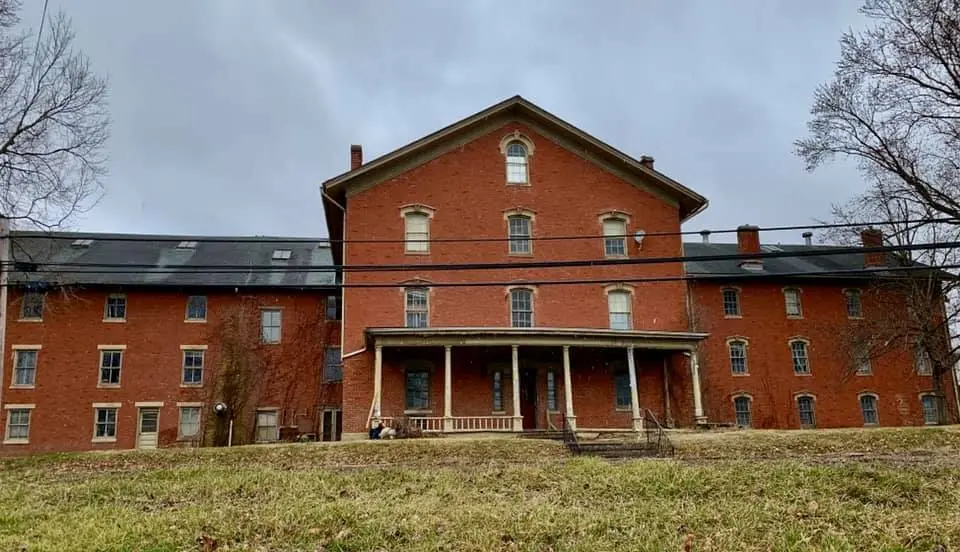
The building, begun in 1828 and rebuilt or enlarged in brick in 1840, gained an Italianate wing in 1865, and behind it lies a paupers' cemetery of an estimated 400 to 500 graves, most unmarked, with headstones as late as 1981. From 1986 to 2013 it housed county offices, the Health Department the longest. Since 2020 it has been privately owned by Adam Kimmell, who runs public and psychic ghost hunts there, and it is on the National Register of Historic Places. Its ghosts are recorded from 2014, when the Ohio Exploration Society gathered employees' stories of voices, a ghost called Willy and a vanishing girl. Some of the figures that circulate with them do not hold: the much-repeated last burial of 1929 comes from a page about a different Fairfield County, in South Carolina.
What is the history of Fairfield County Infirmary?
The Fairfield County Infirmary stands at 1587 Granville Pike, State Route 37, on the north side of Lancaster, Ohio, across the road from the Lancaster campus of Ohio University. Before it existed, township officers called overseers of the poor "let out the contract for the keeping of each pauper to the lowest bidder", as the county history of 1912 edited by Charles C. Miller explains. Around 1827 the county decided to build an infirmary on a farm of 170 acres, and "The first buildings were of frame, but in 1840 they were supplanted by a brick building." The Fairfield County Chapter of the Ohio Genealogical Society dates the purchase of the land to 1826 and the first building to 1828.
The architect Steve Luchtenberg, of VPL Architects, who surveyed the building for the county commissioners in February and March 2014, read its fabric differently. In his report the original three-storey structure of 1828, 32 by 46 feet, survives inside the present building; the work of 1840 was a three-storey addition of 50 by 46 feet on its south side, and both had brick façades. In 1865 an L-shaped addition went up on the north side with arched windows and Italianate lintels. It carried the "widow's walk" cupola on the roof and the front porch that still faces Route 37. The building was entered in the National Register of Historic Places on 26 March 2020, reference 100005128, as an Italianate building.
The infirmary was also run as a working farm on the land across the road. The Ohio Exploration Society, which researched the building for a 2016 article, found that the farm earned $4,300 from crops and livestock in 1917. Natural gas for lighting and heating arrived that year; piped water followed in 1926 and electricity only in 1958. The resident population peaked at 82 "inmates" in 1903. In February 1881 there were 70 male and 54 female residents, according to the genealogical society; 32 of them were children, and there was a common school on the site. In 1911 the county spent $9,775.54 on 69 paupers (Miller). The society also found the death of Jane Householder, aged 73, on 22 March 1929: her clothing caught fire at a gas stove, two attendants smothered the flames with rugs, and she died nine hours later.
Up the hill behind the building is the paupers' cemetery. A memorial stone dated 1886 reads "To the Memory of Our Dead". The Ohio Exploration Society estimates 400 to 500 burials, most unmarked; among the few headstones it photographed in 2008 are those of Wilhelm Reel (died 1894), Bennie Stephens (died 1980) and Henry Jones Jr. (died 1981).
The farmland across the road was sold to Ohio University in the mid-1960s. The infirmary closed in May 1985 with sixteen residents; they were sent to nursing homes or foster homes. In 1986 the county remodelled it as the Clarence E. Miller Building (named after the late congressman) and it held county offices, the Health Department the longest, until the department moved out in late 2013. In its 2014 report VPL put the cost of renovating it at $4,287,885. According to the Asylum Projects wiki, in a version archived in January 2023, the building was bought in February 2020 by Adam Kimmell, "who allows tours, photography sessions and private ghost hunts".
Timeline: the documented record of Fairfield County Infirmary
- 1828 The county's first infirmary building, of frame, is erected on land bought in 1826 north of Lancaster, according to the county genealogical society.
- 1840 The frame buildings are replaced by a brick building, according to the county history of 1912; the architect's assessment of 2014 reads the brick work of 1840 as an addition to the 1828 structure.
- 1865 An L-shaped Italianate addition with a widow's-walk cupola and the present front porch is built on the north side.
- 1886 A memorial stone inscribed 'To the Memory of Our Dead' is set up in the paupers' cemetery behind the infirmary.
- May 1985 The infirmary closes with sixteen residents, who are moved to nursing homes or foster homes.
- 1986 The county remodels the building for offices as the Clarence E. Miller Building; the Health Department occupies it until late 2013.
- 18 March 2014 VPL Architects reports to the county commissioners on the empty building and estimates its renovation at $4,287,885.
- 2020 Adam Kimmell buys the building in February (Asylum Projects), and on 26 March it is entered in the National Register of Historic Places, reference 100005128.
Is there a rational explanation for Fairfield County Infirmary?
The haunted reputation is recorded from 2014 onwards, and mostly by people who investigate or film the place and by those who sell the experience. The Ohio Exploration Society's 2016 article relays what employees and other witnesses said: voices at night when nobody else was in the building, a ghost called "Willy" on the second and third floors, a woman in 1800s clothing with her hair in a bun, a little girl who vanished from a doorway, and an attic that staff were afraid to enter, without naming any of them. The society's own visit of 6 April 2014 recorded lavender perfume, signs moving in the attic and temperature drops of "a few degrees", and its authors allowed that equipment switching itself off "could have been due to user error". They were also told of "several suicides at the poorhouse" and wrote that they had found no documentation to support the claims. Willy's name, they suggest, "likely comes from one of the only tombstones in the pauper's cemetery that has a name listed".
The larger claims come from the people who promote the site as haunted. The Far-Land Legacy (2024), which calls the building "one of the most haunted places in Ohio", reports that a survey for the Gorsuch company, which had tried to buy the property, found skulls "positioned in a grid row" because the dead were buried upright, and the belief that "over 1,200 persons" lie in the cemetery with 1,600 more further back. The article gives no date or report for that survey. The one survey with a date points the other way: in 2014 a ground-penetrating radar and magnetometry survey of the cemetery was inconclusive because drainage pipes and other objects interfered, according to the Ohio Exploration Society, which itself estimates 400 to 500 burials. The same Far-Land article quotes a former worker who said that between 2000 and 2004 a third-floor cell held 10 to 14 mentally ill patients whose screams lasted all day. In those years the building was county offices: the last residents left in May 1985, and from 1986 the Health Department occupied it until late 2013, according to VPL's 2014 report.
The date repeated most often, a last burial in 1929, is misattributed. The Wikipedia article on the infirmary states that the last burial in the cemetery was in 1929 and cites Roots & Recall; the page it cites is about the poor house of Fairfield County, South Carolina, whose 73 identified interments run "the earliest on record was 1880, the latest was 1929". In Lancaster the Ohio Exploration Society photographed headstones of 1980 and 1981, and VPL wrote in 2014 that "the most recent visible grave marker in Pauper's Cemetery is dated 1981".
The commercial side of the reputation is public and dated. Visit Fairfield County lists the building as a place "to test your courage on a 'public hunt' or flashlight tour" and says it was featured on the Travel Channel. Kimmell sells public and psychic hunts through Eventbrite. A documentary by Gateway Paranormal Films, Fairfield County Infirmary: The Forgotten, came out in 2020.
Can you visit Fairfield County Infirmary?
The building is at 1587 Granville Pike, Lancaster, Ohio 43130, on State Route 37 opposite the Ohio University Lancaster campus. It is private property, owned since February 2020 by Adam Kimmell, who opens it for night events. The Visit Fairfield County listing, updated on 13 March 2026, says "You can book day tours, public hunts, photography sessions, and self-guided tours by messaging the Fairfield County Infirmary Facebook page" and gives the telephone number (740) 994-1230. Kimmell's "Public Hunt" on Eventbrite, described as group rotations with staff followed by free roam, last sold tickets for 10 October 2025. A psychic hunt followed on 7 November 2025.
VPL's report of March 2014 describes the interior. It records radon throughout the first floor in 2010 and two water mains that burst in its corridors in 2012. After the building emptied, a sprinkler main leaked and flooded parts of the first and second floors, and the report judged the old chimneys "dangerously weak". The Ohio Exploration Society found water damage from frozen pipes in April 2014 and thought "the overall structure seemed sound".
The paupers' cemetery up the hill behind the building is a separate plot. The City of Lancaster took over its care going into 2015. A fence was planned around the burials, and the cemetery was to get its own entrance so that it could be separated from the building's plot (Ohio Exploration Society). The 1886 memorial stone stands at its south end.
Sources consulted
- Fairfield County Chapter, Ohio Genealogical Society, «Infirmary Records, Fairfield County, Ohio, 1848-1910 and Death Records from the Infirmary Records, 1911-1980 (publication page: land bought in 1826, first building 1828, brick building in 1840 per Graham's county history, 70 men and 54 women in February 1881, closure in May 1985 with 16 residents)» — fairfieldgenealogy.org, 1994 book
- Charles C. Miller (ed.), «History of Fairfield County, Ohio and Representative Citizens (the county infirmary and poor farm: overseers of the poor, the decision of 1827, a farm of 170 acres, frame buildings replaced by brick in 1840; 69 paupers in 1911)» — Richmond-Arnold Publishing Co., Chicago; Internet Archive, 1912 book
- Steve Luchtenberg, VPL Architects, for the Fairfield County Commissioners, «Assessment of the Clarence E. Miller Building, 1587 Granville Pike (building history: 1828 structure, 1840 and 1865 additions, the 1886 cemetery marker, 1986 renovation, Health Department until late 2013; renovation estimate of $4,287,885; most recent visible grave marker dated 1981)» — Fairfield County, Ohio (Internet Archive copy of 15 May 2025), 2014 report
- Ohio Exploration Society, «Fairfield County Poorhouse (visit of 6 April 2014: history from 1828, the 1865 expansion, farm, gas, water and electricity dates, 82 inmates in 1903, Jane Householder's death in 1929, closure in May 1985, the Health Department until 2013; employees' ghost stories and the society's own investigation)» — ohioexploration.com, 2016 web
- Ohio Exploration Society, «Fairfield County Infirmary Cemetery (visit of 2 March 2008: 400-500 estimated burials, mostly unmarked; the 1886 memorial; headstones of 1894, 1980 and 1981; inconclusive radar survey of 2014; the City of Lancaster's care from 2015)» — ohioexploration.com, 2016 web
- Joe McFarland, «Fairfield County Infirmary (the Gorsuch survey, burials 'over 1,200', the former worker's account of 2000-2004, Adam Kimmell's night tours)» — The Far-Land Legacy, 2024 web
- Visit Fairfield County, «Fairfield County Infirmary (listing: 1587 Granville Pike, Lancaster, OH 43130; day tours, public hunts, photography sessions and self-guided tours booked through the Facebook page; telephone)» — visitfairfieldcounty.org, 2026 web
- Asylum Projects contributors, «Fairfield County Infirmary (purchase of the building by Adam Kimmell in February 2020)» — Asylum Projects wiki (Internet Archive copy of 29 January 2023), 2023 web
- Roots & Recall, «Fairfield County Poor House (Fairfield County, South Carolina: 73 identified interments, 1880 to 1929; the page Wikipedia cites for the Ohio infirmary's 'last burial' of 1929)» — rootsandrecall.com, 2026 web
- Wikipedia contributors, «National Register of Historic Places listings in Fairfield County, Ohio (Fairfield County Infirmary, reference 100005128, listed 26 March 2020)» — Wikipedia, 2026 web
Reviewed by V. Serrano on 2026-10-04 · How we verify our content
📎 Source: Wikipedia (CC BY-SA)
💬 Field testimonies (0)
No testimonies yet. Add the first.
Add your testimony
🔒 Log in to add a testimony