👻 HAUNTED PLACE · EXP. Nº9478
ACTIVE
Ferry Plantation House
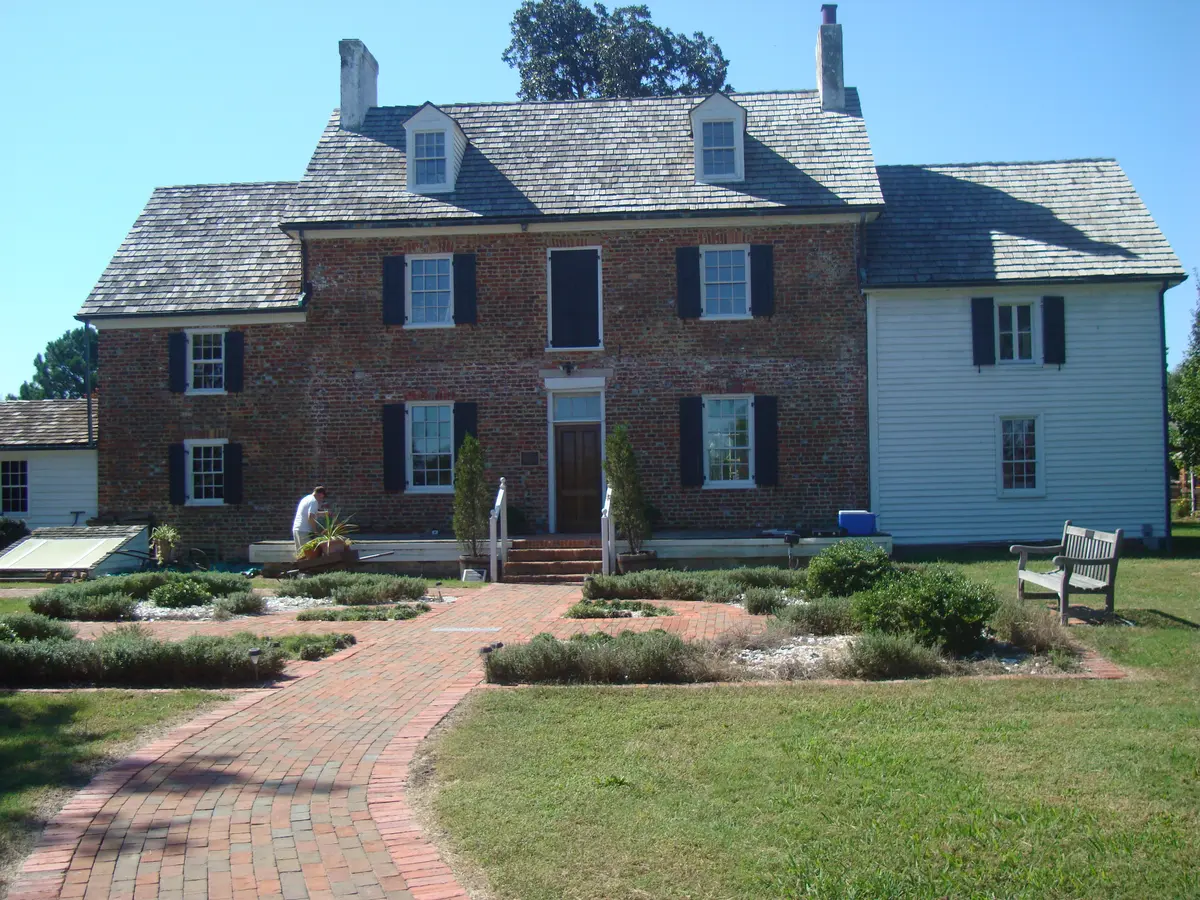
Ferry Plantation House is a Federal-style brick house on the Western Branch of the Lynnhaven River in Virginia Beach, owned by the city and run entirely by unpaid volunteers.
Where is Ferry Plantation House?
- Location
- Virginia, United States
- Type
- House / mansion
- Coordinates
- 36.864, -76.118
- Last updated
LOCATION
Why is Ferry Plantation House said to be haunted?
It is routinely sold as the place where Grace Sherwood, the "Witch of Pungo", was tried by water — and it is not. The Princess Anne County records place her ducking of 10 July 1706 on a branch of the Lynnhaven near John Harper's plantation, at what is now Witchduck Point, about 2.2 km (1.3 miles) north; the museum's own Grace Sherwood page says the same. The house itself was not built until around 1830, from bricks salvaged after the Walke manor burned two years earlier. The land is genuinely old — a ferry ran from it from 1642, and two acres were deeded to the county in 1730 for its third courthouse — but nothing standing here today saw 1706, and the National Register nomination never mentions Sherwood at all. What is real is modern: in 2006 the museum's director, Belinda Nash, won Sherwood's exoneration from Governor Timothy M. Kaine, and the letter was read aloud here on the 300th anniversary. The volunteers say eleven spirits stay on. That count is theirs.
What is the history of Ferry Plantation House?
The house is younger than its reputation, and the land is much older than the house.
Ferry Plantation takes its name from a river crossing. The National Register nomination filed for the property begins its history in 1642, when Savill Gaskin first operated a ferry from this bank of the Lynnhaven River — one of the earliest crossings in what is now Hampton Roads, worked from a landing still visible from the front of the building.
In 1730 Charles and Elizabeth Smyth deeded two acres of the property to Princess Anne County for its third courthouse, a brick building with stocks and a pillory. Archaeologists have never found it. The nomination records that attempts to locate the courthouse by excavation had failed, and that dendrochronology was being run on the southeast wing of the present house to test whether that wing might be the courthouse itself, absorbed into a later building. Rear Admiral Henry Walke, visiting the family home in 1826, remembered that the manor house of about 1751 had been built so close to the courthouse that the older structure ended up serving as its kitchen; the wing matches the courthouse in dimensions and massing. The nomination leaves the question to the tree-ring dating and reports no result.
Anthony Walke III took ownership in 1740 and raised a substantial brick manor around 1751. It was damaged by fire in 1756, rebuilt in 1780, and burned again around 1828 — the second fire finished it. The only image of that lost house is a watercolour painted from memory by General Thomas Hoones Williamson, born on the plantation in 1813 and dead in 1888; it still hangs inside.
George McIntosh and his wife — a sister of Anthony Walke V, named Anna in the National Register nomination and Elizabeth on the museum's own history page — sorted the good bricks out of the rubble and built the present house from them around 1830, for their son, Captain Charles Fleming McIntosh. That was 124 years after Grace Sherwood was thrown into the river. The McIntoshes held the property for more than sixty years and made most of its alterations early, including the northwest wing of about 1850. The museum's history states that Charles Fleming McIntosh later resigned from the United States Navy for the Confederacy; the ironclad he commanded from her commissioning on 20 April 1862, CSS Louisiana, lost only three men when Farragut's fleet forced the river below New Orleans on 24 April, and her captain was one of them.
The Barnetts bought the house in 1896 and lived in it until 1942, when it passed to C. W. Hudgins. Then it emptied. The building stood vacant from 1987 to 1996 while the plantation around it disappeared into suburbia: what survives is 0.2867 acres — the footprint of the house, a walkway and an easement — ringed by large homes built in the late 1980s. A dig in 1987 found a mid-to-late 18th-century tavern under Cheswick Lane, and in 1997 Chris Eckard of the Nansemond Chapter of the Archaeological Society of Virginia opened a five-foot pit beside the riverside porch that reached a brick floor 45 inches down.
The rescue was local and unglamorous. Investors who had bought the house in 1994 discovered a deed restriction blocking private residential use and handed the property to the City of Virginia Beach in June 1996. That October the city council unanimously approved a restoration plan from the newly incorporated Friends of Ferry Plantation House, whose president, Jo Howren, had held her own wedding reception on the site; the city earmarked $68,550 tied to the sale of two lots as seed money and added a $1,000 Virginia Beach Foundation grant to hire a historical architect. Sheriff Frank Drew volunteered his work force for the labour.
The house was listed on the Virginia Landmarks Register on 1 December 2004 and on the National Register of Historic Places on 20 January 2005, under Criterion C — architecture. It is on the register because it is the best-preserved brick Federal house left in Virginia Beach. Grace Sherwood is not mentioned anywhere in the nomination.
Timeline: the documented record of Ferry Plantation House
- 1642 Savill Gaskin begins operating a ferry from this bank of the Lynnhaven River. The National Register nomination dates the property's history from this crossing, which gives the plantation its name.
- 10 July 1706 Grace Sherwood is ducked on a branch of the Lynnhaven near John Harper's plantation — the site now called Witchduck Point, about 2.2 km north of this house. The Princess Anne County records held by the Library of Virginia note that the justices took "care for her life to preserve her from drowning". She floated, and was jailed to await a second trial that never appears in the records.
- 1730 Charles and Elizabeth Smyth deed two acres of the property to Princess Anne County for its third courthouse, a brick building with stocks and pillory. Excavations have never located it; dendrochronology on the southeast wing of the present house has been used to test whether that wing is the courthouse absorbed into a later structure.
- ca. 1751 Anthony Walke III, owner since 1740, builds a substantial brick manor. Rear Admiral Henry Walke, visiting in 1826, recalled that it stood so close to the courthouse that the older building was used as its kitchen.
- ca. 1828 The Walke manor burns down for the second and last time; it had already been damaged by fire in 1756 and rebuilt in 1780. The only surviving image is a watercolour painted from memory by General Thomas Hoones Williamson, born on the plantation in 1813.
- ca. 1830 George McIntosh and his wife, a sister of Anthony Walke V, build the present Federal house from the bricks salvaged from the fire, for their son Captain Charles Fleming McIntosh. It goes up 124 years after Grace Sherwood's ducking.
- 24 April 1862 The museum's history states that Charles Fleming McIntosh left the United States Navy for the Confederacy and commanded the ironclad CSS Louisiana. The ship's record shows she lost three men when Farragut's fleet forced the river below New Orleans, her captain among them.
- 1987 The house falls vacant, and stays empty for nine years. An archaeological dig the same year finds a mid-to-late 18th-century tavern under Cheswick Lane.
- June–October 1996 Investors who bought the derelict house in 1994 find a deed restriction blocking private residential use and hand it to the City of Virginia Beach. In October the city council unanimously backs a restoration plan from the Friends of Ferry Plantation House, with $68,550 of seed money and a $1,000 grant for a historical architect. Reporting the rescue, The Virginian-Pilot writes that Grace Sherwood "was said to have been imprisoned in a jail" on the site — the conflation is already in print.
- 20 January 2005 The house is listed on the National Register of Historic Places (ref. 04001545) under Criterion C, for architecture, after entering the Virginia Landmarks Register on 1 December 2004. The nomination does not mention Grace Sherwood.
- 10 July 2006 Three hundred years to the day after the ducking, Governor Timothy M. Kaine informally restores Grace Sherwood's good name. The letter, obtained by the museum's director Belinda Nash after more than twenty years petitioning three governors, is read out at Ferry Plantation House by Virginia Beach mayor Meyera E. Oberndorf. This — not 1706 — is the house's real link to the case.
- 2007 A bronze statue of Sherwood by Robert G. Cunningham, holding rosemary with a raccoon at her feet, is unveiled on the hospital lawn at 800 Independence Boulevard, about a mile from the ducking site.
- October 2023 WHRO publishes the names of the eleven spirits the volunteers say remain in the house — Charles, Isabel, Bessie, Eric, Julie, Nanny, George, Cora, Stella, Belinda and Henry. Guide Cody Green describes himself as "hypersensitive"; his colleague Kristen Ellis quotes him saying "we're not here to convince anybody".
- 2024 Scott O. Moore publishes the first full study of the case, The Witch of Pungo, with the University of Virginia Press. He says he expected the archive to be exhausted and found it was not, and that half the interest lies in how the legend grew — including the tale that Sherwood sailed to England in an eggshell to fetch rosemary.
Is there a rational explanation for Ferry Plantation House?
Start with the arithmetic, because it settles most of it.
Grace Sherwood was ducked on 10 July 1706, and the present house was built around 1830. Even the manor whose bricks were reused was not raised until about 1751. Nothing standing on this plot today existed when Sherwood was bound and thrown in — and the National Register nomination, the most thoroughly documented account of the site anyone has produced, does not mention her once.
Nor was the ordeal held here: the Princess Anne County records held by the Library of Virginia place it on a branch of the Lynnhaven near John Harper's plantation, with the justices noting that they took "care for her life to preserve her from drowning". That ground is now Witchduck Point, about 2.2 km (1.3 miles) north of the front door. The Friends of the Ferry Plantation House say the same thing themselves: their own Grace Sherwood page dates the ducking "At Witchduck Point, July 10th 1706 at 10am."
The conflation is old, local, and not the museum's invention. In July 1996, reporting the rescue of the derelict building, The Virginian-Pilot opened with "Stand outside historic Ferry Plantation House and listen and you may hear Grace Sherwood flounder in the waters of the Lynnhaven River as she is given a trial by ducking", and added that she "was said to have been imprisoned in a jail on the Ferry Plantation site"; in October the same paper repeated the jail. What the property can legitimately claim is a courthouse — but the one documented on this land is the county's third, deeded in 1730, a generation after Sherwood's case was heard, and archaeology has still not found it.
The eleven spirits come from the house itself: in October 2023 WHRO listed the names on the word of the volunteers who guide the tours: Charles, Isabel, Bessie, Eric, Julie, Nanny, George, Cora, Stella, Belinda and Henry. The museum's own paranormal page rests the identifications on electronic voice phenomena recorded by visiting investigators, on photographs and on a child's description: a voice on a recording becomes a man called Henry who stayed on the plantation after emancipation; a woman reflected in a Best Parlor window in a photograph becomes a pregnant Mrs McIntosh; a bearded man painting on the second-floor landing, whom a docent's toddler granddaughter used to mention, becomes General Williamson. EVP has no accepted evidential standing: recorders pick up radio bleed, structural noise and breath, and the listener supplies the words — the same auditory pareidolia that lets people hear speech in a running fan.
To the volunteers' credit, they do not oversell it. Cody Green, who guides tours and describes himself as "hypersensitive" — "I see, hear, feel and smell every day," he told WHRO, "I don't make a big deal of it because I've done it my whole life" — is quoted by a fellow guide, Kristen Ellis, saying the plain thing: "we're not here to convince anybody."
The house also has an incentive: it stands on 0.2867 acres; the museum's tours page states that all its guides are unpaid volunteers and that opening hours depend on having guides available, and its paranormal page offers the house for a night of investigation in return for a $300 donation for up to twelve people and, when read on 25 September 2026, announced every paranormal night booked through 2026. The accounts can be sincere, and that booking sheet still explains why a Federal farmhouse is better known for eleven spirits than for the ferry that gave it its name.
Can you visit Ferry Plantation House?
Ferry Plantation House is a museum owned by the City of Virginia Beach and run since 1996 by the Friends of the Ferry Plantation House, Inc., whose guides are, in the museum's own words, "100% unpaid volunteers", and that fact governs everything else.
The house stands at 4136 Cheswick Lane, Virginia Beach, Virginia 23455, and the telephone, (757) 473-5182, is answered during opening hours only.
Every tour is booked in advance: the museum's conditions, as posted on 22 September 2026, require booking "more than 12-hours in advance", allow reservations up to thirty days out through its online booking page and exclude refunds, while walk-in slots appear only on selected dates announced through its Facebook and Instagram accounts. That page publishes no fixed timetable and sends the visitor to the booking system for the current days and times, because "hours are based on having guides available". The City of Virginia Beach destination listing, read the same day, gives Tuesdays, Thursdays and Saturdays from 10 a.m. to 3 p.m. with the last tour starting at 2 p.m., and records an admission fee without stating the amount.
The paranormal programme is closed: the house has posted that all its paranormal nights are fully booked and that it is taking no further bookings or enquiries.
The building is a two-and-a-half-storey brick house of about 1830 with original wooden floors, a staircase steepened in the 1930s to fit a bathroom into the upper hall, and small top-floor rooms now used as offices and a gift shop; no route through it avoids steps. The grounds are the last quarter-acre of the plantation, reached by a winding walkway from the car park on a residential street of large modern houses; motor-coach parking is available.
Grace Sherwood's afternoon lies outside the house: the ducking site is Witchduck Point, roughly 1.3 miles (2.1 km) north on the Lynnhaven, and Witchduck Road takes its name from what happened in the water rather than from anything that happened in this building. Robert G. Cunningham's bronze of Sherwood, carrying a basket of rosemary with a raccoon at her feet for her herbal medicine and her animals, was unveiled in 2007 and stands on the hospital lawn at 800 Independence Boulevard. Old Donation Episcopal Church, which gives the property its other historic name of Old Donation Farm, is a short drive away.
Sources consulted
- Virginia Department of Historic Resources, «National Register of Historic Places Registration Form: Ferry Plantation House (DHR file 134-0011)» — United States National Park Service, 2004 report
- Mary Reid Barrow, «An historic revival: after years of neglect, the Ferry Plantation House» — The Virginian-Pilot, 1996 newspaper archive
- Mary Reid Barrow, «Plantation's friends get go-ahead for restoration» — The Virginian-Pilot, 1996 newspaper archive
- Library of Virginia, «Good Witch or a Bad Witch? The Grace Sherwood Trial and Pardon» — The UncommonWealth, 2023 archive
- Encyclopedia Virginia, «Grace Sherwood (ca. 1660-1740)» — Virginia Humanities, 2026 academic
- WHRO, «Haunted Hampton Roads: The ghosts of Virginia Beach's Ferry Plantation House» — WHRO Public Media, 2023 newspaper archive
- Friends of the Ferry Plantation House, Inc., «Paranormal» — Official museum site, 2026 archive
- Friends of the Ferry Plantation House, Inc., «History» — Official museum site, 2026 archive
- Scott O. Moore, «Author's Corner with Scott O. Moore, author of The Witch of Pungo» — University of Virginia Press, 2025 interview
- Friends of the Ferry Plantation House, Inc., «Tours and booking information» — Official museum site, 2026 web
- Visit Virginia Beach, «Ferry Plantation House (visitor listing)» — City of Virginia Beach destination site, 2026 web
- Wikipedia contributors, «CSS Louisiana: commissioning, the action of 24 April 1862 and her destruction» — Wikipedia, 2026 web
- Friends of the Ferry Plantation House, Inc., «Trial of Grace Sherwood - The Witch of Pungo» — Official museum site, 2026 web
Reviewed by V. Serrano on 2026-08-11 · How we verify our content
💬 Field testimonies (0)
No testimonies yet. Add the first.
Add your testimony
🔒 Log in to add a testimony