👻 HAUNTED PLACE · EXP. Nº9478
ACTIVE
Fort Adams
Fort Adams guards the east passage into Narragansett Bay from a headland in Newport, and its presence in a catalogue of haunted places can be dated to the second.
Where is Fort Adams?
- Location
- Rhode Island, United States
- Type
- Fort / battlefield
- Coordinates
- 41.479, -71.338
- Last updated
LOCATION
Why is Fort Adams said to be haunted?
Nothing in its Wikipedia article has ever described a haunting: across 282 revisions between 2005 and 2026, the words ghost, haunt, apparition, spirit, legend and folklore appear zero times in the body of the text. What put the fort on the haunted map was one line added at 00:10 UTC on 22 August 2024 — a 58-byte edit with the summary "Add category", from an editor who had created that category himself twenty-three minutes earlier and tagged fourteen other Rhode Island landmarks the same night.
The ghosts are real as a business, though, and they are much older than the tag. The Fort Adams Trust, the non-profit that runs the fort, has been selling Halloween scares here since at least 2006 and paid paranormal investigations since 2010, and it was the fort's own caretaker who invited a television crew in 2015. This is the story of a granite fortress designed for 468 guns, the five hundred Irish labourers who built it, the listening tunnels engineered to carry the faintest sound, and the night trade that grew up in them.
What is the history of Fort Adams?
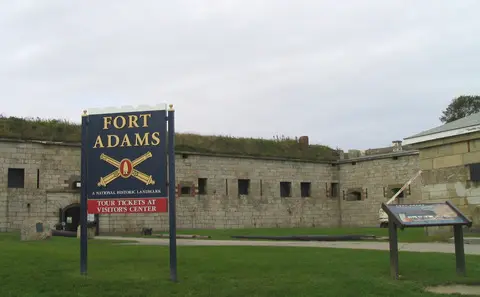
Fort Adams sits on a blunt headland at the south-west end of Aquidneck Island, where it commands the east passage into Narragansett Bay. The position had been fortified on and off since the colonial period — the British raised an observation post here in 1740, and a six-gun battery on the site exchanged fire with Royal Navy warships twice in May 1776 — but the fort that carries the name began on 4 July 1799, when the United States dedicated a compact brick work designed by Major Louis de Tousard of the Corps of Engineers as part of the country's First System of coastal defence. It was named for the sitting president, John Adams. Its first commanding officer was Captain John Henry, later notorious for the intercepted letters that helped push the country into the War of 1812. By the end of that war Tousard's fort stood in decay, and the burning of Washington had exposed how thin American coastal defence really was.
In 1816 the government seated a board of officers under Simon Bernard, a French military engineer who had served Napoleon, to redesign the whole system. Bernard's board treated Narragansett Bay as one of the two harbours between Cape Cod and Cape Hatteras fit for a naval rendezvous, and gave Rhode Island a fort to match. Work began in 1824 and continued at irregular intervals until 1857 at a cost of more than three million dollars. The finished work was designed to mount 468 guns behind a perimeter of 1,739 yards measured at the cordons, with scarps and parade walls of Maine granite, brick vaults and shale structural walls. Lieutenant Colonel Joseph Gilbert Totten supervised construction from 1825 to 1838 and used the years on site to write "Hydraulic and Common Mortars"; he later became Chief of Engineers of the U.S. Army.
The men who actually laid the granite are the part of the story the fort's fame tends to swallow. The master mason was Alexander MacGregor, a Scot; the labour force ran to some five hundred Irish immigrants, and they were the first permanent body of Irish Catholics to settle in Rhode Island. They built their community in Newport's Fifth Ward, a few minutes from the gate, and their numbers were what prompted Bishop Benedict Joseph Fenwick to send the newly ordained Father Robert Woodley to found a congregation: on 8 April 1828 Woodley bought a former schoolhouse on Barney Street, the seed of what became St Mary's, the oldest Catholic parish in the state. Many of that first generation lie under the twenty-six or so surviving stones of the Barney Street burying ground.
The new fort was first garrisoned in August 1841 and never fired a shot in anger. It served the Civil War as a staging and training post and, briefly, as the wartime home of the U.S. Naval Academy. Congress stopped funding harbour defence in 1875 and the masonry work began to rot; the Endicott Board of 1885 rebuilt American coastal defence around guns rather than walls, and at Fort Adams the new concrete batteries were placed along the bay south of the old fort rather than inside it. Through the Second World War the post was the command centre for the defences of both Narragansett Bay and the mouth of Long Island Sound, its garrison falling to about five hundred by August 1945. The Army handed the fort to the Navy in 1953. Neglect, weather and vandalism did the rest: the 1970 National Register nomination warned in as many words that without money and attention Fort Adams would be "another tragic case of 'too late.'" The state took the main work in the mid-1960s for a state park, the fort was declared a National Historic Landmark on 8 December 1976, the Fort Adams Trust was formed in 1994 and began guided tours in 1995, and since 1981 the parade ground and lawns have carried the Newport Folk and Jazz Festivals.
Timeline: the documented record of Fort Adams
- 4 July 1799 The first Fort Adams, a brick First System work designed by Major Louis de Tousard, is dedicated and named for the sitting president. Captain John Henry takes command.
- 1824 Construction of the present fort begins to Simon Bernard's design. Joseph Totten supervises the work from 1825; the master mason is Alexander MacGregor and the labour force reaches some five hundred Irish immigrants.
- 8 April 1828 Father Robert Woodley buys a former schoolhouse on Barney Street for the Irish Catholic workforce of the fort — the origin of St Mary's, the oldest Catholic parish in Rhode Island.
- 1857 Work ends after thirty-three years and more than three million dollars. The fort is designed for 468 guns; its wartime defence would need 2,400 men, though a peacetime garrison of 200 proved sufficient.
- 1953 The Army hands Fort Adams to the Navy after more than a century of garrison duty. Neglect, weather and vandalism take over.
- 8 December 1976 Fort Adams is declared a National Historic Landmark. The 4,808-word nomination describes the countermine listening galleries in detail and contains no reference to any haunting.
- October 2006 The earliest edition of Fortress of Nightmares I have been able to date: the Fort Adams Trust's own page advertises the Halloween attraction at twelve dollars a head, with all proceeds going to restoration.
- 2010 The Trust partners with R.I.S.E.U.P. Paranormal to add "Fortress Ghost Hunts" — billed on the Trust's calendar as "a legitimate paranormal investigation" — to the Tunnels of Terror maze. Ten dollars each, fifteen for both.
- 2012 The Trust extends the format beyond Halloween: three-hour Summer Ghost Hunts on the fourth Friday of each month from May to September, forty tickets a night, guided by the Rhode Island Paranormal Research Group.
- 14 October 2015 Syfy broadcasts "Fortress of Phantoms", the Ghost Hunters episode filmed at the fort. The investigation was requested by the fort's caretaker, Rob McCormack, who had run the Trust's Halloween attraction for years.
- 22 August 2024, 00:10 UTC A 58-byte edit summarised only as "Add category" tags the Wikipedia article as a reportedly haunted location. It is the first and only paranormal content in 282 revisions, and it is the reason this entry exists.
- 2025 The Trust is still selling the ghost: "A Spirited Evening", a lights-out group investigation led by Trust staff and volunteer investigators, at forty dollars for twenty-five places.
Is there a rational explanation for Fort Adams?
Fort Adams is in this atlas because of a single line of text, and the line can be dated to the second.
Between the article's creation in September 2005 and July 2026 the English Wikipedia entry for Fort Adams accumulated 282 revisions. In the body of every one of them, the words ghost, haunt, apparition, poltergeist, spectre, phantom, paranormal, supernatural, spirit, legend and folklore appear a combined zero times — measured on the full wikitext of all 282 revisions, with the category lines stripped out, and controlled in the same sweep by the word "fort", which appears 155 times in the current text alone. The only paranormal thing about the article is a category tag: "[[Category:Reportedly haunted locations in Rhode Island]]", added at 00:10:37 UTC on 22 August 2024 in a 58-byte edit whose entire summary reads "Add category". The editor, Nayyn, is not an anonymous drive-by — a registered account since 2021 with some fifteen thousand edits — but the tag carries no source, and it never has. Nayyn created the category page itself twenty-three minutes earlier and applied it to fifteen Rhode Island articles in a thirty-four-minute session; Fort Adams was the tenth.
That is where the reputation is not. The institutional record is just as silent, and it is silent at length: the 1970 National Register nomination (2,096 words) and the 1976 National Historic Landmark nomination (4,808 words) contain no ghost, haunt, spirit or legend, with controls in the same files of 35 and 91 hits for "fort"; the Fort Adams Trust's own history page archived in January 2001 runs to 8,984 words with the same zero, against 200 hits for "fort" and 22 for "Totten"; and the Trust's full history page as archived in June 2025 runs to 9,037 words with the same zero.
Where the reputation is, is the box office — and it is much older than the Wikipedia tag. The Trust's own site was advertising a Halloween attraction called Fortress of Nightmares by October 2006, at twelve dollars a head, with all proceeds going to restoration. Its 2009 calendar is explicit about the genre: visitors would hear "eerie, bizarre and macabre tales" from "the resident 'spirits' themselves" — actors, in scare quotes, in the Trust's own copy — and the attraction was, it said, "based upon the legends and folklore that surround Fort Adams". In 2010 the format split in two. The Trust teamed up with an outside group, R.I.S.E.U.P. Paranormal, to run the Tunnels of Terror haunted maze alongside "Fortress Ghost Hunts", described on the Trust's calendar as "a legitimate paranormal investigation": ten dollars for the maze, ten for the ghost hunt, fifteen for both. In 2011 the partner changed to the Rhode Island Paranormal Research Group; by 2012 the Trust was selling three-hour Summer Ghost Hunts on the fourth Friday of every month from May to September, capped at forty tickets a night. In September 2015 the Newport paper What's Up Newp announced that the fort would appear on Syfy's Ghost Hunters on 14 October; Syfy's own recap names the man who requested the investigation as the fort's caretaker, Rob McCormack — the same Rob McCormack whose email address had been the Fortress of Nightmares volunteer contact on the Trust's calendar since at least 2009. The programme has never stopped: as of 2025 the Trust sells "A Spirited Evening", a lights-out group investigation led by Trust staff and volunteer investigators, at forty dollars for twenty-five places, with the proceeds again going to preservation.
The underground element deserves its own note, because it is the one physical fact behind the stories and it points the wrong way for them. The passages that visitors describe as oppressive were not built as passages: they are countermines. The 1976 landmark nomination describes listening galleries driven out toward the country on the south-west, two and a half feet wide and four and a quarter feet high, with temporarily sealed openings every twenty feet, dug for the express purpose of letting a defender hear an enemy digging. They are, in other words, a nineteenth-century listening device made of stone. A corridor engineered to make faint sound audible at a distance will do that impartially, including for the footsteps of the group ahead.
And the Trust, which sells the ghost hunts, is also on record debunking the fort's other underground legends. Asked on its own visitor FAQ whether the fort has twenty-five miles of tunnels, it answers "Not likely", and puts the real figure between half a mile and a mile. Asked whether a tunnel runs under the East Passage to Fort Wetherill in Jamestown, it answers that "No evidence has been found to support a theory of a tunnel to Jamestown. This is a rumor which has persisted for over 60 years", and traces it to a submarine communications cable gallery. Two voices from the same organisation, and the sceptical one is the one on the history pages.
Finally, the incidents the television episode was built around — a soldier beaten to death after an argument, and a soldier who shot his wife and then himself — should be treated with care, because the programme's own materials do not agree about them. Published synopses date them to 1879 and 1908 and say the wife was killed; Syfy's own episode recap dates them to "the 1800s" and "the 1920s" and says she survived. I have not been able to verify either case in a contemporary source, and until someone does, they are a claim about the fort, not a fact about it.
Can you visit Fort Adams?
Fort Adams stands in Fort Adams State Park, on the headland at the mouth of Newport Harbor, about 2.5 km (1.5 miles) west-south-west of Washington Square in central Newport. The park belongs to the state, and the fort inside it is operated by the Fort Adams Trust, a non-profit. On 23 September 2026 the Trust's visitor FAQ gave the Visitor Center and ticket office at 80 Fort Adams Drive in Newport (RI 02840) and the Trust building at number 90. According to the same page the park is open daily from sunrise to sunset and parking is free for most daily visits; there is a courtesy dock in front of the visitor centre for pick-ups and drop-offs; mooring and dock space are handled by Sail Newport.
The historic fort keeps a season. The FAQ opens it daily from 9:30 to 16:00 between Memorial Day and Columbus Day, and from Thanksgiving to 1 April "Historic Fort Adams is closed for regular tours". Self-guided visits take in the six-and-a-half-acre parade field and the restored North Overlook but "do not include access to the underground tunnels"; the FAQ lists the parts reached only with a guide as "The East Wall officers quarters, the south wall casemates the outworks, the West Wall and underground listening tunnels." A guided tour lasts about 75 minutes with nearly a mile (1.6 km) of walking; the FAQ puts most self-guided visits at about an hour. The Trust's tours page, consulted the same day, prices the guided tour at $24 for adults, $18 for military, seniors and students, $12 for ages 5 to 16 and $70 for a family of two adults and four children; the self-guided visit costs $16, $12 and $8 on the same scale and runs daily from May to October between 10:00 and a last entry at 15:00.
Fort Adams was designated a National Historic Landmark on 8 December 1976. It is nonetheless a state park, and the FAQ states that the National Park Gold Pass is not accepted; the ticket office stamps passports. Leashed dogs are permitted on self-guided tours, and for guided ones the Trust leaves it to the owner's discretion because of steep stairs and confined spaces. The visitor centre has a coffee bar; picnicking follows a carry-in, carry-out rule; the 2.25-mile (3.6 km) Fort Adams Bay Walk is open year-round.
The paranormal programme is sold separately. On the tours page of 23 September 2026 the Trust's paranormal investigations cost $40 a person, with 25 places, and run from 20:00 to midnight; the dates change every year and are published there.
Sources consulted
- National Park Service, «National Register of Historic Places Inventory–Nomination Form: Fort Adams (National Historic Landmark documentation, ref. 70000014)» — United States Department of the Interior, 1976 archive
- National Park Service, «National Register of Historic Places Inventory–Nomination Form: Fort Adams (ref. 70000014)» — United States Department of the Interior, 1970 archive
- Fort Adams Trust, «Fortress of Nightmares (Fort Adams Trust event page, archived 30 June 2007)» — fortadams.org via the Internet Archive, 2007 archive
- Fort Adams Trust, «Fort Adams Trust event calendar 2010 (archived)» — fortadams.org via the Internet Archive, 2010 archive
- Fort Adams Trust, «Fort Adams Trust event calendar 2012 (archived)» — fortadams.org via the Internet Archive, 2012 archive
- Fort Adams Trust, «Planning Your Visit: Frequently Asked Questions (archived 18 June 2025)» — fortadams.org via the Internet Archive, 2025 archive
- Ryan M. Belmore, «Fort Adams Will Appear on Syfy's 'Ghost Hunters' This October» — What's Up Newp, 2015 newspaper archive
- Wikipedia contributors, «Fort Adams: revision history and revision 1241578728 (22 August 2024)» — English Wikipedia, 2024 archive
- Discover Newport, «Irish History in Newport, RI: Churches, Museums and Cemeteries» — discovernewport.org, 2024 web
- Discover Newport / Fort Adams Trust, «A Spirited Evening: Paranormal Tour at Fort Adams» — visitnewportri.org, 2025 web
- Syfy, «Episode Recap: Fortress of Phantoms (Ghost Hunters, season 10, episode 8)» — syfy.com, 2015 web
Reviewed by V. Serrano on 2026-08-20 · How we verify our content
💬 Field testimonies (0)
No testimonies yet. Add the first.
Add your testimony
🔒 Log in to add a testimony