👻 HAUNTED PLACE · EXP. Nº9477
ACTIVE
Fort Delaware
Fort Delaware is a pentagonal granite fortress on Pea Patch Island, a mudflat in the middle of the Delaware River, built on nearly five thousand timber piles because there was no solid ground to build on.
Where is Fort Delaware?
- Location
- Delaware, United States
- Type
- Fort / battlefield
- Coordinates
- 39.59, -75.572
- Last updated
LOCATION
Why is Fort Delaware said to be haunted?
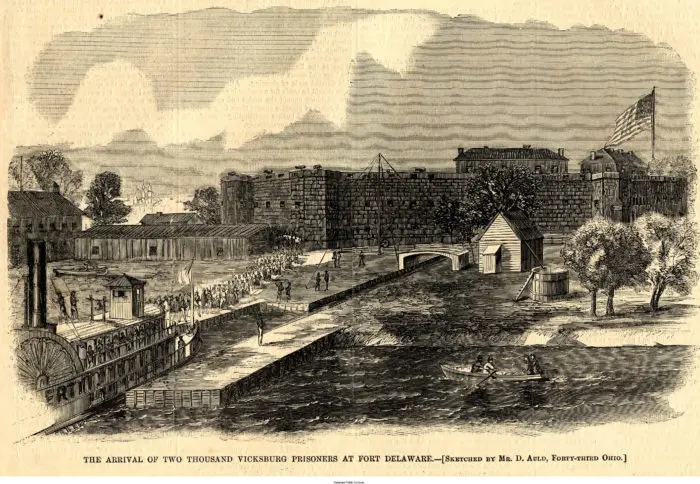
It never fought a fleet. From April 1862 it became one of the Union's largest prisoner-of-war camps, and after Gettysburg and Vicksburg it held more men than it was ever meant to: the state park says as many as 10,048 at one time. A smallpox epidemic swept the island in 1863. The dead were rowed across the river to Finn's Point in New Jersey, and in 1875 the army made that farm field a national cemetery; its 1910 monument carries 2,436 names. The fort's haunted reputation is much younger than its dead. The most detailed prisoner's diary, published in 1874, contains no ghosts at all except one man's dream of Stonewall Jackson. The lantern tours that made Fort Delaware famous were invented in 1997, by a state parks historian and a folklorist, and their creator described them as a supernatural bribe to get visitors onto the island.
What is the history of Fort Delaware?
Pea Patch Island is a mudflat, and that single fact governs everything that happened there.
When Congress appropriated a million dollars in 1847 for a coastal fort in the middle of the Delaware River, the engineers found what one account of the works describes as compressible mud some forty feet deep before sand was reached. An earlier star fort on the same spot had already failed on its foundations. So between 1849 and 1851 Major John Sanders' crews drove nearly five thousand timber piles into the marsh, load-tested them with an 800-pound weight dropped from eight feet, and re-drove some seventeen hundred of them that had sunk too far. Only then did the pentagon of granite and brick designed by the army's chief engineer, Joseph Gilbert Totten, begin to rise. The Delaware State Parks history dates completion to around 1859; the post engineer did not sign the fort off as finished until 1868.
It was built to stop a fleet, and it never fired on one. What it became instead was a prison, and it became one almost by accident.
According to the U.S. Department of Veterans Affairs, the first prisoners of war reached the island in April 1862: 358 Confederate soldiers taken at Kernstown, Virginia. Nothing on the island had been designed to hold them. Wooden barracks — the prisoners called the enclosure the "bull pen" — went up in two phases across 1862 and 1863 on the marshy ground outside the walls, along with a 600-bed hospital. Officers were held inside the fort itself; enlisted men were outside, separated from the junior officers by a tall fence with a guards' catwalk on top.
The crisis came in 1863, when after Gettysburg and Vicksburg the population exploded: Delaware State Parks says the island held "as many as 10,048 Confederate prisoners of war at one time", while other accounts put the August 1863 figure above eleven or twelve thousand. A smallpox epidemic tore through that summer and autumn. On 16 December 1863 an inmate, the Presbyterian minister Isaac W. K. Handy, wrote down what the prison's own clerks told him: "the number of deaths among the Confederate prisoners, since the 16th of April last, is just One thousand, two hundred and forty two! — a number much less than I had supposed, but, nevertheless, fearfully large."
Handy is the closest thing Fort Delaware has to a resident witness. He was arrested in July 1863 while visiting relatives in Delaware — with a pass from Major-General Dix in his pocket, as he never tired of pointing out — and held fifteen months without trial on the strength of a newspaper item and an affidavit. His journal, smuggled out in instalments by his wife and buried in the ground until the war ended, was published in Baltimore in 1874 as United States Bonds; or, Duress by Federal Authority. It records the filthy water and the bad bread, but also the sutler's store, the fishing, the gambling in the passageways, the prayer meetings, and General Albin Schoepf's occasional indulgences.
The dead did not stay on the island: they were rowed across to Finn's Point in New Jersey — Okonowicz records the local name for the barge, the "death boat" — and buried in a farm field, except when ice or weather made the crossing impossible and burials had to be made on Pea Patch itself. In May 1875 the governor of Virginia, James L. Kemper, wrote to the Secretary of War about the neglected Confederate graves on the island; the army's answer was to make Finn's Point a national cemetery, declared on 3 October 1875, and move the remains there. This is why almost nothing of the prison's mortality is visible on Pea Patch Island today: it was deliberately relocated across the river a decade after the war.
Two other things left the island. On 20 August 1864, six hundred Confederate officers were put aboard a steamer bound for Morris Island, off Charleston, to be placed under the fire of their own guns in retaliation for Union officers held under Confederate shelling; they became known as the "Immortal 600". A week earlier, on 12 August, Handy had recorded the rumour running through the barracks that "six hundred officers are to embark, to-morrow, for Hilton Head, South Carolina".
Some men escaped. Official Union reports counted 54 escapes in total; research by Kevin Mackie at the University of Delaware, supervised by the historian Jonathan Russ, argues the real figure lies between 64 and 103, noting that the official reports record zero escapes for 1862 when at least twenty-two can be documented for that year alone.
The prison closed in January 1866 and the garrison thinned; the fort was manned briefly in both world wars, declared surplus in 1944 and handed back to Delaware, and became a state park in 1951.
Timeline: the documented record of Fort Delaware
- 1847–1859 Congress appropriates $1 million for a coastal fort on Pea Patch Island. Designed by chief engineer Joseph G. Totten and built under Major John Sanders on nearly 5,000 timber piles driven into forty feet of river mud, it is completed around 1859.
- April 1862 The fort receives its first prisoners of war: 358 Confederate soldiers captured at Kernstown, Virginia, according to the U.S. Department of Veterans Affairs. Nothing on the island had been built to hold them; wooden barracks known as the "bull pen" go up outside the walls across 1862 and 1863.
- Summer 1863 After Gettysburg and Vicksburg the prison population peaks. Delaware State Parks puts the maximum at 10,048 prisoners at one time; other accounts give figures above eleven or twelve thousand for August 1863. A smallpox epidemic breaks out.
- Late December 1863 The imprisoned minister Isaac W. K. Handy records what the prison clerks in Captain Ahl's office tell him: 1,242 Confederate prisoners have died since 16 April. He calls it "a number much less than I had supposed, but, nevertheless, fearfully large".
- 13 August 1864 Handy writes down the oldest Fort Delaware ghost on record — and it is a dream. "Old Parson Thomas" had seen the ghost of Stonewall Jackson, who predicted a general prisoner exchange on 13 August and peace on 3 September. That day Handy wrote that the exchange "commences to-day — or at least such is the presumption"; the peace did not come.
- 20 August 1864 Six hundred Confederate officers leave the island for Morris Island, off Charleston, to be held under Confederate artillery fire in retaliation. They become known as the "Immortal 600".
- 3 October 1875 After Virginia's governor James L. Kemper complains about neglected Confederate graves on Pea Patch Island, the army declares Finn's Point, New Jersey, a national cemetery and reinters the dead there. This is why the prison's mortality is almost invisible on the island today.
- 1910 The federal government erects the 85-foot Confederate Monument at Finn's Point, its bronze tablets listing 2,436 names of prisoners who died at Fort Delaware. A separate 1879 monument commemorates 135 Union guards buried in the same cemetery.
- 1951 Fort Delaware becomes a Delaware state park, seven years after the island was declared surplus federal property and handed back to the state.
- 1994 The earliest dated appearance of Fort Delaware in modern ghost literature: a chapter titled "Resurrecting the Past at Fort Delaware" in Ed Okonowicz's Spirits Between the Bays, the first volume of his Delmarva ghost-story series.
- 1997 State parks historian Lee Jennings proposes to Okonowicz that they create evening Ghost/History Lantern Tours "with a heavy dose of hauntings and humor" — Jennings telling the history, Okonowicz the folklore. Okonowicz calls the tours "a supernatural bribe" to get visitors onto the island.
- Halloween 1999 A Discovery Channel crew films on the island for a special called Ghost Waters. According to Okonowicz, "the announcer labeled Fort Delaware one of the most haunted sites in the United States near the water" — the origin of the superlative still repeated today.
- 18 June and 31 October 2008 Ghost Hunters broadcasts a Fort Delaware episode and then a seven-hour live investigation on Halloween night. Okonowicz credits this national publicity with the surge in visitors looking for ghosts on Pea Patch Island.
- 31 October 2019 Donald Laskey, lead interpreter at Fort Delaware State Park, replies publicly to a critical H-CivWar review: the paranormal tours cause "the history of the place being lost", but "due to the high profits" they will only be dropped "when the money stops coming in or we can replace them with something better".
Is there a rational explanation for Fort Delaware?
The numbers are the part of Fort Delaware most often repeated and least often checked.
Four incompatible death tolls circulate. The bronze tablets on the Confederate Monument at Finn's Point, erected by the federal government in 1910, carry 2,436 names. The Department of Veterans Affairs, on the same page, gives "an estimated 2,502 men" who died in custody. Ed Okonowicz writes that the Confederate death toll was "close to 2,500". Figures of 2,700 and 2,925 also circulate online without a stated basis. The prisoner totals are worse: 10,048 at once (the state park), "almost 33,000" over the whole war (the Wikipedia article), "approximately 22,773 men" in the fort by the January 1866 closure, soldiers and officers included (the VA), 40,000 in some popular retellings. None of these can be given in a site's own voice. They belong to whoever counted them.
Dating the ghost story is a separate question from dating the deaths.
Handy's 1874 journal is the most detailed published account of imprisonment at Fort Delaware — around 1.4 million characters of diary in the digitised text. Searching it is a cheap test of whether the fort had a haunted reputation among the men who suffered there. It does not. The words "haunt", "apparition", "phantom", "spectre" and "supernatural" appear zero times. As a control on the same file: "prisoner" appears 449 times, "Schoepf" 116, "small-pox" 41. The corpus is complete and searchable; the hauntings simply are not in it.
There is exactly one ghost story in the whole book — the word "ghost" occurs four times, and the other two are "Holy Ghost" — and it is a good one. On Saturday 13 August 1864, amid the excitement of a prisoner movement, Handy recorded that "Old Parson Thomas had a dream about two weeks ago, in which he thought he saw the ghost of Stonewall Jackson", who told him: "Try to do the best you can; there will be the commencement of a general exchange on the 13th of August; and on the 3d of September, peace will be declared." Handy's next lines are about the prophecy and nothing else: "Sure enough, the exchange commences to-day — or at least such is the presumption. How will it be, I wonder, on the 3d of September?" Peace did not come on 3 September. In Handy's book, then, the only ghost at Fort Delaware is a prisoner's dream, written down for what it foretold about the exchange.
The modern reputation can be dated precisely, and its origin is unusually well documented — because the man who built it wrote down how he did it. The earliest dated appearance is a chapter, "Resurrecting the Past at Fort Delaware", in Ed Okonowicz's Spirits Between the Bays (Myst and Lace, 1994), the first volume of his Delmarva ghost-story series. In the introduction to Civil War Ghosts at Fort Delaware, first published in 2006 and later reissued by Stackpole, Okonowicz explains the rest: "These candlelight walks began in 1997, when the late Lee Jennings, state parks historian, suggested that he and I develop the unique historic walks — with a heavy dose of hauntings and humor." Jennings' plan was a double act: "I would do the folklore and ghost tales, and he would provide the fort's history." Okonowicz ran the tours until 2009 and is blunt about their purpose: "the intent was never to deliver an actual ghost, packaged and gift wrapped. Instead, the tours were a lure, a supernatural bribe to entice folks to visit and experience this historic Civil War wonder."
The superlative has a source too. Okonowicz records that in spring 1999 a Discovery Channel crew filmed a segment on the island for a Halloween special called Ghost Waters, in which "the announcer labeled Fort Delaware one of the most haunted sites in the United States near the water". That line, from a television voice-over, is the ancestor of every "most haunted" claim now attached to the fort. The amplification came in 2008, when Ghost Hunters aired a Fort Delaware episode on 18 June and returned for a seven-hour live broadcast on Halloween night. Okonowicz notes the effect directly: "As a result of the national publicity the fort received following an episode and Halloween-night special on the TV program Ghost Hunters, many claimed the potential for spirited sightings on Pea Patch Island was high."
The institution is careful. Neither the Fort Delaware page of Delaware State Parks nor its Paranormal Adventure page, as read on 4 October 2026, calls the fort haunted; the word appears on the second page only in the name of an event in Dover, the Haunted Dover Lantern Tour. The Paranormal Adventure page describes the event as a chance to "experience the history of the park as you and DSGI (Diamond State Ghost Investigators) embark on an evening of paranormal investigations inside the Fort", and states no result of those investigations. The investigators say something similar: the DSGI motto, attributed to their leader Gina Dunham, is "History first, then the paranormal."
The sharpest scepticism comes from inside the park. Reviewing the site for H-CivWar in October 2019, the historian Robert Baumgartner traced the sequence — tourists posting camcorder videos online, then the television coverage, then the fort's own tours — and warned that with ghost hunters "the historical narrative becomes lost". Donald Laskey, then lead interpreter at Fort Delaware State Park, replied publicly six days later, on 31 October 2019: "Likewise Paranormals do present many problems when it comes the history of the place being lost. Due to the high profits in our paranormal tour they will only be replaced when the money stops coming in or we can replace them with something better, both have thus far been elusive."
And the last word belongs to Okonowicz, interviewed by Carl Hamilton for the Cecil Whig in September 2023. Asked whether he believes in ghosts after thirty years of collecting them: "I've talked to hundreds of people who said they have seen ghosts, and there are probably two that have the making to be true, to be possible." Of his own material he says: "Some of the stories have a semi-truth and just enough meat and potatoes."
Can you visit Fort Delaware?
Fort Delaware is a Delaware state park on an island, and the island is reached only by the park ferry; private craft cannot dock on Pea Patch. The ticket office and ferry dock are at 45 Clinton Street, Delaware City. The crossing is half a mile, and the same service — the Forts Ferry Crossing — links Fort DuPont in Delaware City with Pea Patch and with Fort Mott in Pennsville Township, New Jersey.
The season runs from spring to the end of September. The ticket office works from 9:00 to 16:00 and the last boat back to Delaware City leaves at 16:30. Admission is $15 for adults aged 13 and over; $14 for seniors aged 62 and over, and for military; $8 for children aged 2 to 12; free under 2. Adult groups pay $11 a head and youth groups $7. Advance tickets are sold online; same-day tickets are sold on a first-come basis, and the park office number is (302) 834-7941. The fort runs rain or shine, though the ferry stays docked in high winds or lightning.
A tram carries visitors from the dock to the fort. The ferry and the tram take wheelchairs; the tram has a power lift; the ground floor of the fort is accessible. Costumed interpreters work through the day, and the eight-inch Columbiad is fired with a live powder charge. The Prison Camp Trail reaches an observation platform over the Pea Patch heronry, one of the largest mixed wading-bird colonies on the Atlantic coast. Nine species nest there, an estimated 1,000 to 1,500 breeding pairs.
White-nose syndrome is a fungal disease deadly to bats and harmless to people. It was confirmed in Delaware in 2012 in bats hibernating at Fort Delaware and Fort DuPont, and since that year the fort has required white booties over footwear in its Endicott section. The park asks for closed-toe shoes, because the ground is uneven. Visitors under 16 are accompanied by someone aged 18 or over. Pets and alcohol are not admitted.
The ghost programme is separate from the day visit and runs only in season. Delaware State Parks holds Paranormal Adventure evenings with the Diamond State Ghost Investigators on Friday and Saturday nights in October, in two sittings, with the return ferry in the ticket. Diamond State counts seventeen Octobers of work with the park. Parties are split into groups of ten or fewer; the programme is for ages 13 and up; participants bring their own flashlights, since the park lends none. Booking goes through Reserve America on 877-987-2757, and the tickets are non-transferable. These are guided group investigations run for the park's benefit, and the fort is not otherwise open at night.
Fort Delaware became a state park in 1951, and in 2026, for the seventy-fifth anniversary of Delaware State Parks, the state launched Fort Fest here on 25–26 April. It came with a historic marker dedication and a first running of the Charge the Fort 5K.
Sources consulted
- Isaac W. K. Handy, «United States Bonds; or, Duress by Federal Authority: A Journal of Current Events during an Imprisonment of Fifteen Months, at Fort Delaware» — Baltimore: Turnbull Brothers, 1874 book
- National Cemetery Administration, «Finn's Point National Cemetery — Historical Information» — U.S. Department of Veterans Affairs, 2025 report
- Delaware Division of Parks and Recreation (DNREC), «Fort Delaware — About the Park, Park History, Contact, Hours and Fees» — Delaware State Parks, 2026 web
- Delaware Division of Parks and Recreation (DNREC), «Paranormal Adventure» — Delaware State Parks, 2026 web
- Ed Okonowicz, «Civil War Ghosts at Fort Delaware (Introduction: "Let's Take a Step Back in Time")» — Myst and Lace Publishers; reissued by Stackpole Books, 2006 book
- Ed Okonowicz, «Spirits Between the Bays (contents: "Resurrecting the Past at Fort Delaware", p. 37)» — Elkton, Md.: Myst and Lace, 1994 book
- Robert Baumgartner, «Ghosts of the Confederacy at Fort Delaware (site review, with a reply from park interpreter Donald Laskey)» — H-CivWar, H-Net Reviews, 2019 academic
- Tracey Bryant, «Escape from Fort Delaware (research by Kevin Mackie, adviser Jonathan Russ)» — University of Delaware Research Magazine, vol. 2 no. 2, 2013 academic
- Carl Hamilton, «Cecil County man is a prolific writer of ghost stories» — cecildaily.com, 2023 newspaper archive
- Wikipedia contributors, «Fort Delaware (construction, engineers, prison statistics)» — Wikipedia, 2026 web
- Wikipedia contributors, «List of Ghost Hunters episodes (season 4, episode 13; 2008 Halloween live special)» — Wikipedia, 2026 web
- Diamond State Ghost Investigators, «Fort Delaware — "History first, then the paranormal"; seventeen Octobers of collaboration» — diamondstateghostinvestigators.com, 2025 web
Reviewed by V. Serrano on 2026-08-12 · How we verify our content
💬 Field testimonies (0)
No testimonies yet. Add the first.
Add your testimony
🔒 Log in to add a testimony