👻 HAUNTED PLACE · EXP. Nº9478
ACTIVE
Franklin Castle
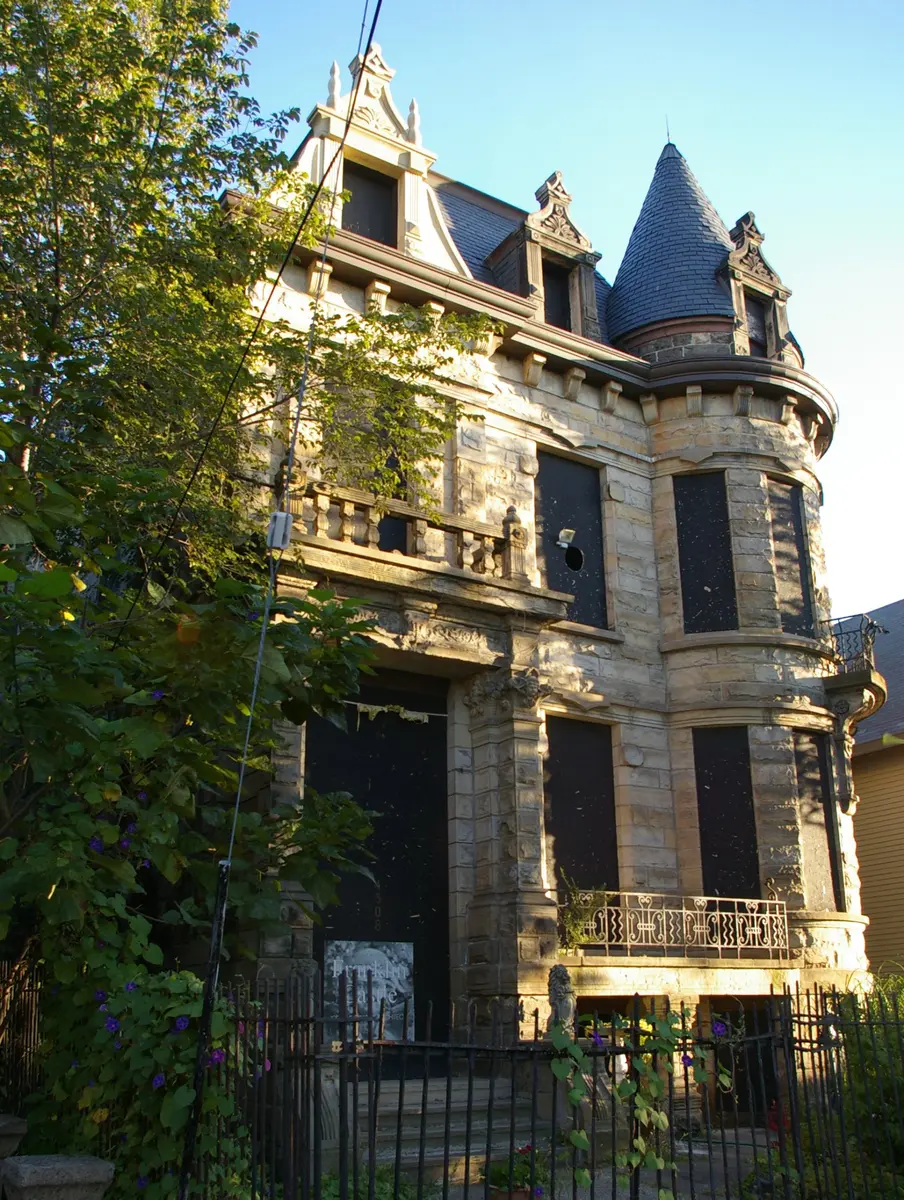
Franklin Castle is the Hannes Tiedemann House at 4308 Franklin Boulevard, in Cleveland's Ohio City neighbourhood: a rock-faced sandstone mansion with a round corner tower, built from 1881 to designs by Cudell & Richardson and finished in 1883.
Where is Franklin Castle?
- Location
- Ohio, United States
- Type
- House / mansion
- Coordinates
- 41.486, -81.717
- Last updated
LOCATION
Why is Franklin Castle said to be haunted?
Tiedemann was a wholesale grocer who became a founder and vice-president of the Savings & Trust Co. in 1883. The popular story says his children died in the house and that he murdered a niece and a mistress, but the family monument at Riverside Cemetery records three infants who died of disease between 1863 and 1873 and a daughter, Emma, who died of diabetes in 1881 aged fifteen, all before the house was completed. From 1921 to 1968 the building was Eintracht Hall, home of a German-American cultural club. The Encyclopedia of Cleveland History states that the haunted-house stories do not seem to predate 1965; rumours spread around 1968, and from 1974 an owner sold public tours of the haunted castle. Human bones were reported in a hidden passageway in 1975, which Scene later said forensic pathologists estimated had lain there some eighty years, though no examiner or conclusion is on record. Listed on the National Register of Historic Places in 1982, gutted by arson in 1999 and restored since, the house is a private residence and is not open to the public.
What is the history of Franklin Castle?
Franklin Castle is an unusual haunted house: almost every claim made about it can be checked. The building has a National Register file, an entry in a university encyclopedia, a public-history study built on the family's own gravestone, and a run of Cleveland newspapers digitised by the city's public library. Checked against those, most of the legend fails — and the part that survives turns out to be about the 1970s, not the 1800s.
The builder was not a banker when he built it. The Encyclopedia of Cleveland History, published by Case Western Reserve University, records Hannes Tiedemann (1832-1908) as "a wholesale grocer in the firm of Weidemann & Tiedemann beginning in 1864". The bank came afterwards: in 1883 he was "a founder and vice-president of the Savings & Trust Co., one of the first institutions organized in Ohio under the law permitting the formation of trust companies".
The house. The address is 4308 Franklin Boulevard (Franklin Ave. in the nineteenth century), on the north side of the street opposite West 44th, in what is now Ohio City. The Tiedemanns had lived at that address since 1866, in an earlier house that was demolished to make room for the new one. The present mansion was erected from 1881 — Cleveland Historical dates the works 1881-1883 — to designs by Cudell & Richardson, "identified by a carved stone on the house" and, in the encyclopedia's words, "Cleveland's most important architectural firm in the 1880s". Frank Cudell was himself a German immigrant; the same partnership built Franklin Circle Christian Church (1874-1875) a few blocks away. The National Register of Historic Places file classifies the building as Queen Anne, significant year 1881, period of significance 1875-1899, areas of significance COMMERCE and ARCHITECTURE. Nothing in the federal record mentions ghosts, and nothing calls it Gothic.
The deaths are real, and they are in the wrong place. This is where the legend breaks. Jim Dubelko, writing for Cleveland Historical — the public-history project of Cleveland State University's Center for Public History + Digital Humanities — with research support from Raymond L. Pianka, went to the Tiedemann family monument at Riverside Cemetery. On the back of it are the names of three infant children who died of disease between 1863 and 1873; on another side is the couple's daughter Emma, who died of diabetes in 1881, aged fifteen. Dubelko's conclusion is flat: "Contrary to rumors circulated about Franklin Castle since the 1960s, none of the Tiedemann children died in the Tiedemann House, which was not completed until 1883."
Hannes and his wife Louise moved into the finished house in 1883 with their two surviving children, August and Dora. Both grew up there, married and gave their parents six grandchildren, all boys. Louise died in 1895; Hannes sold the house in 1896 and retired to Steinberg, the summer residence he had built in Lakewood around 1880-1881, where he died in 1908 at seventy-five.
For half a century it was a German club. From 1921 to 1968 — forty-seven years, far longer than the Tiedemanns lived there — the building was Eintracht Hall, home of the German-American League for Culture, later a German singing society. Cleveland Historical reproduces a Plain Dealer article of 20 December 1938 in which the club's members, shortly after the Munich Agreement, protested Hitler's aggression against German citizens and against Germany's neighbours. That is worth holding on to: the legend's "Nazi cell in a secret room" is the exact inversion of the documented record.
When do the ghosts arrive? The Encyclopedia of Cleveland History is unusually blunt for a reference work: "The spurious haunted-house stories do not seem to predate 1965." Dubelko dates the rumours to around 1968, when the German club sold up, and says they concerned the ghosts of Mrs Tiedemann and her daughter Emma — a daughter who had died before the house was finished. Between the last nineteenth-century Tiedemann death in that family and the first ghost story there is a gap of roughly nine decades. That gap is the story.
Then it is sold — and sold as haunted. From 1968 to 1974 the house was the home of a family who said it was haunted; photographs in the Cleveland Press Collection at Cleveland State University identify them as Mr and Mrs James Romano and their children Jeffrey, John, Delores and Jimmy. In 1974 the family moved out and, in Dubelko's words, "the house was taken over by an individual who ... offered the public tours of 'haunted' Franklin Castle". A second Press photograph, from the paper's picture morgue, carries this note from the verso: "Eleanor Bernstein psychic - tour guide at Franklin Blvd. Castle ... 4308 Franklin Blvd. ... Owner of home geo.[rge] mirceta". The Cleveland Press printed its final edition on 17 June 1982, so the guided-tour operation is documented no later than that year.
The house was also just a hall you could hire. On the night of Saturday 19 April 1975, police raided the annual Community Bail Fund Ball held in the building. The Plain Press, the neighbourhood's own newspaper, led its April 1975 issue with the raid: officers with "billy clubs and shotguns stormed the old haunted castle", eight people were arrested for serving liquor without a licence, and over the police radio came the call "Policeman in trouble ... come to 4300 Franklin!". The following July the paper reported that the first four defendants, including Father Bob Begin, had been acquitted. It is a small, unglamorous document, and it proves something useful: by April 1975 "the old haunted castle" was already the ordinary local name for the place.
The bones. The best-documented paranormal episode is also the thinnest. Writing in Scene on 29 October 1992, Kymberli Hagelberg reported: "In 1975 human bones were found in a hidden passageway at Franklin Castle, which forensic pathologists estimated had rested there some 80 years." Her source, the Ohio City historian Tim Barrett, added only that the newspapers "had a field day with that". A 1996 Scene feature says the finder was "one owner, a minister". No source we were able to read names the pathologists, gives their report, or records any conclusion beyond the age estimate.
Afterwards. The house was listed on the National Register of Historic Places on 15 March 1982 as the Hannes Tiedemann House (reference 82004417). In 1985 Michael DeVinko — stage name Mickey Deans, Judy Garland's last husband — bought it and spent heavily restoring it, living there for over a decade. He sold in 1999, and shortly afterwards the house was torched by an arsonist. A new owner paid for repairs but could not finish the work; in 2011 it was bought by a European couple who have made substantial progress. Cleveland Public Library's Neighborhood Photographic Survey photographed it, standing and intact, on 23 October 2025.
Timeline: the documented record of Franklin Castle
- 1863-1873 Three infant children of Hannes and Louise Tiedemann die of disease. Their names are on the back of the family monument at Riverside Cemetery. All three deaths precede the house by at least a decade.
- 1866 The Tiedemann family is living at the Franklin Avenue address, in an earlier house that will later be demolished to make way for the mansion.
- 1881 Construction begins to designs by Cudell & Richardson. The same year, the Tiedemanns' daughter Emma dies of diabetes aged fifteen — two years before the house is finished.
- 1883 Hannes and Louise move in with their surviving children August and Dora. The same year Tiedemann becomes a founder and vice-president of the Savings & Trust Co.; until then he was a wholesale grocer.
- 1896 A year after Louise's death in 1895, Tiedemann sells the house and retires to Steinberg, his summer residence in Lakewood. He dies there in 1908, aged seventy-five.
- 1921-1968 The building becomes Eintracht Hall, home of the German-American League for Culture and later a German singing society — forty-seven years, longer than the Tiedemanns lived there.
- 20 December 1938 The Plain Dealer reports that the club's members, shortly after the Munich Agreement, protested Hitler's aggression against German citizens and Germany's neighbours — the opposite of the legend's Nazi cell.
- Not before 1965 The Encyclopedia of Cleveland History, published by Case Western Reserve University, states: "The spurious haunted-house stories do not seem to predate 1965."
- c. 1968 Around the time the German club sells up, rumours begin circulating on the west side that the house is haunted by Mrs Tiedemann and her daughter Emma, who died before it was built.
- 1974 The Romano family, who had lived there since 1968 and said the house was haunted, move out. An individual takes the house over and begins offering the public tours of "haunted" Franklin Castle.
- 19 April 1975 Police raid the Community Bail Fund Ball held in the building. The neighbourhood paper Plain Press reports officers who "stormed the old haunted castle" — the earliest contemporaneous use of the name we could verify.
- 1975 — the bones Human bones are found in a hidden passageway. Reporting the episode in 1992, Scene said forensic pathologists "estimated [they] had rested there some 80 years"; no source we read names them or gives a conclusion.
- 15 March 1982 The house is listed on the National Register of Historic Places as the Hannes Tiedemann House (ref. 82004417), Queen Anne, for COMMERCE and ARCHITECTURE. The federal file says nothing about ghosts.
- 1985 Michael DeVinko — stage name Mickey Deans, Judy Garland's last husband — buys the house and restores it, living there for over a decade before selling in 1999.
- 1999 Shortly after the sale, the house is torched by an arsonist and heavily damaged. A new owner pays for repairs but cannot complete the restoration.
- 2011 A European couple buy the house and make substantial progress on its restoration. Cleveland Public Library photographed it standing and intact on 23 October 2025.
Is there a rational explanation for Franklin Castle?
The cleanest way to test the legend is to take its best-told version and check it line by line. That version exists: a full-page feature by Matt Ramagli in Scene of 17-23 October 1996, headlined "America's Most Haunted: Ohio City's Historic Franklin Castle Remains Shrouded In Mystery", which the writer says was researched at the Cuyahoga County Archives.
It gets the house wrong in its first sentence. The article says Tiedemann "constructed it to celebrate his rise in status from barrelmaker to bank president" and that it was "Built in 1864". The encyclopedia has him a wholesale grocer from 1864 and a bank vice-president from 1883; the National Register file gives 1881 as the significant year and Cleveland Historical dates the works 1881-1883. A Scene item of 23 September 1999 repeats the error in another form — "the turreted 1860s design". A house that is seventeen years too old is not a detail; it is the difference between a legend anchored in records and a legend anchored in retelling.
Its two murders do not survive the gravestone. The 1996 piece has Tiedemann hanging a thirteen-year-old daughter from an attic rafter and staging it as suicide, and, "about 30 years later", a servant girl murdered in the Tower Room on her wedding day. The Tiedemanns' only daughter to die young was Emma, fifteen, of diabetes, in 1881, when the house was still a building site — the monument at Riverside Cemetery is explicit, and so is Dubelko: none of the children died in the house.
Its most lurid claim is the exact opposite of the record. The article states that "20 members of the party were found murdered in one of the secret rooms, a room which also contained Nazi propaganda material". The occupants of the house from 1921 to 1968 were the German-American League for Culture, whose members appear in the Plain Dealer of 20 December 1938 protesting against Hitler. The 1992 Scene article had already circulated a softer version of the same slander — "a Nazi-linked German Socialist organization during World War I" — for a club that did not move in until 1921, after the war.
The local historian's explanation is architectural, and it was published in 1992. Tim Barrett, then the Ohio City historian, told Scene that he dismissed the belief that the house is haunted: "What makes the place 'haunted' is its imposing, stone edifice. It is large, looming and unusual. When the state insane asylum out in Newburgh stood — it was a beautiful towering thing — people felt the same way. Haunted houses are very romantic." It is a straightforward account of why a rock-faced stone tower on a boulevard of ordinary houses attracts stories.
The commercial incentive is documented, the hauntings are not. The first owner to sell tickets took over in 1974; a Cleveland Press photograph, necessarily from 1982 or earlier, shows a paid psychic working as tour guide with the owner in the background; by October 1998 Scene was reviewing a three-hour ghost bus tour whose first stop was a drive-past of the house. Its operator, Barbara Zamlen, told the paper she excluded private homes from the route but made an exception here: "That's a private home, but it's well known ... It's a legend, whether they like it or not." Every strand of the story that can be dated is attached to somebody with something to sell or a tour to fill.
On the bones, be precise about what is missing. Two published accounts agree that human remains were found in a concealed space in 1975 and that a forensic estimate put them there for roughly eighty years. Neither names the examiner, quotes a report or states a conclusion; nor could we find one. An eighty-year-old deposit in a house finished in 1883 would date to the Tiedemann tenancy, which is presumably why the figure was repeated — but an unsourced estimate reported seventeen years after the event is not evidence of a crime, and no source we read claims that any authority treated it as one.
What honesty requires. The absence of a haunting story before 1965 in the sources we could reach is not proof that nobody ever told one; local rumour rarely reaches print. But two independent institutional sources — a university encyclopedia and a university public-history project — reach the same conclusion from different material, and the earliest contemporaneous mention we could find (April 1975) already treats the name as neighbourhood shorthand. The Tiedemann children are documented, and their deaths are the commonplace tragedy of nineteenth-century Cleveland: measles, diphtheria, typhus, diabetes. Nothing in the record connects them to the building that now carries their story.
Can you visit Franklin Castle?
Franklin Castle is at 4308 Franklin Boulevard, Cleveland, Ohio 44113, in the Ohio City neighbourhood on the near west side. The house entered the National Register of Historic Places on 15 March 1982 as the Hannes Tiedemann House, reference 82004417. It stands inside the Franklin Boulevard Historic District, listed on 31 May 1989 under reference 89000430 and defined in the register as "Franklin Blvd. from W. 52nd to W. 38th Sts."
The access position has moved since the Cleveland Historical entry was written. That entry, published in 2012, still carries the note "The house is not open to the public." Cleveland Scene reported on 28 December 2022 that the owners had begun selling overnight stays at $175 to $245 per person on Friday and Saturday nights, in rooms they call Emma's Rooms, Johanne's Rooms, Louise's Dwelling and The Kastle. Dated tours followed, sold through Eventbrite under the organiser name The Franklin Castle, several of them hosted by the Cleveland author and historian William Krejci. It remains a private home with no walk-up access, and everything inside it is by paid booking on a fixed date.
The street itself is public: Franklin Boulevard between West 38th and West 52nd Streets is the historic district named above, the west side's answer to the Millionaires' Row of Euclid Avenue, and it can be walked from the pavement at any hour without charge.
West Side Market, 1979 West 25th Street, is about twenty minutes away on foot. Its own site gave the hours on 9 September 2026 as 8:00 to 17:00 on Monday, Wednesday, Friday and Saturday; 10:00 to 16:00 on Sunday; shut on Tuesday and Thursday. Sixty small businesses trade there, in a building opened in 1912, and the telephone number is (216) 293-9830. That same page carried a notice of two closures: Labor Day on 7 September and Wednesday 9 September.
The Tiedemann family monument is at Riverside Cemetery, 3607 Pearl Road, Cleveland, Ohio 44109, about four miles south, with the three infant children who died between 1863 and 1873 named on the back and Emma on another face. The cemetery's site gave the grounds as open daily including holidays, 7:30 to 17:00 from October to March and 7:30 to 19:00 from April to September, with the office open Monday to Saturday from 8:00 to 16:00 and closed on holidays; the telephone number is (216) 351-4800 and a map can be downloaded there. Riverside is a working cemetery where burials still take place.
Sources consulted
- Encyclopedia of Cleveland History, «TIEDEMANN HOUSE — 4308 Franklin Ave.: Hannes Tiedemann's career, the 1881 house by Cudell & Richardson, the German clubs of 1921-1968, the 1999 fire, and the statement that "the spurious haunted-house stories do not seem to predate 1965"» — Case Western Reserve University, 2026 academic
- Jim Dubelko, with research support from Raymond L. Pianka, «Tiedemann House: a.k.a. Franklin Castle — including the Tiedemann family monument at Riverside Cemetery and the finding that "none of the Tiedemann children died in the Tiedemann House, which was not completed until 1883"» — Cleveland Historical, Center for Public History + Digital Humanities, Cleveland State University, 2012 academic
- National Park Service, «Tiedemann, Hannes, House — National Register of Historic Places record, reference 82004417, listed 15 March 1982: Queen Anne, architect Cudell & Richardson, significant year 1881, areas of significance COMMERCE and ARCHITECTURE» — NPGallery, National Register of Historic Places, 1982 archive
- National Park Service, «Franklin Boulevard Historic District — National Register of Historic Places record, reference 89000430, listed 31 May 1989: "Franklin Blvd. from W. 52nd to W. 38th Sts.", Cleveland, Cuyahoga County, Ohio» — NPGallery, National Register of Historic Places, 1989 archive
- Plain Press, «"Bail Bond Ball bust was brutal" — front-page account of the police raid of Saturday 19 April 1975 on the Community Bail Fund Ball, with officers who "stormed the old haunted castle" at 4300 Franklin» — Plain Press (Cleveland near west side), April 1975; Community Newspaper Collection, Cleveland Memory Project, Cleveland State University, 1975 newspaper archive
- Cleveland Press Collection, «"Franlkin Castle tour guide and owner" — photograph, verso reading "Eleanor Bernstein psychic - tour guide at Franklin Blvd. Castle … 4308 Franklin Blvd. … Owner of home geo.[rge] mirceta"» — Michael Schwartz Library Special Collections, Cleveland State University (Cleveland Memory Project), 1982 archive
- Cleveland Press Collection, «"Franklin Castle owners, Mr. and Mrs. Romano, on porch" — photograph, verso reading "old Tiedemann mansion at 4308 Franklin … owned by Mr + Mrs James Romano"» — Michael Schwartz Library Special Collections, Cleveland State University (Cleveland Memory Project), 1975 archive
- Kymberli Hagelberg, «Halloween [feature on Ohio's haunted places], Scene, vol. 23 no. 44, 29 October 1992 — Ohio City historian Tim Barrett on why the house looks haunted, and the 1975 bones "which forensic pathologists estimated had rested there some 80 years"» — Scene entertainment weekly, Cleveland; Cleveland Public Library Digital Gallery, 1992 newspaper archive
- Matt Ramagli, «"America's Most Haunted: Ohio City's Historic Franklin Castle Remains Shrouded In Mystery", Scene, vol. 27 no. 42, 17-23 October 1996 — the fullest printed version of the legend, with the 1864 build date, the hanged daughter and the twenty murdered club members» — Scene entertainment weekly, Cleveland; Cleveland Public Library Digital Gallery, 1996 newspaper archive
- Unsigned (Scene), «North Coast Ghost Tours [feature on Barbara Zamlen's three-hour ghost bus tour, whose first stop is a drive-past of Franklin Castle], Scene, vol. 29 no. 41S, 15 October 1998» — Scene entertainment weekly, Cleveland; Cleveland Public Library Digital Gallery, 1998 newspaper archive
- Unsigned (Scene), «"Best Place to Film a Horror Movie: Franklin Castle", Scene, vol. 30 no. 38, 23-29 September 1999 — the house "recently purchased by an individual who … is keeping an understandably low profile", and the "turreted 1860s design"» — Scene entertainment weekly, Cleveland; Cleveland Public Library Digital Gallery, 1999 newspaper archive
- Encyclopedia of Cleveland History, «CLEVELAND PRESS — history of the newspaper, including the closing announced by Joseph E. Cole and the final edition of 17 June 1982» — Case Western Reserve University, 2026 academic
- Adam Jaenke / Cleveland Public Library Photograph Collection, «Hannes Tiedemann House, 2025 — exterior photograph of 4308 Franklin Boulevard taken 23 October 2025 for the Neighborhood Photographic Survey» — Cleveland Public Library Digital Gallery, 2025 archive
- Riverside Cemetery Association, «Visit — Riverside Cemetery, 3607 Pearl Road, Cleveland: grounds and office hours, contact details and downloadable map» — riversidecemeterycleveland.org, 2026 web
- Cleveland Public Market Corporation, «West Side Market — 1979 West 25th Street, Cleveland: opening hours, history since 1912 and vendor information» — westsidemarket.org, 2026 web
- Plain Press, «"The first four of eight defendants have been found innocent of all charges relating to the April 19th liquor bust and riot at Franklin Castle" — acquittal of Father Bob Begin, Chuck Ackerman, Lilian Craig and David Andrews» — Plain Press (Cleveland near west side), July 1975, issue 2; Community Newspaper Collection, Cleveland Memory Project, Cleveland State University, 1975 newspaper archive
Reviewed by V. Serrano on 2026-08-01 · How we verify our content
💬 Field testimonies (0)
No testimonies yet. Add the first.
Add your testimony
🔒 Log in to add a testimony