👻 HAUNTED PLACE · EXP. Nº9478
ACTIVE
Gadsby's Tavern
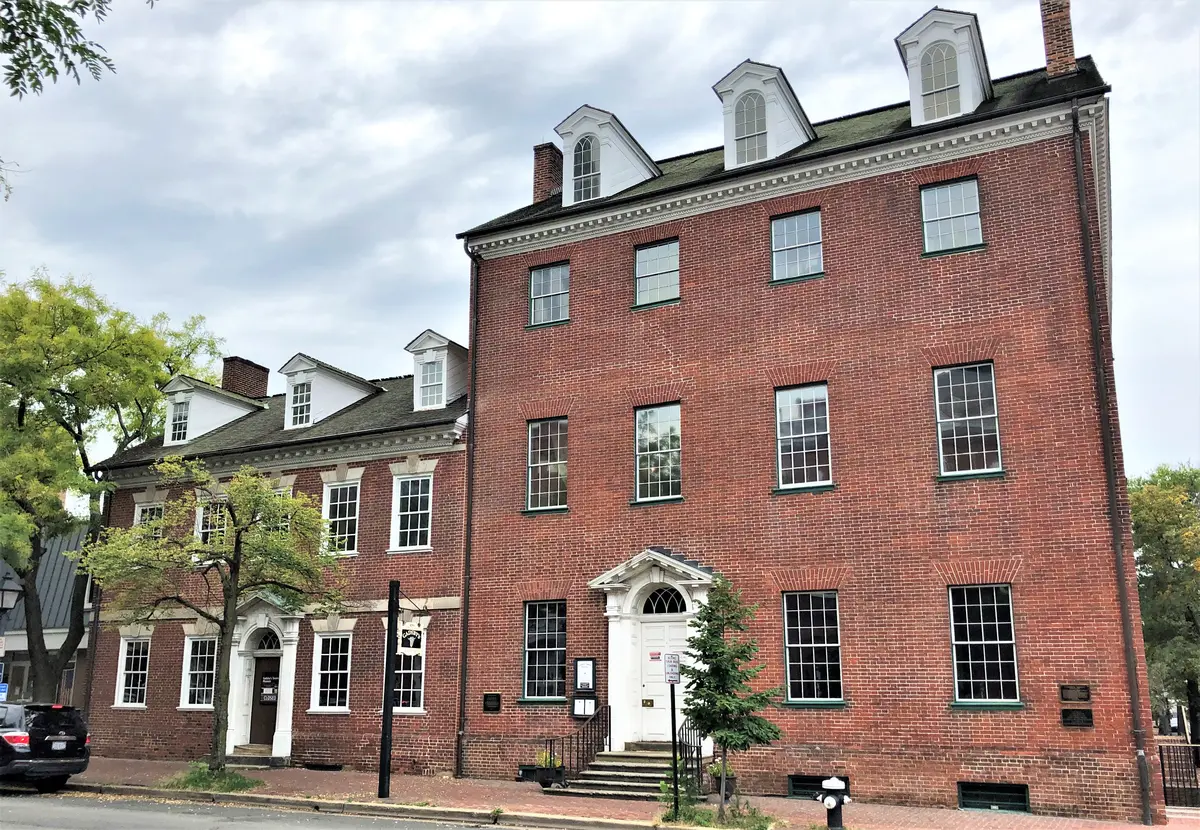
Gadsby's Tavern in Alexandria, Virginia, is two eighteenth-century buildings — a tavern of about 1785 and the City Tavern and Hotel of 1792 — that the merchant John Wise built and the English innkeeper John Gadsby leased from 6 October 1796 until 1808.
Where is Gadsby's Tavern?
- Location
- Virginia, United States
- Type
- Hotel / inn
- Coordinates
- 38.806, -77.044
- Last updated
LOCATION
Why is Gadsby's Tavern said to be haunted?
George Washington attended Birthnight Balls in its ballroom in 1798 and again in 1799, and a month before his death declined the next season's invitation with the line “alas! our dancing days are no more”.
Its ghost story arrived much later. A table tomb in St Paul's Episcopal Cemetery records only that a “Female Stranger” died on 14 October 1816, aged 23 years and 8 months, and was buried by her “disconsolate Husband”. Tradition places her death in an upstairs room here, but Gadsby had left eight years earlier, the owner John Wise had died in 1815, no hotel register survives, and Gadsby's Tavern Museum's own research file dates the first local newspaper account to 20 July 1866 — half a century later, and wrong about the year. The apparitions are newer still: they reach print in the 1990s.
What is the history of Gadsby's Tavern?
Gadsby's Tavern is two buildings, and John Gadsby built neither of them.
The Alexandria merchant John Wise raised the smaller tavern around 1785 at the corner of Royal and Cameron streets, in what was then one of the busiest ports on the Chesapeake. In 1792 he added a three-storey brick hotel beside it, the City Tavern and Hotel, with a ballroom on the upper floor and a gallery above that for the musicians. Under the yard he sank a commercial ice well, dug around 1793 and deep enough for more than sixty tons: in winter enslaved workers cut blocks from the frozen Potomac and hauled them in, so the house could chill its wine and turn out the fashionable new dessert, ice cream. The city's Office of Historic Alexandria states the point without softening it — a large enslaved labour force was what made the tavern's celebrated hospitality possible.
John Gadsby, an Englishman who had reached Alexandria in the mid-1790s, leased the City Hotel from Wise on 6 October 1796 and later took on the older tavern next door as well. He held both until 1808: twelve years, and only twelve. That decade is very nearly the whole of the building's fame. The ballroom took the Birthnight Ball, a British court custom transplanted into a republic and aimed at a private citizen, which is exactly why some Alexandrians thought it improper. George Washington came in 1798 and again in 1799, and his diary entry for the first of them is flat and pleased: he “went with the family to a Ball in Alexa. given by the Citizen[s] of it & its vicinity in commemoration of the Anniversary of my birth day.”
He was back in November 1799 on business and dined at the City Hotel with a few friends. His adopted son, George Washington Parke Custis, remembered Gadsby coming to take the general's order himself and mentioning that there were canvas-back ducks in the larder; Washington asked for the ducks, a chafing-dish, some hominy and a bottle of good Madeira, “and we shall not complain”. On 12 November, from Mount Vernon, he answered the managers of the Alexandria assemblies who had invited him to that winter's dances: “But, alas! our dancing days are no more.” He died on 14 December 1799. Custis, who published the letter in 1860, noted that he had copied it from the original in the Alexandria Museum in 1848.
What happened next matters for the ghost story. Gadsby gave up the lease in 1808 and moved on to the Indian Queen in Baltimore and later to hotels in Washington. John Wise died in 1815. By October 1816 the house had outlived the tenancy of one and the life of the other, and was passing among a succession of keepers as tavern, hotel and boarding house. Those are the years in which, by tradition, the Female Stranger died upstairs.
After the Civil War the buildings slid into shops and rooming houses. In 1917 the Metropolitan Museum of Art bought the ballroom's woodwork, which is still installed in New York as the Alexandria Ballroom. In 1926 American Legion Post 24 bought the property to stop it being demolished. Gadsby's Tavern was designated a National Historic Landmark on 4 November 1963 and entered the National Register of Historic Places on 15 October 1966; the buildings passed to the City of Alexandria in 1972 and reopened as a museum in 1976 for the Bicentennial.
Timeline: the documented record of Gadsby's Tavern
- c. 1785 The Alexandria merchant John Wise builds the smaller tavern at Royal and Cameron streets, the older of the two buildings that now make up the museum.
- 1792 Wise adds the three-storey City Tavern and Hotel next door, with the second-floor ballroom and a musicians' gallery above it.
- c. 1793 A commercial ice well holding more than sixty tons is dug under the yard. According to the Office of Historic Alexandria, enslaved workers cut the ice from the frozen Potomac each winter and hauled it in.
- 6 October 1796 John Gadsby, an English innkeeper, leases the City Hotel from John Wise; he later takes on the older tavern as well and runs both until 1808.
- February 1798 George Washington attends the Birthnight Ball in the new ballroom. His diary records that he went “with the family to a Ball in Alexa. given by the Citizen[s] of it & its vicinity in commemoration of the Anniversary of my birth day”.
- February 1799 Washington attends a second Birthnight Ball at Gadsby's. Gadsby's Tavern Museum records these two years, 1798 and 1799, as the only ones he attended there.
- 12 November 1799 Washington writes from Mount Vernon to the managers of the Alexandria assemblies: “But, alas! our dancing days are no more.” His adopted son G. W. P. Custis printed the letter in 1860, noting that he had copied it from the original in the Alexandria Museum in 1848. Washington died a month later.
- 1808 Gadsby gives up the lease and leaves Alexandria for the Indian Queen in Baltimore. He never returns to run the house.
- 1815 The owner John Wise dies. The National Park Service notes that the tavern then passed through a succession of owners, running as tavern, hotel and boarding house.
- 14 October 1816 The date carved on the table tomb in St Paul's Episcopal Cemetery: a “Female Stranger”, aged 23 years and 8 months, buried by her “disconsolate Husband”. The stone gives no name and no place of death.
- 20 July 1866 The first account in the local press, fifty years after the death, according to the museum's research file. It places the couple at the City Hotel, dates their visit to 1818 rather than 1816, and calls the man a “cheat and a swindler” whose bank notes came back unpaid.
- 1882 William F. Carne publishes The Narrative of John Trust, a story in which the Female Stranger is one of four separated orphans. The museum lists it as one of the three standard versions of the legend, all of them literary in origin.
- 1912 Charles T. Johnson Jr. publishes a third version, in which she is the ward of an English lord who dies in a scuffle, and the couple flee to America. The museum notes that each of these three stories has varied over time.
- 4 November 1963 Gadsby's Tavern is designated a National Historic Landmark; it enters the National Register of Historic Places on 15 October 1966.
- 1992–1993 The museum's research file dates the supernatural version to these two years: the Alexandria Gazette advertised ghost tours built on the Female Stranger in 1992, and L. B. Taylor Jr.'s Ghosts of Virginia (1993) carried the sightings nationally — a woman with a lit candle at a window, a candle found extinguished but still warm.
Is there a rational explanation for Gadsby's Tavern?
Start with the stone, because it is the only hard evidence in the case.
The table tomb in St Paul's Episcopal Cemetery reads, in the transcription published by Gadsby's Tavern Museum: “To the memory of a / Female Stranger / Whose mortal sufferings terminated / On the 14th day of October 1816 / Aged 23 years and 8 months.” It goes on to say the stone was “placed here by her disconsolate Husband in whose arms she sighed out her latest breath”, quotes four lines adapted from Alexander Pope's Elegy to the Memory of an Unfortunate Lady, and closes with a verse from Acts, chapter 10. Popular retellings garble it freely: some print “erected by her disconsolate husband”, some move the death to the 4th of October, and the line “in the full assurance that her Redeemer liveth”, which circulates widely online as her epitaph, is not on the stone at all.
Everything else is late. The museum's own research file states that the story does not reach the local press until 20 July 1866 — fifty years after the date carved on the tomb — and that even that article gets the year wrong, placing the couple's visit in 1818. It describes a woman who died at the City Hotel despite the efforts of a local doctor and some kindly ladies, and calls the man a “cheat and a swindler” because the bank notes he wrote came back unpaid. Other compilations point instead to earlier notices in the Alexandria Gazette in the 1830s and 1840s; the museum's file does not mention them, and the discrepancy is unresolved. On the physical record the museum is blunt: “there are no surviving hotel records to prove these claims.” Nothing ties the death to this address except repetition.
The named identifications fail on arithmetic or on genre. Theodosia Burr Alston, lost at sea in 1813 and the favourite candidate since the 1880s, was born in 1783 and would have been 33 in 1816, not 23 years and 8 months. The other two standard versions are fiction by origin: William F. Carne's Narrative of John Trust, published in 1882, and a 1912 retelling by Charles T. Johnson Jr. were written and printed as stories, and later readers hardened them into history.
The haunting is newer than the tourism. According to the museum's file, the Alexandria Gazette was advertising ghost tours built on the Female Stranger in 1992, and the supernatural version was carried nationally by L. B. Taylor Jr.'s Ghosts of Virginia in 1993 — a woman with a lit candle seen at a window, a candle found extinguished but still warm to the touch. That is the whole documented lineage of the ghost: two centuries after the death, and one century after the legend. Alexandria's late city historian Michael Miller, quoted in 2010, stated the honest position: “Maybe someday, we'll find a new piece of evidence and solve the mystery. Until then, we can only speculate.”
One further reading deserves saying plainly. A man who settled his bills with notes that came back unpaid had every reason to want an unnamed grave, and an unnamed grave carved with Pope is an unusually efficient way of attracting sympathy from a town. That explanation needs no ghost and no lost noblewoman, and it fits the surviving evidence at least as well as any of the romantic versions.
Can you visit Gadsby's Tavern?
Gadsby's Tavern Museum is at 134 North Royal Street, Alexandria, Virginia 22314, a block north of King Street in Old Town; the telephone is 703.746.4242. The City of Alexandria's Office of Historic Alexandria runs it, and the restaurant trading under the Gadsby's name in the adjoining building is a separate business.
The city's visitor page, read on 11 September 2026, publishes two schedules. From mid-March to 31 October the museum opens Monday and Tuesday from 1 to 5 p.m.; Thursday and Friday from 11 a.m. to 4 p.m.; Saturday from 11 a.m. to 5 p.m.; and Sunday from 1 to 5 p.m., with Wednesday closed. From 1 November to mid-March the Monday and Tuesday afternoons go as well, which leaves Thursday to Sunday. The museum also closes on Thanksgiving, Christmas and New Year's Day.
Admission on the same date stood at $5 for adults and $3 for children of 5 to 12; children of 4 and under go free with a paying adult. A dollar comes off for AAA members and for anyone who has eaten at the restaurant. Guided tours of 45 minutes run daily at 1:15, 2:15 and 3:15 p.m. at $8 a head and are recommended for ages 8 and over; the city sells those online in advance, while ordinary admission is bought in person at the museum. The page lists free admission for several groups: residents of Alexandria; city employees; active-duty military and their families; veterans; and members of the American Alliance of Museums and of the Virginia Association of Museums. The Keys to the City pass, $20, covers nine historic sites besides this one, and its holders can upgrade to a guided tour for $3 when there is room.
The house is the exhibit and the Female Stranger is a footnote inside it. The museum's own research file attaches the story to two city locations — the tavern, "where the story claims the lady passed away", and St Paul's Episcopal Cemetery — and ends on the judgement that "even without documentation as to her identity, she remains an important piece of Alexandria's folklore". Commercial ghost walks in Old Town belong to other operators.
Access to the building is documented and awkward. The city's page states that the front door is reached by two stone stairs without a railing; that a gate on the left of the building leads by a short brick path to a ground-level rear entrance; and that reaching the upper floors — the ballroom and the bedchambers are up there — means several period staircases with no lift. Metered parking runs along North Royal Street; the residential streets nearby allow two or three hours, and there are garages a short walk off.
The grave is free and about a mile (1.6 km) to the south-west, in St Paul's Cemetery — one of the thirteen burial grounds the city counts in the Wilkes Street Cemetery Complex at the corner of Wilkes and Payne Streets. The city lists St Paul's among the complex's cemeteries still receiving burials. The stone is a white marble table tomb whose inscription, in the transcription published by the museum, opens "To the memory of a Female Stranger".
Sources consulted
- Gadsby's Tavern Museum, «The Female Stranger (museum research file)» — Office of Historic Alexandria, City of Alexandria, 2018 report
- George Washington Parke Custis (ed. Benson J. Lossing), «Recollections and Private Memoirs of Washington» — New York, 1860 book
- Office of Historic Alexandria, «History of Gadsby's Tavern Museum» — City of Alexandria, Virginia, 2026 archive
- Gadsby's Tavern Museum, «The Birthnight Ball» — City of Alexandria, Virginia, 2026 archive
- National Park Service, «Gadsby's Tavern» — U.S. Department of the Interior, 2026 report
- Alexandria Gazette Packet, «Female Stranger Remains a Mystery» — Connection Newspapers, 2021 newspaper archive
- Office of Historic Alexandria, «Historic Ice Well» — City of Alexandria, Virginia, 2026 archive
- Office of Historic Alexandria, «Admission at Gadsby's Tavern Museum» — City of Alexandria, Virginia, 2026 web
Reviewed by V. Serrano on 2026-08-11 · How we verify our content
💬 Field testimonies (0)
No testimonies yet. Add the first.
Add your testimony
🔒 Log in to add a testimony