👻 HAUNTED PLACE · EXP. Nº9477
ACTIVE
Gadsden Hotel
The Gadsden Hotel opened on Thanksgiving Day 1907 in Douglas, Arizona, a smelter town laid out on the Mexican line to process the copper coming down from Bisbee.
Where is Gadsden Hotel?
- Location
- Arizona, United States
- Type
- Hotel / inn
- Coordinates
- 31.345, -109.554
- Last updated
LOCATION
Why is Gadsden Hotel said to be haunted?
Guests are shown a chip in the seventh step of its white Italian marble staircase and told that Pancho Villa's horse made it. The staircase cannot be the one: Villa was shot dead near Parral in July 1923, fire gutted the hotel from basement to attic in February 1928, and when Trost & Trost rebuilt it in 1929 the lobby stairway was moved from the north side of the room to the east and the marble was laid by Italian artisans brought in for the new building. What the Gadsden does have is a border history that needs no embroidery. On 1 November 1915 Villa threw his army at Agua Prieta a few blocks south, machine-gun fire crossed into Douglas, and a waiter named Louis F. Taylor was hit in the back outside the United States customs house and paralysed. The hotel's own website mentions neither Villa's ride nor its ghosts.
What is the history of Gadsden Hotel?
Douglas exists because of copper. The town was laid out on the Mexican line in the first years of the twentieth century to smelt the ore coming down from Bisbee, and for decades its daily paper printed the copper price in the masthead next to the weather: on the morning of 8 February 1928 the Douglas Daily Dispatch led with "Copper steady; electrolytic spot and futures, 14 1/2c" and, beside it, the boast that Douglas was "the second largest city on the southern United States border, and the gateway to Sonora".
The hotel came out of that boom. A group of local businessmen formed the Gadsden company to give the smelter town a first-class house, ran a prize contest to choose a name — this corner of Arizona had entered the Union through the Gadsden Purchase — and hired Trost & Trost of El Paso to design it and Otto Kreuger, also of El Paso, to build it. It took about a year. The Gadsden opened to the public on Thanksgiving Day 1907 with Thomas Jones as manager, and for the next twenty years its lobby was where cattlemen, mining men and political operators met. It was, the Dispatch noted after it was gone, built "of brick with interior of frame", from an era before a town the size of Douglas required fireproof construction.
The revolution happened on the other side of the fence. On the afternoon of 1 November 1915 Pancho Villa threw his División del Norte at the Carrancista garrison of Agua Prieta, a few blocks south of the hotel. Within two hours of the first gun, machine-gun bullets and shell fragments were falling on American ground. More than seventy rounds swept the front of the United States customs house, among a crowd of soldiers and Mexican women and children crossing the line; a restaurant waiter named Louis F. Taylor was hit in the middle of the back as he turned to run, and was paralysed. General Thomas F. Davis, commanding six thousand American troops on that stretch of border, had to warn both Mexican factions to change the direction of their fire. Colonel Slocum reported from Douglas that Villa, learning that Washington had recognised Carranza and was letting Carrancista reinforcements ride to Agua Prieta through United States territory, had declared "that he would take Agua Prieta if he had to fight the whole Carranza army and the United States combined". He did not take it. Four months later he raided Columbus, New Mexico.
The first Gadsden burned on 7 February 1928. The fire was seen from a mile away around twenty minutes to five in the morning; the alarm went in at about 5:12 from Box 21 at G Avenue and 11th Street, rung by James Hall, a driver for the Douglas Dairy Company. Chief William J. Nemeck, ten firemen and half a dozen volunteers had four streams of water on it within minutes, and it made no difference: the flames had already run under the roof and between the partitions. The hotel was gutted from basement to attic, a loss of roughly $200,000. Its owner, Franklin O. Mackey — who had bought the place some seven months earlier and was in the middle of modernising it — drove in from El Paso and told the paper that "it was a great relief to me to know that every guest got out safely".
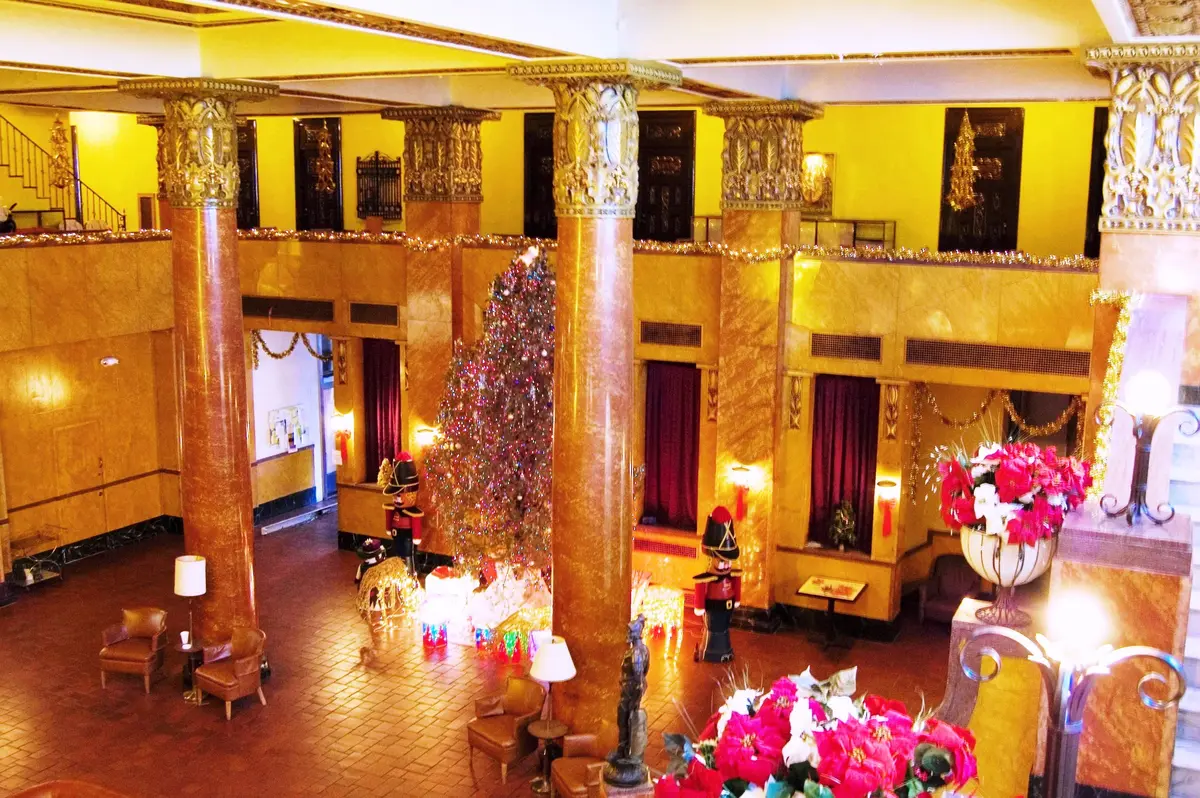
The Mackeys hired the same architects. The second Gadsden opened on Memorial Day, 30 May 1929, and it was a different building: "fireproof material throughout", in the Dispatch's words, with the doors "about all the wood there is to be found in it". The lobby was rebuilt bigger, and rotated — the stairway was shifted from the north side to the east, so that the room now ran north to south instead of east to west. The staircase rises fifteen steps to a landing and splits toward the mezzanine, and at the top of that first flight sits the art glass desert scene, 240 square feet of it. Italian artisans were brought in for the marble and French artisans for the plaster ceiling and its gold leaf. Almost nothing came back from the old hotel; the one object the paper singled out as returning was a bronze by Isidore Bonheur of three horses taking a steeplechase fence, lent by J. S. Douglas, reinstalled on a new pedestal at the exact centre of the lobby.
The Gadsden was listed on the National Register of Historic Places on 30 July 1976. The nomination form is worth reading for its last paragraph, which is not about architecture: the lobby, it says, "is endangered", because the owners might be forced to sell and the prospective buyers wanted to turn the building into a retirement home and dismantle the lobby, selling the windows to help pay for the remodelling.
Timeline: the documented record of Gadsden Hotel
- Thanksgiving Day 1907 The Gadsden opens to the public with Thomas Jones as manager, built by the Gadsden company of local businessmen to a Trost & Trost design, erected by Otto Kreuger of El Paso. It is brick with a frame interior, from an era before Douglas required fireproof construction.
- 1 November 1915 Villa attacks Agua Prieta. Within two hours machine-gun fire crosses into Douglas; more than seventy rounds sweep the front of the US customs house and paralyse a waiter, Louis F. Taylor. Colonel Slocum reports Villa's fury at learning that Carrancista reinforcements had been allowed to cross US territory.
- 20 July 1923 Francisco Villa is ambushed and killed near Parral, Chihuahua, together with his secretary Colonel Miguel Trillo and three men of his escort. Every part of the hotel a visitor is shown today postdates this.
- 1927 Franklin O. Mackey and his wife buy the hotel — about seven months before the fire, according to the Dispatch, though the 1976 National Register form dates the purchase to 1926 — and begin modernising it.
- 7 February 1928 Fire destroys the hotel. The alarm goes in around 5:12 a.m. from Box 21, rung by dairy driver James Hall; Chief William J. Nemeck and ten firemen cannot save it. The building is gutted from basement to attic, a loss near $200,000, with no deaths.
- 30 May 1929 The second Gadsden opens on Memorial Day, fireproof throughout. The lobby stairway is relocated from the north side to the east, 240 square feet of art glass is set at the head of the first flight, Italian artisans lay the new marble, and the only object returning from the old hotel is Isidore Bonheur's bronze of steeplechase horses.
- 30 July 1976 The hotel is listed on the National Register of Historic Places. The nomination warns that the lobby is endangered: prospective buyers wanted to convert the building into a retirement home and dismantle the lobby, selling the windows to defray costs. It does not mention Pancho Villa.
- 25 February 2008 The oldest telling of the staircase story that can be dated and read: owner Robin Brekhus tells KOLD News 13 about a cowboy figure she saw in the basement and a rocking chair moving in room 104, and the report repeats that Villa rode his horse up the stairs and chipped a step.
- 23 February 2016 General manager Joshua Garcia tells KGUN 9 that guests pay extra to sleep in room 333, haunted according to him by a boy who fell from a window. Asked about Villa and the staircase he answers: "I can't say for sure but he was in the area."
- 25 February 2019 Co-owner Anel Lopez tells KGUN 9 that she and her husband Florencio bought the hotel because they had heard it would close if no buyer appeared. She describes 22 rooms in use, metal keys, and the ghost of room 333 as a woman who switches the lamp and television on and off — the third different occupant given to that room in eleven years.
Is there a rational explanation for Gadsden Hotel?
The chip on the seventh step is real, it is white Italian marble, and it has never been repaired. What is not sustainable is the caption.
The arithmetic runs against the story before any archive does. Francisco Villa was ambushed and shot dead near Parral, Chihuahua, on 20 July 1923, along with his secretary Colonel Miguel Trillo and three of his escort. The first Gadsden burned on 7 February 1928 — four and a half years later — and was, in the words of the newspaper reporting it the next morning, "gutted from basement to attic". The building that stands today opened on 30 May 1929. So whatever the marble under that chip is, it is at best five years younger than the man whose horse is supposed to have made it.
The hotel's own account tries to close that gap: its About page says the 1928 fire left "nothing but the elevator car cabin, the marble staircase, and marble columns". The contemporary record does not support a straight survival. The Douglas Daily Dispatch's Gadsden Hotel Edition of 30 May 1929, published to celebrate the new building, describes the rebuilt lobby in detail and states plainly that the stairway was moved "from north to the east side of the lobby" — the flight guests climb today is not merely rebuilt, it is somewhere else in the room. The same edition lists what came back from the old hotel, and it is one item: the Bonheur bronze of steeplechase horses. And the 1976 National Register nomination, the most careful description of the building ever written, says that after the fire "Italian artisans were imported to do the marble work in the new lobby".
The most telling detail is who does not tell the story. The Gadsden itself does not. Its website has never mentioned Pancho Villa's ride, nor a ghost, in any version captured by the Internet Archive between 2014 and 2026; the page that describes the lobby sells a marble staircase as a wedding backdrop. Asked directly by KGUN 9 in 2016 whether Villa had ridden up it, general manager Joshua Garcia answered: "I can't say for sure but he was in the area." That is a fair answer, and it is more cautious than most of what is printed about the hotel.
Dating the telling is harder than it should be. The 1976 nomination form singles out the marble staircase as the lobby's dominant feature and cites Arizona Highways and Sunset among its sources, and does not mention Villa at all. The oldest version I could read and date is a KOLD News 13 piece of 25 February 2008. I could not run a full-text search of books: my control query returned zero results too, so the absence proves nothing there. In digitised newspapers the search is cleaner but the corpus stops early — Chronicling America returns 6,101 pages containing "Gadsden hotel" and 14,738 containing "Pancho Villa", and zero for "Villa rode his horse" or for "horse up the stairs" together with "Gadsden"; the Douglas titles in that collection, however, run out in the early 1930s, so this is a weak negative, not a proof.
The ghosts have the same problem, and one extra. Room 333 is the hotel's famous room, but it has not kept the same occupant. In 2008 the then owner, Robin Brekhus, told KOLD about a cowboy she saw standing in the basement by a fire extinguisher and a rocking chair that moved in room 104, with 333 simply named as the most haunted. In 2016 the manager described 333 as haunted by a boy who fell from a window. In 2019 co-owner Anel López described the resident of 333 as a woman who switches the lamp and the television on and off. Three tellings in eleven years, three different ghosts, one room number. That pattern is what a story looks like when it is being retold rather than reported, and none of the three deaths appears in any record I could find.
There is no published investigation of the building to weigh against them, so no researcher is quoted here saying otherwise. What can be said in plain terms is that the Gadsden is a five-storey concrete-and-steel hotel with a glazed lobby, two coloured skylights, marble surfaces and a mezzanine open to the room below — a set of hard, reflective planes around a tall central void, which is exactly the geometry that carries a voice or a footstep from one floor to somewhere it did not come from.
Can you visit Gadsden Hotel?
The Gadsden Hotel is at 1046 G Avenue, Douglas, Arizona 85607. The telephone number on its own site is (520) 364-4481. The hotel was open and taking bookings when that site was consulted on 9 September 2026, offering three room types: Single King, Double Queen, Jacuzzi Suite King.
The house rules are published in full and they are specific about the hours, giving "Check in time: 3:00 p.m. Checkout time: 11:00 a.m." together with the requirement that guests "must be 21 years and older", while the night rule reads "Quiet hours begin at 9pm. This is a county ordinance." The same page states that "we are a NON-smoking property" and that "we currently do not allow pets to stay at the Gadsden", and on drink that "outside liquor and alcohol is not permitted", with the on-site tavern named as the alternative. The cancellation terms run "Cancellations must be made 24 hours prior to the arrival date. If canceled within 24 hours guest will be charged the cost of the reservation total.", and a no-show is charged for the whole reservation.
There is an electric-vehicle charger on the property, described as "an on-site EV charging station with 80 AMP / 19 KWH charging capability" and priced at "45 cents per KWH". The desk holds a valid driver's licence for the length of the session and returns it on payment, and the same page warns that "Tesla vehicles require an adapter, and adapters are not provided by the hotel."
The hotel publishes no room rates, so the price of a night appears nowhere on the public pages and comes only from the reservation system or the front desk. The site also carries no accessibility statement for a five-storey building of 1929 and says nothing about lifts or doorways anywhere on it, which leaves that question to the telephone as well; both gaps were checked on 9 September 2026.
Sources consulted
- Douglas Daily Dispatch, «Gadsden Hotel Burns; Loss $200,000 / Gadsden Was Opened in 1907 as One of Southwest's Best Hotels by Gadsden Company» — Douglas Daily Dispatch (Douglas, Ariz.), 8 February 1928, pp. 1 and 10, 1928 newspaper archive
- Douglas Daily Dispatch, «Douglas Holds Two Big Dates in Her Hotel History / Gadsden Boasts a Hotel Lobby of Outstanding Beauty (Gadsden Hotel Edition)» — Douglas Daily Dispatch (Douglas, Ariz.), 30 May 1929, Gadsden Hotel Edition, 1929 newspaper archive
- United States Department of the Interior, National Park Service, «National Register of Historic Places Inventory — Nomination Form: Gadsden Hotel (reference 76000371)» — National Register of Historic Places, 1976 report
- Associated Press dispatch from Douglas, Ariz., «American Wounded as Bullets Cross Border» — Daily Kennebec Journal (Augusta, Maine), 2 November 1915, p. 1, 1915 newspaper archive
- Wire dispatch from Chihuahua City, «Francisco Villa Dies by Bullet of Hidden Assassins» — Americus Times-Recorder (Americus, Ga.), 21 July 1923, p. 1, 1923 newspaper archive
- KOLD News 13, «The Gadsden Hotel» — KOLD News 13, Tucson, 2008 web
- KGUN 9, «Gadsden Hotel: history, legend and hauntings» — KGUN 9, Tucson, 2016 web
- Pat Parris, «New life for the historic Gadsden Hotel in Douglas» — KGUN 9, Tucson (Absolutely Arizona), 2019 web
- The Gadsden Hotel, «About the Gadsden Hotel and House Rules / FAQ (official site, consulted 12 August 2026)» — thegadsdenhotel.com, 2026 web
- Internet Archive, «Archived captures of thegadsdenhotel.com, 2014-2026 (no mention of Pancho Villa or of ghosts in any capture)» — Wayback Machine, 2026 archive
Reviewed by V. Serrano on 2026-08-12 · How we verify our content
💬 Field testimonies (0)
No testimonies yet. Add the first.
Add your testimony
🔒 Log in to add a testimony