👻 HAUNTED PLACE · EXP. Nº9478
ACTIVE
General Wayne Inn
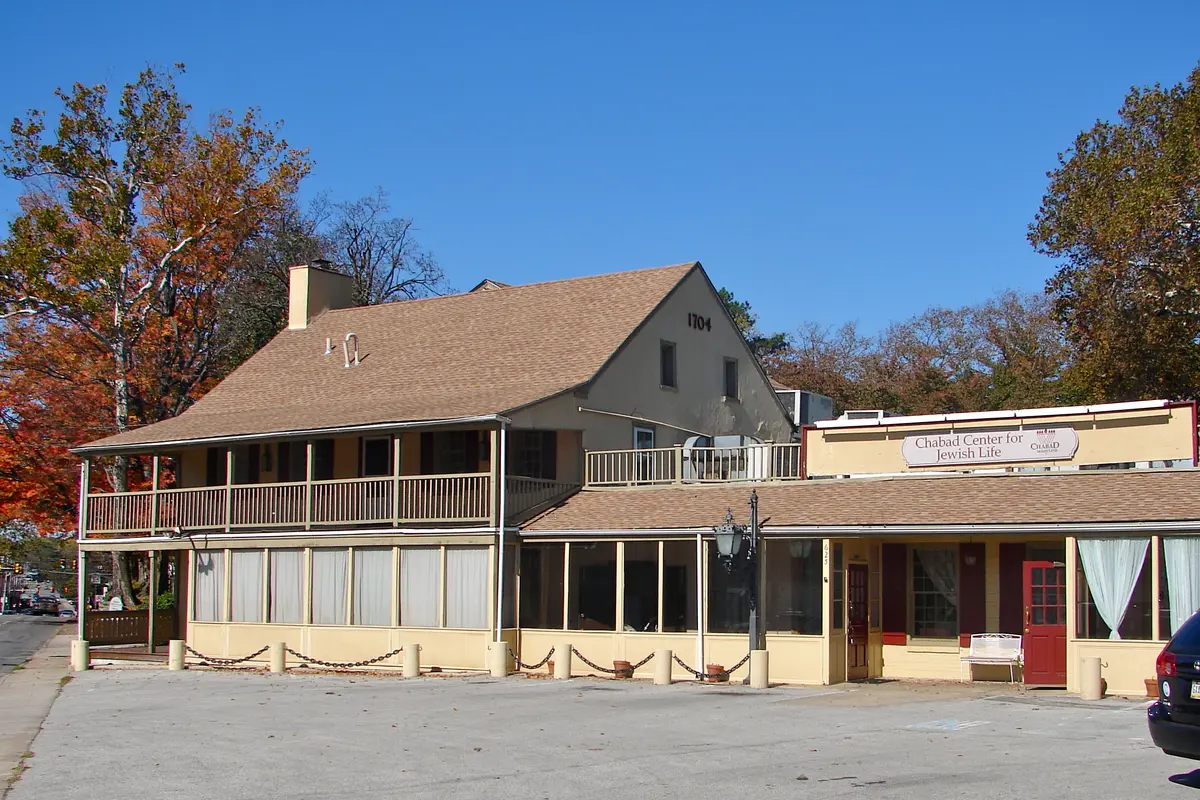
The date 1704 is still painted on the gable at 625 Montgomery Avenue, but the sign underneath it now reads "Chabad Center for Jewish Life".
Where is General Wayne Inn?
- Location
- Pennsylvania, United States
- Type
- Church / religious site
- Coordinates
- 40.009, -75.254
- Last updated
LOCATION
Why is General Wayne Inn said to be haunted?
The building that ghost books call America's oldest continuously operated tavern has not served a drink in some twenty years: it stood largely empty from the late 1990s, was bought in 2005 by Chabad of the Main Line and reopened in the autumn of 2006 as an Orthodox synagogue and community centre. What is left is a much better story than the folklore. Its two famous ghosts can be dated: Edgar Allan Poe never wrote "The Raven" here, as his own scholarly editor said in print in 1969, and the Hessian soldier called Wilhelm cannot be found in the two detailed local descriptions of the inn published in 1905 and 1922, both of which happily tell ghost stories about other places. The oldest account of him anyone can date is from 1986, and the local paper named the man who told it: the landlord. And in December 1996 a real killing happened here, with a court record and a victim's name — which is exactly why it does not belong in a ghost story.
What is the history of General Wayne Inn?
The building at 625 Montgomery Avenue, in Merion Station just west of Philadelphia, still carries the date 1704 painted on its gable. That is also the date the federal government accepted. The National Register nomination form drawn up in December 1974 by Elizabeth M. Brown and J. Robert Mendte states that "in 1704 the Welsh Quaker leader, Edward ap Rees, purchased an acre of ground on which a wayside inn was erected", and the property was listed on 1 January 1976 under reference number 76001655.
Local historians are less certain. Writing for the Lower Merion Historical Society, Mary M. Wood and James B. Garrison open their account of the inn with a warning — "Myths overlaid facts about this special gathering place for more than 250 years" — and date the surviving walls to 1709, built for Robert Jones (Robert ap John), a member of the Provincial Assembly who, they point out, was never an innkeeper. On their reading the first person known to have served food on the site was Anthony Tunis, who rented the property from Jones's grandson Silas some time after 1746 and ran it as an "Ordinary", a house serving meals at a fixed price. Whichever date is right, the reason the place mattered is the same: it stood on the King's Highway, the Great Conestoga Road, the route by which Philadelphia reached Lancaster and the country beyond the Susquehanna.
Abraham Streaper bought the tavern in 1775 and probably enlarged it. On Sunday 14 September 1777, after Brandywine, Washington's army forded the Schuylkill at Levering's ford and camped in an open field by the Merion meeting house next door; the Lower Merion account quotes a participant's journal on "the water being nearly up to the waist" and then adds, drily, that "perhaps Washington had a bowl of soup at the Streepers, but proof is lacking". The 1974 nomination form is far more generous: it has General Wayne dining and lodging at the inn, Washington and Lafayette staying the following night, the British holding it as an outpost from 20 December 1777 to 1 February 1778 and Captain Allen McLane running his spy operations from it afterwards. The form cites four general histories for the whole statement and gives no source for any single claim.
Where the name came from has three incompatible answers in print. Phebe Westcott Humphreys, in a 1905 motoring guide, attributed it to Wayne encamping there "probably in 1792" on his western expedition. The 1974 nomination form dates it precisely to 9 February 1795, when three troops of Philadelphia Light Horse supposedly rode out to Streeper's Tavern to fete Wayne on his return from Fallen Timbers. Wood and Garrison demolish that version with a document: Joseph Price, a neighbour who drank at Streeper's bar and was courting Mary Streeper, kept a diary, and for the days of the supposed reception he recorded fox hunting, coffin making and attending Merion Meeting. They also cite an advertisement of 1790 for a stolen horse, to be returned to "Abraham Streeper, living at the sign of General Wayne" — five years before the celebration that is said to have produced the name.
The long civilian life of the place is better documented than any of it. The inn was the district polling place from 1806 to 1867; the General Wayne post office opened on 5 February 1830, closed, reopened in 1850 and moved away in 1882. Yerkes's daughter sold the property to David Young for $13,500 in 1854; James Baird owned it from 1883 and Edward O'Dell from 1897; a sheriff's sale delivered it to I. Newton Smith in 1936. Humphreys described it in 1905 as a two-storey stone and plaster building painted yellow, its oldest walls twenty-six inches thick. In 1922 Dora Harvey Develin recorded the old signboard on its pole outside, lettered "Established in 1704", and added a footnote: since Prohibition came in, the sign had been taken down. A brick dining room went up at the rear in 1940 and a fire in 1964 seriously damaged the interior, which was rebuilt around what survived. When the nomination form was filed, the owner of record was Barton B. Johnson — the landlord the Main Line Times would later remember as the man who told the ghost stories.
On 17 November 1995 the inn was bought for $1,286,000 by two chefs, James Edwin Webb and Guy Angelo Sileo Jr., each holding half the stock of the company; the restaurant opened that December. What happened next is in the public judicial record. On the morning of 27 December 1996 Webb was found dead in his third-floor office, killed between 7 p.m. and midnight the previous evening by a single .25 calibre bullet to the back of the head. On 1 August 2001 a Montgomery County jury convicted Sileo of first-degree murder; he was sentenced to life imprisonment, and on 1 September 2011 the Superior Court of Pennsylvania, sitting en banc, affirmed the denial of his post-conviction petition. The court's summary of the evidence is financial and mundane: the restaurant was insolvent, a $650,000 policy on Webb's life was payable to the business, and Webb had told an advertising salesman he meant to end the partnership after New Year.
The restaurant never recovered. It passed through three owners trying everything from Cajun food to a sports bar; in May 2002 its own website announced a re-opening under Frank Cacciutti of the Seven Stars Inn, and by 2004 the domain had become a parking page. The building stood empty for most of the decade. In 2005 Rabbi Shraga Sherman and his wife Michal, directors of Chabad of the Main Line, assembled a partnership to buy it, and after roughly two years of restoration the Chabad Center for Jewish Life opened in the autumn of 2006, in time for the Jewish New Year. It is a synagogue and community centre today.
Timeline: the documented record of General Wayne Inn
- 1704 According to the National Register nomination form, the Welsh Quaker leader Edward ap Rees buys an acre of ground on which a wayside inn is erected. The date is painted on the gable to this day.
- 1709 The Lower Merion Historical Society dates the surviving walls to this year and to Robert Jones, a member of the Provincial Assembly who was never an innkeeper; the first known ordinary was run later by his grandson's tenant, Anthony Tunis.
- 14 September 1777 Washington's army fords the Schuylkill at Levering's ford and camps by the Merion meeting house next door. The local history is careful: "perhaps Washington had a bowl of soup at the Streepers, but proof is lacking".
- 1790 An advertisement for a stolen horse asks that it be returned to "Abraham Streeper, living at the sign of General Wayne" — the earliest documented use of the name, five years before the reception said to have produced it.
- 9 February 1795 The date on which the 1974 federal nomination says Philadelphia Light Horse troops feted General Wayne here after Fallen Timbers. The diary of neighbour Joseph Price records fox hunting, coffin making and Quaker meeting for those days.
- 1905 Phebe Westcott Humphreys describes the inn over two pages of her motoring guide — deeds, wall thickness, yellow paint, the Washington claim — and mentions no ghost, although the same book sends motorists to Castle Rock for "a ghostly visit".
- 1922 Dora Harvey Develin records the signboard outside lettered "Established in 1704", and notes in a footnote that Prohibition has caused it to be taken down. Her account contains no ghosts, no Hessian and no Poe.
- 1964 A fire seriously damages much of the interior, according to the nomination form; the inside is rebuilt around the original fabric that survived, and the ground floor is fitted out as a colonial tavern.
- 1 January 1976 The building is listed on the National Register of Historic Places, reference 76001655. The owner recorded on the form is Barton B. Johnson, the landlord later remembered as the teller of the ghost stories.
- 1986 Arthur Myers devotes a chapter of The Ghostly Register to the inn — the oldest printed account of its hauntings that I have been able to date.
- 26 October 1988 NBC's Unsolved Mysteries broadcasts the segment "The Unexplained: The General Wayne Inn" in its first season, taking the story to a national audience.
- 17 November 1995 James Edwin Webb and Guy Angelo Sileo Jr. buy the Inn for $1,286,000, each holding half the stock. The restaurant opens that December and never turns a profit.
- 27 December 1996 Webb is found dead in his third-floor office, killed the previous evening by a single .25 calibre shot to the back of the head. On 1 August 2001 a jury convicts Sileo of first-degree murder; he is sentenced to life.
- May 2002 The inn's own website announces a re-opening under Frank Cacciutti of the Seven Stars Inn. By 2003 the domain serves a hosting advert, and by 2004 a parking page: the business is gone.
- Autumn 2006 After a purchase in 2005 by a partnership assembled by Rabbi Shraga Sherman and about two years of restoration, the building reopens as the Chabad Center for Jewish Life, a synagogue and community centre.
- 1 September 2011 The Superior Court of Pennsylvania, sitting en banc, affirms the denial of Sileo's post-conviction petition, describing the evidence of guilt as overwhelming.
Is there a rational explanation for General Wayne Inn?
The two star attractions of the General Wayne Inn's ghost lore can both be dated, and neither survives the exercise.
The first is Edgar Allan Poe, said to have written part of "The Raven" at the inn and to have carved his initials into a windowsill. The standard scholarly edition of the poem disposes of it in one sentence. Thomas Ollive Mabbott, editing the Collected Works of Edgar Allan Poe for Harvard, wrote: "The story told at the General Wayne Inn, Merion, Pennsylvania, that Poe wrote part of 'The Raven' there seems to me due to the zeal of a local historian." Mabbott also fixes the poem's composition: its metrical form "seems to place its composition not earlier than 1844", and he traces the surviving eyewitness account to the Brennan farm near the Hudson late that year. Popular versions of the inn legend that date Poe's visit to 1836 or 1839 are therefore describing a visit that could not have produced the poem, whatever else Poe may have done in Pennsylvania.
The second is Wilhelm, a Hessian soldier said to have been killed in 1777 and dragged into the cellar. The oldest account of him I have been able to date is not a colonial one. In 1986 Arthur Myers gave the inn a chapter in The Ghostly Register; on 26 October 1988 the NBC series Unsolved Mysteries broadcast a segment on it in its first season; the ghost books multiply from there. When the Main Line Times looked back on the stories in 2006, its columnist Mike Weilbacher — executive director of the Lower Merion Conservancy, and no believer — named their source plainly: Wilhelm walked down the bar blowing on the necks of women seated there, "longtime owner Bart Johnson liked to recount". The teller was the man selling the drinks.
Against that, two detailed local descriptions of the building say nothing at all. Phebe Westcott Humphreys devoted two pages to the inn in her 1905 motoring guide — its deeds, its thickness of wall, its yellow paint, the claim that Washington dined there — without a word about a ghost. Dora Harvey Develin did the same in 1922, down to the lettering on the signboard. The silence is meaningful because both authors were happy to tell ghost stories elsewhere: Humphreys' own book proposes a moonlit run out to Castle Rock for "a ghostly visit" and promises "the indispensable ghost certain to haunt such homesteads" at another stop, and describes the Hessian prisoners of Trenton in another chapter. She simply had no ghost to report here. A popular guide of 2015 asserts that the inn's ghost stories "have been told since 1848"; it gives no source, and I could find none.
The superlative attached to the place deserves the same treatment. Ghost books call it the oldest continuously operated inn, tavern or restaurant in the United States. Develin's 1922 footnote records the signboard being taken down when Prohibition arrived; a fire gutted much of the interior in 1964; and the building stood largely empty from the late 1990s until 2006. Whatever "continuously" means, it does not mean that.
It is worth noting where one error was manufactured. The 1974 nomination form asserts, as fact, that the inn was renamed after a reception for General Wayne on 9 February 1795 — a story a diary kept two doors away contradicts, and which an advertisement of 1790 makes impossible. Once a claim reaches a federal heritage file it is copied for decades. The same form, often cited today as evidence of the building's haunted reputation, contains no ghosts, no Hessian and no Poe: I have read it.
Finally, the murder. James Webb's death in December 1996 is documented, prosecuted and on the appellate record, and it has nothing to do with the folklore. Ghost-tour writing habitually runs the two together, as though a modern homicide confirmed a colonial haunting or a colonial haunting explained a homicide. It does neither. A man was killed in an office over a failing restaurant for reasons a jury found to be financial, and his family is alive to read about it.
Can you visit General Wayne Inn?
The building at 625 Montgomery Avenue, Merion Station, Pennsylvania 19066, has been a synagogue for twenty years. Chabad of the Main Line bought it in 2005 and opened it in the autumn of 2006 as the Chabad Center for Jewish Life. On 22 September 2026 the congregation's site, chabadmainline.org, gave that address and carried a calendar of daily and Shabbat services, adult classes in Torah, Kabbalah and Talmud, a Hebrew school and youth programmes. Those same pages advertise no exhibit and no tour of any kind: the congregation is the building's only occupant and its only business.
The restaurant's web address has gone too. A DNS query for generalwayneinn.com on 22 September 2026 returned NXDOMAIN — the domain has been released and no longer resolves to anything.
The killing that ended the restaurant is documented in the court record. Guy Sileo, one of its two owners, was convicted of murdering his partner James Webb inside the building in April 1996, and the Superior Court of Pennsylvania reviewed that conviction en banc in 2011 at 32 A.3d 753. The congregation bought the premises nine years after the shooting and had nothing to do with it.
The facade is fully visible from Montgomery Avenue and carries the whole sequence at once: stuccoed stone, a double porch the length of the front, the date 1704 painted high on the gable, and under it the modern sign of the Chabad Center for Jewish Life. The inn was listed on the National Register of Historic Places in 1976 under reference number 76001655. The Merion Friends meeting house next door was listed on 5 August 1998, and in September of that same year a petition to the Pennsylvania Historical and Museum Commission joined the two into the Merion Friends Meeting/General Wayne Inn Historic District, which is what now governs alterations to the exterior.
Merion station, on SEPTA's Paoli/Thorndale Regional Rail line at 293 Idris Road, is the nearest stop, and its building also houses the village post office. Montgomery Avenue at this point is a busy suburban road with narrow footways.
Sources consulted
- Elizabeth M. Brown and J. Robert Mendte, «National Register of Historic Places Inventory — Nomination Form: General Wayne Inn (ref. 76001655)» — Pennsylvania Historical and Museum Commission / National Park Service, 1974 report
- Dora Harvey Develin, «Historic Lower Merion and Blockley» — Philadelphia, 1922 book
- Phebe Westcott Humphreys, «The Automobile Tourist: Motor Car Journeys from Philadelphia, with Historical and Descriptive Notes» — Ferris & Leach, 1905 book
- Mary M. Wood and James B. Garrison, «The General Wayne Inn, in The First 300: The Amazing and Rich History of Lower Merion» — Lower Merion Historical Society book
- Thomas Ollive Mabbott, «Collected Works of Edgar Allan Poe, Vol. I: Poems — notes to "The Raven"» — Harvard University Press, 1969 book
- Superior Court of Pennsylvania, «Commonwealth of Pennsylvania v. Guy Angelo Sileo Jr., 32 A.3d 753 (Pa. Super. 2011) (en banc)» — Atlantic Reporter, 3rd series, vol. 32, 2011 report
- Mike Weilbacher, «Haunted history and the rebirth of the General Wayne Inn» — Main Line Times, 2006 newspaper archive
- Arthur Myers, «The Ghostly Register: Haunted Dwellings, Active Spirits — chapter "A 1704 Restaurant, Merion, Pennsylvania"» — Contemporary Books, Chicago, 1986 book
- «List of Unsolved Mysteries episodes — season 1, episode 3 (26 October 1988)» — Wikipedia web
- «Archived captures of generalwayneinn.com, 2002-2004» — Internet Archive Wayback Machine, 2002 archive
- «Chabad of the Main Line — official website» — Chabad of the Main Line, 625 Montgomery Avenue, Merion Station web
Reviewed by V. Serrano on 2026-08-12 · How we verify our content
💬 Field testimonies (0)
No testimonies yet. Add the first.
Add your testimony
🔒 Log in to add a testimony