👻 HAUNTED PLACE · EXP. Nº9477
ACTIVE
George Stickney House
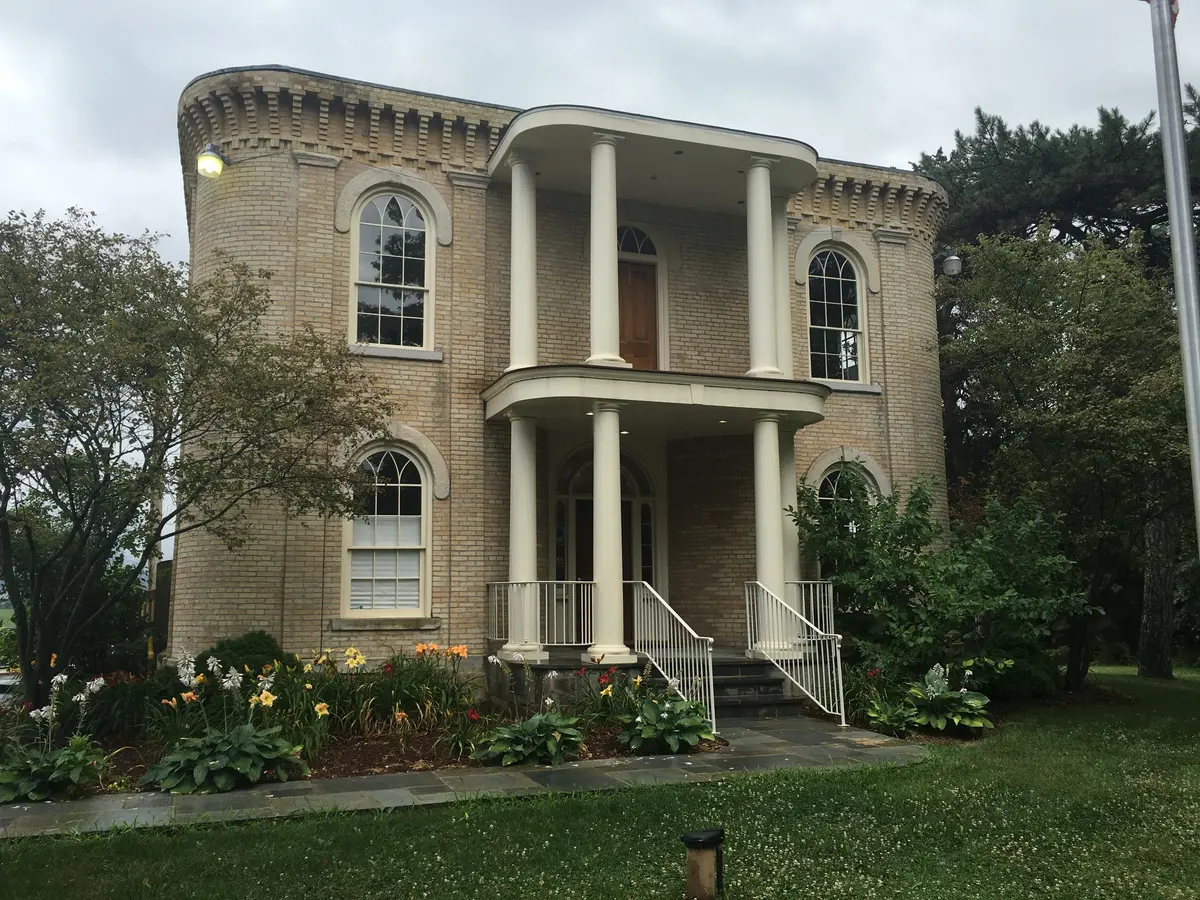
The house that George and Sylvia Stickney began building in 1849 on Cherry Valley Road, in what is now Bull Valley, Illinois, really does have no square corners on the outside: the brick turns in a smooth radius at all four corners and the heavy Italianate cornice bends to follow it.
Where is George Stickney House?
- Location
- Illinois, United States
- Type
- House / mansion
- Coordinates
- 42.301, -88.352
- Last updated
LOCATION
Why is George Stickney House said to be haunted?
The Stickneys were Spiritualists who had buried seven of their ten children, and the village of Bull Valley states in its own brochure that their faith led them to build "with no square corners to prevent spirits from being trapped within." The famous sequel — that one 90-degree corner was left in by mistake, and that George Stickney was later found dead in it — does not survive contact with the record. The family sold the house to J. S. Watrous in 1872 and moved away; Sylvia died in 1879 and George in 1897, of apoplexy and heart disease, twenty-five years after leaving. The building today is neither a ruin nor a museum: it is the Bull Valley village hall and police station, still being restored on private donations.
What is the history of George Stickney House?
George Stickney was the first white settler of what is now Nunda Township, McHenry County. The county history published by Munsell in 1922 puts it flatly: "The first white man to invade the confines of what is now Nunda Township was George Stickney, who came in December, 1835, locating on section 6, where he erected the first house in the township." That first house was a log cabin, and the same page records a detail worth keeping: it "contained no iron of any description, wooden pegs being used instead of nails."
He had been born in Jaffrey, New Hampshire, on 26 June 1809. On 27 October 1839 he married Sylvia Marilla Beckley, daughter of another pioneer family, in what local record-keepers call the first marriage entered in the township. The Stickneys took title to the land in 1840. He served as the township's first supervisor, as road commissioner, and for sixteen years as director of the Holcombville school.
Then came the children, and this is the part of the story that matters. The couple had ten — some accounts say twelve — and seven of them died young. Three of those deaths fell in three consecutive years: Orange Harrison (1840–1841), Adaline Lovina (1841–1842), Rosira Elmina (born and dead in 1843). Caroline Levia lived from 1849 to 1851; Phoebe Silona from 1857 to 1868. Most of the family lies in Holcombville Cemetery, a mile or so from the house.
The Stickneys were Spiritualists, in the decades when Spiritualism claimed millions of adherents across North America. The village of Bull Valley states the connection plainly in its own brochure: their faith "informed the design of their prominent home on Cherry Valley Road, built with no square corners to prevent spirits from being trapped within."
That home was begun in 1849 and finished, ten rooms of cream-coloured brick, in 1856. It is Italianate: two storeys under a heavy bracketed cornice, tall round-arched windows, a two-storey columned portico, and a second-floor ballroom running the length of the building where the séances were held. And the corners of the outer walls do not turn — they curve, and the cornice curves with them. The village brochure calls it, in period language, the "House with Round Corners."
What almost no retelling includes is what happened next. The Stickneys left. By 1872 George was living several miles to the south-east, growing grapes, and the house had been sold to J. S. Watrous, who stripped off its second-floor porches and went on to build the Crystal Spring Butter and Cheese Factory, winning a gold medal for his butter at the Philadelphia Centennial Exhibition in 1877. Sylvia Stickney died on 21 September 1879, aged sixty-six. George Stickney died on 11 March 1897, aged eighty-seven; the cause recorded for him is apoplexy and heart disease. Neither of them died in the house with the round corners. They had been out of it for a quarter of a century.
Timeline: the documented record of George Stickney House
- December 1835 George Stickney, born in Jaffrey, New Hampshire, in 1809, arrives in what is now Nunda Township and builds the first house in the township, a log cabin put together with wooden pegs instead of nails.
- 27 October 1839 He marries Sylvia Marilla Beckley, daughter of another pioneer family. Of their ten children, seven die young; three of them within three consecutive years, 1841, 1842 and 1843.
- 1849–1856 Construction of the brick house on Cherry Valley Road, begun in 1849 and completed with ten rooms in 1856. The village's own brochure calls it the "House with Round Corners" and states that the Stickneys' Spiritualist faith led them to build it "with no square corners to prevent spirits from being trapped within."
- 1872 The Stickneys have left. George is living several miles to the south-east, growing grapes, and the house passes to J. S. Watrous, who removes its second-floor porches. This is the fact that dismantles the legend: the family no longer lived there.
- 21 September 1879 Sylvia Stickney dies in Nunda Township aged sixty-six and is buried at Holcombville Cemetery — eighteen years before her husband, which is the reverse of the order given in the popular version of the story.
- 11 March 1897 George Stickney dies at eighty-seven, twenty-five years after selling the house. The cause recorded for him is apoplexy and heart disease, not an unexplained collapse in a right-angled corner.
- 1960s–1970s The house stands derelict and is squatted. Rooms are painted dark, fires are lit on the floors, and spray paint and drug paraphernalia are left behind. Foundation president Nicole Horn later recalled beetle infestations and animals inside. This, not a séance, is the period in which the building's bad reputation forms.
- 14 May 1979 The George Stickney House is listed on the National Register of Historic Places, reference number 79003115. The nomination text has still not been digitised on the National Park Service's NPGallery, so its description of the plan cannot be consulted online.
- 1986–1991 The house and two acres are deeded to the Village of Bull Valley, which makes it its village hall; the village's own timeline dates the police department's move in to 1991, while the 2005 WGN-TV report says the offices had been there since 1985. The Stickney House Foundation is set up in 1991 to restore the building on private donations.
- 1997 Ursula Bielski's Chicago Haunts is the oldest printed treatment of the haunting I have been able to date; its index carries "Stickney, George" and the "Stickney House Restoration Committee" side by side.
- 2001 Troy Taylor publishes "The Stickney Mansion — The House with No Square Corners" on Ghosts of the Prairie. It is the source of the modern story, it labels the fatal corner as legend, it gets the order of the couple's deaths backwards, and it reports the official line of the day: "while the house was badly treated by vandals, it is not, nor was it ever, haunted."
- 31 October 2005 A WGN-TV Halloween segment by Juan Carlos Fanjul reverses that official line. Police chief Norbert Sauers describes footsteps in the ballroom, doorknobs turning and a shout in his ear; the curator of the McHenry County Historical Society, Nancy Fike, explains the round corners in spiritualist terms. This broadcast is what most later accounts mean when they say the police confirm it.
- 2022 The Historic Preservation Program of the School of the Art Institute of Chicago draws a measured ground-floor plan of the house and, with the village, publishes the "Living with the Land" restoration plan. The plan confirms the rounded external corners and the coved parlours — and shows ordinary right angles where the interior partitions meet.
Is there a rational explanation for George Stickney House?
The legend has two halves, and they do not hold up equally.
The architecture is real. This is unusual enough to say twice. Photographs of the west and north elevations show the brickwork of the outer corners turning in a smooth radius, with the bracketed cornice bending to follow it — no mason does that by accident. The measured ground-floor plan drawn in 2022 by the Historic Preservation Program of the School of the Art Institute of Chicago, and published by the village itself, shows the same thing from above: a rectangular footprint whose four external corners are struck as quarter-circles, and two front parlours whose internal corners are coved rather than square. Even the walnut front door was cut on a radius to match. Whatever the Stickneys believed, they paid for it in brick.
The dead man in the corner is not real. The story says a single 90-degree corner was left in the house by mistake, and that George Stickney was found dead in it. Three things are wrong with that. First, the same 2022 plan that confirms the rounded corners also shows ordinary right-angled junctions where the interior partitions meet in the service rooms and around the stair: the house has right angles, more than one, and they are not a secret. Second, George Stickney did not die in the house. The Stickneys had moved out by the early 1870s and the property was sold to J. S. Watrous in 1872; George died in 1897, twenty-five years later. Third, his death was not unexplained: the cause recorded for him is apoplexy and heart disease.
The relato can be dated. The oldest printed treatment I have been able to fix is Ursula Bielski's Chicago Haunts (Lake Claremont Press, 1997), which indexes both "Stickney, George" and the "Stickney House Restoration Committee" — the ghost and the fundraising campaign arriving together. The version everyone now repeats, however, is traceable to a single web page: Troy Taylor's "The Stickney Mansion — The House with No Square Corners", on Ghosts of the Prairie, copyright 2001. Every element of the modern story is there, and Taylor was careful enough to flag the crucial one as folklore: "According to legend though, one corner of a room accidentally ended up with a 90-degree measurement." He also got the sequence backwards, writing that after George's death Sylvia "lived on in the house and gained considerable fame as a spirit medium." Sylvia died eighteen years before her husband, and neither of them was living there.
And there is a much better explanation for the haunting, in Taylor's own text. The house stood derelict through the 1960s and 1970s. A former resident named Rodrick Smith moved out and began saying he had heard noises and that the place had been "tainted" by devil-worshippers — who, Taylor concedes, turned out to be squatters who painted the rooms dark, lit fires on the floors and left spray paint and drug paraphernalia behind. The Stickney House Foundation's own account matches: "At the very beginning we had beetle infestations and animals. People were squatting in there during the 1970s," its president Nicole Horn told the McHenry County Historical Society. A burnt, spray-painted, roofless-feeling brick mansion with curved walls, empty for years, on an empty country road, does not need a ghost to acquire one.
What the authorities say — and how it changed. Taylor's 2001 page reports the official position of the day without softening it: "The official word is that, while the house was badly treated by vandals, it is not, nor was it ever, haunted." Four years later, on 31 October 2005, WGN-TV ran a Halloween segment in which the Bull Valley police chief, Norbert Sauers, said the opposite on camera — footsteps in the ballroom, doorknobs turning, a shout in his ear, two officers who had quit — and it is that broadcast, not any archive, that most later accounts are quoting when they say "the police confirm it."
Today the village says nothing at all. I read all thirty-four pages of the official Village of Bull Valley website (about 1.25 MB of text) looking for ghost, haunted, paranormal, séance or spiritualism: zero occurrences. In the same sweep, "police" appears 255 times and "village" 988. The village's history page describes its headquarters only as "an historic 1800's Georgian style residence that was formerly home to the first family to settle in the area." The spiritualist design survives in the village's brochure; the ghosts do not.
Can you visit George Stickney House?
The house at 1904 South Cherry Valley Road, Bull Valley, Illinois 60098 is the seat of the Village of Bull Valley and of the Bull Valley Police Department. On 23 September 2026 the village's website gave the clerk's office hours as "M-W-F, 9a-3p", with the village clerk on 815-459-4833 and the police non-emergency line on 815-459-4728; it listed no tours or open days for the house. The village's history page describes its headquarters as "an historic 1800's Georgian style residence that was formerly home to the first family to settle in the area." The building has been on the National Register of Historic Places since 14 May 1979, under reference 79003115.
The curved brick corners, with the bracketed cornice bending round them, are on the outside of the building and face Cherry Valley Road. When the McHenry County Historical Society wrote about the restoration in 2013, one of the people interviewed said: "Whenever I'm there, there is someone who is walking in who wants to take a photograph and know more about it."
That 2013 article is also the most detailed published account of the interior. By then the house had been "under a slow restoration for 20 years", paid for from "private donations and not taxpayers". All 15 windows were being replaced with similar or original materials, some 2,700 vintage bricks had gone into repairs in 2002, a ramp for disabled access had been added on the east side and the basement's dirt floor had been replaced with cement. "At least a quarter million dollars" had been spent, and the foundation's president, Nicole Horn, put the cost of renovating the second floor, where the 30-by-30-foot ballroom is, at another $200,000.
In 2022 the village and the Historic Preservation Program of the School of the Art Institute of Chicago published "Living with the Land", a phased plan for the house, the surrounding farmstead and a trail along Cherry Valley Road. On 23 September 2026 the project's website, run by the village, set out the order of the work: an existing barn is to be adapted so that the present offices can move into it, "making the Stickney House available for restoration."
The family is buried at Holcombville Cemetery on Crystal Springs Road, about 2.2 km (1.4 miles) south-east of the house in a straight line. George (1809–1897) and Sylvia (1813–1879) lie there with several of their children.
Sources consulted
- School of the Art Institute of Chicago, Historic Preservation Program, con el Village of Bull Valley, «Stickney House / Stickney Farmstead — folleto y presentación del plan «Living with the Land», con la cronología de propietarios (1835-1991) y el plano acotado de la planta baja» — Village of Bull Valley, 2022 report
- McHenry County Historical Society and Museum, «Stickney House renovation brings a lot of angles — restauración, cronología familiar y estado del edificio, con declaraciones de Nicole Horn, Virginia Peschke, Peter Helms y Michelle Stankus» — McHenry County Historical Society and Museum, 2013 web
- Munsell Publishing Co., «History of McHenry County, Illinois, vol. I — capítulo de Nunda Township, «Early Settlers» (p. 442-443)» — Chicago: Munsell Pub. Co., 1922 book
- Find a Grave, «Memoriales de George Stickney (1809-1897) y Sylvia Marilla Beckley Stickney (1813-1879), Holcombville Cemetery, McHenry County, Illinois — fechas, causa de muerte e hijos» — Find a Grave, 2026 archive
- Troy Taylor, «The Stickney Mansion — «The House with No Square Corners»» — Ghosts of the Prairie (prairieghosts.com), copia archivada en la Wayback Machine, 2001 archive
- Juan Carlos Fanjul, «WGNTV CoverStories: Stickney House — entrevistas al jefe de policía Norbert Sauers y a Nancy Fike, conservadora de la Sociedad Histórica del condado de McHenry» — WGN-TV, Chicago (copia archivada en la Wayback Machine), 2005 interview
- National Park Service, «National Register of Historic Places, ficha n.º 79003115 — Stickney, George, House, 1904 Cherry Valley Rd., McHenry County, Illinois; inscrita el 14 de mayo de 1979. El expediente de nominación no está digitalizado» — NPGallery, National Register of Historic Places, 1979 report
- Ursula Bielski, «Chicago Haunts: Ghostly Lore of the Windy City — el tratamiento impreso más antiguo del caso que he podido fechar (índice: «Stickney, George, 175»; «Stickney House Restoration Committee, 176»)» — Chicago: Lake Claremont Press, 1997 book
- Village of Bull Valley, «Our Village and History — web oficial del Village of Bull Valley: describe su sede como «una residencia histórica de estilo georgiano del siglo XIX» y no menciona en ninguna de sus 34 páginas fantasmas, embrujo ni espiritismo» — thevillageofbullvalley.com, 2026 web
- McHenry County Historic Preservation Commission, «McHenry County Comprehensive Landmark List — origen documentado de la fecha «1865» que circula por internet, frente al 1849-1856 de las fuentes locales» — McHenry County, Illinois, 2016 report
Reviewed by V. Serrano on 2026-08-12 · How we verify our content
💬 Field testimonies (0)
No testimonies yet. Add the first.
Add your testimony
🔒 Log in to add a testimony