👻 HAUNTED PLACE · EXP. Nº9475
ACTIVE
Glen Tavern Inn
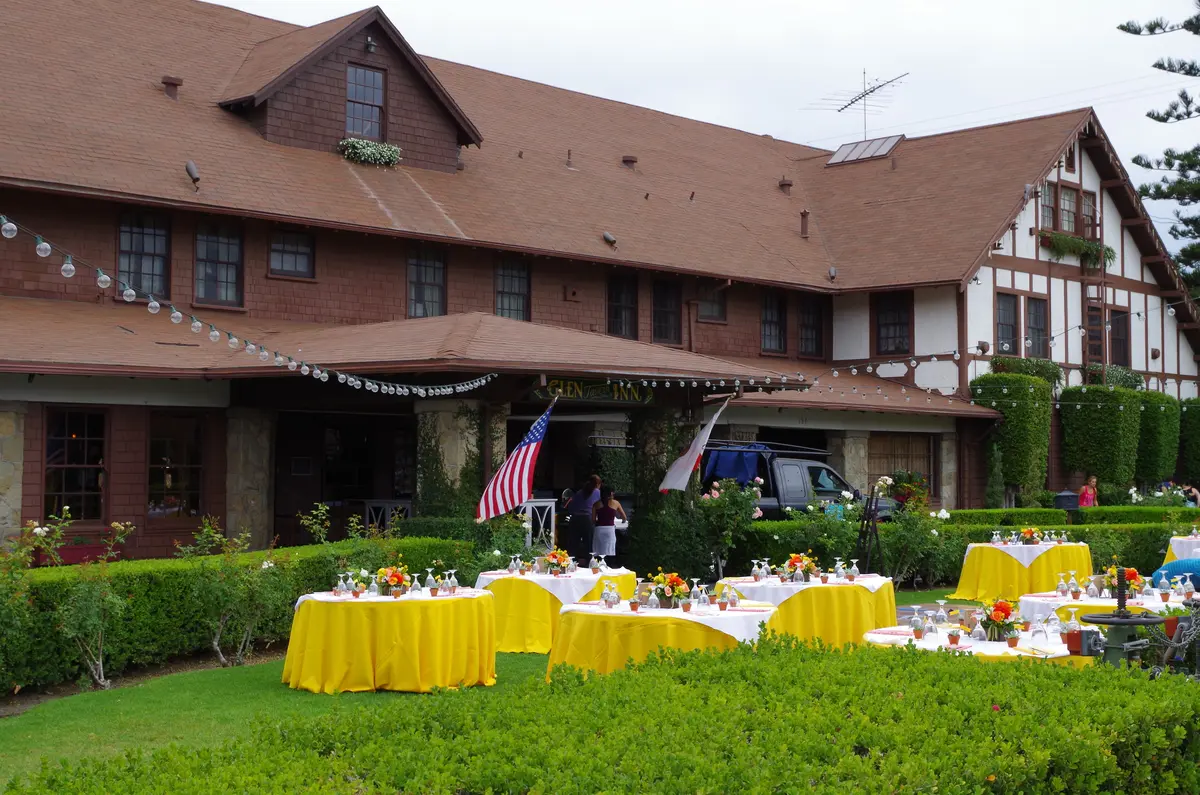
The Glen Tavern Inn opened in Santa Paula, California, in 1911, built by a company of local businessmen who wanted a hotel facing the railroad depot in a town booming on oil and citrus.
Where is Glen Tavern Inn?
- Location
- Santa Paula, California, United States
- Type
- Hotel / inn
- Coordinates
- 34.355, -119.061
- Last updated
LOCATION
Why is Glen Tavern Inn said to be haunted?
The architects Sumner P. Hunt and Silas R. Burns drew an English inn outside and a Craftsman lobby inside, and the nomination that put the building on the National Register in 1984 records that silent-film companies working in the valley made extensive use of it. The ghost story is younger than the hotel and can be dated. Its oldest traceable version is not a crime but a conversation: in 1993 Richard L. Senate reported that a former manager said the presence in room 307 had given her its name, Calvin. The gambler murdered over a crooked card game, the third-floor speakeasy and brothel, and Rose the beheaded prostitute all enter print later, and the researcher Craig Owens, who devoted a chapter of a 2017 book to this hotel, concludes that no such gambler and no such murder ever existed. The inn is open, sells both rooms by phone, and is worth the stop for the building.
What is the history of Glen Tavern Inn?
Santa Paula built the Glen Tavern because it had lost a hotel. The Petrolia burned down in 1903, and a town that billed itself as the citrus capital of the world — and that had Union Oil's headquarters a block away — spent seven years with nowhere decent to put a visiting buyer or a geologist. The fix was a company: the Santa Paula Hotel Company, a corporation of local businessmen whose board included Charles C. Teague, James Sharp and Carlysle Thorpe. Local accounts put the arithmetic at twenty-five townsmen and a thousand dollars each.
The commission went to Sumner P. Hunt and Silas R. Burns, then among the leading architects in Los Angeles, who would later design the Southwest Museum and the Wilshire Ebell Club. They drew it in 1910 as an English inn: half-timbered stucco under steep gables at each end, dark shingles everywhere else, a long porch on square sandstone piers, a porte cochère at the entrance. The interior went Craftsman instead — wood wainscoting, boxed beams, a stone fireplace, window seats. The Los Angeles builders Crookshank and Summers finished it in 1911, and the hotel's own literature has long given 19 May 1911 as the opening date.
It was placed directly opposite the railroad depot on purpose. Four trains a day ran between San Francisco and Los Angeles, and the guest list followed the tracks: oil and citrus men, tourists bound for the healing waters of Sulphur Mountain Hot Springs, and film crews. The nomination that put the building on the National Register says so flatly: "Silent movie companies filming in Santa Paula made extensive use of the hotel." Judy Triem, the historical consultant who wrote that nomination in 1983, later added that Warner Bros. worked the valley and that its canine star Rin Tin Tin "supposedly had his own room during the mid-1920s" — her hedge, kept here as she wrote it.
J. N. Crane held the hotel in 1917, when the lobby was hung with flags and flowers for a banquet and dance honouring Ventura County's draftees. In October 1918 influenza shut every hotel and restaurant in the region. In 1919 Mr and Mrs Charles D. Estep bought the place, and it was Estep who converted the unused attic into a third floor of guest rooms, finished around 1920 — which means the third floor is younger than the building by nine years, a detail that matters later.
The 1920s were its social peak: Rotary meetings, church bazaars in the lobby, high-school functions in the dining room, a Thursday night bridge club. Ignacy Jan Paderewski, the pianist who had served a year as prime minister of Poland, stayed at least twice in 1922. William Jennings Bryan lunched there in 1923.
In June 1943 the Federal Public Housing Authority leased the building and ran it as a dormitory for women working at the Port Hueneme naval base; it returned to hotel use in 1946. Oil crews filled it through the 1950s and 1960s while elderly Santa Paulans moved in permanently and treated the lobby as a living room. Then the depot closed, development bypassed the town, and the Glen Tavern spent decades sliding toward flophouse. Through the 1980s and 1990s it changed hands repeatedly and changed purpose with them, at one point housing Japanese students of the Tokyo International College and Elderhostel classes.
It was declared Ventura County Landmark No. 65 on 6 July 1981 and listed on the National Register of Historic Places on 26 July 1984. Rescue came with Tom and Rosanna Jennett, whom the hotel's own site listed as owners from January 2004 and whom the local press credits with buying it in 2005. Their restoration ran to 2007; in April 2006, mid-works, a fire burned part of the third floor and had to be rebuilt. The inn reopened as a full-service hotel and restaurant in 2007, and on 24 February 2008 collected certificates of special recognition from the US Senate, the US Congress and the California State Assembly.
Timeline: the documented record of Glen Tavern Inn
- 1910 Sumner P. Hunt and Silas R. Burns design the hotel for the Santa Paula Hotel Company, a corporation of local businessmen formed after the Petrolia Hotel burned in 1903 and left the oil and citrus town without lodgings.
- 19 May 1911 The hotel opens opposite the railroad depot, built by the Los Angeles firm of Crookshank and Summers. The opening date is the one the hotel itself has published for decades.
- October 1918 Influenza closes every hotel and restaurant in the region, the Glen Tavern among them, a year after its lobby had been hung with flags for a banquet honouring Ventura County's wartime draftees.
- 1919 Mr and Mrs Charles D. Estep buy the hotel. Estep converts the unused attic into a third floor of guest rooms, finished around 1920 — the floor on which every later ghost story is set did not exist for the hotel's first nine years.
- 1922 The pianist and former Polish prime minister Ignacy Jan Paderewski stays at least twice while visiting the area; the following year William Jennings Bryan lunches at the inn.
- June 1943 The Federal Public Housing Authority leases the building and runs it as a dormitory for women working at the Port Hueneme naval base. It returns to hotel use in 1946.
- 6 July 1981 The Glen Tavern is declared Ventura County Landmark No. 65. Its National Register listing follows on 26 July 1984, reference number 84001225; the hotel's own literature has long misdated both as a single "national landmark" award in 1981.
- 1986 A group of students investigating the reports photographs room 307 on infrared film; the developed image shows a faint bearded figure in a room the student says she occupied alone. Craig Owens later dates the invention of the murdered-gambler legend to this same decade.
- 1993 Richard L. Senate publishes "The Haunted Southland", the oldest datable text for the story: a former manager, Dolores Diehl, says the presence in room 307 told her its name was Calvin. Senate offers the poker murder and a film-industry connection as rival theories, and records that skeptics blame the former management's publicity.
- 2007 The Jennetts' restoration finishes and the inn reopens as a full-service hotel and restaurant, having rebuilt the third floor after a fire in April 2006. In July the Ventura Paranormal Society holds its annual convention there.
- 15 April 2009 A Santa Paula Times feature quoting the inn's general manager is the earliest text traced here to place a speakeasy, brothel and gambling parlour on the third floor during Prohibition — while stating in the same paragraph that the stories are not confirmed.
- 29 March 2013 Ghost Adventures broadcasts a lockdown at the inn; The Dead Files follows on 23 August 2014, and Ghost Adventures returns on 30 April 2025. In October 2014 a chapter of the Colonial Dames dedicates a bronze plaque at the hotel while staff give tours of room 307.
- August 2017 Craig Owens publishes "Haunted by History Vol. 1", devoting a chapter to the Glen Tavern and concluding that no gambler called Calvin ever existed and no such murder took place. The Museum of Ventura County programmes his talk in November 2018.
Is there a rational explanation for Glen Tavern Inn?
The ghost of the Glen Tavern can be dated, and dating it is what dismantles it.
The oldest version anyone can put a finger on is not a Prohibition crime. It is a conversation. Richard L. Senate's "The Haunted Southland" (1993) reports that a former manager, Mrs Dolores Diehl, said she had spoken to the presence in room 307 and that it had told her its name was Calvin: middle-aged, long hair, pointed beard. Everything else is offered by Senate as speculation, in his own words — one theory has Calvin murdered after an illegal poker game "in which he may or may not have been cheating"; "another theory holds that 'Calvin' may have been a part of the motion picture industry", since westerns were shot around Santa Paula in the early 1920s. Senate also dates a 1986 visit by students, one of whom photographed room 307 on infrared film and got a faint bearded figure in a room she says she occupied alone. And Senate himself records the objection: "Skeptics derided the accounts, saying they were the creation of the former management in an attempt to secure publicity and attract visitors." That is the hotel's own website quoting him, in 2004.
What is not in that 2004 page is the rest of the modern story. There is no brothel, no speakeasy, no woman named Rose, no beheading. Those enter the printed record later: a Santa Paula Times feature of 15 April 2009, written while the Jennetts were reopening the restored hotel and quoting its general manager, is the earliest text traced here that puts a "speakeasy, brothel and gambling parlor" on the third floor — and even that article adds, in the same breath, that "many of these stories and others like them are not confirmed".
Craig Owens went looking for the paperwork. His "Haunted by History Vol. 1" (2017), which devotes a chapter to the Glen Tavern among eight Southern California hotels and which the Museum of Ventura County put on stage in 2018, concludes that the murdered gambler is a marketing invention of the mid-1980s: no such person, no such killing. Owens still thinks the building is haunted. He simply does not think Calvin ever lived.
Two cheap checks point the same way. First, the county's own historian wrote about this hotel twice — the 1983 National Register nomination and a 2010 newspaper history — and neither mentions a brothel, a speakeasy, a gambling parlour or a ghost. Second, the third floor did not exist as guest space until Estep converted the attic around 1920, so a "Wild West" gambling den upstairs has, at most, the thirteen years of Prohibition to have happened in.
The story also keeps moving, which is what invented stories do and documented ones do not. In 2004 Calvin was in room 307 and room 308 was the room Houdini was rumoured to have used for his props; in 2014 hotel staff were still telling tour groups the history of 307. Today the hotel's own site puts Calvin in 308 — "Calvin's Room is Room 308", its most expensive room, bookable only by phone — and installs Rose, a beheaded prostitute, in 307. The bullet-holed cowboy hat offered as evidence was, by the hotel's own account, found in a crawlspace during a remodel and has since disappeared. Nobody has to lie for this to happen; a good room needs a good story, and the story improves with each retelling.
Can you visit Glen Tavern Inn?
The Glen Tavern Inn is open and trading. It stands at 134 North Mill Street, Santa Paula, California 93060, one block off Main Street in the historic district and directly across from the old wooden depot; telephone +1 805-933-5550, e-mail [email protected]. Booking is direct through officialglentavern.com. Note that the hotel's former address, glentavern.com, no longer resolves at all: any link to it is dead, and pages still citing it are out of date.
The inn advertises 35 rooms and suites in six categories, from standard queens to jacuzzi rooms and a penthouse. The two rooms named in the ghost stories can be booked, but only by telephone; the hotel lists room 308, which it calls Calvin's Room, as its premium room, starting at $189. Room 307, marketed as Rose's room, is also bookable. Treat both as a paid experience rather than as evidence.
Practical points, all from the hotel's own published terms as of August 2026: check-out is 11:00, cancellation is 48 hours, indoor smoking carries a $150 fee, parking is free and the wi-fi is included. Dogs are welcome for a $50 pet fee per stay, with Steckel Park four miles away for walks. Enzo's Italian Restaurant occupies the dining room — telephone +1 805-933-3444, open 17:00 to 21:00 Monday, Wednesday, Thursday and Sunday, until 22:00 Friday and Saturday, closed Tuesdays — and outside alcohol is not allowed in the public rooms.
Accessibility deserves a warning. The building dates from 1911 and has no lift. Accessible rooms exist on the ground floor and must be requested by phone; there is a step-free route from the car park to the lobby and to the restaurant. Anyone who cannot manage two flights of stairs cannot reach the third floor, which is precisely the floor the ghost tours are about.
Santa Paula itself repays the stop: the California Oil Museum and the Aviation Museum of Santa Paula are each about a mile away, the town's painted murals are a short walk, and Ventura's beaches are fifteen miles down Highway 126.
Sources consulted
- Judy Triem, «National Register of Historic Places Inventory–Nomination Form: Glen Tavern Hotel (ref. 84001225)» — US Department of the Interior / National Park Service, 1984 report
- Judy Triem, «Santa Paula Hospice Home Tour features Glen Tavern Inn» — Santa Paula Times, 2010 newspaper archive
- Santa Paula Times, «Hospice Home Tour: Historic Glen Tavern Inn again has a story to tell» — Santa Paula Times, 2009 newspaper archive
- Glen Tavern Inn, «The Glen Tavern Inn — The Hauntings (official site, quoting Richard L. Senate), archived 3 August 2004» — Internet Archive Wayback Machine, 2004 archive
- Glen Tavern Inn, «The Glen Tavern Inn — History (official site), archived 5 February 2005» — Internet Archive Wayback Machine, 2005 archive
- Richard L. Senate, «The Haunted Southland: Ghosts of Southern California» — Charon Press, 1993 book
- Craig Owens, «Haunted by History Vol. 1: Separating the Facts and Legends of Eight Historic Hotels and Inns in Southern California» — Sad Hill LLC, 2017 book
- Kit Stolz, «Historical society honors Santa Paula inn» — Ventura County Star, 2014 newspaper archive
- Glen Tavern Inn, «Glen Tavern Inn official website: About, Restaurant, Accommodations and Terms (accessed 12 August 2026)» — officialglentavern.com, 2026 web
- Museum of Ventura County, «Author Craig Owens Discusses Haunted Histories of Local Hotels» — Museum of Ventura County events archive, 2018 web
- Travel Channel episode guides, «Broadcast dates for Ghost Adventures "Glen Tavern Inn" (S7E17, 2013) and "Glen Tavern Tragedy" (S29E2, 2025) and The Dead Files "Double Jeopardy" (2014)» — Episode guides, 2025 web
Reviewed by V. Serrano on 2026-08-12 · How we verify our content
💬 Field testimonies (0)
No testimonies yet. Add the first.
Add your testimony
🔒 Log in to add a testimony