👻 HAUNTED PLACE · EXP. Nº9478
ACTIVE
Goodleberg Cemetery
Goodleburg Cemetery — the Town of Wales spells it Goodleberg — is a village-lot burial ground on a knoll in South Wales, Erie County, New York, holding the graves of the district's settler families: the Manns, the Stephenses, the Tanners, the Blairs, the Webers.
Where is Goodleberg Cemetery?
- Location
- New York, United States
- Type
- Cemetery
- Coordinates
- 42.714, -78.538
- Last updated
LOCATION
Why is Goodleberg Cemetery said to be haunted?
When William F. and Molly B. Hauck surveyed it for the Wales Historical Society in May 1980, they numbered the plots to 107 and found that more than forty of those numbers had no legible stone left. For the last twenty-odd years the place has been better known for a legend: a Dr. Goodleberg said to have buried aborted infants on the hill and to have hanged himself from a pine before he could be tried. The town historian, Jean Allen, told The Buffalo News in 2007 that she knew exactly where the story came from — 1940s gossip about a Buffalo physician with a summer home two miles away — and that it had "nothing to do with the Goodleberg Cemetery". Mason Winfield, the western New York author who gathered and published the ghost material, said in the same article: "I almost wish I had never written anything about it."
What is the history of Goodleberg Cemetery?
Goodleburg Cemetery — the Town of Wales spells it Goodleberg, and so do the town's own signs and its old website — is a burial ground the size of a village lot, on Goodleberg Road off Vermont Hill Road in South Wales, Erie County, New York. The town of Wales was set off from Willink on 15 April 1818; its first settlers had arrived about a decade earlier. The plot on the knoll is one of the small country graveyards that came with them.
The name has nothing to do with a doctor. In August 2007 a local editor added to the English Wikipedia article the explanation that "Goodleberg" comes from a Mr. Goodell, who ran the cheese factory on the south side of the road just east of the cemetery until it was abandoned in the late 1800s, when cheesemaking in the area moved to East Aurora. The claim is unsourced and was later deleted from the article, but it has a footprint in the ground: the tombstone survey lists a GOODELL — Irene, wife of S. J. Strong, died 3 January 1884, aged 82 years 6 months, on a double stone shared with her husband.
That survey is the single best document about this place, and it is not a ghost book. In May 1980, William F. and Molly B. Hauck of the Wales Historical Society walked the plot and wrote down every stone they could read, checking their readings against an older list compiled by the Aurora Historical Society in East Aurora. Molly Hauck noted that many stones were so worn that "we read many of them with our fingers". The plots are numbered to 107. For more than forty of those numbers the surveyors could record no legible stone at all: gone, broken – gone, unreadable, unmarked, and in one case a "large depression, no marker — 4 ft. by 9 ft." Another eleven stones carried only initials.
What the rest carry is a rural community. Mary Ann, wife of Thomas Mann, died 23 July 1826 — the earliest death date the surveyors could read on a surviving stone. Robert Stephens died 2 January 1853 aged 79 years 9 months 23 days, and his wife Abigal on 9 August 1863 aged 86 years 3 months 1 day. Isaac G. Stephens and Fanny K. buried five of their children in this plot between 1854 and 1866 — Edgar, Jerome, Fanny, Armanilla and John — and then died within eleven months of each other in 1869. Amos S. Tanner of Wales died in Buffalo on 22 April 1849, aged 54. Agnes L. Weber was ten when she died in 1892; her sister Bertha I. did not reach her second year.
The Weber family also settles a question that the internet has got wrong for more than a decade. Nearly every page about this cemetery, including the earlier version of this one, says it was "an active cemetery from 1811 until 1927". Neither end of that range survives contact with the survey it is supposedly drawn from. The Hauck transcription's own heading reads "1811 – 1926", and the last date in its list is Helen "Nel" Weber, 1858 – 1932, with Christian Weber, 1857 – 1930, beside her. At the other end, the only two "1811" readings in the whole document — Nathan Corey and Leonard Wright — are flagged as alternative readings of 1841 and 1851; Molly Hauck closed her report by observing that Wales "had not begun to be settled until (1806)" and that "most of the dates in the cemetery seem to be started in the 1840's", and said she agreed with the Aurora Historical Society's readings. Find a Grave, whose 69 memorials for this cemetery follow the same readings, dates Nathan Corey 28 September 1785 – 14 May 1841.
The "1927" can be dated exactly, because it happened on a screen. On 19 April 2014 a Wikipedia editor added the sentence "Goodleberg Cemetery was an active cemetery from 1811 until 1927" and sourced it not to the survey but to a WGRZ Channel 2 web story of 31 October 2011 — a Halloween piece whose URL is now dead and which the Wayback Machine has not preserved. The same edit added the paragraph about the Lady in White, the strong winds followed by the cry of a baby by the back pond and the coloured orbs in night photographs, cited to weirdus.com. Wikipedia has since removed that paragraph. Everyone who copied it in the meantime, this site included, kept it.
Timeline: the documented record of Goodleberg Cemetery
- 15 April 1818 The town of Wales is set off from Willink. Its first settlers had arrived about a decade earlier; the burial ground on the knoll on Goodleberg Road is one of the small country cemeteries that came with them.
- 23 July 1826 Death of Mary Ann, wife of Thomas Mann — the earliest death date the 1980 tombstone survey could read on a surviving stone. The only two stones read as "1811" in the whole survey are flagged in the same document as alternative readings of 1841 and 1851.
- 3 January 1884 Death of Irene Goodell, wife of S. J. Strong, aged 82 years 6 months, buried under a double stone with her husband. The surname is the one a local resident later gave as the origin of the name Goodleberg: a cheesemaker, not a doctor.
- 1930 and 1932 Christian Weber (1857–1930) and Helen "Nel" Weber (1858–1932) are the last dates recorded on stones in the survey — later than the 1926 in that survey's own heading and later still than the "1927" repeated online.
- August–September 1948 Helen Lindeman of Kenmore leaves home to buy milk and disappears. The following month a kneecap and a severed forearm are found on Hunter's Creek Road, near the cemetery; her torso and head turn up some 25 miles away near Ischua. Her husband, a dentist, identifies her. The case is never solved, and is later grafted onto the cemetery's folklore.
- May 1980 William F. and Molly B. Hauck survey the cemetery for the Wales Historical Society, checking their readings against an older Aurora Historical Society list. Plots are numbered to 107; more than forty of those numbers have no legible stone. Molly Hauck records that "we read many of them with our fingers".
- 21 June 2003 A nineteen-year-old from Hamburg, New York, walking to the cemetery at night with the Paranormal & Ghost Society, is struck and killed by a pick-up truck on Hunter's Creek Road — not inside the cemetery, as this page previously said. The driver, a 44-year-old woman from Holland, was arrested by the State Police the next day and was charged with leaving the scene of a fatal incident; the group's account is the only record of the case available online.
- 2005 Weird New York, by Chris Gethard, carries a section headed "Goodleburg's Lady in White" — the earliest datable appearance of the modern legend in a printed book that a full-text search of scanned books returns.
- 23 February 2006 The English Wikipedia article is created. It tells the "Dr. Goodleburg" abortion story as folklore and places the cemetery in the wrong town — Holland, not Wales. In January 2007 local editors twice strip the folklore, one of them noting it "causes incessant trespassing & local disturbance"; both edits are reverted within minutes as vandalism.
- 23 October 2007 The Wales Town Board approves "No Standing" zones on Goodleberg Road so that ghost hunters' cars can be ticketed and towed. Signage costs $1,591.52. A month earlier the board had complained publicly that neighbours were being harassed and threatened and that trespassers were not being ticketed hard enough.
- 27 October 2007 The Buffalo News puts the cemetery on its front page. Town historian Jean Allen: "It's still not haunted… It's somebody else's imagination." Supervisor Rickey Venditti: "It's just a plain old cemetery. We really wish people would stop coming." And Mason Winfield, who collected the ghost material from more than a hundred local interviews: "I almost wish I had never written anything about it."
- 19 April 2014 A Wikipedia editor adds the sentence "an active cemetery from 1811 until 1927", sourced to a WGRZ web story of 31 October 2011 whose URL is now dead and which the Wayback Machine has not preserved, plus a paragraph on the Lady in White, the wind and crying baby by the back pond and the coloured orbs in night photographs. Wikipedia later deleted the paragraph; the sites that had copied it, this one included, did not.
Is there a rational explanation for Goodleberg Cemetery?
The best sceptic available for Goodleberg is the person who has known it longest. Jean Allen had lived in Wales almost all of her 75 years and had been town historian for three when the Buffalo News walked the plot with her in October 2007. She admitted that two years earlier a college student had asked her whether the cemetery was haunted and she had said yes — "he wanted to be scared, so I scared him". Then she gave the honest answer: "It's still not haunted. I don't know what it is. It's somebody else's imagination. It's a normal cemetery. . . . As one person suggested, the name sounds spooky." Standing on the knoll, looking towards the pond, she offered a mechanism as well as a denial: "If you were standing here at night and that wind was blowing, you would think that you heard ghosts."
The supervisor of the town, Rickey Venditti, was blunter — "It's just a plain old cemetery. We really wish people would stop coming" — and, notably, so was the author who put the stories into circulation. Mason Winfield, of the Town of Aurora, founder of Haunted History Ghost Walks and author of Shadows of the Western Door, told the same reporter that he had assembled the Goodleberg material by interviewing more than a hundred local people, that he does not take his tours to the cemetery, and that he has never had a haunted experience there: "I don't see ghosts. I may have seen two in my life, but it was never when I was looking for them." His verdict on his own work is the sentence most often quoted from that article: "I almost wish I had never written anything about it."
Two claims made by a local editor on Wikipedia in August 2007 would, if true, dismantle the legend outright, and neither has ever been sourced or refuted — the encyclopaedia simply deleted them and kept the story. The first is that the doctor cannot have hanged himself from one of the cemetery's pines, because the pines were planted in the 1950s. The second is that the pond behind the cemetery was excavated in the late 1990s and did not exist at the time the folklore describes: the water into which the infants are said to have been thrown, and beside which visitors report hearing a baby cry, would then be younger than the story about it. That claim sits awkwardly with the same 2007 Buffalo News report, which describes teenagers drinking and skinny-dipping in the pond as a long-standing local habit; the honest position is that the pond's age is unresolved and worth resolving.
The doctor himself dissolves on contact. The Buffalo News found only "accounts of a 'Dr. Goodleberg' and a 19th century abortion doctor" circulating online. Jean Allen knew where they came from: as a teenager in the 1940s she knew of a physician with a Buffalo practice and a summer home on Hunter's Creek Road, about two miles from the cemetery, and "the local gossip was that he did perform abortions". Her comment on it: "This is all gossip. That was back in the '40s. That has nothing to do with the Goodleberg Cemetery." Onto that gossip a real crime was later grafted. In August 1948, Helen Lindeman of Kenmore left home to buy milk and disappeared; the following month a kneecap and a severed forearm were found on Hunter's Creek Road, and her torso and head some 25 miles away near Ischua. Her husband, a dentist, identified her. The case was never solved. "They found her bones, and they assumed it was an abortion," Allen said of her neighbours. "Stories get started because there's assumptions. Half the stuff that you hear, you should not take too much stock in. . . . I like facts."
The name "Dr. Albert Speaker", which the earlier version of this page gave to the doctor, could not be traced to any source. No Speaker appears among the sixty-nine Find a Grave memorials for this cemetery, nor anywhere in the 1980 tombstone survey. A full-text search of the Library of Congress newspaper collection returns zero hits for "Goodleberg" and zero for "Goodleburg", repeated to be sure; the control term "Lindeman", run in the same corpus, returns 21,161. A full-text search of Open Library's scanned books returns five snippets, in three books, none earlier than 2005 — and none of them by Mason Winfield, although his books are in that index (86 hits for his name, 23 for the title of Shadows of the Western Door); the OCR of at least one of his volumes is visibly poor, so this is suggestive rather than conclusive. A search there for the phrase "Albert Speaker" returns only Carl Albert, Speaker of the House.
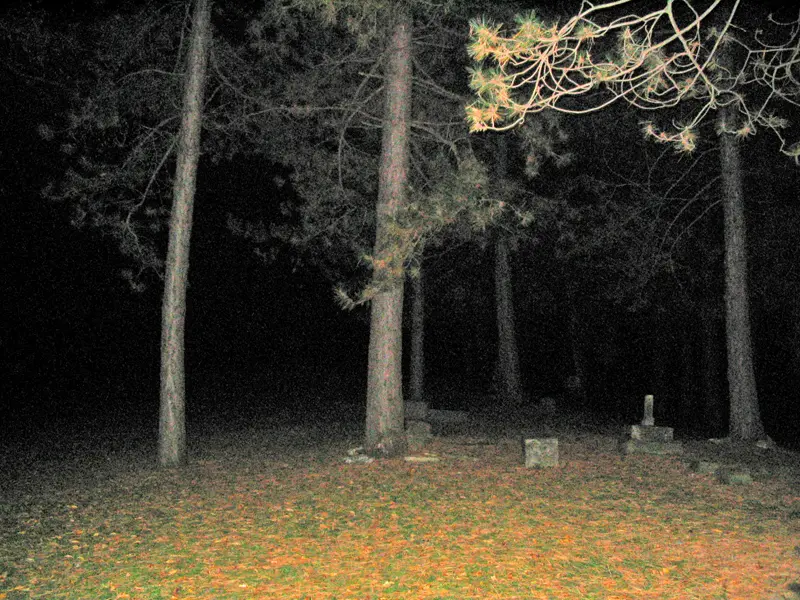
That leaves the orbs, and the exhibit is on this page. The photograph at the top was taken in the cemetery at night, in October 2005, with a compact camera's built-in flash, and it is full of bright specks. A flash sitting a few centimetres from the lens lights dust, pollen, insects and airborne moisture that are far too close to be in focus, and returns them as soft luminous discs. Any night visitor with a small camera can reproduce them at will, which is roughly what the record of this cemetery shows people doing.
Can you visit Goodleberg Cemetery?
Goodleberg Cemetery is a small burial ground in the Town of Wales, Erie County, on Goodleberg Road, South Wales, NY 14139, the address the town's own cemeteries page gave in its archived version of April 2006. The current version of that page, read on 24 September 2026, lists six town cemeteries and does not include this one. Find a Grave places the cemetery at 42.71404, -78.53756, about 25 metres from the pin on this file, and counts sixty-nine memorials. The Buffalo News reporter Michelle Kearns, who went there with the town historian Jean Allen in October 2007, described Goodleberg Road as "easy to miss because it has no street sign" and the cemetery as a mound of cracked and faded headstones rimmed by tall pines, with a pond at its far edge.
The opening hours most often repeated for the site come from a passage added to the English Wikipedia article on 27 November 2006 by an anonymous editor, who described it as an excerpt from a local newspaper. According to that passage, the cemetery, like the other town-owned parks and cemeteries, is open until dusk and reopens at 8 a.m.; anyone found there after sunset is charged with trespassing and faces a fine of "not less than $125"; and the land around it, pond included, is posted private property where anyone found, day or night, would be charged, the Erie County Sheriff and the New York State Police having been notified to charge all violators. The only source the passage gives is a link to a page on zwire.com.
The town's efforts to keep visitors out at night are on record in the local press. On Halloween night 2006, from 10 p.m. to 2 a.m., the town supervisor Rickey Venditti, a highway supervisor and a sheriff's deputy turned away about thirty-five cars, according to the Buffalo News. At the board meeting of 11 September 2007 the highway superintendent Michael Zywar took the Sheriff's Department to task for not following through on ticketing trespassers, the East Aurora Advertiser reported. On 23 October 2007 the Wales Town Board approved "no standing" zones on Goodleberg Road, which allow vehicles to be ticketed and towed at the owner's expense; the signs cost the town $1,591.52. Mason Winfield, founder of Haunted History Ghost Walks, who collected much of the cemetery's ghost lore from interviews with local people, told the Buffalo News that he does not take his tours there; the same report says the cemetery has so many tipped-over and broken stones that people blame ghost-seeking vandals as well as age.
The May 1980 tombstone survey by William F. and Molly B. Hauck for the Wales Historical Society numbers the plots to 107 and records more than forty of those numbers as gone, broken, unreadable or unmarked; it survives in the Internet Archive's copy of the WNY Roots page. The same Wikipedia edit of November 2006 said that the grave of a small child had been dug up in the late 1990s, and an edit of August 2007 added that the remains were recovered and re-interred. On 21 June 2003, at about 11.30 p.m., Robert Carr, 19, of Hamburg, was struck and killed by a pick-up truck while walking with members of the Paranormal & Ghost Society along the shoulder of Hunters Creek Road towards the cemetery; the group's pages reproduce the State Police release on the arrest of the driver the next day for leaving the scene of a fatal incident.
Wales Town Hall is at 12345 Big Tree Road, Wales Center, NY 14169, telephone (716) 652-0589, according to the town website on 24 September 2026.
Sources consulted
- William F. Hauck y Molly B. Hauck (Wales Historical Society), «Goodleberg Cemetery, Town of Wales, Erie County, New York — transcripción completa de lápidas (mayo de 1980), con números de tumba, lecturas alternativas y nota final de la Sociedad Histórica de Wales» — WNY Roots — Erie County Cemeteries Online, 1980 archive
- Michelle Kearns, «Reputation haunts cemetery: Despite Internet hype, town officials in Wales find nothing supernatural about Goodleberg Road site» — The Buffalo News, 27 de octubre de 2007, portada (A1), 2007 newspaper archive
- Pat McDonnell, «Goodleburg 'No Standing' zones aim to discourage unwanted cemetery visitors» — East Aurora Advertiser, 1 de noviembre de 2007, 2007 newspaper archive
- East Aurora Advertiser, «Wales board members worry over enforcement at Goodleburg Cemetery» — East Aurora Advertiser, 20 de septiembre de 2007, 2007 newspaper archive
- Chris Gethard, «Weird New York: your travel guide to New York's local legends and best kept secrets — incluye el apartado «Goodleburg's Lady in White»» — Sterling Publishing, Nueva York, 2005 book
- Paranormal & Ghost Society, «Goodleburg — relato de la propia Paranormal & Ghost Society, incluida, en su segunda página (goodleburg2.htm), su versión de la muerte de Rob Carr el 21 de junio de 2003 en Hunters Creek Road y la nota de la policía estatal sobre la detención de la conductora» — paranormalghostsociety.org, 2003 web
- Town of Wales, New York, «Cemeteries / Town History — páginas oficiales del municipio: la lista actual de seis cementerios (sin Goodleberg) y la fecha de constitución del municipio; la versión archivada de 2006 sí lo listaba, con dirección» — townofwalesny.gov, 2026 web
- English Wikipedia, «Goodleburg Cemetery — historial completo de ediciones del artículo (creación el 23 de febrero de 2006; explicación del nombre y de los pinos y el estanque añadida en agosto de 2007 y luego borrada; «1811 until 1927» añadido el 19 de abril de 2014)» — Wikipedia, historial de revisiones, 2026 web
- Find a Grave, «Goodleberg Cemetery, Wales, Erie County, New York — índice de 69 registros, con fechas de nacimiento y defunción» — Find a Grave, cementerio n.º 64673, 2026 web
- Library of Congress, «Chronicling America — búsqueda a texto completo de prensa histórica estadounidense: «Goodleberg» 0 resultados, «Goodleburg» 0 resultados, control «Lindeman» 21.161 resultados» — Chronicling America (National Digital Newspaper Program), 2026 archive
- English Wikipedia (IP 24.49.120.83), «Goodleburg Cemetery — revision of 27 November 2006 (anonymous editor): the hours 'until dusk … re-opens at 8am', the fine 'of not less than $125', the private land round the cemetery, and the late-1990s opening of a child's grave» — Wikipedia, revision 90537903, 2006 web
- Town of Wales, New York, «Local Services > Cemeteries — the town's list in April 2006, with Goodleberg Cemetery, Goodleberg Rd., South Wales, NY 14139» — townofwales.com via the Internet Archive (captured 3 April 2006), 2006 archive
Reviewed by V. Serrano on 2026-08-12 · How we verify our content
💬 Field testimonies (0)
No testimonies yet. Add the first.
Add your testimony
🔒 Log in to add a testimony