👻 HAUNTED PLACE · EXP. Nº9478
ACTIVE
Great Salt Lake
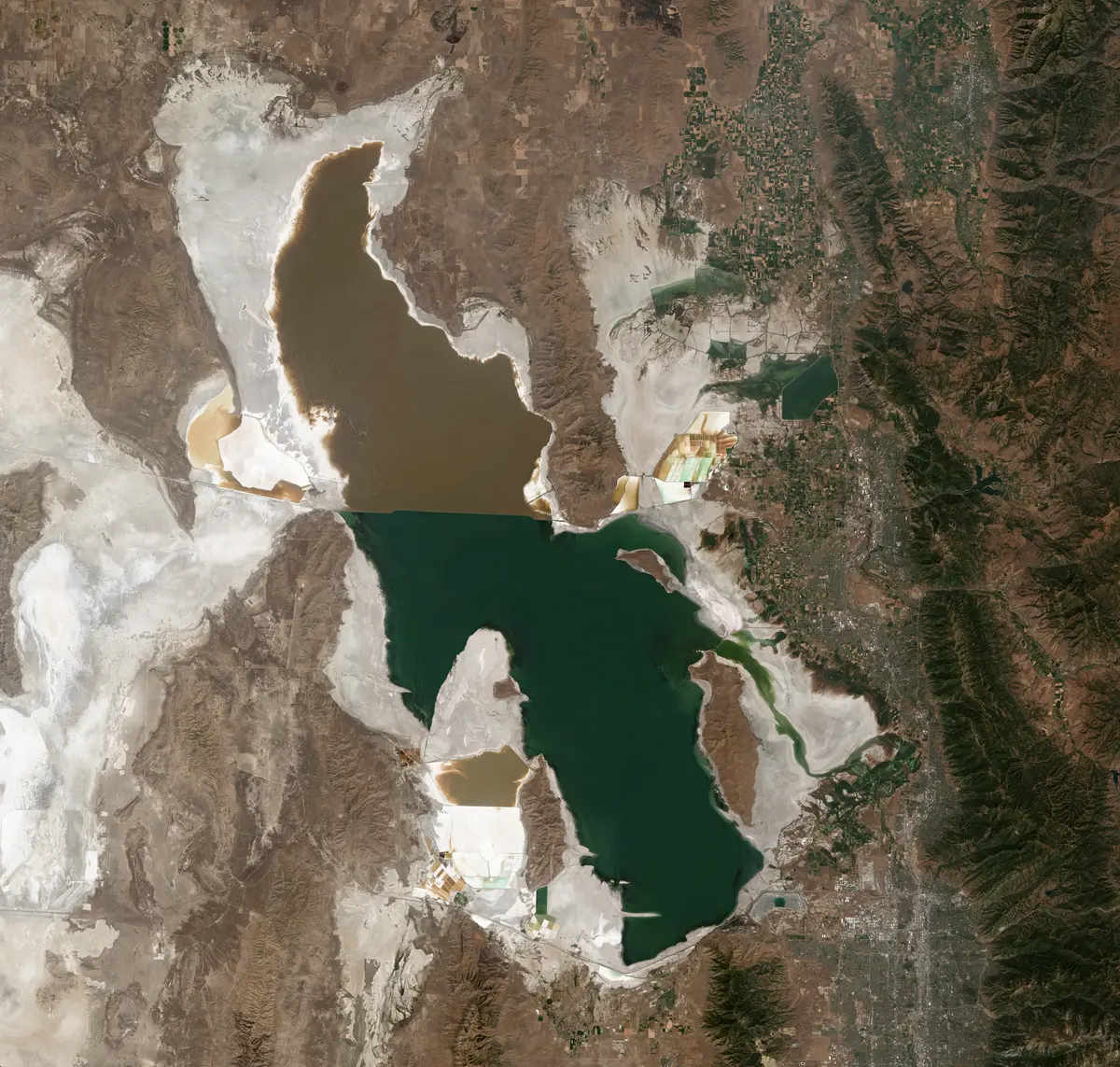
Great Salt Lake is the shrunken remnant of Ice Age Lake Bonneville: a terminal lake with no outlet, roughly 1,700 square miles at its long-term average level and nowhere much more than 33 feet deep.
Where is Great Salt Lake?
- Location
- Utah, United States
- Type
- Lake / river
- Coordinates
- 41.167, -112.533
- Last updated
LOCATION
Why is Great Salt Lake said to be haunted?
Nothing with a backbone lives in it, only brine shrimp, brine flies and salt-tolerant algae, and since a rock-fill railroad causeway cut it in two in 1959 it has behaved as two lakes, a hypersaline north arm and a far fresher south. Its best-known monster story is precisely dated. On 9 July 1877 a correspondent writing from Kelton for the Corinne Record described night workers at the Barnes and Co. salt works, on the north shore at Monument Point, fleeing a bellowing animal, and attached a sworn affidavit from one of them, J. H. McNeil, who called it a great animal like a crocodile or alligator, seventy-five feet long, with the head of a horse. The same letter admits the men were too frightened to describe what they saw. The lake carries a documented ghost too: Jean Baptiste, the Salt Lake City gravedigger exiled to Fremont Island in 1862, who vanished from it and was never found.
What is the history of Great Salt Lake?
Great Salt Lake is the leftover of something far larger. Lake Bonneville, a Pleistocene inland sea, covered about 20,000 square miles of Utah, Nevada and Idaho — roughly 325 miles long by 135 wide, and up to 1,000 feet deep. It existed from about 30,000 years ago until, about 16,000 years ago, it cut an outlet at its northern end and discharged a flood that reached the Snake River. What remained, after a dry spell nearly finished the job, is the lake we have now.
It is a terminal lake: rivers run in and nothing runs out, so the salt they carry stays and the water leaves by evaporation. At the long-term average surface altitude of 4,200 feet the lake is about 75 miles by 28, covers roughly 1,700 square miles, and its maximum depth is about 33 feet. It is, in other words, enormous and almost flat. Nothing with a spine lives in it. The food web runs on algae, brine shrimp and two species of brine fly, which in summer can reach 370 million per mile of shoreline and which feed two to five million shorebirds.
The United States mapped it late. Howard Stansbury's expedition entered the valley in 1849 and had traced the whole shoreline by 1850; every large island except Fremont carries the name of someone on that survey. Then came the railroad. The transcontinental line was joined at Promontory in 1869 and the Central Pacific ran around the lake's northern end, curving past a headland called Monument Point. There, on the strip of ground between the track and the water, Barnes and Co. built boiling tanks and made salt, day and night, with a handful of men on the night shift.
That salt works is where the lake's monster story begins, and the date is exact. A correspondent signing himself William Harris wrote to the Corinne Record from Kelton, Box Elder County, on 9 July 1877. The night hands, he reported, had "frequently heard strange noises in the lake which could not be accounted for"; on the night of the 8th they saw "a huge mass of hide and fins rapidly approaching, and when within a few yards of the shore it raised its enormous head and uttered a terrible bellow". They ran up the mountain and stayed there until daylight. Harris appended a sworn affidavit from one of them: "J. H. McNeil, being duly sworn, deposes and says: On the night of July 8th, I was working at the salt works at Monument Point, when about 10 o'clock I heard a great noise on the lake, and looking in that direction saw a great animal like a crocodile or alligator approaching the bank, but much larger than I had ever heard of one being. It must have been seventy-five feet long, but the head was not like an alligator's — it was more like a horse's." The letter names a second witness, Houghton, who saw only "two great, big eyes and a long tail", and a blacksmith named Wheeler who set about forging a harpoon. Within a fortnight the story had been reprinted in Nevada and Idaho.
The lake's other ghost is a man, and he is documented. In 1862 Jean Baptiste, the Salt Lake City gravedigger, was found to have stripped some three hundred graves; officers who searched his house found around sixty pairs of shoes and piles of burial clothing. Faced with talk of lynching, the authorities took him quietly out to Antelope Island and then to Fremont Island. Three weeks later the herders found a butchered heifer and a cabin torn apart for timber. Baptiste was gone, and no one ever established what became of him.
The modern lake was reshaped twice. Saltair, the pavilion resort the LDS Church built with the Salt Lake and Los Angeles Railway, opened on the south shore in 1893 and was called the Coney Island of the West; it burned in 1925, was rebuilt, closed in 1958 and burned down in 1970. And in 1959 a rock-fill railroad causeway replaced the old wooden trestle across the lake, cutting it in two. Because almost all the fresh water enters south of the line, the lake has behaved as two lakes ever since.
Timeline: the documented record of Great Salt Lake
- 1849–1850 Howard Stansbury's US government expedition enters the Salt Lake Valley and maps the entire shoreline of the lake. Every large island except Fremont takes the name of a member of the survey party.
- 1862 Jean Baptiste, the Salt Lake City gravedigger, is found to have robbed some three hundred graves. Faced with threats of lynching, the authorities exile him to Antelope Island and then to Fremont Island. Three weeks later herders find a butchered heifer and a dismantled cabin; Baptiste is never seen again.
- 8–9 July 1877 Night workers at the Barnes and Co. salt works at Monument Point, on the lake's north shore, report fleeing a bellowing animal. On the 9th, correspondent William Harris sends the account to the Corinne Record with a sworn affidavit from J. H. McNeil describing "a great animal like a crocodile or alligator" some seventy-five feet long with the head of a horse. A second worker, Houghton, reports only two large eyes and a long tail.
- 15–20 July 1877 The story is reprinted outside Utah within a fortnight: the Eureka Daily Sentinel of Nevada runs it on 15 July under the headline "Monster of the Lake", and the Idaho Semi-Weekly World on the 20th as "A 'Monster' Story".
- 8 June 1888 The Salt Lake Herald reprints a Montreal newspaper's claim that an Englishman, James Wickham, had stocked the lake with Australian whales — but frames it as a hoax, one of the "Munchausen articles which sensational scribblers and pen yarners hatch". The same subheading calls it the probable origin of the Bear Lake monster story.
- 1893 Twelve bison are landed on Antelope Island, founding the herd that still runs free there. The same year a skeleton with an iron clamp on its leg is found near the mouth of the Jordan River; the Salt Lake Tribune suggests it is Jean Baptiste, the Deseret News disputes it, and police note that Baptiste was never shackled.
- 1959 A rock-fill railroad causeway replaces the old wooden trestle across the lake and splits it in two. Because almost all the fresh water enters south of the line, the north arm (Gunnison Bay) drifts towards saturation while the south arm (Gilbert Bay) stays far less salty — the two have averaged about 317 g/L and 142 g/L respectively since 1966.
- 3 June 1986 The lake reaches its highest recorded level, 4,211.60 feet, covering roughly 2,300 square miles and flooding roads, railways and lakeside industry.
- 13 July 2013 A fifty-three-year-old kayaker drowns 75 to 100 yards off Antelope Island in eight to ten feet of calm water, his life jacket unworn in the boat — a direct rebuttal of the popular claim that the lake's buoyancy makes drowning impossible.
- 7 November 2022 The south arm falls to a record low of 4,188.5 feet, leaving the lake at under 1,000 square miles — less than half its 1986 extent — and exposing wide plains of dry lakebed.
Is there a rational explanation for Great Salt Lake?
The 1877 document is more interesting than the legend built on it, because the document argues against itself. Harris admits in the same letter that the witnesses "can not give an intelligent description of it" and that "they both candidly admit they were so frightened they hardly knew what they were doing". McNeil swore to a seventy-five-foot crocodile with a horse's head; his workmate Houghton, standing beside him, reported two eyes and a tail. What they agreed on was that they ran.
The letter also gets the lake wrong. It describes the water at Monument Point as "very deep". The USGS puts the maximum depth of the whole lake at about 33 feet at its average level, and there is nothing in it for a large predator to eat: no fish, no molluscs, only brine shrimp, brine flies and algae. A seventy-five-foot animal in Great Salt Lake would have had neither depth to hide in nor prey to live on.
The context is a boom-town press. Corinne was the non-Mormon railway capital of Utah, built in 1869 and already dying by 1878, and its papers promoted the district energetically. Utah editors of the period knew exactly what they were reading. When the Salt Lake Herald reprinted the tale of an Englishman who had supposedly stocked the lake with Australian whales, it ran it on 8 June 1888 under the headline "Very Like a Whale — One of the Biggest Fish Stories on Record" and introduced it as one of the "Munchausen articles which sensational scribblers and pen yarners hatch for the delectation of their unsuspecting readers and palm off as verities". The same subheading called it the probable origin of the Bear Lake monster whopper — which is worth noting, because Bear Lake, launched in the Deseret News in 1868, was the region's famous lake monster. We found no evidence that Great Salt Lake sightings ever rivalled it, and no trace at all of a sighting in 1893.
One modern claim about the lake needs correcting too, because it is repeated everywhere and it is dangerous. The water is not uniformly "nine times saltier than the ocean": since the causeway of 1959 the north arm, Gunnison Bay, sits at or near saturation — around 317 g/L on average since 1966, roughly nine times seawater — while the south arm, Gilbert Bay, has ranged between about 6 and 27 per cent salinity, which the USGS describes as two to seven times the ocean. And extreme buoyancy is not safety. On 13 July 2013 a fifty-three-year-old kayaker drowned in calm water 75 to 100 yards off Antelope Island, in eight to ten feet of water, with an unworn life jacket in the boat. The park manager's advice afterwards was as plain as it gets: "you're always safer in pairs, and you're always safer with a life jacket."
Can you visit Great Salt Lake?
Antelope Island State Park is the practical way to the water: 4528 West 1700 South, Syracuse, Utah 84075, telephone 801-725-9263, entered over a two-lane causeway from the mainland. Utah State Parks gives the park's hours as 06:00 to 22:00 daily, the visitor information centre as 09:00 to 17:00 and the Fielding Garr Ranch museum as 10:00 to 17:00 daily, with self-guided access to the ranch outside staffed hours. Day-use entry on 11 September 2026 was $15 per vehicle for up to eight people; $10 where the driver is 65 or over; $5 per motorcycle; $3 per cyclist or pedestrian. The $65 annual park pass covers the Davis County causeway fee, while the statewide day-use pass does not and a separate causeway sticker costs $15 at the entrance booth. Camping was $20 a night at Ladyfinger and at the Split Rock Bay backcountry sites; $30 at Bridger Bay without hookups and $40 with water and electricity; $40 at White Rock Bay; $180 for the Lakeside group site.
The park's current-conditions page, updated 10 September 2026, reads "The Antelope Island main boat ramp is CLOSED due to low water". It put the lake at 4190.9 feet and the water at 62.4 °F, trails dry and roads clear, and carried this advisory: "Due to extremely low water levels in Great Salt Lake, access from parking areas to shoreline exceeds 1/3 mile with potentially hazardous muddy conditions." The island's bison are free-ranging and unfenced, and the park's own safety page puts the herd at "500-700 depending on the time of year". The USGS water-resources report on the lake records brine flies reaching 370 million per mile of shoreline in summer and notes that the two Ephydra species there do not bite.
The two places this file names are harder to reach. Fremont Island, where Jean Baptiste was put ashore in 1862, was bought in late 2020 by an anonymous buyer with the Palladium Foundation on behalf of The Nature Conservancy, which donated it to the Utah Division of Forestry, Fire and State Lands; a Nature Conservancy easement bars development, and the division manages the island as public open space with no roads, trails, restrooms or campgrounds. The nearest boat access is the Antelope Island marina, about six miles to the south, and crossing on foot or by bicycle depends on the lake standing below 4,195 feet. Monument Point, where McNeil swore his affidavit at the salt works in 1877, is a headland on the remote north shore, outside the state park system.
Sources consulted
- William Harris, correspondent of the Corinne Record, «Monster of the Lake: Great Salt Lake Presents a Reptile Seventy Feet Long» — Eureka Daily Sentinel (Eureka, Nevada), 15 July 1877, p. 1, 1877 newspaper archive
- Unsigned, «A "Monster" Story» — Idaho Semi-Weekly World (Idaho City), 20 July 1877, p. 2, 1877 newspaper archive
- Unsigned, «Very Like a Whale: One of the Biggest Fish Stories on Record» — The Salt Lake Herald, 8 June 1888, p. 9, 1888 newspaper archive
- Yvette D. Ison, «Unsolved Mysteries in Utah: The Bizarre Case of Grave Robber Jean Baptiste» — History Blazer, Utah State Historical Society, 1995 archive
- U.S. Geological Survey, «Great Salt Lake, Utah (Water-Resources Investigations Report 1999-4189)» — U.S. Geological Survey, 2007 report
- Utah Water Science Center, «Great Salt Lake Elevations and Areal Extent» — U.S. Geological Survey, 2026 report
- James S. White, Sarah E. Null and David G. Tarboton, «How Do Changes to the Railroad Causeway in Utah's Great Salt Lake Affect Water and Salt Flow?» — PLOS ONE 10(12), 2015 academic
- Standard-Examiner staff, «Kayaker drowns in Great Salt Lake» — Standard-Examiner (Ogden, Utah), 14 July 2013, 2013 newspaper archive
- Utah Division of State Parks, «Antelope Island State Park: park fees and visitor information» — Utah State Parks, 2026 archive
- Utah Division of Forestry, Fire and State Lands, «Fremont Island» — Utah Department of Natural Resources, 2026 archive
Reviewed by V. Serrano on 2026-08-11 · How we verify our content
💬 Field testimonies (0)
No testimonies yet. Add the first.
Add your testimony
🔒 Log in to add a testimony