👻 HAUNTED PLACE · EXP. Nº9477
ACTIVE
Gunntown Cemetery
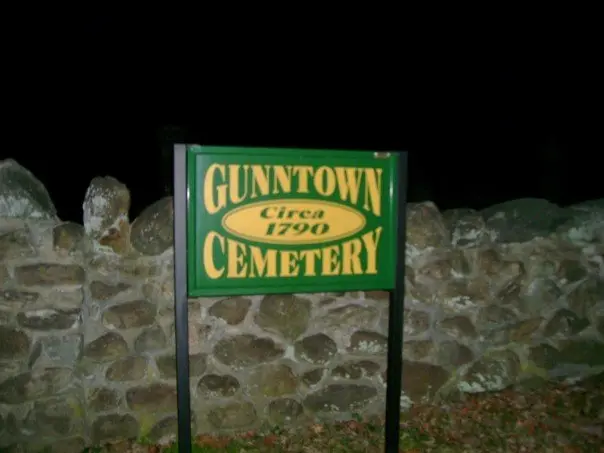
Gunntown Cemetery lies behind a low fieldstone wall on Gunntown Road in Naugatuck, Connecticut, under a green sign that reads "Circa 1790".
Where is Gunntown Cemetery?
- Location
- Connecticut, United States
- Type
- Cemetery
- Coordinates
- 41.491, -73.104
- Last updated
LOCATION
Why is Gunntown Cemetery said to be haunted?
Almost every account of it repeats two claims, and the archives contradict both. This is not the resting place of a Congregational patriot community: Katharine Prichard's 1917 transcription records that the ground was given to the Episcopal society of Gunntown, and Constance McLaughlin Green's 1948 history of the town names the young men of this neighbourhood as Tories who helped hold a kidnapped boy in a Gunntown barn in 1780. Nor is the phantom black dog reported here a local story. Connecticut's famous black dog belongs to West Peak in Meriden, fifteen miles away, where W. H. C. Pynchon set a magazine tale that The Connecticut Quarterly printed in 1898 under the subtitle "A Story". What is verifiable is quieter and stranger: gravestones from July 1790 onward, a sexton's handwritten list of every grave he dug, and a park next door added to the Connecticut Freedom Trail because an enslaved man named Tobiah turned a gun on the kidnappers.
What is the history of Gunntown Cemetery?
Gunntown was never a town. It was a neighbourhood, and it belonged to one family.
In 1733 Nathaniel Gunn, then twenty-four, bought land at the foot of Lewis Hill from John Andrew, in the Towantic Meadows west of what is now the Millville section of Naugatuck. Constance McLaughlin Green, who wrote the town's standard history for Yale University Press in 1948, puts the same purchase in the same year and calls it the beginning of "a large property". The Naugatuck Historical Society records that the family kept buying — the Weed and Hawkins farms, the Lewis and Ward lands — until the holding reached the Derby line, and that Nathaniel remained the largest landowner in the district until his death in 1769, when, by Green's count, he owned eight hundred acres. The Gunns ran their own sawmill, general store, blacksmith shop, distillery and farm, and the Historical Society states plainly that sixteen enslaved people did the work that made that self-sufficiency possible.
Two things about Gunntown are usually got backwards, and both matter here.
The first is religion. This was not a Congregational settlement. Gunntown was an Anglican, later Episcopal, pocket in a Congregational valley. Jobamah Gunn petitioned for an Episcopal church in 1803; it was finished in 1806 on parishioners' donations, and in 1831 it was taken apart and hauled piece by piece in an oxcart two and a half miles to Salem Bridge, where it reopened in 1832 as St. Michael's. Green describes the same moment more briskly: the Episcopalians "chose to abandon the Gunntown church location and build a new edifice". Either way, the congregation walked out of Gunntown and took its building with it.
The second is the Revolution. In March 1780 a gang loyal to the Crown robbed the Bethany house of Captain Ebenezer Dayton and, on the road, seized a sixteen-year-old boy, Chauncey Judd, who had seen them. Green's account is unambiguous about where the gang came from: "young Tories here were inspired to raid his house". The fugitives reached Jobamah Gunn's place and, at gunpoint, made him let them shelter in his barn. Judd was held five days before his brothers and neighbours got him back. The kidnappers drew four years' imprisonment; Judd's father sued and ruined the Wooster family; and Green records that Jobamah Gunn settled his own fine by carrying eight hundred pounds in silver to the Judds in his beaver hat. "The older men in Gunntown who had connived with the kidnappers suffered sharply too," she writes. Israel P. Warren turned the episode into a book, Chauncey Judd; or, The Stolen Boy, serialised and published in 1874; Warren had it from his grandmother Millicent, Chauncey's younger sister.
The burial ground itself is documented, and by an unusually good source. Katharine A. Prichard's Ancient Burying-Grounds of the Town of Waterbury, compiled for the Mattatuck Historical Society and published in 1917, gives Gunntown its own section. "This burial-ground lies within the limits of present Naugatuck," she writes, and adds that "it is said to have been given to the Episcopal society of Gunntown by Enos Osborn, but the date is uncertain." The earliest deaths she found cut into stones there are Enos, son of Noah and Abigail Scovill, 20 July 1790; Alma, daughter of Joel and Mehitabel Hull, 31 August 1796; Sarah, wife of Nathaniel Gunn, 8 March 1797, aged 79; and Comfort, wife of Deacon Thomas Osborn, 1 July 1798.
Prichard also printed something rarer than epitaphs: "A list of the Graves Dug by Enos Osborn", the sexton's own running record of his work, followed by a second list of graves dug after him. Osborn died on 26 June 1851 in his seventy-fourth year and lies in the ground he tended; his heir, Enos Osborn Adams, deeded the plot to Naugatuck in 1860.
After that the record thins into housekeeping. David Davis and Levi Glasson copied every legible inscription on 20 November 1934. Green, writing in 1948, found the eighteenth century surviving in Gunntown only "in the form of a few old farmhouses, and of the Gunntown burial yard", with its "beautifully carved gravestones marking the extinction of the half dozen families who dominated the life of Gunntown one hundred fifty years ago". Volunteers have since photographed 244 stones for BillionGraves. The Grove Cemetery Association of Naugatuck maintains the ground today. And in January 2013 the neighbouring Gunntown Passive Park and Nature Preserve — the land where the kidnappers halted — was added to the Connecticut Freedom Trail, not for the Gunns but for Tobiah, an enslaved man who tried to free the boy.
Timeline: the documented record of Gunntown Cemetery
- 1733 Nathaniel Gunn, aged twenty-four, buys land at the foot of Lewis Hill from John Andrew, west of present-day Millville. Green's 1948 history dates the same purchase to the same year and calls it the start of a large property; the family holding would grow to some eight hundred acres and take the name Gunntown.
- 1769 Nathaniel Gunn dies, still the largest landowner in the district, according to the Naugatuck Historical Society. The family works its mill, store, blacksmith shop, distillery and farm with sixteen enslaved people.
- March 1780 A gang loyal to the Crown robs Captain Ebenezer Dayton's house in Bethany and abducts sixteen-year-old Chauncey Judd. Green writes that "young Tories here were inspired to raid his house"; the fugitives force Jobamah Gunn at gunpoint to shelter them in his Gunntown barn. Judd is recovered after five days. The kidnappers get four years; Green records that Gunn paid the Judd family eight hundred pounds in silver carried in his beaver hat.
- 20 July 1790 The earliest death recorded on a gravestone at Gunntown, according to Katharine A. Prichard's 1917 transcription: Enos, son of Noah and Abigail Scovill. Alma Hull follows in 1796, Sarah, wife of Nathaniel Gunn, on 8 March 1797 aged 79, and Comfort, wife of Deacon Thomas Osborn, on 1 July 1798.
- 1803–1832 Jobamah Gunn petitions for an Episcopal church at Gunntown in 1803; it is completed in 1806, dismantled in 1831 and hauled by oxcart two and a half miles to Salem Bridge, reopening in 1832 as St. Michael's. Green describes the same move as the Episcopalians abandoning the Gunntown site for a new building. Gunntown was an Anglican pocket, not a Congregational one.
- 26 June 1851 Enos Osborn, the sexton whose handwritten "list of the Graves Dug by Enos Osborn" Prichard later printed, dies in his seventy-fourth year and is buried in the ground he tended. Prichard notes the cemetery is said to have been given to the Episcopal society by an Enos Osborn, "but the date is uncertain" — and the man buried here was a child in 1790.
- 1860 Enos Osborn Adams, heir of the sexton, deeds the burial plot to the town of Naugatuck, as recorded by Prichard.
- April–June 1898 W. H. C. Pynchon publishes "The Black Dog: A Story" on page 153 of The Connecticut Quarterly, setting Connecticut's famous phantom black dog on West Peak at Meriden, some fifteen miles from Gunntown Road. The magazine presents it as fiction; readers took it as fact within a generation.
- 1917 The Mattatuck Historical Society publishes Katharine A. Prichard's Ancient Burying-Grounds of the Town of Waterbury, with a full section on Gunntown Cemetery, its epitaphs, the Episcopal society's records and the sexton's grave lists.
- 20 November 1934 David Davis and Levi Glasson copy every legible inscription in the cemetery, producing the second full transcription of the ground; their list is now online through the Oxford Past Cemetery Project.
- 1948 Constance McLaughlin Green's History of Naugatuck, Connecticut appears from Yale University Press. She finds the eighteenth century surviving only in a few farmhouses and in the burial yard, with "beautifully carved gravestones marking the extinction of the half dozen families who dominated the life of Gunntown one hundred fifty years ago". She says nothing about ghosts.
- 15 January 2004 The earliest dated Gunntown ghost report located by this review: Cathy Johnson photographs the cemetery at night from her car and submits a picture of mist to Ghostvillage.com, published on 26 October 2004. She writes that on different visits a different stone appears lit up, and lists the local reputation as "children laughing to a ghost horse riding through, black dogs running around".
- 2005 Jeff Belanger's Communicating with the Dead (New Page Books) carries a caption stating that a paranormal anomaly was captured at Gunntown Cemetery in Naugatuck — the first appearance of the cemetery in a print book on the paranormal that full-text search can find.
- 5 May 2009 Ray Bendici's Damned Connecticut entry consolidates the modern roster — music and children's laughter, a man with a lantern leading a horse, a boy at the back wall, a black dog — and states that the Warrens "deemed it officially haunted". No source, date or case file is given for the Warren claim, then or since.
- January 2013 Gunntown Passive Park and Nature Preserve, the land beside the cemetery where the 1780 kidnappers halted, is added to the Connecticut Freedom Trail by a unanimous vote of its planning committee; a formal dedication and a bronze plaque are announced for September. The listing honours Tobiah, an enslaved man who turned a gun on the gang demanding Chauncey Judd's release and who later gained his freedom by enlisting.
- October 2014 On 15 October the local Patch reports the ghost stories and repeats the Warren attribution, noting there are no posted hours but that police patrol the road.
Is there a rational explanation for Gunntown Cemetery?
The paranormal file on Gunntown is short, late and traceable, which is unusual enough to be worth setting out in order.
The historical claim goes first, because it is the one that is demonstrably wrong. Gunntown is routinely described — including in the earlier version of this entry — as the burial ground of Congregational families and of townspeople who backed independence from the Crown. Prichard's 1917 transcription says the ground was given to the Episcopal society of Gunntown, and Green's 1948 history says the young men of this neighbourhood were Tories who kidnapped a boy in 1780 and whose elders connived at it. Naugatuck as a whole certainly sent men to the Continental cause; Gunntown, specifically, is remembered in the town's own history for the opposite. A cemetery does not need a haunting to be interesting when its actual record is that.
Then the black dog. Connecticut has one famous phantom black dog, and it is a piece of literature with a date on it: "The Black Dog: A Story", by W. H. C. Pynchon, printed on page 153 of The Connecticut Quarterly for April–June 1898. The magazine's own subtitle says what it is. Pynchon set it on West Peak in the Hanging Hills at Meriden, about fifteen miles from Gunntown Road, and attached to it the saying that has outlived him — that to meet the dog once is for joy, twice for sorrow, and the third time to die. The story was taken for reportage almost immediately and has been retold as fact ever since. The earliest mention of a black dog at Gunntown that this review could find is from 2004. We cannot prove borrowing; folklore does not leave receipts. But a motif that is documented in print in 1898 fifteen miles away, and undocumented at Gunntown for the following century, is more economically explained as travel than as coincidence. No eighteenth- or nineteenth-century source connects any dog to this cemetery.
The photographs are the most testable part of the file, and they come with their own explanation attached. The Ghostvillage account of January 2004 — the earliest dated Gunntown report located here — describes photographing the graveyard at night from inside a car, and notes that on different visits a different headstone appears "lit up". A camera flash fired from a car window in a Connecticut January will find exhaled breath, exhaust, drizzle and dust, and will bounce off whichever weathered marble stone happens to face the lens squarely. The photograph used on this page, taken from Wikimedia Commons, is itself a night flash shot of the cemetery sign. That is the mode in which almost all Gunntown evidence has been produced.
The Warrens are the weakest link of all. Ed and Lorraine Warren are said, on essentially every haunted-places page about this cemetery, to have declared it "officially haunted". No page cites a book, a lecture, a date or a case file, and a full-text search of the Internet Archive's book corpus for "Gunntown" returns no Warren title. It is a claim about a claim.
Finally, the cast. Nobody has ever matched the man with the lantern, the boy at the back wall or the crying children to a name on a stone — and two full transcriptions of this cemetery exist, from 1917 and 1934, so the matching could be attempted. Until someone does it, the ghosts of Gunntown are anonymous in a graveyard where almost everyone else is not.
Can you visit Gunntown Cemetery?
Gunntown Cemetery is on Gunntown Road in the Millville section of Naugatuck, Connecticut 06770, about 4.4 km (2.7 miles) west of the town centre. Katharine A. Prichard placed it in 1917 "not far from the intersection of the Middlebury and Oxford lines", which is still where the plot sits. Its front on the road is a dry fieldstone wall with a green sign reading "Gunntown Cemetery, Circa 1790", as a photograph uploaded to Wikimedia Commons in January 2007 shows. Damned Connecticut, whose entry was first published in May 2009 and describes a visit in 2014, calls it "a smallish plot" that is "enclosed by a stone wall and an iron gate", and says to be careful parking "as it's on a narrow road where cars go surprisingly fast."
The Grove Cemetery Association of Naugatuck lists Gunntown as one of the four cemeteries in its care. Its cemeteries page, consulted on 24 September 2026, gives the hours at Gunntown as "Dawn-Dusk"; its rules invite visitors to use the grounds "for walks, reading and peaceful time of reflection" and state that "the cemetery is sacredly devoted to the deceased". The association's postal address is Post Office Box 824, Naugatuck, CT 06770, with telephone 203-729-1297 and the address [email protected]. The older guidance in circulation predates that page: Damned Connecticut reported "no set hours" and no "No Trespassing" signs, while adding that "the local police patrol the area regularly and frown upon after-dark visits". Naugatuck Patch repeated both points in October 2014, crediting Damned Connecticut.
The inscriptions can be read without touching a stone, because two complete transcriptions exist. Prichard's, published by the Mattatuck Historical Society, also prints the sexton Enos Osborn's own "list of the Graves Dug by Enos Osborn" for 1801 to 1857; the second was copied by David Davis and Levi Glasson on 20 November 1934 and is online through the Oxford Past Cemetery Project. BillionGraves counts 244 headstone images and 247 records for the cemetery and marks it as fully photographed.
Gunntown Passive Park and Nature Preserve is also on Gunntown Road. Citizen's News reported on 23 January 2013 that the Connecticut Freedom Trail Planning Committee had voted unanimously to add the park to the trail, and that the volunteer committee maintaining it put its size at 39 acres (about 16 hectares). The listing rests on the kidnapping of Chauncey Judd in 1780: the gang halted on this land at a bend in Long Meadow Brook near the Gunn barn, where their leader was prevented from shooting the boy. The trail also commemorates Tobiah, an enslaved man at an inn near Derby who turned a gun on one of the kidnappers to demand Judd's freedom and who later won his own by enlisting. The Freedom Trail's page for the site, consulted on 24 September 2026, says "This site is open to the public". A Connecticut Museum Quest post dated 17 April 2018 mentions the park's parking lot and a Freedom Trail obelisk beside it, and Naugatuck's municipal website publishes a map of the park's trails on its Parks and Trails page.
The Naugatuck Historical Society, whose page on Gunntown reproduces photographs of the cemetery taken in March 1937 and in September 2024, keeps its museum at 380 Church Street; its website gives the opening hours as Saturdays from 10 a.m. to 2 p.m., with [email protected] and (203) 729-9039 for research requests.
Sources consulted
- Katharine A. Prichard (comp.), «Ancient Burying-Grounds of the Town of Waterbury, Connecticut, together with other records of church and town — Gunntown Cemetery, pp. 148–168» — The Mattatuck Historical Society, Waterbury, 1917 book
- Constance McLaughlin Green, «History of Naugatuck, Connecticut — pp. 3, 26, 46–47, 77» — Yale University Press, New Haven, 1948 book
- Sandra Clark, for the Naugatuck Historical Society, «Gunntown Rd. / Gunntown (drawing on the Society's Newsletter, May–June 2005)» — Naugatuck Historical Society, street histories, 2005 archive
- W. H. C. Pynchon, «The Black Dog: A Story, in The Connecticut Quarterly, vol. 4, April–June 1898, p. 153» — The Connecticut Quarterly, Hartford, 1898 archive
- David Davis and Levi Glasson, «Gunntown Cemetery, Naugatuck — inscriptions copied by David Davis and Levi Glasson, 20 November 1934» — Oxford Past Cemetery Project, 1934 archive
- Cathy Johnson, «The Mist of Gunntown Cemetery — Naugatuck, Connecticut, January 15, 2004» — Ghostvillage.com, Encounters, 2004 web
- Ray Bendici, «Gunntown Cemetery, Naugatuck» — Damned Connecticut, 2009 web
- Feroze Dhanoa, «Looking to Get Spooked Out? Check out the Gunntown Cemetery in Naugatuck» — Naugatuck Patch, 2014 newspaper archive
- Steve Wood, «Concept of Freedom Trail: Naugatuck — Gunntown Passive Park and the story of Tobiah» — CTMQ (Connecticut Museum Quest), 2018 web
- Grove Cemetery Association of Naugatuck, «Grove Cemetery Association of Naugatuck — cemeteries managed and contact details» — grovenaugatuck.com, 2026 web
- BillionGraves volunteers, «Gunntown Cemetery, Naugatuck, New Haven, Connecticut — 244 headstone images, 247 records» — BillionGraves, 2026 web
- Jeff Belanger, «Communicating with the Dead: Reach Beyond the Grave (caption: anomaly captured at Gunntown Cemetery in Naugatuck)» — New Page Books, Franklin Lakes NJ, 2005 book
- Luke Marshall, «Gunntown now part of freedom trail — committee vote of January 2013, 39-acre park, dedication and plaque announced for September» — Citizen's News, Naugatuck (archived copy, Wayback Machine, 30 October 2020), 2013 newspaper archive
- Grove Cemetery Association of Naugatuck, «Cemeteries — Gunntown Cemetery, Gunntown Road, Naugatuck: hours Dawn-Dusk» — grovenaugatuck.com, 2026 web
- Grove Cemetery Association of Naugatuck, «Cemetery Rules and Regulations — the four cemeteries in the Association's care» — grovenaugatuck.com, 2026 web
- Connecticut Freedom Trail, «Gunntown Passive Park — Concept of Freedom site, Gunntown Road, Naugatuck: open to the public» — ctfreedomtrail.org, 2026 web
- Borough of Naugatuck, «Parks & Trails — trail maps, including the Gunntown Passive Park and Nature Preserve Map» — naugatuck-ct.gov, 2026 web
- 2112guy, «Gunntown01.jpg — the cemetery sign, "Gunntown Cemetery, Circa 1790", on the fieldstone wall (photographed 12 January 2007)» — Wikimedia Commons, 2007 archive
Reviewed by V. Serrano on 2026-08-11 · How we verify our content
💬 Field testimonies (0)
No testimonies yet. Add the first.
Add your testimony
🔒 Log in to add a testimony