👻 HAUNTED PLACE · EXP. Nº0482
ACTIVE
Holcomb Creek Trestle
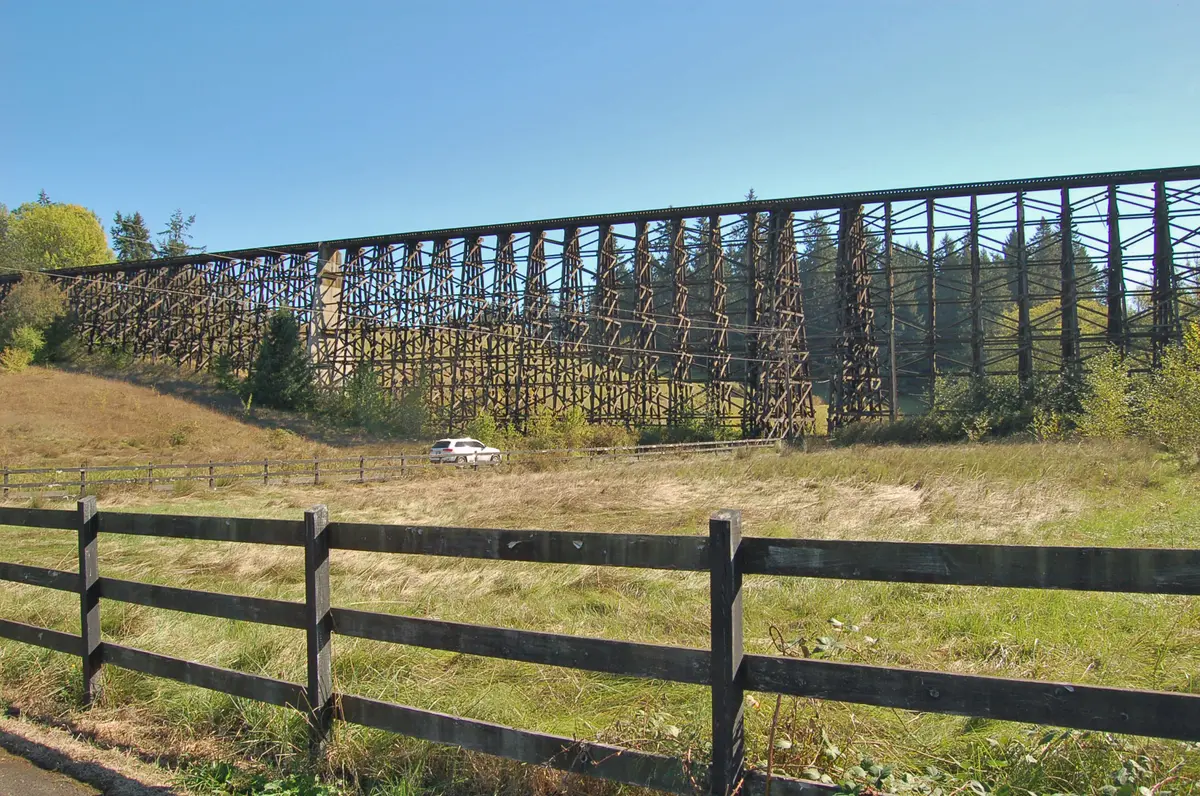
The Holcomb Creek Trestle, also known as the Dick Road Trestle, is a 1,168-foot wooden railroad bridge spanning Holcomb Creek in Helvetia, Oregon, built in 1905 for the United Railways.
Where is Holcomb Creek Trestle?
- Location
- Oregon, United States
- Type
- Road / bridge
- Coordinates
- 45.597, -122.898
- Last updated
LOCATION
Why is Holcomb Creek Trestle said to be haunted?
It is the longest wooden trestle still in use in the United States. The line was electrified overhead until 1923, then served by steam and diesel freight. Rebuilt in 1947 after a Cornelius Pass fire, it remains an active freight line operated by Portland & Western Railroad. Despite internet legends of hauntings, no primary historical sources — newspaper archives, railroad records, or contemporary accounts — document suicides, murders, or violent deaths at the site. The haunting story originates from a 2015 blog post by Tyler Willford on This Oregon Life, which cited anonymous internet forum stories. The archived website traintrestle.com, which documented the trestle's history in detail, explicitly states there is no mention of strange sightings, ghosts, or hauntings. The Trackside Photographer (June 2019) also makes no mention of any haunting. The volume of wood necessary for the Dick Road structure probably exceeds that of the taller wooden trestle on the San Diego & Arizona Eastern line in Carrizo Gorge, though that bridge is not longer.
What is the history of Holcomb Creek Trestle?
The Holcomb Creek Trestle, also known as the Dick Road Trestle, is a wooden railroad trestle spanning Holcomb Creek in Washington County, Oregon, on Dick Road near the unincorporated community of Helvetia. Built for the United Railways, in 1905 according to The Trackside Photographer (traintrestle.com marks that year 'not confirmed yet', and Senator Merkley's 2010 funding request says about 1910), an electric interurban railway that ran from Portland to Wilkesboro with a connection to Banks. Although it initially had passenger service, its main commodity was lumber. In the 1930s the overhead wires were dismantled and the line was served by steam and later diesel freight trains. The line was nearly abandoned by Burlington Northern, who eventually obtained it through the 1995 merger of Burlington Northern and the Atchison Topeka & Santa Fe Railway. The State of Oregon officially owns the right-of-way and the shortline Portland & Western Railroad runs freight trains on the line. The trestle is 1,168 feet long and about 90 feet tall, and is thought to be the longest wooden railroad trestle still in use in the United States. It was known by the Burlington Northern Railroad as "Bridge 16.7". The designation "United Railways District" by P&W of the line from United Jct. to Banks pays respect to the original name of this railroad, which was United Railways (UR). The overhead electrification was dismantled early in 1923 when steam locomotives took over operation of this road. Extensive logging rail lines constructed under different names penetrated the Coast Range from Wilkesboro and Banks, so the United carried a lot of timber to a log dump named Rafton on the Multnomah Channel of the Willamette River near present-day Burlington. Two logging lines were operated as common carriers: the Gales Creek & Wilson River Railroad went as far as Gales Creek from Wilkesboro and the Portland Astoria & Pacific built from Banks to Vernonia where a network of logging company lines fanned out into the mountains. The trestle was designated a Bridge 16.7 by BNSF, which referred to it as a timber pile-driven trestle. The portion of the line between United Jct. and Bowers Jct. became an integral part of the Oregon Electric's main line when the OE was forced off its historic first route that utilized downtown streets of Portland and an alignment via Multnomah and Garden Home. The designation "United Railways District" by P&W of the line from United Jct. to Banks pays respect to the original name of this railroad, which was United Railways (UR). The line was built as an overhead electrified interurban railway and the intent was to build through the Coast Range to Tillamook. However, UR never got beyond Banks and electric interurban service between Portland and Banks began on April 16, 1911. The next year, service was cut back to Wilkesboro. Although UR started as an independent company in January of 1906, it was acquired in early 1910 by the Great Northern Railway. Later that same year, half of the stock was sold to the Northern Pacific Railway and then both GN and NP turned their stock over to their jointly owned Spokane Portland & Seattle Railway. It is believed United continued to exist as a separate company owned by SP&S until it was merged into SP&S in 1944. SP&S, GN, NP and some other lines were merged in 1970 to form Burlington Northern. BN merged with the Atchison Topeka & Santa Fe Railway in 1995 to form the Burlington Northern and Santa Fe Railway Company, now renamed BNSF Railway Company. The Holcomb Creek Trestle was rebuilt in approximately 1947, according to the funding request published by Senator Merkley's office in 2010. Separately, the line was out of service from September 1994 after a major trestle on the east side of Cornelius Pass was lost by fire; P&W replaced that bridge with a new steel box girder structure, reopening Cornelius Pass to traffic on July 1, 1998. The Holcomb Creek Trestle itself was not the structure that burned; it was a different major trestle on the east side of Cornelius Pass. The Holcomb Creek Trestle continued in service and remains in use today. Local sources estimate its height at around 90 feet, and it spans Holcomb Creek in a valley presumably created by the creek itself. Despite its reputation as the longest wooden railroad trestle still in use in the United States, there are no contemporary newspaper accounts or official records documenting suicides, murders, or any violent deaths at the site. The haunting stories were gathered in a 2015 blog post on That Oregon Life, which collected them from internet forums, Reddit and a Facebook page that were already circulating them. The archived website traintrestle.com, which documented the trestle's history in detail, does not mention ghosts or hauntings; That Oregon Life noted in 2015 that it had "no mention of strange sightings, ghosts, or hauntings". The Trackside Photographer, in a June 2019 article about the trestle, also makes no mention of any haunting. The volume of wood necessary for the Dick Road structure probably exceeds that of the taller wooden trestle on the San Diego & Arizona Eastern line in Carrizo Gorge, San Diego County, California, though the latter is not longer. The trestle remains an active railroad bridge carrying freight trains on the Portland & Western line.
Timeline: the documented record of Holcomb Creek Trestle
- 1905 Holcomb Creek Trestle built for United Railways (traintrestle.com gives the year as 'not confirmed yet'; Senator Merkley's 2010 funding request says about 1910)
- Early 1923 Overhead electrification dismantled, steam takes over
- c. 1947 Trestle rebuilt, in approximately 1947 according to the funding request published by Senator Merkley's office in 2010
Is there a rational explanation for Holcomb Creek Trestle?
The legend that the Holcomb Creek Trestle is haunted is collected in a 2015 blog post on That Oregon Life, which gathered stories already circulating on internet forums, Reddit and a Facebook page. No primary historical sources — newspaper archives, railroad records, or contemporary accounts — document suicides, murders, or violent deaths at the site. The archived traintrestle.com, which documented the trestle's history in detail, does not mention ghosts or hauntings, as That Oregon Life itself pointed out in 2015. The Trackside Photographer (June 2019) also makes no mention of any haunting. The supposed haunting appears to be a modern legend without documentary support. Alternative explanations include: pareidolia (seeing patterns where none exist), suggestion from internet folklore, and the natural creaking and movement of a 115-year-old wooden trestle under train traffic. Senator Jeff Merkley's 2010 funding request dates the rebuilding of the Dick Road trestle to approximately 1947 and mentions no fire; the steel box girder bridge of 1998 replaced a different trestle, on Cornelius Pass, lost to fire in 1994. The bridge's age and the common occurrence of ghost legends at old railroad bridges may contribute to the persistence of the story, but there is no verified evidence of paranormal activity.
Can you visit Holcomb Creek Trestle?
The trestle carries the Portland & Western Railroad's United District over Holcomb Creek and over Dick Road, a county road, slightly east of the small community of Helvetia in the far east of Washington County. That is how the site is described in a funding request that Senator Jeff Merkley's office published in 2010, which measures the trestle at 1,168 feet (356 m) long and about 90 feet (27 m) high at its highest point. The same request says the line carries several freight trains a day, and it sought 604,000 dollars for new rail and new bridge-deck timbers. The coordinates on this file, 45.5969, -122.8983, match those that English Wikipedia gives for the structure.
Dick Road passes beneath the timber bents. The Trackside Photographer stated in June 2019 that the State of Oregon owns the right-of-way and that Portland & Western runs its freight trains over it. It is a working bridge on a freight line, and the ghost stories that That Oregon Life gathered from forums and from Reddit in 2015 include accounts of people walking up onto it at night. One of the accounts reproduced there adds that security around the trestle had become tighter because of vandalism.
Sources consulted
- Anonymous webmaster (a neighbour of the trestle), quoting Bob Melbo and Arlen Sheldrake, Pacific Northwest Chapter NRHS, «traintrestle.com (archived)» — Website, 2017 web
- Admin, «The Trackside Photographer: A Sense of Place» — Blog article web
- Jeff Merkley, «Senator Jeff Merkley Transportation Document» — FY 2011 THUD Appropriations, 2011 report
- Wikipedia contributors, «Holcomb Creek Trestle, Wikipedia» — Wikipedia, 2025 web
- Tyler Willford, «That Oregon Life: This Old Oregon Train Trestle on Dick Road is Said To Be Haunted» — Blog article web
Reviewed by V. Serrano on 2026-08-22 · How we verify our content
📎 Source: Wikipedia (CC BY-SA)
💬 Field testimonies (0)
No testimonies yet. Add the first.
Add your testimony
🔒 Log in to add a testimony