👻 HAUNTED PLACE · EXP. Nº9478
ACTIVE
Hot Lake Hotel
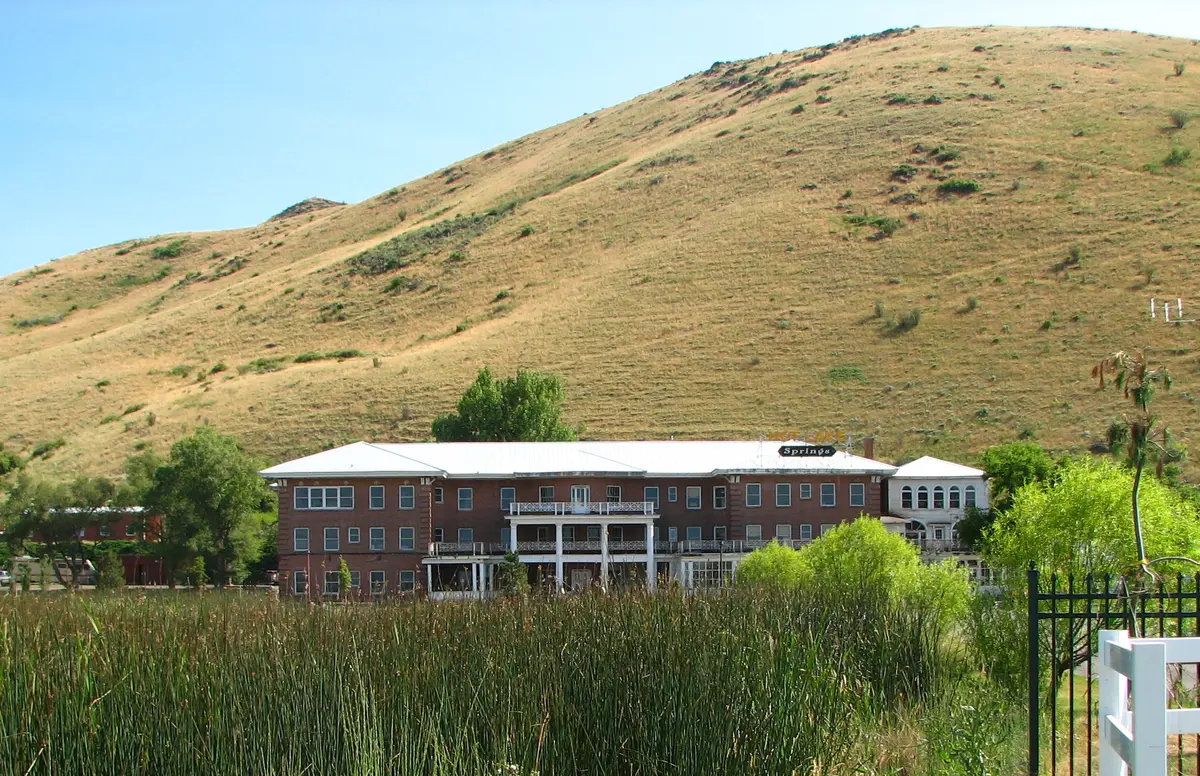
Beside a sulphur lake in eastern Oregon that Washington Irving's sources already called "extremely noisome" in 1812 stands a three-storey brick sanatorium finished in 1906.
Where is Hot Lake Hotel?
- Location
- Oregon, United States
- Type
- Hotel / inn
- Coordinates
- 45.243, -117.957
- Last updated
LOCATION
Why is Hot Lake Hotel said to be haunted?
It was built not by a doctor but by the Oregon Railway & Navigation Company and Walter M. Pierce, a future governor, who laid an expensive line right past the door. The surgeon W. T. Phy arrived afterwards as assistant manager and only took charge in 1917, turning it into "the Mayo Clinic of the West": a 60-bed surgical ward, early x-ray diagnosis, four transcontinental trains a day. Fire took the wooden wings in 1934, the aged were housed there from 1951, and after 1974 the building stood mostly empty. That is when the ghost stories start: the earliest printed account, Mike Helm's in 1983, quotes the owner of the day flatly denying them. It was never an asylum, and the surgical equipment famously left inside was recorded in the federal register file in 1978, years before anyone was hunting ghosts. Restored twice, it reopened in 2020 as a hot springs resort that does not sell its ghost.
What is the history of Hot Lake Hotel?
The lake came first, and it was already famous for being unpleasant.
In the summer of 1812 Robert Stuart's eastbound party of the Pacific Fur Company crossed the Grande Ronde plain and passed a steaming pool that Washington Irving would describe, from their journals, in "Astoria" (1836): "a great pool of water, three hundred yards in circumference, fed by a sulphur spring, about ten feet in diameter, boiling up in one corner. The vapor from this pool was extremely noisome, and tainted the air for a considerable distance." Irving does not name the valley; the National Register nomination that later quoted him added the gloss. Native people had been coming to the sulphur springs long before that; the Register file records the name "Ea-kesh-pa", and the present owners attribute it to the Nez Perce.
The resort began in 1864, when Samuel Fitzgerald Newhart arrived in the Grande Ronde Valley from California and built a hotel, a row of bath houses with wooden tubs for mud and hot mineral treatments, and a dance hall, in partnership with a man named Clark. Clark died in 1878. The enterprise was incorporated in 1887 and sold in 1900 to a Dr. Minthorn, who built a newer facility with a partner remembered only as "Bear" Cook before selling his interest to a Dr. Tape and going off to invest in a spa on the Oregon coast.
What turned Hot Lake into an institution was the railway. The Oregon Railway & Navigation Company had laid an expensive stretch of line directly in front of the hotel — bypassing Union, the county seat, on a route that made no obvious engineering sense — and it bought the resort from Tape in partnership with Walter M. Pierce, a Pendleton lawyer who would go on to serve as state senator, Governor of Oregon (1923-1927) and congressman (1933-1943). After several years of construction, their $150,000 three-storey brick and concrete building was finished and opened for use in 1906. It ran to some 65,000 square feet and was said to have been patterned after the newest bathhouses at Hot Springs, Arkansas. The Register nomination states plainly that the architect is not known; Oregon's state historic sites database records "possibly John V. Bennes", and the current owners attribute it to Bennes outright.
This matters because of who did not build it. Dr. William T. Phy, the name attached to Hot Lake ever since, arrived afterwards: Pierce recruited him as assistant manager once the east wing was up. Phy was a local man who had trained in medicine in Kansas City and done postgraduate work in the East.
The railway's own 1911 tourist guide, "Outings in Oregon", shows what the place actually was. It advertised "an institution inviting to the sick, and attractive to all", with over $400,000 spent on a brick building with a 600-foot frontage 200 yards from the station. "The hospital department is on the third floor; here are wards and private rooms. The surgical equipment is complete. The operating room has white tiling floors, walls and ceiling, metal doors, and is perfectly lighted." Rates ran from $2 to $3.50 a day. The guide's boast that "the Sanatorium is a small community in itself, every want being provided under the one roof" is the origin of the nickname "The Town Under One Roof".
That year the business took $178,000, at a time when meals started at 25 cents. Shortly afterwards Phy left, reportedly after a dispute with Pierce over control of operations. He was brought back in 1917 and floated a $96,000 renovation bond through the Boise Trust Company, paid off in under five years, and it is from that point that Hot Lake's international reputation dates. Phy was known for the early use of x-rays as a diagnostic tool and for radiological treatment of cancer; he sat on the State Board of Health and served as assistant adjutant of the US Army Medical Corps while on leave. Hot Lake was called "the Mayo Clinic of the West", a phrase the Register file says the original Rochester clinic itself endorsed.
At its height the complex held a 60-bed surgical ward, ballroom, poolroom, cafeteria, barber shop, drug store, laboratories and x-ray rooms, employed between 125 and 175 people, and in 1924 averaged 125 new guests a day, with four transcontinental trains stopping daily at Hot Lake station. Its closed-loop geothermal heating system, installed with the 1905-1906 construction, is believed to be among the oldest in any large commercial building in the United States.
The collapse was quick. Phy died in 1932 — some accounts say 1931 — and his son Mark T. Phy, also a surgeon and administrator, died the following year. The Depression closed every local bank; by 1934 the resort had more than $250,000 of unpaid patient accounts on its books when it applied for federal reconstruction funds. That same year, with maintenance abandoned, fire destroyed most of the wooden portion of the main building and the old hotel of about 1900. Only the brick survived, and it never recovered.
After that the building was rented out to whatever would pay. It served as a flight school and nurse training centre during the Second World War. A. J. Roth acquired it in 1941 and in 1951 turned it into a home for the aged, which the Register describes as well maintained and financially successful. A partnership bought it from Roth in 1974 and closed the rest home — its only income — abruptly; a restaurant opened without much success and no guest rooms were ever reopened. In November 1977 the Hot Lake Development Company took it on, and it was its president, Stephen M. Munson, who prepared the nomination that put the property on the National Register of Historic Places on 15 March 1979 (reference 79002148). That file describes an extraordinary plan — 105 guest rooms, a disco in the show barn, a banquet hall for 700 under a canopy of stained glass — which never happened. Dr. Lyle Griffith ran a bath house there in the mid-1980s. The building was abandoned in 1991.
It has been restored twice since. The sculptor David Manuel bought the ruin in 2003, opened it for tours in 2005 and by 2010 was running a bed and breakfast, a restaurant, a bronze foundry and a history centre in it, surviving the collapse of the west wing in 2008. In 2020 the owners of the neighbouring Grande Hot Springs RV Resort took over and began a further phase of work.
Timeline: the documented record of Hot Lake Hotel
- Summer 1812 Robert Stuart's eastbound Pacific Fur Company party passes the steaming lake. Washington Irving later works their journals into "Astoria" (1836), describing "a great pool of water, three hundred yards in circumference, fed by a sulphur spring" whose vapour "was extremely noisome, and tainted the air for a considerable distance".
- 1864 Samuel Fitzgerald Newhart, newly arrived from California, builds a hotel, bath houses with wooden tubs and a dance hall beside the springs in partnership with a man named Clark.
- 1906 After several years of construction, the $150,000 three-storey brick and concrete sanatorium is completed and opened by the Oregon Railway & Navigation Company in partnership with Walter M. Pierce, the future governor. The nomination records the architect as unknown. Dr. W. T. Phy is recruited afterwards, as assistant manager.
- 1911 The railway's own tourist guide "Outings in Oregon" advertises Hot Lake Sanatorium as "an institution inviting to the sick", with a third-floor hospital department, a white-tiled operating room and mineral and mud baths. That year the business takes $178,000.
- 1917 Phy, who had left after a dispute with Pierce over control of operations, is brought back and floats a $96,000 renovation bond through the Boise Trust Company. From this point dates the resort's international reputation as "the Mayo Clinic of the West".
- 1932 Dr. W. T. Phy dies — some accounts give 1931 — and his son Mark T. Phy, also a surgeon and administrator, dies the following year. The Depression closes every local bank.
- 1934 With maintenance abandoned and more than $250,000 of unpaid patient accounts on the books, fire destroys most of the wooden portion of the main building and the old hotel of about 1900. Only the brick sanatorium survives.
- 1939 The Federal Writers' Project guide "The Oregon Trail" records that at Hot Lake "water gushing from springs has a temperature of 208 degrees, the boiling point at this altitude" — the origin of a figure still repeated today.
- 1951 A. J. Roth, who bought the property in 1941, converts the brick building into a home for the aged. The Register file describes it as well maintained and a financial success.
- 1974 A partnership buys the building from Roth and abruptly closes the rest home, its only source of income. No guest rooms reopen. It is from the empty years that follow that the ghost reports date.
- 15 March 1979 Hot Lake Resort is individually listed on the National Register of Historic Places (reference 79002148) on a nomination prepared by Stephen M. Munson of the Hot Lake Development Company. It is a Register listing, not a National Historic Landmark.
- 1983 Mike Helm publishes "Oregon's Ghosts & Monsters", the earliest printed account of the haunting that can be fixed. He first heard the stories "several years ago from the librarian", names the caretaker Richard Owens as his informant, and quotes the then owner Dr. Griffith: "Hot Lake Hotel is not a haunted house."
- 1991 After a bath house run by Dr. Lyle Griffith in the mid-1980s fails, the building is abandoned. It is looted and left open to the weather for over a decade.
- 2003 The sculptor David Manuel buys the ruin and begins restoring it, opening for tours in 2005 and running a bed and breakfast, restaurant, bronze foundry and history centre by 2010. His website never once mentions a ghost.
- 2020 The owners of the neighbouring Grande Hot Springs RV Resort take over and reopen the property as Hot Lake Springs Resort: nine outdoor soaking pools, sixteen rooms in the 1906 lodge, a pub and a 60-seat cinema. The foundry and history centre are gone; so is any mention of hauntings.
Is there a rational explanation for Hot Lake Hotel?
The most testable claim about Hot Lake is not about ghosts at all. It is the claim, repeated across the internet, that this was a psychiatric hospital or an asylum. It was not, and the documents are unusually clear.
The railway's 1911 guide describes a surgical hospital and a bath house: a third-floor hospital department, a tiled operating room, anaesthetising and sterilising rooms, mineral and mud baths. The 1979 Register nomination describes a 60-bed surgical ward and a doctor known for x-ray diagnosis and the radiological treatment of cancer. The documented later uses are a wartime flight school and nurse training centre, a home for the aged from 1951, a restaurant in the mid-1970s and a bath house in the mid-1980s. To check that this silence is real and not a failed search, I counted the vocabulary in the 1911 guide: in the Hot Lake entry, "surgical" appears twice, "hospital" once and "baths" once, while "insane", "mental", "asylum" and "psychiatric" appear zero times — and zero times in the whole 64-page book, even though "nerve" turns up three times elsewhere in it (the neighbouring Radium Springs Sanatorium is sold for "nerve restoration") and "rheumatism" four times. The words existed in the sales language of the period. They were not used here.
The haunting itself can be dated, and it is much younger than the sanatorium. The earliest printed account I have been able to fix is Mike Helm's "Oregon's Ghosts & Monsters" (Rainy Day Press, 1983), whose Hot Lake chapter begins on page 82. Helm says he "first heard about the ghosts at Hot Lake Hotel several years ago from the librarian" — placing the oral tradition in the late 1970s, that is, after the rest home closed in 1974 and the building stood mostly empty, and roughly seventy years after the sanatorium opened. Helm's informant is named: "The person who best knows the ghosts of Hot Lake Resort is Richard Owens, 27", the caretaker. Jo-Anne Christensen's "Haunted Hotels" (Lone Pine, 2002) recycles the same man — "A fellow named Richard Owens worked at Hot Lake Hotel as a caretaker and handyman" — and opens its chapter by conceding the point: "It's easy to see how the ghost stories might have started. Hot Lake Hotel itself looks like…". The stories are also collected in Margaret Read MacDonald's "Ghost Stories from the Pacific Northwest" (August House, 1995).
And Helm quotes the owner of the day turning it down flat. His conclusion is built around Dr. Griffith's verdict: "Hot Lake Hotel is not a haunted house."
That refusal has been remarkably consistent, and it is the finding that surprised me most. Businesses normally sell their ghost. Neither owner of the restored building ever has. I swept the current operator's entire website — all 33 pages listed in its own sitemap, 3.9 MB of text: "ghost", "haunt", "paranormal" and "apparition" appear zero times, against 2,452 occurrences of "soak" and 390 of "history". I then swept 60 distinct archived pages of the Manuel family's site between 2006 and 2020 in the Internet Archive, about 128,000 characters: again zero, against 71 occurrences of "bronze" and 22 of "Manuel". The haunted reputation of Hot Lake is entirely third-party — folklore books, ghost-hunting groups and television, including the Fox Family series "The Scariest Places on Earth" (2000-2006), which lists Hot Lake Resort among its featured locations.
Two details usually offered as evidence are real but prove less than they seem. The abandoned surgical equipment was not a ghost hunters' discovery: the federal nomination of 1978 already recorded the operating room "completely finished in white ceramic tile" and noted that "numerous pieces of medical equipment remain on the premises", eight years before the building was even abandoned. And the water temperature of 208 degrees Fahrenheit, quoted in every account including Helm's, comes from the Federal Writers' Project guide "The Oregon Trail" (1939), which itself explains the number: 208 °F is simply the boiling point at this altitude. The present operators give a source temperature of about 186 °F.
The ordinary explanations available here are unusually physical. The building is heated by convection through a closed geothermal loop: near-boiling mineral water runs through ornate vertical tube radiators in every room and through pipework threaded across three floors of a 65,000-square-foot brick shell. Large plumbing systems carrying water at that temperature expand, contract, knock and sigh. Outside, the sulphur that made Irving's party gag in 1812 is still coming out of the ground at up to two million gallons a day. A dark, half-empty, echoing building over a boiling sulphur spring does not need a ghost to be unnerving, and Christensen, to her credit, says so on the first line.
Can you visit Hot Lake Hotel?
Hot Lake Springs Resort operates at 66172 Highway 203, La Grande, Oregon 97850, just off Interstate 84 south-east of La Grande; the telephone is (541) 226-3944. Its site is hotlakespringsresort.com; the older address hotlakesprings.com has passed to other hands, and on 9 September 2026 it served the site of an epoxy flooring contractor in Allen, Texas.
Day-use soaking is sold by online reservation, and on 9 September 2026 the resort's soaking page gave prices of $20 Monday to Thursday and $29 Friday to Sunday. The posted hours were 8 am to 8 pm every day, with a Wednesday two-for-one offer running through 2026. Arrival is at the front desk within fifteen minutes of the reserved time.
Nine outdoor pools line the lake shore: the round ones seat six to eight; the historic brick pool and the rock pool take about eight to ten; the square ones about six. A single-person cold plunge is held, in the resort's words, "around 40–45°F". The amenities page states that "over 2,000 gallons per minute of mineral-rich water emerge at 186°F and flow naturally into nine outdoor tubs".
The age rules are strict: booking requires an adult of 18 with ID; those aged 12 to 17 must have an adult present in the soaking area; children of 11 and under are excluded from it altogether, in the resort's wording "not allowed in soaking area (nor left unattended)". The soaking area is a quiet zone, where the resort asks for "talking in a low voice and not playing any music". Glass containers and cans are banned there; outside alcohol and outside food are banned as well, and pets are not admitted.
Sixteen rooms are let in the restored 1906 lodge, several with clawfoot tubs in the room; Room 118 is described as an "Accessible ground-floor queen room with private ADA zero-entry shower bathroom". Overnight guests get 24-hour soaking privileges. Check-in runs from 4 pm to 10 pm Pacific time and check-out is at noon.
On site the resort lists the Thermal Pub & Eatery, a gift shop across from the theatre and a 60-seat cinema with Thursday-to-Sunday screenings. None of the products it advertises is a ghost tour or a paranormal night.
Sources consulted
- Stephen M. Munson (Hot Lake Development Company), «Hot Lake Resort — National Register of Historic Places Inventory / Nomination Form (ref. 79002148)» — United States Department of the Interior, National Park Service, 1979 report
- Passenger Department, Oregon-Washington Railroad & Navigation Co. and Southern Pacific Lines in Oregon, «Outings in Oregon: A Guide to the Seaside and Mountain Resorts, Lakes, Rivers and Springs of Oregon — "Hot Lake Sanatorium", pp. 57-59» — Oregon-Washington Railroad & Navigation Co., Portland, 1911 book
- Washington Irving, «Astoria; or, Anecdotes of an Enterprise Beyond the Rocky Mountains» — Project Gutenberg (from the 1836 edition), 1836 book
- Mike Helm, «Oregon's Ghosts & Monsters — "Hot Lake Resort", from p. 82» — Rainy Day Press, Eugene, Oregon, 1983 book
- Margaret Read MacDonald, «Ghost Stories from the Pacific Northwest» — August House Publishers, 1995 book
- Jo-Anne Christensen, «Haunted Hotels — chapter on Hot Lake Hotel» — Lone Pine Publishing, 2002 book
- Federal Writers' Project, Works Progress Administration, «The Oregon Trail: The Missouri River to the Pacific Ocean (American Guide Series)» — Hastings House, New York, 1939 book
- Oregon State Historic Preservation Office, «Oregon Historic Sites Database — Hot Lake Resort, 66172 Hwy 203 (year built 1906; architect unknown, possibly John V. Bennes)» — Oregon Parks and Recreation Department, 2026 web
- Hot Lake Springs Resort, «Hot Lake Springs Resort — official website (history, soaking, lodging, policies; consulted 12 August 2026)» — hotlakespringsresort.com, 2026 web
- Internet Archive Wayback Machine, «Hot Lake Springs (Manuel family) — archived captures of hotlakesprings.com, 2006-2020» — Internet Archive, 2020 archive
Reviewed by V. Serrano on 2026-08-12 · How we verify our content
💬 Field testimonies (0)
No testimonies yet. Add the first.
Add your testimony
🔒 Log in to add a testimony