👻 HAUNTED PLACE · EXP. Nº9477
ACTIVE
Hotel Colorado
The Hotel Colorado opened above the hot springs of Glenwood Springs on 10 June 1893, and for a century its fame rested on its guests: Theodore Roosevelt spoke to the town from its courtyard in May 1905, William Howard Taft was driven up to the west entrance at dawn in September 1909, and the Chicago gunman “Diamond Jack” Alterie made the western slope his playground in the 1920s.
Where is Hotel Colorado?
- Location
- Colorado, United States
- Type
- Hotel / inn
- Coordinates
- 39.551, -107.325
- Last updated
LOCATION
Why is Hotel Colorado said to be haunted?
Its ghost stories are much younger and much thinner than its history. The sentence that put the hotel into the haunted canon — that the two suites in the bell towers are frequently reported to be haunted — carries no source at all, and the only investigation ever cited, an electromagnetic survey of September 2006 outside rooms 325 and 551, reaches the reader through a ghost-tourism website. What the hotel itself tells is better and more specific: a nurse called Bobbie, a manager called Walter, a houseman and a security guard with names and dates, and a basement that held a morgue and eight naval cells between 1943 and 1946, when this was a U.S. Naval Convalescent Hospital for men coming back from the Pacific.
What is the history of Hotel Colorado?
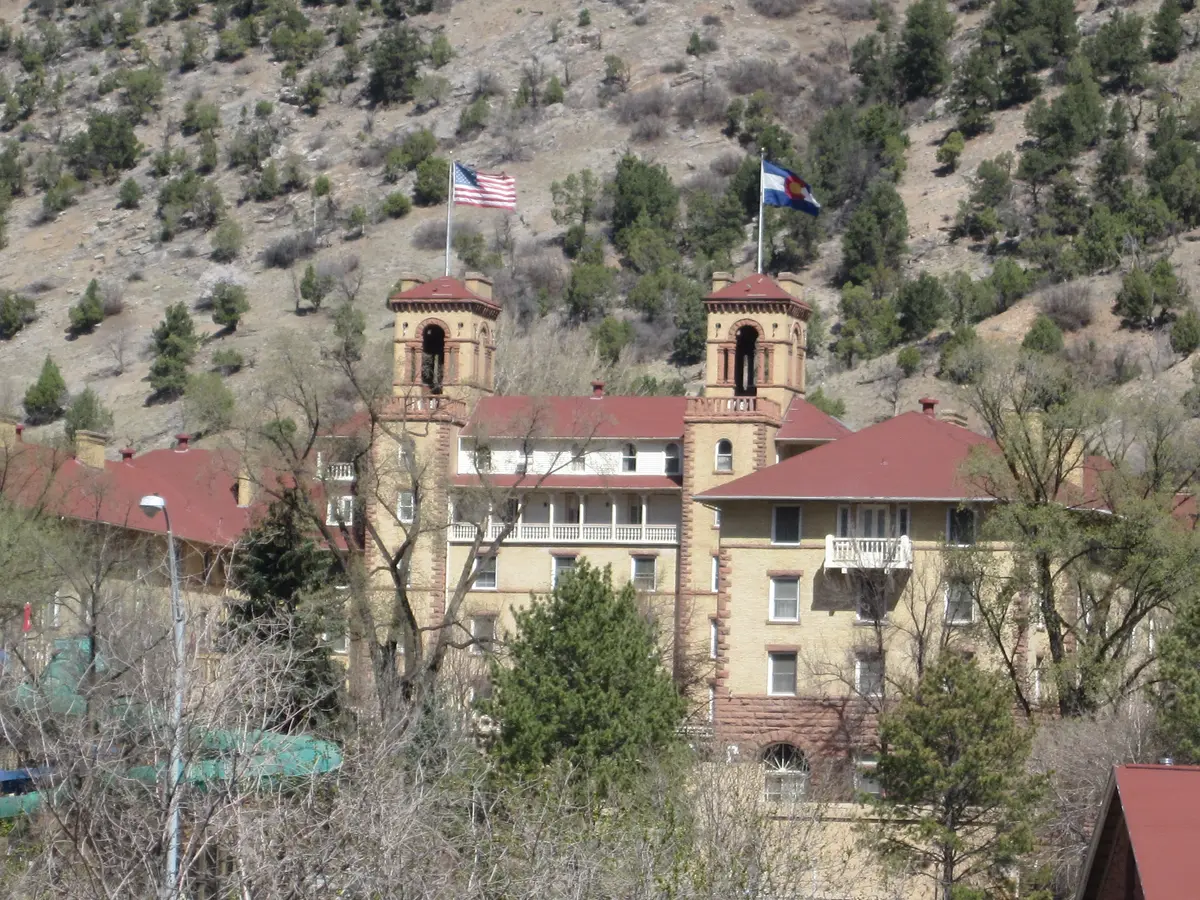
The Hotel Colorado was silver money turned into stone. Walter Devereux, an engineer who had made a fortune in the Aspen mines and then set about rebuilding Glenwood Springs around its hot water, began construction in 1891 on the bluff above the Yampah spring and opened the hotel on 10 June 1893. What went up was an Italianate pile of cream-coloured Roman brick and red Peach Blow sandstone, six storeys, two bell towers, a courtyard with a fountain, and a bath house and pool terraced below it.
A visitor who came to the opening left an account of it. An excursion party from Utah, brought over by the Rio Grande Western, published its impressions in the Salt Lake Herald that June: "The opening was grand — the ballroom, the fire works, the music, the fashionable assembly, all led to the idea that we were taking part in some fairy drama." The same writer named the people running the place — Mr and Mrs Raymond and Mr and Mrs Bailey, with W. A. Bailey as manager, lately of the Manitou, and a Mr Mather over the bathing department — and noted that the club house and swimming pool lay some 150 feet below the hotel.
The presidential visits that made the hotel's name are documented down to the hour. Theodore Roosevelt rode in from a hunting camp on West Divide Creek on Saturday 6 May 1905, arriving at ten past three with Dr Alexander Lambert, P. B. Stewart and his courier Elmer Chapman, two hours ahead of a pack train of twenty horses and thirty dogs. Nearly the whole town was waiting at the west entrance; a twenty-one-gun salute went off as he dismounted. At half past six he spoke from the elevated court, introduced by Mayor Parkison, and the Glenwood Post printed the address in full the following Saturday: "We found the bears all right both in quality and quantity, and only hope they enjoyed it as much as we did." On Sunday morning he walked to the Presbyterian church to hear the Rev. J. Wilson Currens, and stopped on the way back at Frank Hayes's taxidermy shop to look over the skins of the bears he had killed. Pressed that afternoon by people who had come a hundred miles from Grand Junction, Leadville and Aspen, he stepped onto the balcony and said a word about the hunt: "I wish that in the last week up in the mountains there had been a little more weather like this. If there had been I think we would have gone about two bears better. But still as we got ten I do not think we have got any right to complain." That evening he gave a dinner in the hotel for his guides — John Goff, Jake Borah, Brick Wells, Jack Fry, Al Anderson, Charley Allen, G. M. Sprague — and autographed their menu cards. The Glenwood Mandolin Club had volunteered to play in the hotel on both evenings of his stay. At about eleven he walked to his private car, the Rocket, and left for Washington.
William Howard Taft came four years later, on 23 September 1909, arriving at one minute to six in the morning in the private car Mayflower. Seven hundred people had been got out of bed by the whistle of the Gavin ice plant. The Glenwood W.C.T.U. presented him with six mountain trout, mountain raspberries and a bouquet of white flowers for his breakfast, and he asked them, deadpan, whether they were quite sure there were no intoxicants in the fish or the berries. It was too cold for the swim on his programme. A parade of seven carriages took him across the state bridge to the Hotel Colorado, and he was walked out to the south-east corner of the court — the spot, the Post noted, where Roosevelt had spoken a few years before.
The 1920s brought Chicago. The hotel's own history names the gangsters it entertained: the Verain brothers, Bert and Jack, the latter better known as "Diamond Jack" Alterie. Alterie is not folklore. He was a front-page figure in his own lifetime: in February 1925 the International News Service reported from Denver that the "noted Chicago underworld leader", a friend of the murdered Dean O'Banion, had bought four thousand acres in Colorado and meant to give up "dogging it" for the life of a rancher. He was shot dead in Chicago in 1935.
The building's strangest chapter is the one our short file left out entirely. In 1942 the hotel was leased to the United States Navy; the U.S. Naval Convalescent Hospital was commissioned on 5 July 1943, and by the time it was decommissioned in 1946 more than 6,500 patients had passed through it. In mimeographed "Know Your Hospital" newsletters of March and April 1944, held in the historical library of the Navy's Bureau of Medicine and Surgery, LT (jg) William X. Heelan described the place to its own staff: a six-storey building of native matched red sandstone and pressed brick with 250 guest rooms, fed by the Yampah spring at 3,600 gallons a minute and 127 degrees Fahrenheit, and — the point of the whole exercise — so far from anywhere that "no military operations are conducted within a radius of well over 700 miles". Men wrecked by combat, he wrote, "may here find relaxation and recuperation in the absence of nerve racking elements". The basement was fitted with a morgue and, because naval regulation requires a brig wherever sailors are stationed, eight cells five feet by seven. Bill Kight of the Glenwood Springs Historical Society says the bars were still in place as late as 1974.
The Navy left, the hotel changed hands repeatedly, and the building went down. It was listed on the National Register of Historic Places on 26 May 1977 (reference 77000376) and restored through the 1990s. It is still an operating hotel.
Timeline: the documented record of Hotel Colorado
- 1891 Walter Devereux, an engineer enriched by the Aspen silver mines, begins building above the Yampah spring. The construction cost has been printed as both $350,000 and $850,000; the higher figure enters the record only in 2017 (see below).
- 10 June 1893 The hotel opens. A Utah excursion party publishes its account in the Salt Lake Herald: the ballroom, the fireworks, the music and 'the fashionable assembly' made them feel they were 'taking part in some fairy drama'. W. A. Bailey, lately of the Manitou, is the manager.
- 6-8 May 1905 Theodore Roosevelt rides in from West Divide Creek and spends three days at the hotel. From the balcony he tells the town the hunt got ten bears; the Glenwood Post prints both speeches, names his whole party, and mentions no maid, no stuffed bear and no member of his family.
- 22 June 1907 The Glenwood Post reports that 'a real live Rocky mountain Teddy bear' captured near Coal Basin is drawing crowds to a department-store window in town. In Glenwood the phrase already means a live cub.
- 3 July 1909 Manager E. E. Lucas stocks the hotel courtyard with six live 'Teddy bears', swans, geese, ducks and two dozen Texas squirrels. The Post calls the bears 'by far the leading attraction'. It is the first documented commercial use of the association at the hotel — animals, not a toy.
- 23 September 1909 William Howard Taft arrives at 5.59 a.m. in the private car Mayflower. Seven hundred people turn out; the local W.C.T.U. gives him trout and raspberries for breakfast and he asks whether they are sure there are no intoxicants in them. It is too cold for his scheduled swim.
- 3 February 1925 The International News Service reports from Denver that 'Diamond Jack' Alterie, the Chicago gunman and friend of Dean O'Banion, has bought four thousand Colorado acres and means to become a rancher. He, not Al Capone, is the gangster the hotel's own history names.
- 5 July 1943 The U.S. Naval Convalescent Hospital is commissioned in the leased hotel. A staff newsletter of 1944 explains the choice: no military operation within 700 miles, so that men 'subjected to the shock of combat may here find relaxation and recuperation'. The basement holds a morgue and eight cells.
- 1946 The hospital is decommissioned after more than 6,500 patients. Both of the hotel's named ghosts are anchored to this period or to the founder's generation, and no ghost account of the building is known to predate it.
- 26 May 1977 The Hotel Colorado is listed on the National Register of Historic Places, reference 77000376. It is not, and has never been, a National Historic Landmark, contrary to a claim repeated twice in a university public-history article.
- 1993 The two most precisely told stories the hotel publishes are dated to this year: a houseman named Dave who sees an old woman at a deep basement window, and a couple in tower suite 661 whose windows are closed each time they open them.
- September 2006 CCPI Paranormal Investigations spends a night in the hotel and reports EMF readings of 8 to 10 milligauss outside rooms 325 and 551. No control readings elsewhere in the building are published. This is the only investigation the encyclopaedia article cites.
- 6 July 2017 An anonymous IP edit to English Wikipedia changes the hotel's construction cost from $350,000 to $850,000 — one character, zero bytes, no edit summary, and the existing citation left untouched. The Spanish article, translated earlier, still says $350,000. The higher figure has since been reprinted as fact.
Is there a rational explanation for Hotel Colorado?
Ask of each claim here what it is resting on, and the answers separate very cleanly.
Start with the sentence that put the Hotel Colorado in the haunted canon. Wikipedia's ghosts section says that "the two suites in the bell towers are frequently reported to be haunted". It carries no footnote — not a weak one, none. The sentence beside it, about a September 2006 visit by CCPI Paranormal Investigations that "recorded two areas of higher electromagnetic energy" outside rooms 325 and 551, traces back to a single ghost-tourism page, which reproduces the investigators' own write-up. That report is worth reading for what it actually claims: a needle "pegged at 10 milligauss" on a Cell Sensor meter, and 8 to 10 milligauss by a locked door on the fifth floor. A hand-held EMF meter registers mains wiring, lift motors, transformers and fluorescent ballasts; in a 130-year-old building that has been rewired repeatedly, and beside a locked service door, a reading of that size is what one would expect to find whether or not anything else is present. No control readings elsewhere in the hotel are published, which is the measurement that would make the figures mean something.
The teddy bear is the clearest case, because the town's own newspaper covered the week in question. The story in circulation is that Roosevelt came back from the 1905 hunt empty-handed and the hotel's maids sewed him a bear from scraps. The Glenwood Post of 13 May 1905 devoted its front page to the visit under the headline "After Most Successful Hunt", printed both of the president's speeches, listed his party, his guides, his dinner guests and the two men who managed to shake his hand — and used the word "maid" not once. Roosevelt himself, standing on the hotel balcony, said they had got ten bears. The New-York Tribune's dispatch of 6 May puts the tally at ten bears and four bobcats, four of the bears shot by the president, the skins already at a taxidermist's to be made into rugs. No member of his family was on the trip; the versions that place his daughter Alice at the scene, or that have a maid amusing his young children, describe people who were not there. And the name was not available to be invented in Glenwood in 1905: it had been in American newspapers since the Mississippi hunt of November 1902.
What the hotel really did with the teddy bear is better than the legend, and it is in the same newspaper. On 3 July 1909 the Glenwood Post reported that guests "have been treated to a number of surprises this season by Manager Lucas, who secured six Teddy bears, two mute swan, two Canada geese, four eastern ducks and twenty-four Texas squirrels for the parks and hotel court pool. The six Teddy bears are by far the leading attraction." They were live cubs. Two years earlier the Post had noted a "real live Rocky mountain Teddy bear captured near Coal Basin" drawing crowds to a shop window in town. The hotel was trading on Roosevelt and bears within four years of his visit — with animals, in the courtyard, as a paid attraction. That is a documented commercial origin for the association, and it is not a toy.
The nickname is thinner than it looks too. "The little White House of the West" appears in Wikipedia sourced to a 1993 retrospective in the Aspen Daily News. In the Glenwood Post's own digitised run, 1897 to 1922, the phrase "little White House" occurs exactly once — in a syndicated short story about a cottage — against 471 hits for "White House". The nickname is real; it is just not contemporary with the presidents it describes.
Al Capone is the weakest link of all, and it is the one our own file was built on. Searching every title in Chronicling America between 1925 and 1950, "Capone" and "Glenwood Springs" occur together on three pages, and on all three the coincidence is accidental: a circus proprietor who began his career in Glenwood Springs, an aviatrix from Glenwood Springs, a fatal car crash near Glenwood Springs. The control is healthy — the same corpus returns 197 pages for "Hotel Colorado" and Roosevelt in 1905 alone, and puts Diamond Jack Alterie's Colorado land purchase on front pages. The hotel's own history page, listing the gangsters it entertained in the twenties, names the Verain brothers and Alterie and does not mention Capone at all. Our previous description had Capone keeping a mistress in an upper room and posting lookouts on the roof; none of that appears in the hotel's material, in the investigators' report, or in the contemporary press.
Even the hotel's construction cost turns out to rest on nothing. English Wikipedia says the building cost $850,000; Spanish Wikipedia, translated earlier, says $350,000. The change happened on 6 July 2017, in an edit by an anonymous IP address that altered the page by zero bytes — one digit, 3 to 8 — with an empty edit summary and without touching the citation attached to the sentence. The higher figure has since been repeated in a Brigham Young University public-history article, which also states twice that the hotel was designated a National Historic Landmark in 1974. It was not. The National Park Service's own register lists the Hotel Colorado as a National Register property certified on 26 May 1977, with the landmark flag empty; eleven Colorado properties carry that flag and this is not one of them.
Which leaves the part of the story that has documents behind it, and it is the part nobody sells. Between 1943 and 1946 this was a hospital for men coming back from the Pacific, with a morgue and eight cells in its basement, chosen by the Navy precisely because it was 700 miles from anything. The hotel's own ghost page hangs its two named ghosts on that period and on the founder — Bobbie, said to have been a nurse here, and Walter, whom the writer Kathy Rippy Fleming argues is not Walter Devereux at all but E. E. Lucas, the controller who became manager in 1905 and owned the place from 1916 until his death in 1927. That page also does something the derivative sites do not: it dates its anecdotes and names its witnesses — a houseman called Dave in 1993, a security guard called Richard leading a night tour, a couple in tower suite 661 — and then declines to vouch for any of it. "We're not here to tell you whether these stories bear any truth, just to pass them on." That is a more honest position than the one the encyclopaedia takes, and it is the one this file adopts.
Can you visit Hotel Colorado?
The Hotel Colorado is a working hotel at 526 Pine Street, Glenwood Springs, Colorado 81601, on the National Register of Historic Places since 26 May 1977 (reference 77000376). It stands on the north side of the Colorado River; the Amtrak station where the California Zephyr stops is across the river, at 413 7th Street. On 23 September 2026 the hotel's site gave two reservation numbers, 833-568-3623 and 800-544-3998, and named its restaurant as Baron's.
The two rooms the ghost stories name are the suites at the top of the two bell towers. The hotel's own ghost-stories page numbers them 661 and 662 and gives 661 as the Molly Brown Suite, the one most often reported as active. Its room pages describe both with a king bedroom, two private balconies, a living room and a dining room, and mark them "Only accessible via stairwell".
Of the Navy years, the hotel's history page, drawing on Bill Kight of the Glenwood Springs Historical Society, says a basement room held eight prisoner cells "only five by seven feet" and that "All evidence of the brig is now gone", though some residents recall the bars in place as late as 1974. The society's home page in September 2026 listed guided history tours of downtown and a "History Ghost Walk" among its ticketed events; in July 2019 the Post Independent described its "Walk Back In Time" tours inside the hotel, led by costumed portrayalists, at $20 on Saturday evenings and Sunday mornings through Labor Day.
The society's Frontier Museum is at 1001 Colorado Avenue, open Tuesday to Saturday from 10:00 to 16:00; admission is $5 from age 17 and free for 16 and under, telephone 970-945-4448, all as listed on 23 September 2026. The Glenwood Post issues cited in this file can be read free, page by page, in the Library of Congress's Chronicling America collection, which carries the paper from 1897 to 1922.
Sources consulted
- The Glenwood Post, «President Says Good-Bye: After Most Successful Hunt, the Chief Executive, Tanned and Beaming with Good Health, Departs for Nation's Capital» — The Glenwood Post (Glenwood Springs, Colo.), 13 May 1905, p. 1, 1905 newspaper archive
- New-York Tribune, «President's Hunt Ends. Party Got Ten Bears» — New-York Tribune, 7 May 1905, p. 1 (dispatch datelined Glenwood Springs, 6 May), 1905 newspaper archive
- The Glenwood Post, «Local news of Glenwood: Manager Lucas secures six Teddy bears for the hotel court pool» — The Glenwood Post (Glenwood Springs, Colo.), 3 July 1909, p. 5, 1909 newspaper archive
- The Glenwood Post, «Local news of Glenwood: a real live Rocky mountain Teddy bear captured near Coal Basin» — The Glenwood Post (Glenwood Springs, Colo.), 22 June 1907, p. 5, 1907 newspaper archive
- The Glenwood Post, «President Taft Guest of Glenwood: Schedule Smashed and He Remained More Than Hour» — The Glenwood Post (Glenwood Springs, Colo.), 25 September 1909, p. 1, 1909 newspaper archive
- The Salt Lake Herald, «A Utah party at the opening of the Hotel Colorado, Glenwood Springs» — The Salt Lake Herald (Salt Lake City), 13 June 1893, p. 5, 1893 newspaper archive
- Michael F. Dacey, International News Service, «'Diamond Jack' Alterie Buys 4,000 Acres and Will Quit 'Dogging It' Soon» — The Washington Times, 3 February 1925, p. 8, 1925 newspaper archive
- Thomas L. Snyder, «U S Naval Convalescent Hospitals: Glenwood Springs, Colorado and Asheville, North Carolina — notes from the BUMED Historical Library files, quoting LT (jg) William X. Heelan's 'Know Your Hospital' newsletters of March and April 1944» — Of Ships & Surgeons / Historical Library, U.S. Navy Bureau of Medicine and Surgery, 2012 archive
- National Park Service, «National Register of Historic Places: Hotel Colorado, 526 Pine St., Glenwood Springs, Garfield County, Colorado — reference 77000376, certified 26 May 1977, National Historic Landmark flag empty» — NRHP Locations dataset, NPS mapservices, 1977 report
- Hotel Colorado, «Ghost Stories of The Hotel Colorado» — hotelcolorado.com (archived 25 February 2026), 2026 web
- Legends of America, «Haunted Hotel Colorado in Glenwood Springs — reproducing the CCPI Paranormal Investigations report of September 2006» — legendsofamerica.com, 2006 web
- Nikki Smith, Brigham Young University, «The Haunted Hotel Colorado» — Intermountain Histories, 2021 academic
- Wikipedia contributors, «Hotel Colorado: revision 789280530 of 6 July 2017 by IP 208.72.70.188, changing the construction cost from $350,000 to $850,000 in a zero-byte edit with an empty summary» — English Wikipedia, revision history, 2017 archive
- Hotel Colorado, «History — Hotel Colorado (including 'Our Naval History', with the brig described by Bill Kight of the Glenwood Springs Historical Society, the Taft visit, the Verain brothers and 'Diamond Jack' Alterie, and the teddy bear legend as the hotel tells it)» — hotelcolorado.com (archived 1 January 2026), 2026 web
Reviewed by V. Serrano on 2026-08-21 · How we verify our content
💬 Field testimonies (0)
No testimonies yet. Add the first.
Add your testimony
🔒 Log in to add a testimony