👻 HAUNTED PLACE · EXP. Nº9477
ACTIVE
Huntingdon College
Huntingdon College, a private Methodist liberal arts college in Montgomery, Alabama, traces its origins to Tuskegee Female College, chartered in 1854, and moved to its present campus in 1909-1910.
Where is Huntingdon College?
- Location
- Alabama, United States
- Type
- School / university
- Coordinates
- 32.35, -86.285
- Last updated
LOCATION
Why is Huntingdon College said to be haunted?
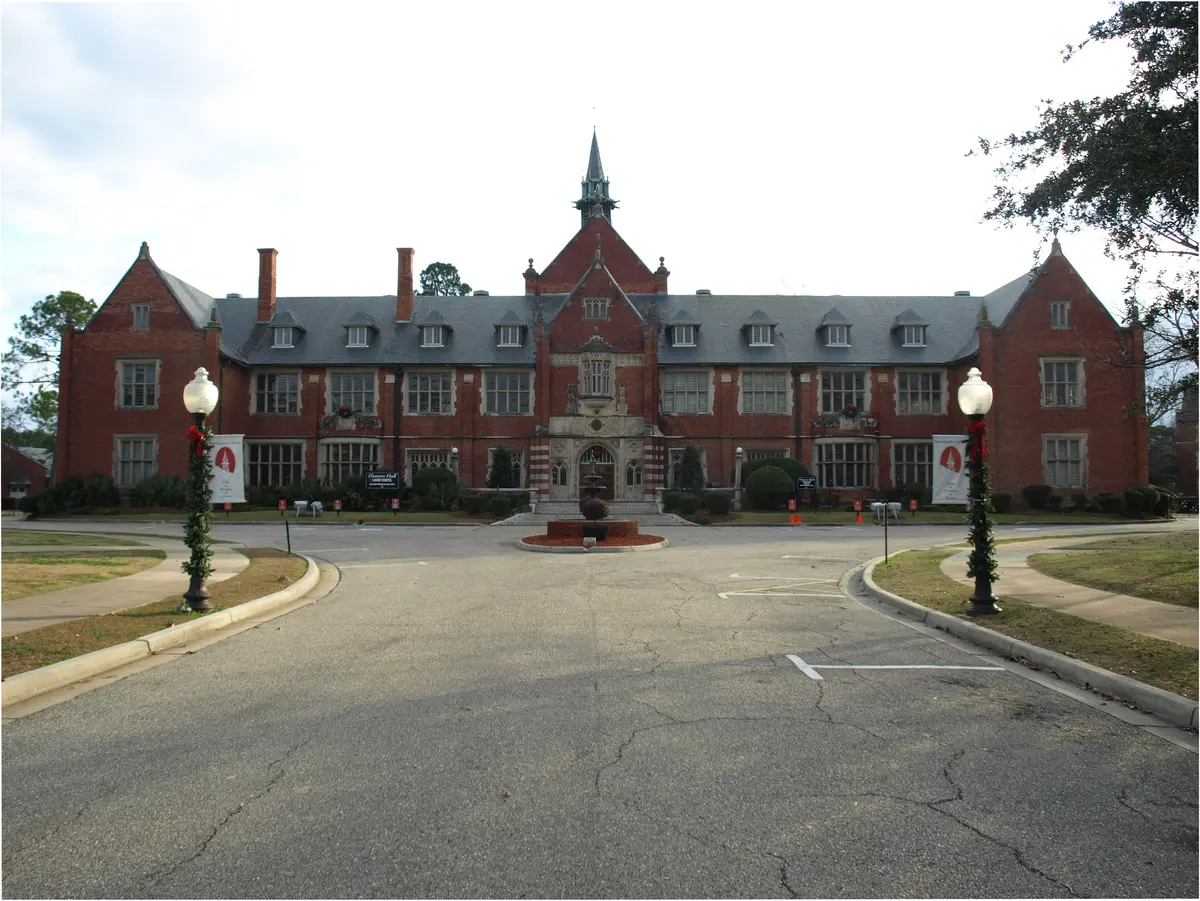
It is the home of the "Red Lady", a ghost story printed in 1969 in "13 Alabama Ghosts and Jeffrey" by the Huntingdon alumna Kathryn Tucker Windham and Margaret Gillis Figh, then an English professor at the college. The story tells of a lonely student who took her own life in Pratt Hall, a dormitory built in 1912, and whose ghost is said to return on the anniversary of her death. The college history page does not mention it, but the college keeps the tale alive: a 2023 news release calls Huntingdon "often recognized as the home of 'The Red Lady'" and describes the students' annual Red Lady Run during Halloween week. The campus is listed on the National Register of Historic Places as the Huntingdon College Campus Historic District.
What is the history of Huntingdon College?
Huntingdon College began as Tuskegee Female College, whose charter Alabama Governor John Winston signed on February 2, 1854. The cornerstone of the Tuskegee campus was laid on April 9, 1855. The doors opened on February 11, 1856, under the first president, Andrew Adgate Lipscomb. There were four students in the first graduating class of 1856; by September 1859 enrollment averaged 216, with 29 women graduating that year.
In 1872 the Alabama Conference of the Methodist Episcopal Church, South, took over full management and renamed the school the Alabama Conference Female College. In the aftermath of the Civil War the administration chose to move to Montgomery. In 1906 Dr. John Massey, president since 1876, led the plans, and a group of the college's friends bought 50 acres in the Cloverdale section of Montgomery from J. G. Thomas and donated them to the college. Frederick Law Olmsted Jr., son of the designer of Central Park, laid out the campus in 1908. On August 24, 1909, the furniture and all the official college records of more than half a century were moved into a rented building in Montgomery to wait for Flowers Hall, the first building on the new campus; the rented building burned that night with everything in it. The new campus opened in the fall of 1910 under the name Woman's College of Alabama, and 1909 is still the recognized founding date of the Montgomery campus.
Julia Pratt Hall, the dormitory where the ghost story is set, went up in 1912. The first male student graduated in 1934, although full-time male resident students were not admitted until 1954. In 1935 the name Woman's College of Alabama gave way to Huntingdon College, in honor of Selina, Countess of Huntingdon, one of the first and most influential figures of the Wesleyan movement in England. The National Register nomination for the Huntingdon College Campus Historic District, prepared in 1999 and listed under reference 00000138, counts thirteen contributing buildings on 58 acres. In 2000 the college expanded across Fairview Avenue with the purchase of the 13-acre former Cloverdale School property.
Timeline: the documented record of Huntingdon College
- February 2, 1854 The Alabama State Legislature and Governor John A. Winston charter the school as Tuskegee Female College; Andrew Adgate Lipscomb becomes its first president.
- 1872 The college passes to the Alabama Conference of the Methodist Episcopal Church, South, and is renamed the Alabama Conference Female College.
- August 24, 1909 The college's furniture and records are moved into a rented building in Montgomery; the building burns that night, destroying the records of its first fifty years. The date is still recognized as the founding of the Montgomery campus.
- 1910 The new Cloverdale campus, with Flowers Memorial Hall as its first building, opens in the fall under the name Woman's College of Alabama.
- 1935 With coeducation underway, the college is renamed Huntingdon College in honor of Selina, Countess of Huntingdon, an early supporter of English Methodism.
- 1969 Kathryn Tucker Windham, a Huntingdon alumna, and Margaret Gillis Figh, then an English professor at the college, publish '13 Alabama Ghosts and Jeffrey' (Strode Publishers), which tells the story of the 'Red Lady of Huntingdon College'.
- February 24, 2000 The Huntingdon College Campus Historic District, with thirteen contributing Gothic and Tudor Revival buildings, is listed on the National Register of Historic Places (reference 00000138).
Is there a rational explanation for Huntingdon College?
The Red Lady reached print in 1969 in 13 Alabama Ghosts and Jeffrey (Strode Publishers), written by Kathryn Tucker Windham, a Huntingdon alumna of the class of 1939, with Margaret Gillis Figh, who in Windham's own later account was "then an English professor at Huntingdon College". The folklorist Elizabeth Tucker, in Haunted Halls: Ghostlore of American College Campuses (2007), calls her a college ghost "known only by her color", the Red Lady "whose anger and refusal to make friends culminate in a bloody suicide", and cites the story from the 1983 edition of Windham and Figh, pages 97-104. Tucker reads her together with another college ghost, the Black Lady, as warnings to students "to keep their shadow-selves from becoming dominant".
The college tells the story itself. Its news release of 1 November 2023 on the Student Government Association's Fright Week describes Huntingdon as "often recognized as the home of 'The Red Lady' made famous by 13 Alabama Ghosts and Jeffery". It reports that 75 women from the Panhellenic organizations "perpetuated the annual tradition of the Red Lady Run through the dark of night and around campus", and that a student haunted house ended with "a glimpse of the Red Lady". The college's history page, Huntingdon Past and Present, read on 6 October 2026, lists Julia Pratt Hall among the buildings put up from 1912 onwards and does not mention the Red Lady or any death on campus.
The same news release names a second ghost: students and staff "lovingly refer to Frank, the library ghost, who is blamed or credited for anything abnormal in the Houghton Memorial Library". The rest of the roster that circulates for the campus, a male student said to have shot himself on the green in the 1970s, a drowned boy, a murdered co-ed and a student in a towel, is listed in the English Wikipedia article on the Red Lady, whose one citation for it, a thespook.org page given for the male student, has been marked as a dead link since August 2025.
Can you visit Huntingdon College?
Huntingdon College is a private college of the United Methodist Church in the Cloverdale area of Montgomery, Alabama, about 3.4 km (2.1 miles) south-south-east of the Alabama State Capitol in a straight line, measured from the pin on this file. Its main address is 1500 East Fairview Avenue, the street number given on the 1999 National Register form. The form describes a 58-acre campus bounded by East Fairview Avenue to the north, Narrow Lane Road and the Montgomery Country Club to the east, Woodley Road to the south and Bankhead Avenue to the west. The campus has been on the National Register of Historic Places since 2000 as the Huntingdon College Campus Historic District, reference 00000138, and the form records the ownership as private.
The admission office's visit page, read on 24 September 2026, offers personal visits on any weekday, each with a campus tour led by a student recruiter and a meeting with an admission representative, and asks visitors to allow at least an hour and a half; its telephone number is +1 334-833-4497. Visits check in at Flowers Hall, which the page places at 3022 Huntingdon College Drive, Montgomery, AL 36106, with parking in front of the building or in the adjacent Smith Parking Lot. Weekend visitors are pointed to the MUST SEE HC preview days, on 10 October and 14 November 2026 and 15 February 2027. The same page puts Montgomery Regional Airport 15 to 20 minutes away by car, by I-65 North to exit 170 and then two miles along Fairview Avenue. Birmingham's airport is given as about an hour and a half away and Atlanta's as about two and a half hours. The college also publishes an online walking tour of its buildings.
Julia Pratt Hall, the building of the Red Lady story, was put up as a dormitory in 1912. The National Register form gives the laying of its cornerstone as 31 May 1912 and its completion in time for the autumn term, and in 1999 still described it as a residence hall joined at the rear to Weenona Hanson Hall. The college's history page lists it among the campus's historic buildings. Wikipedia states that Pratt Hall has since been turned from a dormitory into the college's Department of Education and Psychology, citing Daniel Barefoot's book of 2004. The college's walking tour, read on the same day, has no entry for Pratt Hall among its numbered buildings and places the Department of Teacher Education in the Dr. Laurie Jean Weil Center on the Cloverdale Campus, across Fairview Avenue.
Sources consulted
- Wikipedia contributors, «13 Alabama Ghosts and Jeffrey, Stories included section (citing Kathryn Tucker Windham and Margaret Gillis Figh, 13 Alabama Ghosts and Jeffrey, 1969)» — Wikipedia, 2026 web
- Huntingdon College, «Huntingdon Past and Present» — Official college history, 2026 archive
- Susan M. Entzweiler and Trina Binkley, «Huntingdon College Campus Historic District — National Register of Historic Places Registration Form» — National Park Service, 1999 report
- Daniel W. Barefoot, «Haunted Halls of Ivy: Ghosts of Southern Colleges and Universities (chapter on the Red Lady of Huntingdon College)» — John F. Blair Publisher, 2004 book
- Wikipedia contributors, «Red Lady of Huntingdon College» — Wikipedia, 2026 web
- Huntingdon College Office of Admission, «Plan Your Visit - campus visits, check-in at Flowers Hall, preview days and airport directions» — Official college website, 2026 web
- Huntingdon College, «Walking Tour - numbered list of campus buildings and their current use» — Official college website, 2026 web
- Kathryn Tucker Windham, «Alabama, One Big Front Porch — Windham's account of writing 13 Alabama Ghosts and Jeffrey with Margaret Gillis Figh, 'then an English professor at Huntingdon College'» — NewSouth Books, Montgomery; Internet Archive, 2007 book
- Huntingdon College, «Huntingdon Concludes Fun-Filled Fright Week — news release of 1 November 2023: the Red Lady, the annual Red Lady Run and Frank, the library ghost» — huntingdon.edu, 2023 web
- Elizabeth Tucker, «Haunted Halls: Ghostlore of American College Campuses — the Red Lady of Huntingdon College, 'known only by her color'» — University Press of Mississippi, Jackson; Internet Archive, 2007 book
Reviewed by V. Serrano on 2026-08-22 · How we verify our content
💬 Field testimonies (0)
No testimonies yet. Add the first.
Add your testimony
🔒 Log in to add a testimony