👻 HAUNTED PLACE · EXP. Nº9475
ACTIVE
Jean Bonnet Tavern
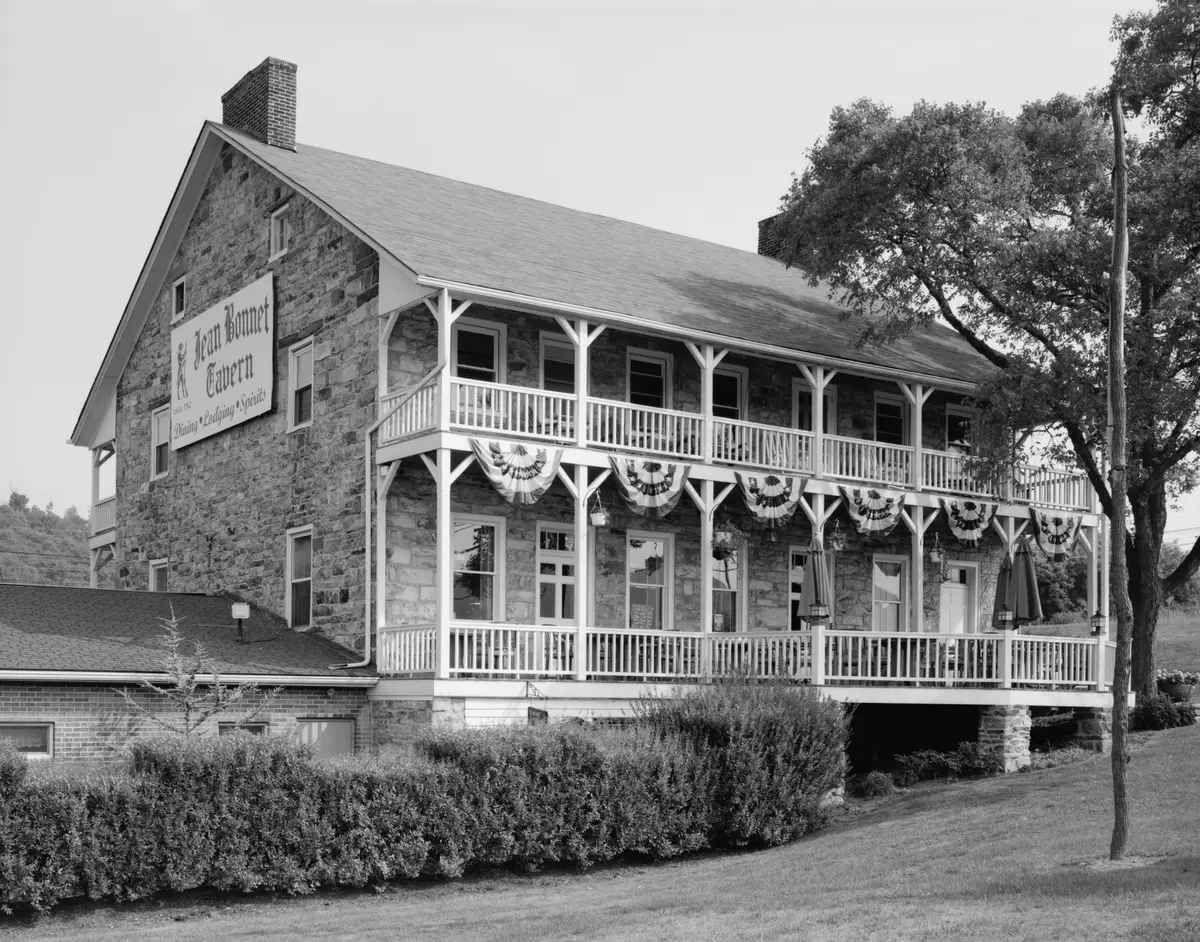
Four miles west of Bedford, Pennsylvania, the old road across the state forks, and a fieldstone tavern stands in the angle.
Where is Jean Bonnet Tavern?
- Location
- Bedford, Pennsylvania, United States
- Type
- Hotel / inn
- Coordinates
- 40.042, -78.561
- Last updated
LOCATION
Why is Jean Bonnet Tavern said to be haunted?
It is dated c. 1762, when the land passed to the Indian trader Robert Callender — the man whose pack train the Black Boys burned in 1765. Jean Bonnet and his wife bought it in 1779 and were licensed the next year to keep a public house "at the Fork of roads leading to Fort Pitt and the Glades". A New Jersey emigrant, Colonel Israel Shreve, halted here on 22 July 1788; a Philadelphia newspaper used the place as a direction that August. In 1794 Bedford County men were bound over for raising a seditious pole against the whiskey tax, and one of them was a Bonnett — though no record says where the pole stood, and Washington, contrary to the usual telling, turned back at Bedford and never passed the forks. The tavern still serves dinner and lets four rooms. It also dates its own ghost story: the stories, it says, began to reach the public after 1957.
What is the history of Jean Bonnet Tavern?
Four miles west of Bedford, Pennsylvania, the road that crosses the state forks. In the eighteenth century the branch bearing west was the Glade Road, towards the Youghiogheny and the Monongahela; the other carried on to Fort Pitt. Travellers called the place simply the forks of the road, and the fieldstone house standing in the angle between them has been serving them, with interruptions, for something over two hundred and forty years. Today the two branches are US Route 30 — the Lincoln Highway — and Pennsylvania Route 31.
The building is conventionally dated c. 1762. The National Register of Historic Places, which listed it on 1 August 1979 under reference number 79002164, gives that date, and the same c. 1762 turns up in the architectural survey Buildings of Pennsylvania, as far as a full-text index snippet of it shows. What supports it is a chain of title rather than a datestone. By the tavern's own account of the deeds, a tract of 690 acres passed from an agent of the Penn family to a speculator named Hans Ireland, and from Ireland in 1762 to Robert Callender, an Indian trader; the house is assigned to Callender's ownership because that is when the land was his. The tavern's own history page is refreshingly blunt about the limits of this: "There is little to prove the actual date of the building." The NPS has not digitised the 1979 nomination — the file requested on 12 August 2026 returns a single page reading "The PDF file for this National Register record has not yet been digitized" — so the reasoning behind the official date cannot be read.
Robert Callender was no innkeeper. He was one of the largest Indian traders on the Pennsylvania frontier, and in March 1765 his goods made him the target of an armed rising against the Crown a decade before Lexington. Lieutenant-Colonel Reid, commanding in the district of Fort Pitt, reported it to General Gage from Fort Loudoun on 4 June 1765: the rioters — the men remembered as the Black Boys — first gathered at Justice Smith's, about five miles from Fort Loudoun, on 6 March, "From thence they followed the first Convoy of Goods, consisting of eighty-one horse loads, twelve miles further, and burnt and pillaged Sixty-three loads." Callender applied to Lieutenant Grant for a sergeant and twelve men, who saved the remaining loads, "chiefly consisting of Liquor", took prisoners and confiscated eight rifles. When the governor went up to Carlisle to get to the bottom of the affair he "immediately sent for Captn Callender, one of the Owners of the Goods that were destroyed". That is the man in whose hands the stone house at the forks is believed to have been built.
The namesake arrives in 1779, when Jean — John — Bonnet and his wife bought the property. In October 1780 Bonnet was licensed as a publican on a petition the house still quotes: the "Petitioner lives at the Fork of roads leading to Fort Pitt and the Glades with everything necessary for keeping Public House".
Two independent documents catch the house working eight years later, and six years before the Whiskey Rebellion. On 22 July 1788 Colonel Israel Shreve, moving his family west from New Jersey with four two-horse wagons, two three-horse wagons and four cows, wrote in his journal: "Passed through Bedford, halted for a horse shoe . . . halted at John Bonnet's Tavern at the forks of the old Pennsylvania and Glade Roads, 15 miles to-day." Two days later Ann Beck, daughter of Joseph Beck of the same party, died on the road, and they sent to Berlin for a coffin. And on 20 August 1788 the Pennsylvania Journal of Philadelphia carried an advertisement from Stephen Bayard, who was selling Kentucky boats at Elizabeth Town on the Monongahela and needed to tell buyers how to get there: "The rout to it from Bedford, is by Bonnet's tavern, from thence the Glade Road to Cherry's mill, to Budd's ferry on Yough, thence to Captain Peterson's." By 1788 the tavern was a direction, printed in a Philadelphia newspaper.
The Whiskey Rebellion of 1794 did reach Bedford County, and the county's own court records prove it. At the November sessions of 1794, before president judge James Riddle with George Woods and Hugh Barclay as his associates, some one hundred and thirty named residents were bound in sums varying from £30 to £300 each to appear at the January 1795 term and answer "such bills of Indictments as shall be then and there preferred against them for Riot and other Treasonable proceedings in assisting and abetting the setting up a seditious Pole in opposition to the Laws of the United States". They all appeared in January 1795, pleaded guilty and were fined between five shillings and £15, the heaviest falling on William Wilson, Simon Kenton, George Sill, Joseph Scullknot, Conrad Haverstock, Andrew Sheets, John Blitz, Jacob Helm and Baltzer Hess. On that list, between William Wilson of Hopewell and Martin Fritz, stands Isaac Bonnett. The record does not say where the pole stood.
Washington came as far as Bedford and no further. Writing privately to Edmund Randolph from Fort Cumberland on 16 October 1794 he judged that "From present appearances it is not likely I shall proceed beyond Bedford", and on 20 October, from Bedford, he wrote to Henry Lee as commander-in-chief of the militia army: "Being about to return to the seat of government, I cannot take my departure, without conveying through you to the army under your command, the very high sense I entertain of the enlightened and patriotic zeal for the constitution…" He handed the army to Lee and turned east. In Bedford he lodged in the Espy house, in the town itself. The troops went on west past the forks; the president did not.
After that the house simply kept its trade as the traffic changed: wagons, then the Lincoln Highway from 1913, then motor tourists. The Enyeart family bought it in 1957. Shannon and Melissa Jacobs were the innkeepers in the early 2000s; the innkeeper named on the tavern's website in 2026 is Brandon Callihan.
Timeline: the documented record of Jean Bonnet Tavern
- 1762 (building c. 1762) A tract of 690 acres passes to the Indian trader Robert Callender, according to the chain of title the tavern publishes. The house is dated to his ownership by inference; the National Register gives c. 1762, and the tavern itself concedes that "there is little to prove the actual date of the building".
- 6 March 1765 The Black Boys gather at Justice Smith's near Fort Loudoun and burn 63 of the 81 horse-loads of Callender's convoy. Lieutenant-Colonel Reid reports it to General Gage on 4 June; the governor sends for "Captn Callender, one of the Owners of the Goods that were destroyed".
- 1779 Jean (John) Bonnet and his wife buy the property. The tavern's own pages disagree on who sold it to them.
- October 1780 Bonnet is licensed as a publican: the "Petitioner lives at the Fork of roads leading to Fort Pitt and the Glades with everything necessary for keeping Public House".
- 22 July 1788 Colonel Israel Shreve, moving his family from New Jersey to the Monongahela, writes in his journal: "Passed through Bedford, halted for a horse shoe . . . halted at John Bonnet's Tavern at the forks of the old Pennsylvania and Glade Roads, 15 miles to-day."
- 20 August 1788 The Pennsylvania Journal of Philadelphia prints Stephen Bayard's advertisement for boats at Elizabeth Town: "The rout to it from Bedford, is by Bonnet's tavern, from thence the Glade Road to Cherry's mill, to Budd's ferry on Yough." The tavern has become a printed direction.
- 16 and 20 October 1794 Washington writes to Randolph from Fort Cumberland that "it is not likely I shall proceed beyond Bedford", and on the 20th, from Bedford, hands the militia army to Henry Lee and turns for home. The troops march west past the forks; the president does not.
- November sessions, 1794 Before judge James Riddle, some 130 Bedford County residents are bound over for "assisting and abetting the setting up a seditious Pole in opposition to the Laws of the United States". Isaac Bonnett is among them. All plead guilty in January 1795 and are fined between five shillings and £15. The record does not say where the pole stood.
- 1957 The Enyeart family buys the tavern. Its own history page, unchanged on this point since at least 2002, says it was during their ownership that "stories of hauntings at the Jean Bonnet began to reach the public".
- 1 August 1979 Listing on the National Register of Historic Places, reference 79002164. The nomination text has not been digitised: the NPS file requested on 12 August 2026 returns a single page saying so.
- 2000-2001 Patty A. Wilson publishes "Return to the Haunted Jean Bonnet Tavern" in The Pennsylvania Ghost Guide, Vol. II (Piney Creek Press). The title presupposes an earlier piece in Vol. 1 (2000). This is the oldest printed telling of the tavern's haunting I have been able to date.
- 14 December 2002 The Wayback Machine's earliest capture of the tavern's "Folk Lore" page. Its three ghost accounts are word for word the ones on the site in 2026; owners then were Shannon and Melissa Jacobs.
Is there a rational explanation for Jean Bonnet Tavern?
Almost nothing in the ghost story that used to appear on this page can be traced to the house itself, and the house is the party with the strongest reason to tell it.
On 12 August 2026 I downloaded the tavern's whole website from its own sitemap — seventeen pages, about 107 KB of text once the markup is stripped — and searched all of it. "Bonnet" appears 139 times, "Forbes" 22, "ghost" 12, "haunt" 7, "liberty pole" 5, "Enyeart" once. "Witch" appears zero times. So do "bride", "suicide", "sliding" and "most haunted". The only two hits for "rocking chair" are the hickory rockers on the porch of the gift shop and the ones on the upper balcony. Neither the hanged witch nor the jilted bride nor the glasses that slide down the bar exists in the proprietor's own account. A parallel search of Open Library's full-text index across the ghost-tourism literature that does cover the tavern — Patty A. Wilson, Rosemary Ellen Guiley, Rich Newman — returned the tavern's address, its 1779 purchase and its 1760s date, and no witch and no bride.
What the house does say is stable and datable. Its "Folklore" page reproduces three excerpts from "Return to the Haunted Jean Bonnet Tavern", published in Patty A. Wilson's The Pennsylvania Ghost Guide, Vol. II (Piney Creek Press, 2001) — the title implies an earlier piece in Vol. 1, of 2000. The three stories are a bartender and a male friend who saw a solitary man drinking in a bar they had locked; a party led by Scott Crownover, with members of the Central Pennsylvania Paranormal Association, one of whom, Al Brindza, described seeing people in "frontier type" clothes in a doorway "like trying to watch two televisions at once"; and the owner Melissa Jacobs and a bemused salesman finding the attic door open and shut by turns. Those excerpts are word for word what the site carried on 14 December 2002, in the Wayback Machine's earliest capture of the page. In twenty-four years the tavern has not added a story.
The house also dates its own fame, and dates it late. Its history page has said, since at least June 2002: "In 1957 the Jean Bonnet was purchased by the Enyeart family. It was during their ownership that stories of hauntings at the Jean Bonnet began to reach the public." By its owners' own reckoning, the reputation is a phenomenon of the second half of the twentieth century, and the oldest printed telling I can put a year on is a paperback ghost guide from 2000. That is a claim about the record, not about what anyone did or did not experience.
Several of the historical claims the tavern attaches to the ghosts do not survive checking. "It served as an early French fort and trading post": no French fort ever stood at the Bedford forks. The fort at Raystown, which became Bedford, was British, thrown up in 1758 for the Forbes campaign; the only two mentions of a "French fort" in the 1884 county history are Fort Le Boeuf, four hundred kilometres away, where Washington delivered Dinwiddie's letter in 1753. "We know General Forbes stopped here to await reinforcements": Forbes cut his road in 1758, four years before the date the building itself is given. The tavern's Whiskey Rebellion section closes by naming its source — "Info about this has been drawn from Wikipedia" — which makes the encyclopaedia article and the business page useless as confirmation of each other. And the tavern's own two pages disagree about 1779: the About page has Callender selling the building to Bonnet, while the History page has Bonnet and his wife simply purchasing it.
"George Washington and his troops passed here" is half right, and the wrong half is the famous one. His troops did march west past the forks in October 1794. He did not: he wrote to Randolph from Fort Cumberland on 16 October that he did not expect to proceed beyond Bedford, and on 20 October he wrote from Bedford to hand the army to Henry Lee and go home. Washington had crossed this ground before — with the Forbes expedition in 1758 — but the building is dated four years after that.
Against all this, the phenomena themselves are unremarkable. Doors that swing in a fieldstone building with walls over two feet thick, three storeys, no lift, an open bar and a restaurant on a different level, and a stair layout that the 2001 account describes as confusing enough that its own witnesses could not rule out someone slipping downstairs, do not need an explanation imported from the eighteenth century. No published investigation of the building has ever attributed anything to anything in particular, and the tavern does not claim one: its folklore page ends by pointing at a YouTube series and then at its own restaurant — "Whether you are interested in ghosts or not, the Jean Bonnet is one restaurant and tavern that you really should visit!"
Can you visit Jean Bonnet Tavern?
The Jean Bonnet Tavern is open and trading. Checked on 12 August 2026 against its own website, which was last updated on 1 August 2026: it is at 6048 Lincoln Highway, Bedford, Pennsylvania 15522, at the junction of US Route 30 and Pennsylvania Route 31, about four miles west of Bedford borough; the telephone is +1 814-623-2250, and the innkeeper named on the site is Brandon Callihan.
The kitchen serves Monday to Saturday, 11.00 to 21.00, with the tavern often open later. It is closed all day Sunday and on New Year's Day, Easter Sunday, Memorial Day, 4 July, Labor Day, Thanksgiving and Christmas Day, and closes early on Christmas Eve. There are no reservations for meals — first come, first served — and no online ordering or delivery; takeaway is by telephone only. A 3.5 % fee is added to card payments.
Four guest rooms and suites are let on the third floor, at 150, 150, 175 and 200 US dollars a night for two, including a cooked breakfast served between 8.00 and 10.00. Pennsylvania sales tax of 6 % and Bedford County lodging tax of 5 % are added. Booking is by request through the site or by telephone and is confirmed by personal e-mail rather than instantly; full payment is taken at booking and cancellations must be a week ahead. Check-in is 14.00 to 21.00 and check-out is enforced at 11.00, with a dollar a minute charged after that. Sunday nights are not let, though guests staying Saturday get breakfast on Sunday. No pets, no televisions, free Wi-Fi, and one thermostat for the whole building.
Accessibility is the real constraint and the house says so plainly: the rooms are on the third floor, there is no lift, and the building is "not completely handicap accessible". The restaurant, tavern, outdoor deck and the Cabin Shoppe by the restaurant entrance are the parts most visitors will see.
One thing this file previously implied should be corrected: as of August 2026 the tavern sells no ghost tour and no overnight paranormal investigation. Nothing on its site charges for access to the story; the ghost content is a single page called "Folklore". If you want the building, book a room or eat there.
Bedford borough, six kilometres east, is where the rest of this history is: the Espy house, where Washington lodged in October 1794, stands in the town. Shawnee State Park — the "Old Shawnese Cabins" of the eighteenth-century trader accounts — is a short drive west along the same Route 30.
Sources consulted
- Waterman, Watkins & Co., «History of Bedford, Somerset and Fulton Counties, Pennsylvania, with Illustrations and Biographical Sketches» — Waterman, Watkins & Co., Philadelphia, 1884 book
- John Thomson Faris, «On the Trail of the Pioneers: Romance, Tragedy and Triumph of the Path of Empire (quoting the Journal of Colonel Israel Shreve from Jersey to Monongahela, 1788, printed in the Magazine of American History, vol. II, 1878)» — George H. Doran Company, New York, 1920 book
- Archer Butler Hulbert, «The Ohio River: A Course of Empire (quoting Stephen Bayard's advertisement in the Pennsylvania Journal, Philadelphia, 20 August 1788)» — G. P. Putnam's Sons, New York, 1906 book
- George Washington, ed. Worthington Chauncey Ford, «The Writings of George Washington, vol. XII (1793-1794): letter to Edmund Randolph, Fort Cumberland, 16 October 1794, and to Henry Lee, Bedford, 20 October 1794» — G. P. Putnam's Sons, New York, 1891 book
- Jean Bonnet Tavern, Inc., «Jean Bonnet Tavern official website: History, Folklore, About, Hours and Lodging pages (whole site downloaded from its sitemap and searched, 12 August 2026)» — jeanbonnettavern.com, 2026 web
- Patty A. Wilson, «The Pennsylvania Ghost Guide, Vol. II (including "Return to the Haunted Jean Bonnet Tavern")» — Piney Creek Press, 2001 book
- National Park Service, «National Register of Historic Places, Jean Bonnet Tavern, Bedford County, Pennsylvania, reference number 79002164, listed 1 August 1979 (nomination text not digitised as of 12 August 2026)» — U.S. Department of the Interior, 1979 report
- Internet Archive Wayback Machine, «Jean Bonnet Tavern, "Folk Lore" page, as archived on 14 December 2002, and the whole domain's capture index» — web.archive.org, 2002 archive
Reviewed by V. Serrano on 2026-08-12 · How we verify our content
💬 Field testimonies (0)
No testimonies yet. Add the first.
Add your testimony
🔒 Log in to add a testimony