👻 HAUNTED PLACE · EXP. Nº1189
ACTIVE
Jewett House
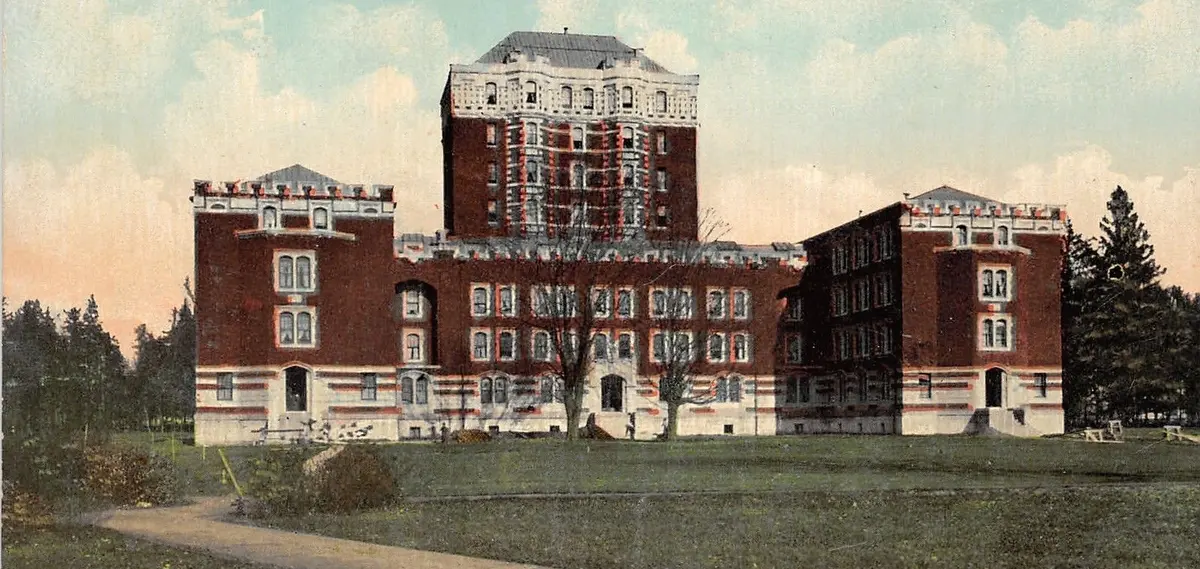
Jewett House, originally North Hall, is a nine-story Tudor-style dormitory on the campus of Vassar College in Poughkeepsie, New York.
Where is Jewett House?
- Location
- Poughkeepsie, New York, United States
- Type
- Public building
- Coordinates
- 41.69, -73.897
- Last updated
LOCATION
Why is Jewett House said to be haunted?
Designed by art professor Lewis Pilcher and completed in 1907 at a cost of $212,500, the building was so poorly received that critics nicknamed it Pilcher's Crime. Renamed in 1915 after Vassar's first president, it underwent a $21 million renovation completed in 2003. Today it houses up to 195 students. Alongside its architectural reputation, Jewett carries a supernatural one: students report encounters with several distinct ghosts in its stairwells and corridors, making it one of Vassar's most talked-about haunted dorms, even as the identities behind the hauntings remain campus legend rather than documented history.
What is the history of Jewett House?
The building that students now call Jewett House began its life with a different name and a very different reputation.
When it opened in 1907, it was simply North Hall, the fourth dormitory in Vassar College's residential quadrangle. The college had completed Davison House just five years earlier, and by 1905 enrollment pressure made a fifth dormitory necessary. The board approved the project, and Lewis Pilcher, who was then an art professor at Vassar and a partner in the firm Pilcher and Tachau, designed it. The total cost was $212,500, paid from college operating funds rather than from a donor's gift - a fact that mattered to the trustees, who had hoped Strong and Davison Houses would be followed by a named benefactor.
From the beginning, the architecture divided opinion. The dormitory was built in a Tudor vocabulary - brick, stone, terracotta trim, crenellations, a pitched copper roof - but architectural historians note that its spirit was Tudor rather than the Elizabethan style of the earlier quad dorms. The most striking feature was the nine-story tower, which the college justified as a way to help campus water pressure but which writers such as Karen Van Lengen and Lisa Reilly argue created a more monumental and less homelike impression than its neighbours. By the time of Vassar's semicentennial in 1915, no donor had come forward to name the building, and President Henry Noble MacCracken renamed it Milo Jewett House after the college's first president, who had served from 1861 to 1864.
Milo Jewett never saw the dormitory that bears his name. He had left Vassar in a dispute with founder Matthew Vassar before the college actually opened its doors to students in 1865. The renaming was therefore an act of institutional memory rather than personal gratitude.
By the early 2000s, the building had accumulated serious physical problems. The Vassar alumnae/i magazine listed them in a 2002 article: an elevator that did not stop at the second floor, balconies that students could not reach, a mezzanine-level bathroom with stalls so cramped that residents of all heights bruised their kneecaps, and a stairway wrapped tightly around the nine-story elevator shaft that no longer met fire safety codes. The college developed a master plan for campus residences in 2000 and chose Jewett as the first building to undergo renovation. Herbert S. Newman & Partners of New Haven, Connecticut, carried out a fifteen-month project that was completed in October 2003 at a cost of $21 million. The work replaced the exterior fire escape with an interior stairwell and brought the building up to contemporary codes.
Today Jewett is a co-educational dormitory with a capacity of 195 students, any of whom may live there regardless of class year. Room types include singles, one-room doubles, one-room triples, two-room doubles and suites. A 2003 guide compiled by the Yale Daily News staff ranked it as one of the two most popular dorms at Vassar, alongside Cushing House.
Alongside its architectural reputation, Jewett has long carried a supernatural one. Students have reported encounters with several distinct ghosts said to inhabit the building's stairwells and corridors, making it one of Vassar's most talked-about haunted dorms. The best-documented claims appear in Leslie Rule's 2001 book Coast to Coast Ghosts, which describes a Panama-suited gentleman ghost in an east-arm apartment and a wailing baby heard from a disused bathtub. These stories circulate on campus as legend rather than as documented history, and the college itself does not publish them on its official residential-life pages.
Timeline: the documented record of Jewett House
- February 1861 Milo P. Jewett is elected the first president of Vassar College. He will serve until spring 1864, when he departs after a dispute with founder Matthew Vassar, before the college opens its doors to students.
- 1865 Vassar College opens to students. Milo Jewett is no longer president; the building that will later bear his name does not yet exist.
- 1902 Davison House, the fourth dormitory in Vassar's residential quadrangle, is completed. Enrollment is approaching the 1,000-student limit, and the trustees begin planning a fifth dormitory.
- 1905 The board of trustees formally approves construction of a new dormitory to relieve housing pressure. Lewis Pilcher of Pilcher and Tachau is selected as architect.
- 1907 The new dormitory opens as North Hall. Built of brick and stone with terracotta trim and a nine-story tower, it costs $212,500 and is financed from college operating funds. Early critics nickname it Pilcher's Crime.
- 1915 By Vassar's semicentennial no donor has come forward to name the building. President Henry Noble MacCracken renames it Milo Jewett House after the college's first president.
- 2002 Vassar Quarterly publishes an article documenting serious physical problems in Jewett: an elevator that does not stop at the second floor, inaccessible balconies, cramped bathrooms and a stairway around the elevator shaft that violates fire codes. The college selects Jewett as the first building in its 2000 master plan for residence renovation.
- October 2003 The 15-month, $21 million renovation by Herbert S. Newman & Partners is completed. The exterior fire escape is replaced with an interior stairwell, and the building is brought up to contemporary fire and accessibility codes.
Is there a rational explanation for Jewett House?
The ghost stories attached to Jewett House have a source, but it is a popular-history book, not an archive, and its author is the daughter of a prominent ghost writer.
The most widely cited printed appearance of the hauntings is Leslie Rule, Coast to Coast Ghosts: True Stories of Hauntings Across America (Andrews McMeel, 2001). Rule is a journalist and photographer; her mother was the long-running paranormal author Ann Rule. The Vassar-related passage in Rule's book describes two phenomena: a Panama-suited gentleman ghost in an apartment in the dormitory's east arm, and the sound of a wailing baby coming from a disused bathtub. These claims are repeated on Wikipedia and on various campus-ghost listicles, but no Vassar archival source, no college newspaper article, no dean's letter and no police or health report has been located that corroborates either story. The 2002 Vassar Quarterly article about the building's physical deterioration does not mention hauntings at all.
The college's own communications are worth reading alongside the legend. The Office of Residential Life website does not carry the ghost stories. The Vassar Encyclopedia, maintained under the direction of the College Historian, includes a Vassar Myths & Legends page that treats campus folklore as a subject of study rather than as fact. The Wikipedia article on Jewett House - last edited in March 2026 - carries the haunting claims but marks them as allegations, and its references for them are the Rule book and a 2003 Miscellany News article about students moving in after renovation, which itself does not mention ghosts.
A separate caution concerns the building's earlier history. Some ghost-tour and listicle sources attribute to Jewett a backstory involving a suicide or a death in the building during the early twentieth century. No primary source for such a death has been identified in the college's published histories, in the Daniels 1987 building history, or in the Van Lengen & Reilly 2004 campus guide. Until a name, a date and a document are produced, the responsible description is that the hauntings are campus legend whose earliest printed appearance is Rule 2001 and whose content has not been verified against college records.
The physical building, meanwhile, has a documented history that is dramatic enough. The 2002 Vassar Quarterly article documents elevator failures, inaccessible balconies and a fire-safety stairway that wrapped around the elevator shaft in a way that violated code. Those are verifiable facts. The ghosts are not.
Can you visit Jewett House?
Jewett House is an active dormitory on the campus of Vassar College, and it is not open to the public as a standalone visitor attraction.
Vassar College is located at 124 Raymond Avenue in Poughkeepsie, New York 12604. The campus is accessible by car from I-90 or US 9, and by train via the Poughkeepsie Metro-North station on the Hudson Line, which is a short taxi or bus ride from the campus. The college runs a visitor information service and offers campus tours; details are on the Vassar admissions website.
Because Jewett is a working residence hall, there is no public entrance for casual visitors. The exterior can be viewed from the residential quadrangle, which is open to the public as a pedestrian space. The building's most visible feature from the quad is the nine-story tower, which can be photographed from the courtyard between Jewett, Lathrop House, Davison House and Josselyn House.
The campus is walkable and relatively flat. The main entrance and the quad are wheelchair accessible; interior access to student rooms and stairwells is restricted to residents and their guests. There are no ghost tours of Jewett House. The Office of Residential Life does not list paranormal programming in its public calendar, and the college's Halloween events are student-run rather than institutional.
For visitors interested in haunted college buildings, the Vassar College Historic District is listed on the National Register of Historic Places, and the campus includes several other buildings with documented histories of use and alteration. The Vassar Encyclopedia provides an online building-by-building history that is the most reliable published source for the college's architecture.
Sources consulted
- Veronika Ruff, «This Old House» — Vassar: The Alumnae/i Quarterly, 2002 newspaper archive
- Karen Van Lengen and Lisa Reilly, «The Campus Guide: Vassar College» — Princeton Architectural Press, 2004 book
- Elizabeth A. Daniels, «Main to Mudd: An Informal History of Vassar College Buildings» — Vassar College, 1987 book
- Leslie Rule, «Coast to Coast Ghosts: True Stories of Hauntings Across America» — Andrews McMeel Publishing, 2001 book
- Office of Residential Life, «Jewett House» — Vassar College, 2015 web
- Vassar Encyclopedia, «Vassar Myths & Legends» — Vassar College, 2024 web
Reviewed by V. Serrano on 2026-08-23 · How we verify our content
💬 Field testimonies (0)
No testimonies yet. Add the first.
Add your testimony
🔒 Log in to add a testimony