👻 HAUNTED PLACE · EXP. Nº9475
ACTIVE
Joliet Correctional Center
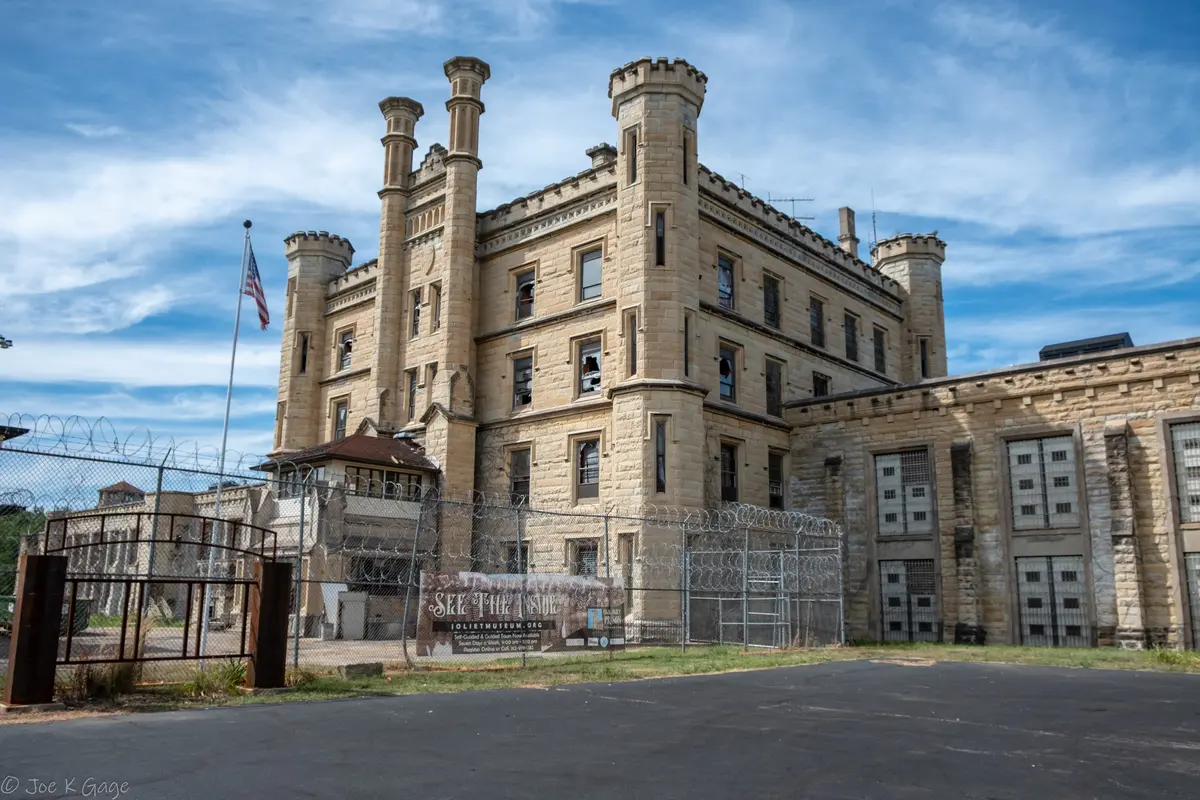
Old Joliet Prison — the Joliet Correctional Center when it closed in 2002 — is a sixteen-acre limestone ruin on Collins Street that Illinois convicts quarried and built for themselves.
Where is Joliet Correctional Center?
- Location
- Illinois, United States
- Type
- Prison
- Coordinates
- 41.547, -88.074
- Last updated
LOCATION
Why is Joliet Correctional Center said to be haunted?
The site's own history dates the institution from 22 May 1858, when fifty-three men arrived from the failing penitentiary at Alton. Behind the castellated walls came 144 years of prison history that the ghost version leaves out: a separate women's prison across the street from 1896 to 1933, and, on 22 April 1975, a cell-house takeover that produced hostages, an official inquiry and a Chicago Tribune headline three days later reading "The Latest Riot at Joliet". After closure the empty complex was vandalised and burned — a fire on Memorial Day 2017 took hours to put out — before the Joliet Area Historical Museum opened it to visitors in 2018. It has been on the National Register of Historic Places since 25 September 2023. Its haunted reputation is newer than all of that and thinner than it looks: the operator's own website does not mention a ghost anywhere, no episode of Ghost Adventures or Ghost Hunters has ever been shot here, and the printed ghost-guide literature of Illinois passes it by. What Joliet is genuinely famous for is film — the opening of The Blues Brothers was shot inside the working prison in August 1979.
What is the history of Joliet Correctional Center?
Illinois's first penitentiary stood at Alton, opened in 1831 and run under a private lease that let it fall apart. The reformer Dorothea Dix inspected it in 1847, and the state decided to start again — this time on ground that was itself the building material, the pale dolomite that quarrymen along the Des Plaines River sold as Joliet limestone.
The prison was built by the men sentenced to it. The site's own published history dates the institution from 22 May 1858, "when fifty-three prisoners arrived" from Alton to open the quarry and raise the walls. What they built looks less like a modern penitentiary than a Victorian fortress: a castellated administration block with corner towers, long cell houses behind it, all in the same buff stone. It is the reason the place photographs the way it does.
Praise came first and overcrowding came almost at once. The museum's history records that the Chicago Tribune approved of the new prison, and that by 1878 — twenty years in — it held close to 2,000 men in conditions it describes as overcrowded and unsanitary.
The women are the part that falls out of most retellings. A separate women's prison stood at Joliet from 1896 to 1933, built, in Dana Britton's description, directly across the street from the men's administration building. L. Mara Dodge's study of women, crime and prisons in Illinois gives it a chapter of its own, "Doing Time at Joliet Women's Prison, 1896-1933". It ended when the women were transferred to the new state reformatory at Dwight.
One distinction is worth fixing before any story about this address is believed. A second, far larger Illinois prison — Stateville — opened a few kilometres to the north in the mid-1920s and shares the Joliet postal address. Stateville is where Nathan Leopold and Richard Loeb went after being sentenced in 1924; Stateville is where John Wayne Gacy was executed in May 1994; and the prison riot in Natural Born Killers was filmed at Stateville, not here. A great many claims that circulate about "Joliet" belong to its neighbour — including, as far as I could establish from sources I was able to read in full, much of the execution history routinely attached to this building.
The event that defines the old prison's last decades is real, and it is dated. On 22 April 1975 inmates took over a cell house and held staff hostage. Robert Adams, writing about prison disturbances on both sides of the Atlantic, refers to "the inquiry report into the riot at Joliet correctional centre on 22 April 1975": there was an official inquiry. Ron Chepesiuk's history of Chicago's street gangs cites a Chicago Tribune article three days later headlined "The Latest Riot at Joliet", which is itself informative — it was not the first. Chepesiuk names one of the men caught up in it: Herbert Catlett, twenty-nine, a former member of the Black P. Stone Nation. Accounts that he was killed during the takeover circulate widely, but the most-copied of them has carried a "citation needed" tag since 2010, so his name is recorded here without a manner of death I could not verify in a source I could read.
Governor George Ryan closed the prison in 2002 as a budget measure and the men were moved to Stateville. What followed was sixteen years of an empty sixteen-acre complex behind a fence; the site's own account speaks of "rampant vandalism, including arson". On Memorial Day, 30 May 2017, a fire burned inside the abandoned prison for hours. That December the mayor, Bob O'Dekirk, petitioned the state to hand the site to the city, the Joliet Area Historical Museum formed the Old Joliet Prison Preservation Coalition, and the gates opened to visitors in 2018. The Administration Building lost its roof to a collapse in 2020 and did not reopen — in hard hats — until 2025. On 25 September 2023 the complex was entered on the National Register of Historic Places as the Illinois State Penitentiary-Joliet Historic District.
Timeline: the documented record of Joliet Correctional Center
- 22 May 1858 Fifty-three prisoners arrive from the failing state penitentiary at Alton to quarry the limestone and build the prison they will live in. The site's own history dates the institution from this day.
- 1896 A separate women's prison opens at Joliet, built directly across the street from the men's administration building. L. Mara Dodge's study of women and prisons in Illinois devotes a chapter to it.
- 1933 The Joliet women's prison closes after thirty-seven years; the women are transferred to the new state reformatory at Dwight.
- 22 April 1975 Inmates take over a cell house and hold staff hostage. Robert Adams cites "the inquiry report into the riot at Joliet correctional centre on 22 April 1975", confirming that an official inquiry followed.
- 25 April 1975 The Chicago Tribune publishes "The Latest Riot at Joliet" — a headline that implies earlier ones. Ron Chepesiuk, citing it, names Herbert Catlett, twenty-nine, a former Black P. Stone Nation member, among the men caught up in the takeover.
- Late August 1979 The opening sequence of The Blues Brothers is shot over two days inside the still-operating prison. A newspaper report of 23 August 1979 notes that the stars and the producer "nixed any publicity of the filming, and refused to even confirm that shooting was going on".
- 2002 Governor George Ryan closes the prison as a budget measure after 144 years. The men are moved to Stateville, and the sixteen-acre complex is left empty behind its fence.
- 30 May 2017 A fire erupts inside the abandoned prison on Memorial Day and burns for hours; the cause has not been released at the time of the first reports. The site's own history describes the abandoned years as a period of "rampant vandalism, including arson".
- 2018 After the mayor's petition of December 2017 and the creation of the Old Joliet Prison Preservation Coalition, the Joliet Area Historical Museum opens the prison to visitors. The earliest archived capture of the site's own website dates from 25 November 2018.
- 2020 The roof of the Administration Building collapses and the building is closed to the public.
- 25 September 2023 The complex is listed on the National Register of Historic Places as the "Illinois State Penitentiary-Joliet Historic District, 1125 Collins St., Joliet", reference number 100009371. It is a National Register historic district, not a National Historic Landmark.
- 28 May 2025 The museum announces hard-hat tours of the Administration Building, "a rare look inside the very nerve center of one of the most legendary correctional facilities", at $52 per person and restricted to ages 16 and over.
Is there a rational explanation for Joliet Correctional Center?
Something is missing from Joliet's haunted reputation, and it is the paperwork.
Start with the people who run the place. On 12 August 2026 I read the whole public website of the Old Joliet Prison Historic Site — home page, history, about, tours, events, visitor rules and its own page on the prison in popular culture. There is not one mention of a ghost anywhere on it. The operator is a non-profit museum working in partnership with the City of Joliet, it sells $22 self-guided tickets and $35 guided tours, and it has every commercial reason to lean into the ghost trade. It does not. The only nocturnal product it refers to at all is a "Prison After Dark" tour, mentioned once in the visitor rules with the warning that it is "not for small children" — and on that date with no dates or prices published anywhere on the site.
Then the literature. A full-text search of Open Library for "ghosts of Joliet" returns exactly one book, and it is about the seventeenth-century explorer Louis Jolliet, not the prison. A zero only means something with a control, so here is the control: the same search for "Bachelor's Grove" — a Chicago-area cemetery an hour up the road — returns about 203 books, among them titles by Troy Taylor, Scott Markus, Rachel Brooks and Charles Wetzel. The Illinois ghost-guide tradition is thoroughly represented in that corpus. It simply does not write about this prison.
Then television. Neither Ghost Adventures nor Ghost Hunters has ever filmed an episode here, according to the Wikipedia episode lists for both series, checked on 12 August 2026. Control again: Ghost Adventures alone has investigated Moundsville (2008), Eastern State Penitentiary (2009), the Ohio State Reformatory (2009), the Missouri State Penitentiary (2013), the Wyoming Frontier Prison (2013) and the Old Montana State Prison (2015). The format is built for prisons. It skipped this one.
So the reputation is anchored neither in print nor in the ghost-hunting canon, and I could not date a first published claim at all. What Joliet actually has is cinema: an opening sequence shot inside a working prison in 1979, and a hit television series that used the ruin as a fictional penitentiary from 2005. Between 2002 and 2018 the building sat empty, fenced and photogenic — precisely the years in which the internet's "most haunted places" lists were assembled.
The reports that do circulate — voices in empty cell houses, cold spots, a heavy door closing on its own — arrive with no name attached to any of them. A sixteen-acre stone ruin, unheated and in places roofless, will carry sound a long way and will be cold in odd places, and visitors now arrive primed by two famous productions. There is also a cost to the ghost version worth naming. The deaths documented here have names, dates and an inquiry report. Herbert Catlett was twenty-nine years old. Turning that into an anonymous chill in a corridor is the one thing the archive does not support.
Can you visit Joliet Correctional Center?
The site is at 1125 Collins Street, Joliet, Illinois 60432, and it is genuinely open to the public — no special permission and no ghost tour required. Everything below was checked on 12 August 2026 and, like all opening information, will go out of date.
The historic site opens daily from 10:00 to 16:00, and it is seasonal: "the prison closes for the winter in November and reopens by April, weather permitting." It also closes on Easter, Memorial Day, the 4th of July and Labor Day. Self-guided admission is $22 for the general public, $11 for children aged 3 to 12, free under 3 and free for museum members; the self-guided route takes in the North Segregation Building, the inmate dining room, the library, the commissary, the fire house and the West cell houses. A 90-minute guided general history tour, covering the prison "from its opening in 1858 through its closure in 2002", costs $35, or $30 for members. Private group and school tours run from May to October. Since 2025 there is also a separate hard-hat tour of the Administration Building — shut to the public after the 2020 roof collapse — on the second and fourth Saturdays from June to November at 9:00, at $52 per person, $37 for members, and restricted to ages 16 and over.
Practicalities matter more here than at most museums. Tours are "primarily conducted outdoors, rain or shine", so dress for the weather and wear closed-toe shoes. The site states plainly that it is "not fully ADA compliant" because of the age and condition of the buildings, although benches are placed throughout and staff say they will make every effort to accommodate guests; which buildings are open changes through the season as preservation work advances, and no advance guarantee is given. Bags are limited to one clear bag no larger than 12 by 6 by 12 inches or one gallon, plus one small clutch; backpacks, weapons, drones, selfie sticks, outside food and drink and cameras with detachable lenses are all refused, and only service animals may enter. Photography for personal use is encouraged; professional or influencer filming requires a signed film policy agreement.
Sources consulted
- Joliet Area Historical Museum, «History» — Old Joliet Prison Historic Site web
- Joliet Area Historical Museum, «Tours» — Old Joliet Prison Historic Site web
- Joliet Area Historical Museum, «Know Before You Go» — Old Joliet Prison Historic Site web
- Joliet Area Historical Museum, «Pop Culture in Old Joliet Prison» — Old Joliet Prison Historic Site web
- National Park Service, «Weekly List of Actions Taken on Properties: 9/25/2023 through 9/26/2023» — National Register of Historic Places, 2023 report
- Robert V. Adams, «Prison Riots in Britain and the USA» — Macmillan, 1992 book
- Ron Chepesiuk, «Black Gangsters of Chicago» — Barricade Books, 2007 book
- L. Mara Dodge, «Whores and Thieves of the Worst Kind: A Study of Women, Crime, and Prisons in Illinois, 1835-2000» — Northern Illinois University Press, 2002 book
- Dana M. Britton, «Gender and Prisons» — Routledge, 2005 book
- «Massive Fire Burns for Hours at Iconic Old Joliet Prison» — NBC Chicago, 2017 newspaper archive
- Joliet Area Historical Museum, «Joliet Area Historical Museum, Blues Brothers Approved Ventures to Host Special 45th Anniversary Celebratory Screening of The Blues Brothers at Old Joliet Prison» — 2025 web
- Joliet Area Historical Museum, «Explore the Past Like Never Before: Go Behind the Scenes at the Old Joliet Prison Administration Building» — 2025 web
Reviewed by V. Serrano on 2026-08-12 · How we verify our content
💬 Field testimonies (0)
No testimonies yet. Add the first.
Add your testimony
🔒 Log in to add a testimony