👻 HAUNTED PLACE · EXP. Nº9478
ACTIVE
Kay's Cross
Kay's Cross stood in a wooded ravine above Kaysville, Utah, a few hundred metres from the city cemetery, and for most of a century nobody outside a small circle knew who had put it there.
Where is Kay's Cross?
- Location
- Utah, United States
- Type
- Ruin / ancient site
- Coordinates
- 41.051, -111.925
- Last updated
LOCATION
Why is Kay's Cross said to be haunted?
Generations of Davis County teenagers hiked in at night to see a cross that was said to glow under a full moon, to burn anyone who touched it, and to mark the graves of a polygamist's murdered wives. At about ten o'clock on the night of 25 February 1992 someone destroyed it with explosives; the Davis County Sheriff's Department found debris scattered more than 100 feet and nobody was ever charged. The real answer only surfaced in 2019, when the family of ninety-six-year-old Malvern Hansen released a journal entry describing how he and seven other men from the Kingston polygamous cooperative built the cross in the summer of 1946 for a wandering preacher named Francis Pencovic, who called himself Krishna Venta, claimed to be Christ returned, and was himself killed by a bomb twelve years later in California. The hollow is private land: the ruin can be reached lawfully only on a seasonal paid tour.
What is the history of Kay's Cross?
Kaysville sits on the bench below the Wasatch Front, about 20 miles (32 km) north of Salt Lake City, and takes its name from William Kay, the pioneer who became bishop of the settlement in 1851. North of the town, Holmes Creek cut a wooded ravine into the bench that was too steep and too shaded to farm. By the 1940s the fields around that hollow belonged to the Davis County Cooperative Society, a Mormon fundamentalist group that had broken from the LDS Church in the 1920s under Charles Elden Kingston and that its own members called simply the Order, or the Co-op. They practised plural marriage, shared goods under a communal United Order, and kept to themselves.
What happened in that hollow in the summer of 1946 was written down by one of the men who did the work — and then left in a drawer for decades. Malvern Hansen set the account in his journal in 2012. His family released it in October 2019, when he was ninety-six, through Brent Hugh, a Kaysville-raised researcher who had been collecting material on the cross for years.
Hansen's version begins with a visitor. "In the summer of 1946 a man came to the people of the Co-op with a plan he wanted to present to us," he wrote. "He called himself Dr. Pencovic, but wanted to be referred to as Krishna Venta, which when translated to our language meant Christ returned." Francis Herman Pencovic, born in San Francisco in 1911, had begun preaching while stationed with the Army at Fort Douglas in Salt Lake City; his enlistment record described him as a "self-employed lecturer, teacher and writer of Philosophy". He was around six feet tall, bearded, robed and barefoot, and he was recruiting for a community he was assembling in California.
Hansen was not convinced, and took his doubts to the Co-op's leader. The answer surprised him. "I went to brother Elden with my concerns because I didn't believe Mr. Pencovic was Christ, and he informed me he was of the same belief. However he welcomed Pencovic in order to give all the members the chance to follow him if they chose."
After a few meetings Pencovic asked the Order to build him a stone cross on the Kaysville farm "to pay tribute to the crucifixion and resurrection of Christ". Elden Kingston agreed and put a crew together: Allen "Mac" Frandsen, Alfred Grundvig, Ammon and Ivan Nielsen, Ernie Ekstrom, Merlin Kingston, Gerald Hansen and Malvern Hansen himself.
They dug a pit about a foot deep and ten feet by six, wired together three lengths of steel rail salvaged from the group's coal mine, drove the frame into the ground and poured concrete around it. Hansen, Merlin Kingston and Gerald Hansen hauled the stone down from the upper road, on ground now covered by the Cherry Hills subdivision; Frandsen and Grundvig laid it; Hansen mixed a mortar of neat cement with no aggregate, which is a large part of why the wreckage is still in one piece today. Ekstrom built the form for the letter set into the south face: a recess three inches deep, twenty inches high and fourteen wide, holding a capital K. By the builder's own measurements the unfinished monument stood about nine feet tall and seven feet across the arms. In a follow-up conversation in 2016 Hansen added that letters had been set into the ends of the arms as well — W, F and L. With the K they spell Wisdom, Knowledge, Faith and Love: WKFL, the name Pencovic would give the order he founded at Box Canyon, Chatsworth, after legally becoming Krishna Venta in a California court in 1951.
The cross was never finished. Pencovic went back to California later in 1946 and the crew simply stopped work.
A second builder had told a shorter version of the same story forty years earlier than Hansen's release, and at the time nobody could check it. In February 1992, days after the monument was blown up, Merlin Kingston asked to meet the Kaysville-Layton Historical Society "to set the record straight". The meeting was tape-recorded and confidential; someone leaked it, and the Deseret News published a summary on 5 April 1992. Kingston's account matched Hansen's on the essentials — a bearded, robed preacher in 1946, plans drawn by him, a truck hauling rock into the secluded hollow, recesses in the arms meant to hold scriptures behind coloured glass — and differed on the details. He put the cross at twenty feet and said the K stood for "Kingdom". Roselyn W. Slade, the society member who had heard him, confirmed the story to the paper but would say no more: "He gave us the information with the understanding we wouldn't talk about it." The society has since dissolved and the recording is lost.
Pencovic's own end is the part of the story that keeps circling back on itself. On 10 December 1958, two of his followers detonated dynamite inside the WKFL compound at Box Canyon, killing themselves, Venta and most of the people in the building; the toll is usually given as ten dead. The man the cross was built for died in an explosion. Thirty-four years later, so did the cross.
Timeline: the documented record of Kay's Cross
- 1945 Francis Herman Pencovic, a Californian born in San Francisco in 1911, begins preaching his own gospel while stationed with the US Army at Fort Douglas in Salt Lake City. His enlistment record lists him as a "self-employed lecturer, teacher and writer of Philosophy".
- Summer 1946 Pencovic, who asks to be called Krishna Venta, addresses the Davis County Cooperative Society in the hollow above Kaysville. Malvern Hansen records that he told the group's leader, Charles Elden Kingston, that he did not believe the visitor was Christ, and that Kingston privately agreed with him but let the preacher speak anyway.
- Summer 1946 A crew of eight — Allen "Mac" Frandsen, Alfred Grundvig, Ammon and Ivan Nielsen, Ernie Ekstrom, Merlin Kingston, Gerald Hansen and Malvern Hansen — builds the cross to Pencovic's design over a frame of coal-mine rails. Hansen gives its height as about nine feet and records that the letter K stood for "Knowledge".
- Late 1946 Pencovic returns to California and the crew stops work. The cross is left permanently unfinished: the recesses in its arms, intended to hold volumes of scripture behind coloured glass, are never filled.
- 1951 Pencovic legally changes his name to Krishna Venta before a California court and founds the WKFL — Wisdom, Knowledge, Faith and Love — Fountain of the World at Box Canyon, Chatsworth. The same four initials had been set into the arms of the Kaysville cross.
- 10 December 1958 Two of Venta's followers detonate dynamite inside the Box Canyon compound, killing themselves, Venta and most of those present; the toll is usually given as ten dead. Greg Christensen argues these deaths are the likely source of the Kaysville legend about murdered wives buried at the cross.
- 1986 Roselyn W. Slade of the Kaysville-Layton Historical Society writes to a man enquiring about the cross that it was thought to honour a polygamist leader named Kingston: "No one thinks (he) actually ever lived here, but the group must have thought highly of him and erected the structure in his honor." It was the best local answer available at the time, and it was wrong.
- 25 February 1992 The cross is blown up at about 10 p.m. The Davis County Sheriff's Department, which has jurisdiction because the hollow lies outside the city, finds debris scattered more than 100 feet. Capt. Colin Hart tells the Deseret News: "We don't really have any leads yet. The crime lab went out and is investigating. It had to be a pretty strong explosive, though."
- February 1992 Days after the blast, Merlin Kingston asks to meet the Kaysville-Layton Historical Society "to set the record straight" and describes building the cross in 1946 for a robed preacher named Pencovic. The tape-recorded session was confidential; it was leaked to the Deseret News, which published it on 5 April.
- 8 May 1992 The Bureau of Alcohol, Tobacco and Firearms links the cross to three other Davis County bombings and offers a $1,000 reward. Agent John Minichino cites "the location and time frame of the bombings, as well as the same essential makeup of the explosives". No one is ever charged.
- 2005 A suicide takes place on the property immediately adjacent to the cross, an event later folded into the site's reputation by ghost-tour and paranormal accounts.
- 13 September 2013 The owners open the hollow to the paying public as "Haunted Kay's Cross". Property manager John Finley tells Fox 13: "So many people want to see it, we should create a way where we can come down and get a look at it, where they don't have to be afraid of being chased off or have the sheriff called on them." A scale replica of the cross is built nearer the road.
- 30 October 2019 Brent Hugh publishes Malvern Hansen's 2012 journal entry, released by his family when Hansen was ninety-six. Asked why the builders had kept quiet for so long, Hansen replied: "It was not kept secret. We just didn't talk about it as we had other things to do."
Is there a rational explanation for Kay's Cross?
Every legend attached to Kay's Cross puts it in the wrong century.
The stories Davis County children grew up with — a polygamist who murdered seven wives and buried six of them around the base, the seventh's heart entombed in the crossarm, the man hanging himself from a tree beside it — all imagine a pioneer, somebody out of the 1800s. Brent Hugh, who grew up in Kaysville and has spent years collecting the variants, makes the point plainly: nobody ever suspected the modern polygamous group that actually owned the ground, because the cross was always imagined as far older than it was. It was put up in 1946 by eight men whose names are on record, one of whom lived long enough to write the whole thing down.
Some of the legend's raw material is easy to trace. Linda Arnell, who first hiked in with a group of fifth-graders in the 1960s, described to Atlas Obscura what she actually saw: "I was shocked the first time I saw it because it was so large. The horizontal part of it was the size of a casket. We thought for sure there were bodies in the cross." The object generated the story. So, plausibly, did Pencovic's death: Greg Christensen suggests that the people who died alongside him in the 1958 Box Canyon bombing are the origin of the tale about murdered wives buried at the base.
The satanic layer arrived with the Utah satanic panic of the 1980s, and it was largely self-inflicted. The same reporting that records animal bones and pentagrams at the base also records who put them there: teenagers who, in Christensen's account, "bragged about hiking to the cross at night, getting drunk or stoned, and spray-painting pentagrams on the rocks". Nothing in the 1992 sheriff's investigation — the only official file the site ever generated — mentions ritual activity of any kind. The reclusive figure with a rock-salt shotgun said to guard the hollow needs no explaining either: the land really did belong to a private, secretive community that did not want visitors.
The werewolves, or "dog men", are harder to source than anything else here. No account of them predates the teenage legend cycle of the 1970s and 1980s, and today they appear mainly on the promotional page of the tour that charges to walk you into the hollow.
Three details that circulate everywhere do not survive checking. The explosion is universally dated to 15 February 1992; the Deseret News reported it the morning after and gave the time as "about 10 p.m. Tuesday" — Tuesday 25 February — and the same paper's May follow-up on the federal investigation repeated 25 February. The 15 February date appears to come from a slip in one Deseret News article of 5 April 1992, and has been copied ever since. The figure of 80 pounds of dynamite appears in no 1992 reporting at all: Davis County Sheriff's Capt. Colin Hart said only, "We don't really have any leads yet. The crime lab went out and is investigating. It had to be a pretty strong explosive, though." And it was the county sheriff, not the Kaysville police, who worked the case, because the hollow lies outside the city.
The destruction is also not unexplained in the way the legend needs it to be. On 8 May 1992 the Bureau of Alcohol, Tobacco and Firearms announced that one person or group was behind four Davis County bombings: the cross, a metal rubbish skip beside a convenience store on Kaysville's Main Street, a concrete culvert on Mutton Hollow Drive, and a water tank on Geneva Rock property in South Weber. "The location and time frame of the bombings, as well as the same essential makeup of the explosives," said ATF agent John Minichino, pointed to a single hand. The bureau's stated fear was not occult; it was that whoever was doing this would eventually kill a passer-by or themselves. A $1,000 reward went unclaimed and nobody was ever charged.
Keith Elison, who crawled under his school fence to see the cross in the 1980s, gave Atlas Obscura the fairest verdict on the whole affair: had the children known that "some guy who thought he was Jesus tricked some polygamists into building it, we probably would have just stayed on school grounds and played tag".
Can you visit Kay's Cross?
Kay's Hollow, the ravine on the northern edge of Kaysville where the remains of the cross stand, is private land beside the Kaysville City Cemetery. Atlas Obscura described it in 2022 as property of the Kingston clan, whose organisation appears in public records as the Davis County Cooperative Society. When the cross was blown up in February 1992, the Davis County Sheriff's Department investigated "because Kays Hollow is in the county", as the Deseret News reported.
The owners first let the public in during September 2013, when Jared Peterson opened Haunted Kay's Cross with their permission. "So many people want to see it, we should create a way where we can come down and get a look at it, where they don't have to be afraid of being chased off or have the sheriff called on them," the property manager, John Finley, told Fox 13 at the time. A capture of the attraction's website from 27 September 2023 gave the address as 388 Boynton Road, Kaysville, UT 84037, and the season as 1 to 30 October, on Fridays and Saturdays from 7pm to 11pm. General admission was $15.00 and needed no reservation. The contact number was 801-828-6799. The directions started at exit 328 of I-15 and ran east on 200 North, north on N 100 E / Fairfield Road and then east on Boynton Road until it turns into a one-way road, up to the entrance.
On 24 September 2026 the home page of kayscross.com carried a "Book Now" button that led to a booking service, while its Tickets, Dates and Directions pages returned "page not found" and the footer read "Copyright © 2024". Kaysville lies about 32 km (20 miles) north of downtown Salt Lake City in a straight line.
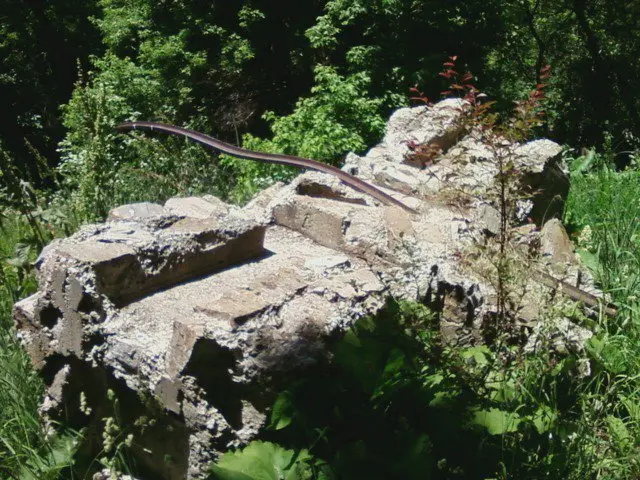
The 2023 site described the attraction as "over 3/4 mile of sloping real forest trail" and warned that dates and times could change because of the weather. According to Atlas Obscura, a scale replica of the cross was built closer to the main road for the tours. The original is in the hollow as a pile of cement and creek rock. The railroad ties that framed it, which Malvern Hansen described in his journal, are exposed and twisted by the explosion, and the large letter K is still visible in the middle.
Sources consulted
- Deseret News staff, «12-foot stone, mortar cross in Kays Hollow is blown up» — Deseret News, 1992 newspaper archive
- Paul C. Parkinson, «Another angle surfaces in Kays Cross saga» — Deseret News, 1992 newspaper archive
- Deseret News staff, «Bomb experts suspect a link between 4 Davis County blasts» — Deseret News, 1992 newspaper archive
- Malvern Hansen, published by Brent Hugh, «The Kay's Cross mystery finally solved for good? New eyewitness testimony, withheld for decades, tells all (journal of Malvern Hansen, written 2012)» — Kay's Cross and other Kaysville Mysteries, 2019 archive
- Greg Christensen, «The Strange, Awful Truth Behind Utah's Eerie Stone Cross» — Atlas Obscura, 2022 newspaper archive
- Ben Winslow, «Mysterious Kaysville cross opens to the public» — Fox 13 (KSTU), 2013 newspaper archive
- Claire Larson, «Kay's Cross» — Intermountain Histories (Charles Redd Center, Brigham Young University), 2019 academic
- Haunted Kay's Cross, «Haunted Kay's Cross — tickets, dates and directions (2023 season)» — Operator's website, 2023 archive
Reviewed by V. Serrano on 2026-08-11 · How we verify our content
💬 Field testimonies (0)
No testimonies yet. Add the first.
Add your testimony
🔒 Log in to add a testimony