👻 HAUNTED PLACE · EXP. Nº9478
ACTIVE
KiMo Theater
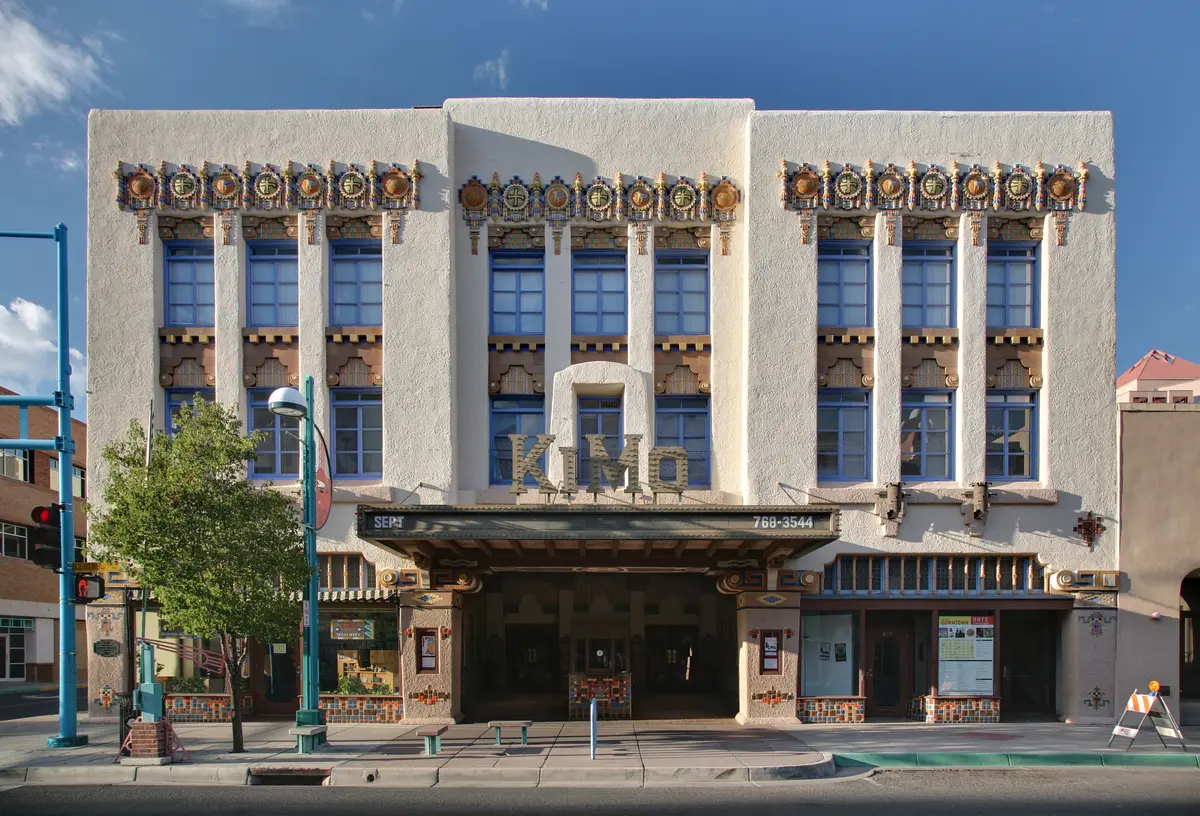
The KiMo is one of the last surviving examples of Pueblo Deco: a 1927 picture palace on Albuquerque's stretch of Route 66 in which Carl Boller married adobe massing and Navajo and Puebloan motifs to Art Deco line, for an Italian immigrant, Oreste Bachechi, who had started out selling from a tent by the railroad.
Where is KiMo Theater?
- Location
- New Mexico, United States
- Type
- Theater
- Coordinates
- 35.085, -106.653
- Last updated
LOCATION
Why is KiMo Theater said to be haunted?
Its ghost story is real in a narrower sense than usual. On the afternoon of 2 August 1951 a water heater under the lobby stairs exploded during an Abbott and Costello comedy; eight people were hurt and six-year-old Robert Darnall Jr., who had just come down from the balcony, died on the way to hospital. Decades later, staff began attributing backstage mishaps to him, and the leftover doughnuts a crew once tied to a conduit as a joke grew into a shrine under the dressing-room stairs. But the founding incident of the legend has been dated to 1986 and denied by the people who were there, and the first recorded sighting comes thirty-six years after the accident. The city that owns the theatre does not tell this story at all.
What is the history of KiMo Theater?
The KiMo was the ambition of an Italian immigrant. Oreste Bachechi reached New Mexico in 1885 and built a business out of a tent pitched near the railroad tracks; by 1925 he owned Albuquerque's Pastime Theater and wanted something grander. He went to Hollywood to find an architect and came back with Carl Boller, senior partner of the Boller Brothers, a firm that had made a speciality of picture palaces.
Boller's first impression of the corner of Fifth and Central was that it stood too far out of town. He changed his mind, then spent months travelling through New Mexico's pueblos and the Navajo Reservation collecting design material. What he drew has few parallels anywhere: a movie palace in the style Marcus Whiffen would later name Pueblo Deco, in which adobe massing and Native motifs are married to the vertical line and repetition of Art Deco. Pablo Abeita — governor of the Pueblo of Isleta and a founder of the All-Pueblo Indian Council — supplied the name, KiMo, glossed in the 1976 National Register nomination as "king of its kind".
Robert E. McKee's firm built it in a little over a year for $150,000, of which $18,000 went on the organ alone. The theatre opened on 19 September 1927 with 2,000 people crammed into a house seating 1,300. Mayor Clyde Tingley, US Senator Sam G. Bratton and delegations from Tesuque, Cochiti and Isleta Pueblos and the Navajo Reservation attended; sixty Indian dancers performed; the film was "Painting the Town". Inside were quadratura murals of the Seven Cities of Cíbola by the German-born painter Carl von Hassler, longhorn-skull sconces, Navajo Yei figures painted on the ceiling vigas, and chandeliers modelled on a funerary "Farewell Canoe". The unsupported balcony, spanning the auditorium east to west, was designed to give: at a full house it drops four to eight inches in the middle.
On the afternoon of Thursday 2 August 1951, with around a thousand people inside watching the Abbott and Costello comedy "Comin' Round the Mountain", a water heater under the stairs exploded into the lobby. Eight people were hurt — broken arms and legs, and one man lost an eye. The most seriously injured was six-year-old Robert "Bobby" Darnall Jr., who had come down from the balcony and was entering the lobby as the heater burst. He still had a faint pulse when he was picked up, and was dead on arrival at hospital. The Albuquerque Journal and the Albuquerque Tribune covered the accident; the Journal of 3 August 1951 carried a photograph of the wrecked lobby on page two.
The rest is the ordinary death of a downtown. The KiMo lost the audience that had filled it, closed in 1968, and reopened only twice — for one season of musical theatre and for a rock concert in 1972, the year the great vertical KiMo sign was taken down. Fire had already destroyed the canoe chandeliers in the late 1940s and damaged the proscenium in 1962. The 1976 nomination, which lists no ghost and does not mention the boy's death, notes drily that "in spite of numerous fires and other mishaps the theater is in good condition".
It was listed on the New Mexico State Register on 30 July 1976 and on the National Register of Historic Places on 2 May 1977 (reference 77000920). By then the City of Albuquerque had told the Bachechi family it would either buy the building at a reduced price or condemn and demolish it. In 1977 the city's voters approved a $324,000 bond and the family sold. A second bond was rejected; the city put in $1.1 million for a partial renovation under the architects Harvey Hoshour and Dan Pearson. The von Hassler murals were cleaned later for about $35,000 by the conservator Anne Rosenthal, paid for largely by the Friends of the KiMo and the Urban Enhancement Trust Fund. A $2 million overhaul by Kells and Craig in 1999-2000 replaced every seat, brought the main floor up to accessibility codes and left the capacity at 650, and more than $1 million went into roof, climate control, orchestra pit and dressing rooms between 2020 and 2022.
Timeline: the documented record of KiMo Theater
- 1925 Oreste Bachechi, owner of Albuquerque's Pastime Theater, travels to Hollywood in search of an architect and hires Carl Boller of the Boller Brothers, who then tours New Mexico's pueblos and the Navajo Reservation gathering design material.
- 19 September 1927 The KiMo opens. Two thousand people pack a 1,300-seat house built for $150,000; Mayor Clyde Tingley and delegations from Tesuque, Cochiti and Isleta Pueblos and the Navajo Reservation attend, sixty Indian dancers perform and the film is "Painting the Town". The name was suggested by Pablo Abeita, governor of Isleta Pueblo.
- 2 August 1951 On a Thursday afternoon, with about a thousand people watching the Abbott and Costello film "Comin' Round the Mountain", a water heater under the stairs explodes into the lobby. Eight people are injured and six-year-old Robert "Bobby" Darnall Jr., who had just come down from the balcony, dies on the way to hospital. The Albuquerque Journal of 3 August runs a photograph of the wrecked lobby on page two.
- 1962 Fire damages the proscenium and the wooden grilles that concealed the organ; they are later removed to fit a wider film screen. The canoe-shaped chandeliers had already been destroyed by an earlier fire in the late 1940s.
- 1968 The KiMo closes as downtown Albuquerque empties out. It reopens only twice in the years that follow: for one season of musical theatre and for a rock concert in 1972, the year the great vertical KiMo sign is taken down.
- 22 November 1976 Sylvia Cook and William G. Osofsky sign the National Register nomination, noting that the city is considering buying the theatre and that "in spite of numerous fires and other mishaps the theater is in good condition". The document does not mention the 1951 death or any ghost.
- 1977 Facing an offer to sell cheaply or see the building condemned, the Bachechi family sells to the city after Albuquerque voters approve a $324,000 bond. The KiMo is listed on the National Register of Historic Places on 2 May (reference 77000920).
- December 1986 The production of "A Christmas Carol" that the legend blames on Bobby's ghost — and that is almost always dated 1974 — actually takes place. Its only source is technical manager Dennis Potter; the actor Steve Schwartz and the director Andrew Shea, asked in 2008, do not recall any disaster.
- 1987 The Southwest Ghost Hunter's Association dates the first recorded sighting at the KiMo to this year — thirty-six years after the accident, with nothing reported during the renovation work of the 1960s.
- 1999-2000 A $2 million overhaul by the firm Kells and Craig replaces every seat, restores the murals and Pueblo Deco plasterwork and brings the main floor up to accessibility codes, leaving the auditorium at 650 seats.
- 23 October 2008 Benjamin Radford and Mike Smith publish "The Definitive KiMo Ghost" in the Alibi, tracing the legend to a single account, correcting the date of the accident against the 1951 newspapers and concluding that the founding episode "simply did not occur".
Is there a rational explanation for KiMo Theater?
This is one of the few American ghost stories with a documented birthday, and the documentation does not favour it.
The founding episode is always the same: a production of "A Christmas Carol" wrecked by technical disasters after somebody removed the doughnuts left for Bobby, order restored only when they were put back. The date usually attached to it is 1974. In 2008 Benjamin Radford and Mike Smith published an investigation in the Albuquerque weekly Alibi that traced the account to Dennis Potter, the KiMo's technical manager, established that the production in question was staged in December 1986, and then did the obvious thing: they asked the other people who were there. The actor Steve Schwartz answered "I can't corroborate any of that"; the director, Andrew Shea, said "I don't remember it being a disaster in any way". Their verdict was blunt: "All the evidence points to one inescapable conclusion: The ruined play — the very genesis of the KiMo ghost story — simply did not occur; it is but folklore and fiction."
The doughnuts themselves have a mundane origin, and it is Potter who gives it. By his account the crew got coffee and doughnuts, and at the end of the day the leftovers were tied to the electrical conduit on the back wall as a joke. The joke accumulated: the nook beneath the stairs to the dressing rooms filled up with toys, notes, photographs, ballet slippers and cheap jewellery, and became a shrine after the fact. It is a real object and a genuinely interesting piece of theatre folklore — an offering practice that grew out of a gag — but it is not evidence of anything, and it is backstage, not in the lobby.
The chronology is the other problem. Bobby Darnall died in 1951; the Southwest Ghost Hunter's Association, which examined the case in 2008 and closed it as solved, dates the first recorded sighting to 1987 and notes that nothing was reported during the theatre's renovation work in the 1960s. Whichever gap you prefer, thirty-five years passed between the death and the first ghost.
Finally, the story is visibly unstable. Popular accounts put the explosion on 1 August, 2 August or 5 September 1951; they move the heater from under the stairs to the basement to "right beneath the concession stand"; some have the boy playing by the sweets counter rather than coming down from the balcony, where the contemporary reporting places him. Neither the City of Albuquerque's official history of the building nor the 1976 National Register nomination mentions a ghost, a shrine or the death at all. The KiMo does not sell this story. Other people do.
One last thing worth saying plainly: Bobby Darnall was a real six-year-old with a real family in Albuquerque, and the legend as normally told casts him as a prankster who eats doughnuts and sabotages plays.
Can you visit KiMo Theater?
The KiMo stands at 423 Central Avenue NW, Albuquerque, New Mexico 87102. The building takes the north-east corner of Fifth and Central, in the downtown stretch of old Route 66. It belongs to the City of Albuquerque and works as a municipal performance venue; programming and tickets run through ABQtickets.com, and the usual way in is a ticket for a show.
The city's contact page, read on 11 September 2026, states that "The KiMo Theatre box office will open 2 hours prior to ticketed events and will remain open 30 minutes after the event starts." The box office number is 505-228-9857; the city switchboard is 311 or 505-768-2000, and TTY is 1-800-659-8331. The $2 million overhaul of 1999-2000 left the auditorium at 650 seats against the 1,300 of 1927, so popular bills sell out.
Free "Meet The KiMo" events include a tour of the theatre. The city's tours page carries a short virtual tour narrated by the theatre manager and sends anyone wanting the real thing to ABQtickets.com for the next date; there is no published calendar. The same page lists the parking: street meters along Central Avenue, paid lots and garages nearby, and a covered structure behind the theatre at Copper Avenue and Fifth Street.
Accessibility splits by floor. The city states that the main floor is fully ADA compliant, with "four wheelchair and companion seating areas in the auditorium" and an accessible dressing room at stage level, and also that "The KiMo was built without an elevator, or any room to install one." Several flights of stairs lead to the balcony and the upper floors, which the city says "may not be accessible to some persons".
The shrine that grew out of the doughnut joke sits in the nook beneath the stairs to the dressing rooms; it is backstage, off the public route. Robert "Bobby" Darnall Jr. was six years old when he died of injuries from the lobby explosion of 2 August 1951. On 11 September 2026 the city's own KiMo pages — history, restoration, contact, tours and visitor information — carried no mention of the ghost, of that death or of any memorial.
Sources consulted
- Sylvia Cook and William G. Osofsky, «National Register of Historic Places Inventory — Nomination Form: KiMo Theater (ref. 77000920)» — New Mexico State Records Center and Archives / National Park Service, 1976 report
- Benjamin Radford and Mike Smith, «The Definitive KiMo Ghost» — Weekly Alibi (Albuquerque), 2008 newspaper archive
- City of Albuquerque, Department of Arts & Culture, «History of The KiMo» — Official city history, 2026 archive
- Cody Polston, Southwest Ghost Hunter's Association, «KiMo Theater Investigation» — SGHA case file (closed as solved), 2008 report
- City of Albuquerque, Department of Arts & Culture, «Restoration of the KiMo» — Official restoration record, 2026 archive
- City of Albuquerque, Department of Arts & Culture, «Meet The KiMo / Contact the KiMo (address, box office hours, ADA information)» — Official visitor information, 2026 archive
- Inara Cedrins, «Albuquerque Ghosts: Traditions, Legends, and Lore» — Schiffer Publishing, 2009 book
Reviewed by V. Serrano on 2026-08-11 · How we verify our content
💬 Field testimonies (0)
No testimonies yet. Add the first.
Add your testimony
🔒 Log in to add a testimony