👻 HAUNTED PLACE · EXP. Nº9478
ACTIVE
Lake Drummond
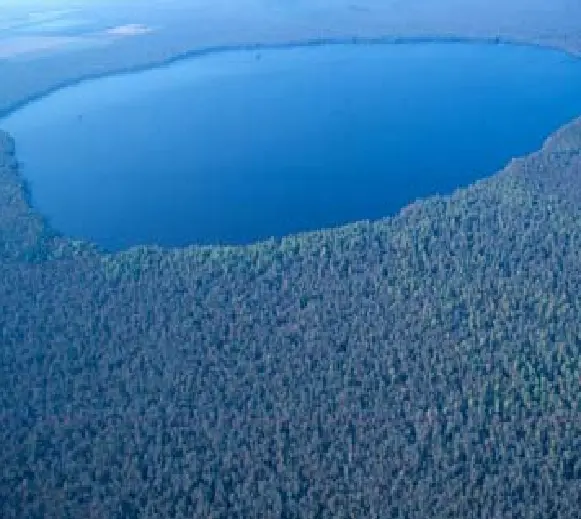
Lake Drummond is a shallow, tea-coloured lake at the heart of the Great Dismal Swamp, and its ghost has a publication date.
Where is Lake Drummond?
- Location
- Virginia, United States
- Type
- Forest / nature
- Coordinates
- 36.602, -76.47
- Last updated
LOCATION
Why is Lake Drummond said to be haunted?
In 1806 the Irish poet Thomas Moore printed "A Ballad. The Lake of the Dismal Swamp", subtitled "Written at Norfolk, in Virginia", about a young man who believed his dead sweetheart had gone into the swamp: "They made her a grave, too cold and damp / For a soul so warm and true; / And she's gone to the Lake of the Dismal Swamp, / Where, all night long, by a fire-fly lamp, / She paddles her white canoe." Moore credited the tale to an anonymous story he was told, and his own footnote puts the swamp "ten or twelve miles distant from Norfolk" — nothing he printed says he ever saw the lake. The swamp's documented history is stranger than its ghost: for generations it sheltered maroon communities of people who had escaped slavery, a past that archaeology, not folklore, has been recovering.
What is the history of Lake Drummond?
The lake at the centre of the Great Dismal Swamp has belonged to the imagination for so long that its documented history tends to get lost. That is a pity, because the documented history is the better story.
Colonial tradition credits the lake to William Drummond, first governor of the Albemarle settlements in what became North Carolina, who is said to have come upon it while hunting in 1663. He was captured and executed on Governor William Berkeley's orders in the reprisals that followed Bacon's Rebellion of 1676, and the water kept his name. In 1728 William Byrd II ran the dividing line between Virginia and North Carolina along the swamp's edge and supplied the adjective that stuck. Byrd did not go in: as Encyclopedia Virginia notes, he sent assistants instead, complaining that "there was no Intelligence of this Terra Incognita to be got".
Then came the drainage men. In 1763 the Virginia General Assembly granted 40,000 acres to the Dismal Swamp Land Company, an enterprise assembled by George Washington and his brother John Augustine Washington, whose plan was to drain the wetland for rice ground and timber. The company bought fifty-four enslaved people, who dug the ditches, hauled the logs and lived in shacks along the swamp's western edge. Two of those cuts — Washington Ditch and Jericho Ditch — are still there, and are now the refuge's main walking routes. From 1793 crews began the twenty-two-mile Dismal Swamp Canal between Deep Creek in Virginia and South Mills in North Carolina, again with enslaved labour; Encyclopedia Virginia dates its completion to 1804 and records that between the heat, the mosquitoes and the root mat the work advanced about thirty feet a day.
In the middle of all this arrived a tourist with a notebook. The Irish poet Thomas Moore spent part of his fourteen-month American voyage at Norfolk, and out of it came "A Ballad. The Lake of the Dismal Swamp", printed at page 38 of Epistles, Odes, and Other Poems (London: James Carpenter, 1806) under the subtitle "Written at Norfolk, in Virginia". Moore opens it with a prose note credited only to "Anon.": "They tell of a young man, who lost his mind upon the death of a girl he loved, and who, suddenly disappearing from his friends, was never afterwards heard of." He had said in his ravings, the note goes on, that the girl had "gone to the Dismal Swamp", and "it is supposed he had wandered into that dreary wilderness, and had died of hunger, or been lost in some of its dreadful morasses." The first stanza is the part everyone quotes: "They made her a grave, too cold and damp / For a soul so warm and true; / And she's gone to the Lake of the Dismal Swamp, / Where, all night long, by a fire-fly lamp, / She paddles her white canoe." In the stanza it is the maiden who paddles. Her lover hollows a boat of birchen bark, follows a "meteor spark" out across the water, and "the boat returned no more".
The ditches cut both ways. The wilderness that resisted drainage sheltered people the drainage companies owned. Freedom seekers had been going into the swamp since the late 1600s, and by the 1840s, Encyclopedia Virginia notes, it "was widely known as a place of marronage and resistance to slavery". Some passed through on their way north; others stayed for generations, in communities on the dry interior islands. The US Fish and Wildlife Service, which manages the swamp today, cites the historians' estimate that some 50,000 self-emancipated African Americans — along with free Blacks, Indigenous people and outsider Europeans — lived in the swamp across the whole period. Those communities emptied during the Civil War: after Union forces took Norfolk in May 1862, many maroons went out to Fort Monroe.
The maroon settlements are an archaeological site. Daniel O. Sayers, of American University, ran five years of field schools on a large interior island and published the results as A Desolate Place for a Defiant People (University Press of Florida, 2014). Interviewed by Humanities magazine in 2015, Sayers described a world that "thousands of African-American Maroons, Indigenous Americans, and enslaved African-American laborers" made for themselves "between 1607 and 1860", cultivating community fields and making furniture, instruments and containers out of wood and swamp plants. He also pointed out how much has gone: the swamp today is roughly a tenth of its eighteenth-century extent, cut down by the lumbering and canal work of the nineteenth century.
The modern refuge dates from 1973, when the Union Camp Corporation gave 49,097 acres to The Nature Conservancy, which passed them to the federal government. Congress established the Great Dismal Swamp National Wildlife Refuge the following year. It now protects some 113,000 acres, and Lake Drummond sits in the middle of it.
Timeline: the documented record of Lake Drummond
- 1663 Colonial tradition holds that William Drummond, first governor of the Albemarle settlements, came upon the lake while hunting. He was later captured and executed on Governor Berkeley's orders after Bacon's Rebellion, but the water kept his name.
- 1728 William Byrd II runs the Virginia–North Carolina dividing line along the swamp and gives it its adjective. He does not enter it himself: he sends assistants, complaining that "there was no Intelligence of this Terra Incognita to be got".
- 1763 The Virginia General Assembly grants 40,000 acres to the Dismal Swamp Land Company, assembled by George Washington and his brother John Augustine. The company buys fifty-four enslaved people to dig the drainage ditches and haul timber; Washington Ditch and Jericho Ditch survive as refuge trails.
- From 1793 Work begins on the twenty-two-mile Dismal Swamp Canal between Deep Creek, Virginia and South Mills, North Carolina, dug by enslaved and free Black labourers advancing roughly thirty feet a day. Encyclopedia Virginia dates its completion to 1804.
- 1806 Thomas Moore publishes "A Ballad. The Lake of the Dismal Swamp" in Epistles, Odes, and Other Poems (London: James Carpenter), page 38, subtitled "Written at Norfolk, in Virginia". He credits the story to an anonymous account and adds a footnote placing the swamp "ten or twelve miles distant from Norfolk". Nothing he prints says he saw the lake.
- By the 1840s The swamp "was widely known as a place of marronage and resistance to slavery", in Encyclopedia Virginia's words: freedom seekers had been entering it since the late 1600s, some passing through, others settling for generations on the dry interior islands.
- May 1862 Union forces capture Norfolk, and many of the swamp's maroons leave the interior for the safety of Fort Monroe. Nothing of the interior communities persists after the 1860s.
- 1973 The Union Camp Corporation donates 49,097 acres of swamp to The Nature Conservancy, which transfers the land to the federal government.
- 1974 Congress establishes the Great Dismal Swamp National Wildlife Refuge, today some 113,000 acres of forested wetland and the largest intact remnant of a swamp that once covered more than a million acres.
- 2015 Archaeologist Daniel O. Sayers, of American University, tells Humanities magazine about five years of field schools on a large interior island: thousands of maroons, Indigenous Americans and enslaved labourers built their own social and economic world in the swamp "between 1607 and 1860". No human remains have been found.
Is there a rational explanation for Lake Drummond?
Almost everything usually said about the ghost of Lake Drummond can be traced to one printed page, and the page is still there to check.
The lady of the lake has a named author and a date: she is the subject of a ballad published in London in 1806, and Moore himself says where he got it. His headnote credits an anonymous told story — "They tell of a young man…" — and his own footnote to the poem describes the setting from the outside: "The Great Dismal Swamp is ten or twelve miles distant from Norfolk, and the Lake in the middle of it (about seven miles long) is called Drummond's Pond." The subtitle places the writing at Norfolk. Nothing Moore printed says he ever went to the lake. His letters to his mother from Norfolk, dated 7 and 28 November and 2 December 1803 and printed by Lord John Russell in 1853, do not mention it either: a full-text search of that volume on 25 September 2026 returns no match for "swamp" or "Drummond", against fifteen for "Norfolk". The often-repeated claim that he visited the lake in 1803 and wrote the poem there is not in the 1806 book, not in those letters, and not in the scholarly text of the poem at Representative Poetry Online (University of Toronto), which is set from the 1806 edition.
Two details commonly attached to the story contradict the poem. The maiden is not drowned: Moore's poem buries her, "They made her a grave". And in the poem the one who paddles by fire-fly light is the dead girl; her lover follows "the meteor spark", and "the boat return'd no more". The white canoe first appears in Moore's stanzas. The prose note he credits to "Anon." has a young man who lost his mind, a girl "gone to the Dismal Swamp" and a death by hunger or in the morasses, and no canoe, no lake and no light. The white doe belongs to a different Virginia and Carolina legend altogether.
Even the lights are the poem's. Moore names them himself: fireflies, and "a meteor bright / Quick over its surface played". Fireflies swarm over the swamp in summer, and drifting lights over deep peat wetlands are the classic setting for ignis fatuus reports.
Finally, the lake's origin, which is where the fine print usually goes wrong. It is often written that science cannot explain how Lake Drummond formed, with a meteor strike offered as a live option. That is out of date. Virginia Places, the geography site of Charlie Grymes, states that an extraterrestrial cause "has been disproven": the stratigraphy below each Carolina bay "is intact", where an impact would have shattered it, and meteorite fragments are rare in the area. The debate that remains is between two mechanisms: a wind-shaped Carolina bay later deepened by fire, or a basin excavated outright by a peat fire that burned down to the confining clay. The date of that fire differs between the sources. Virginia Places puts a lightning-triggered fire "perhaps 6,000 years ago"; Encyclopedia Virginia says the lake "was likely formed four millennia ago by a peat fire", and gives the same 4,000 years for the Nansemond Indian Nation's oral tradition, in which a great firebird made the lake.
Can you visit Lake Drummond?
Lake Drummond lies inside the Great Dismal Swamp National Wildlife Refuge. The US Fish and Wildlife Service gives the refuge an area of nearly 113,000 acres (about 45,700 hectares) and describes it as the largest intact remnant of a swamp that once covered more than a million acres of south-eastern Virginia and north-eastern North Carolina. Refuge headquarters is at 3100 Desert Road, Suffolk, Virginia 23434-8973, telephone (757) 986-3705. On 24 September 2026 the refuge's page said that visitor centre hours were "limited by staff availability" and asked for a call before any visit.
The refuge has more than 40 miles (64 km) of trails and boardwalks, open from sunrise to sunset and reached from four entrances: Portsmouth Ditch, Jericho Lane, Washington Ditch and Railroad Ditch. The road to the water is the Lake Drummond Wildlife Drive, which leaves from the Railroad Ditch trailhead at 3120 Desert Road. It is a gravel road six miles (9.7 km) long one way, with three boardwalks along it and a boat ramp with parking at the lake end. From 1 April to 30 September it is open from 7am to 7pm, and from 1 October to 31 March from 7.30am to 5pm; the electronic entry gate closes an hour earlier. It is the only part of the refuge that needs a vehicle permit. The fee is $5 in cash per vehicle, paid at headquarters or at a self-service station about half a mile along the drive, and it is waived for holders of a Duck Stamp or an America the Beautiful pass; the refuge also sells its own annual pass for $25. The other way in is by water, along the Feeder Ditch from the Dismal Swamp Canal, an access operated by the US Army Corps of Engineers. Camping is forbidden on refuge land; the Corps runs a primitive 24-hour recreation site near the lake that can only be reached by boat from the Feeder Ditch.
Boats of up to 25 horsepower may use Lake Drummond itself, "as the ditches are not maintained for passage". The refuge's own pages disagree on the depth of the lake: the boating page gives an average of 3 feet (0.9 m), while the fishing page gives an average of 4 to 6 feet (1.2 to 1.8 m) and an area of about 3,100 acres (1,250 hectares). Fishing is allowed year-round in daylight under Virginia regulations, in the lake and the Feeder Ditch, for chain pickerel, crappie, sunfish and catfish. White-tailed deer, black bear, wild turkey, coyote and grey squirrel are hunted in designated areas on Thursdays, Fridays and Saturdays from 1 October to the first Saturday in January, with a refuge hunt permit. The refuge lists one of the largest black bear populations on the east coast among its wildlife.
The refuge's account of its own history says that in 1763 George Washington and other investors formed the Dismal Swamp Company, which used enslaved workers to build drainage ditches and roads. It also states that from the late 1600s until the Civil War freedom-seekers built settlements on islands deep in the swamp. The refuge is listed as a site of the National Underground Railroad Network to Freedom.
Sources consulted
- Thomas Moore, «A Ballad. The Lake of the Dismal Swamp. Written at Norfolk, in Virginia (in Epistles, Odes, and Other Poems, p. 38)» — London: James Carpenter, 1806 book
- Perri Meldon, «The Great Dismal Swamp» — Encyclopedia Virginia (Virginia Humanities), 2025 academic
- Steve Moyer, «Anthropologist Daniel Sayers on the Maroons Who Found Freedom in the Great Dismal Swamp» — Humanities, National Endowment for the Humanities, 2015 interview
- US Fish and Wildlife Service, «Great Dismal Swamp National Wildlife Refuge — About Us» — Official refuge information, 2026 report
- US Fish and Wildlife Service, «Great Dismal Swamp National Wildlife Refuge — Visit Us and Activities» — Official visitor information, 2026 report
- Charlie Grymes (Virginia Places), «Lake Drummond and the Great Dismal Swamp / Origin of Carolina Bays, Lake Drummond and Great Dismal Swamp» — virginiaplaces.org, 2026 academic
- Thomas Moore, ed. G. G. Falle, «A Ballad: The Lake of the Dismal Swamp (text set from the 1806 edition)» — Representative Poetry Online, University of Toronto, 2000 archive
- US Fish and Wildlife Service, «Great Dismal Swamp National Wildlife Refuge — Lake Drummond Wildlife Drive (Auto tour): hours, $5 vehicle fee and passes» — fws.gov, 2026 report
- US Fish and Wildlife Service, «Great Dismal Swamp National Wildlife Refuge — Boating - motorized (boats up to 25 hp on Lake Drummond only; Feeder Ditch access)» — fws.gov, 2026 report
- US Fish and Wildlife Service, «Great Dismal Swamp National Wildlife Refuge — Fishing (Lake Drummond and Feeder Ditch)» — fws.gov, 2026 report
- US Fish and Wildlife Service, «Great Dismal Swamp National Wildlife Refuge — Hunting (species, days and season)» — fws.gov, 2026 report
- US Fish and Wildlife Service, «Great Dismal Swamp National Wildlife Refuge — Camping (not permitted on the refuge; US Army Corps of Engineers facility near Lake Drummond)» — fws.gov, 2026 report
- Charlie Grymes (Virginia Places), «Lake Drummond (naming: William Drummond, 1663, and Bacon's Rebellion)» — virginiaplaces.org, 2026 web
- Thomas Moore, ed. Lord John Russell, «Memoirs, Journal, and Correspondence of Thomas Moore, vol. 1 — letters from Norfolk, Virginia, 7 and 28 November and 2 December 1803» — Longman, Brown, Green, and Longmans, London, 1853 book
Reviewed by V. Serrano on 2026-08-11 · How we verify our content
💬 Field testimonies (0)
No testimonies yet. Add the first.
Add your testimony
🔒 Log in to add a testimony