👻 HAUNTED PLACE · EXP. Nº9477
ACTIVE
Leonis Adobe
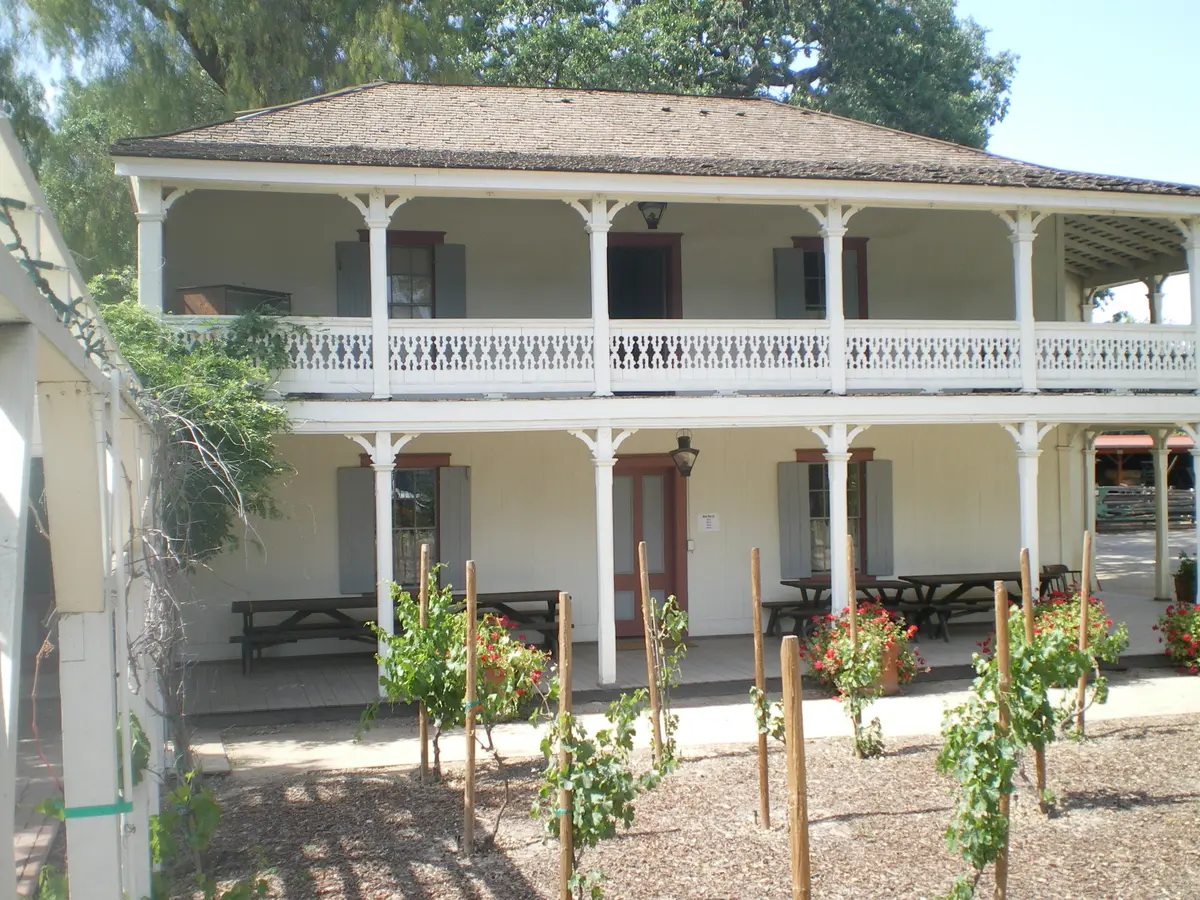
This two-storey adobe in Calabasas is Los Angeles Historic-Cultural Monument No. 1, the first entry on the city's landmark register, declared on 6 August 1962 to stop a supermarket being built on the site.
Where is Leonis Adobe?
- Location
- California, United States
- Type
- House / mansion
- Coordinates
- 34.158, -118.64
- Last updated
LOCATION
Why is Leonis Adobe said to be haunted?
It is named after Miguel Leonis, the French Basque rancher who enlarged it in the late 1870s and died under the wheels of his own wagon in 1889. The older claim to the ground belonged to Espíritu Chijulla, the Chumash and Tongva woman he lived with for thirty years, whose father was one of the grantees of Rancho El Escorpión and whom his will dismissed as his housekeeper. She sued, and won half the estate in 1891 and the last ruling in 1905, sixteen years later. The ghost stories arrived long afterwards: the accounts of footsteps, of unexplained smells, of hands that caught a falling woman on the upstairs veranda and of a voice saying "Chichita" are told by books about the house, not by the museum, whose website mentions no ghost at all.
What is the history of Leonis Adobe?
The Leonis Adobe carries a number no other building in Los Angeles can carry: Historic-Cultural Monument No. 1, the first entry on the city's landmark register, declared on 6 August 1962. The house is named after a man. The older claim to the ground under it belonged to a woman.
The land came first. In July 1845 three Indigenous men — Odón Chihuya, whose surname is also written Chijulla, his son-in-law Urbano Chari and Urbano's son Manuel — negotiated joint ownership of a square league in the western San Fernando Valley that became Rancho El Escorpión. Odón had been born at Humaliwo (Malibu), but his father came from the village at the foot of Kas'ele'ew Peak, inside the grant itself. His daughter, María del Espíritu Santo Chijulla, born about 1836 and baptised at Mission San Fernando, lived at El Escorpión all her life. Half a century later the ethnographer John P. Harrington was told by Sétimo López that Espíritu and her family spoke Ventureño Chumash as well as Fernandeño Tongva — the ordinary bilingualism of that village.
Miguel Leonis, a French Basque from Cambo-les-Bains, reached Southern California in the 1850s with nothing. The Los Angeles Daily Herald compressed the career into a single line when he died: he arrived a poor man in the early fifties, could neither read nor write, found work herding sheep, and through frugal living and shrewd trading in cattle and land became very wealthy. Espíritu had married José Antonio Menéndez in 1856 and had a son, Juan José, in 1857. Widowed, she began living with Leonis at El Escorpión in 1859; their daughter Marcelina was born in 1860 and died at twenty. Through the 1860s and early 1870s the rancho passed piece by piece into Leonis's hands, and by 1878 the couple had made an abandoned 1844 adobe at Calabasas their home. Leonis enlarged it into the two-storey Monterey-style house that stands today; the 1975 federal nomination dates that remodelling to the late 1870s and notes that "most of the restoration was an uncovering process".
On a Tuesday evening in September 1889 Leonis was riding a wagon loaded with wood, with three companions, when a jolt threw him under the wheels. They broke the ribs on his right side and tore his face. He died on the Friday morning, 20 September. His will called Espíritu his housekeeper and left her a fraction of an estate the Herald valued at between half and three quarters of a million dollars.
She refused the money and sued. Eleven lawyers were retained across the parties. The contest opened before Judge Clark on 5 May 1891; witnesses testified that Leonis had introduced her in Spanish as his esposa — wife — and not merely as his mujer. On 5 June the jury answered a list of written questions: yes, Miguel Leonis and Espíritu Chijulla had agreed to be man and wife; yes, he had publicly acknowledged her. She was awarded half the estate. Nettie Pryor, a daughter Leonis had by Librada Pryor, was excluded.
More than a hundred suits followed that verdict, and the man she had made her agent, Laurent Etchepare, put her property into his own name; by 1898 the courts were untangling mortgages he had granted on land she swore he had taken from her by fraud. Her lawyers were Horace Bell and the future United States senator Stephen M. White. The case reached the California Supreme Court three times, and the final ruling in her favour came in 1905, sixteen years after Leonis's death. She died at the adobe a few months later, in 1906, and was buried at Mission San Fernando.
Her son Juan José Menéndez inherited the house, worked as a blacksmith and built the barn that still stands in 1912. In 1917 Harrington and his wife Carobeth — later the writer Carobeth Laird — stayed with Juan and Juana Valenzuela de Menéndez at the adobe and recorded Fernandeño narratives there. Menéndez sold the property to the Agoure family in 1922; they lost it to foreclosure in 1931, after which the house served as a chicken-dinner restaurant and then as a retirement home. Its last resident was the film actor John Carradine.
By 1961 the owner wanted a supermarket on the site. On 5 August 1962 the Los Angeles Herald-Examiner ran a full page on the wreck under the headline "Leonis' Adobe — Park or Parking?"; the next day the newly formed Cultural Heritage Board met for the first time and, within three hours, made the adobe Monument No. 1, which froze the demolition. Kathleen "Kay" Beachy bought the site for $240,000 in March 1963 and handed it to the Leonis Adobe Association. The restored house opened to the public on 21 May 1966 and was listed on the National Register of Historic Places on 29 May 1975. The Plummer House, California Historical Landmark No. 160, was moved onto the grounds in 1983 and is now the visitor centre.
Timeline: the documented record of Leonis Adobe
- July 1845 Odón Chihuya, his son-in-law Urbano Chari and Urbano's son Manuel negotiate joint ownership of a square league in the western San Fernando Valley: Rancho El Escorpión. Odón's daughter, María del Espíritu Santo Chijulla, born about 1836, lives there all her life.
- 1859 Espíritu Chijulla, widowed since the death of José Antonio Menéndez and mother of a two-year-old son, begins living with the French Basque rancher Miguel Leonis at El Escorpión. Their daughter Marcelina is born the following year and dies at twenty.
- 1878 The couple make an abandoned adobe of 1844 at Calabasas their permanent home, according to the museum; the 1975 federal nomination dates Leonis's remodelling of it into a two-storey Monterey-style house to the late 1870s.
- 20 September 1889 Miguel Leonis dies on a Friday morning of injuries suffered the previous Tuesday evening, when a jolt threw him off a wagon loaded with wood, in company with three friends, and the wheels ran over him. The Los Angeles Daily Herald reports it on its front page the next day.
- 5 June 1891 After a trial opened on 5 May before Judge Clark, with eleven lawyers retained across the parties, the jury answers a list of written questions and finds that Leonis and Espíritu Chijulla had agreed to be man and wife and that he had publicly acknowledged her. She is awarded half the estate; Nettie Pryor, his daughter by Librada Pryor, is excluded.
- 1905 After more than a hundred further suits, three trips to the California Supreme Court and the loss of much of her property to her own agent Laurent Etchepare, Espíritu wins the final ruling, sixteen years after Leonis's death. She dies at the adobe in 1906.
- 1917 The ethnographer John P. Harrington and his wife Carobeth, later the writer Carobeth Laird, stay at the adobe with Espíritu's son Juan José Menéndez and his wife Juana Valenzuela and record Fernandeño narratives and place names there.
- 1922 Juan Menéndez sells the adobe to the Agoure family, the first occupants from outside the household. According to John R. Kielbasa it is during their tenure that the accounts of unexplained footsteps and smells begin to circulate; the Agoures also dig out the ground under the outdoor bread oven looking for Leonis's buried gold, and find nothing.
- 5–6 August 1962 The Los Angeles Herald-Examiner devotes a page to the ruined adobe under the headline "Leonis' Adobe — Park or Parking?", reducing Espíritu to "a wealthy widow whose father owned the vast Rancho El Escorpion". The next day the new Cultural Heritage Board meets for the first time and makes the adobe Historic-Cultural Monument No. 1, halting the demolition.
- 29 May 1975 The adobe, open as a museum since 21 May 1966, is listed on the National Register of Historic Places. The nomination, written by the Leonis Adobe Association itself, mentions no ghost and devotes its history section to Espíritu's sixteen-year fight.
- 27 September 2005 The British series Most Haunted broadcasts an episode filmed at the adobe with the medium Derek Acorah. On 5 December the regulator Ofcom clears the programme of deception on the ground that it is entertainment, not "a legitimate investigation".
Is there a rational explanation for Leonis Adobe?
A text search of the eleven pages linked from the Leonis Adobe Museum's home page, run on 8 October 2026, finds none of the words ghost, haunted, haunting, paranormal, spooky or séance, while "Leonis" appears on every one of them, between 7 and 34 times; the tours page is among them. The same search over the 32 pages of the museum's 2004-2006 site that the Internet Archive returned that day gives the same result. Its Halloween event, on 24 October 2026, is a Pumpkin Party with a scavenger hunt, hands-on crafts and live music.
The federal record is just as quiet: the 1975 National Register nomination was written by the Leonis Adobe Association itself, and its "History" section mentions no ghost and is given over to Espíritu, whose will "cut her off with a pittance" and whose "sixteen year battle for her rights against overwhelming odds is a part of California history deserving of further study".
The Herald-Examiner's piece of 5 August 1962 — a vandalised ruin, sagging verandas, a horror-film actor as its last tenant, Shelley's "Ozymandias" quoted at the top — has every ingredient a ghost story needs and contains no ghost. The haunting accounts are told in John R. Kielbasa's chapter on the adobe in Historic Adobes of Los Angeles County (1997), whose web edition gives no sources. Kielbasa dates the first of them to the tenure of the Agoure family, who bought the house in 1922, the railing incident to the 1930s, and later ones to 1965 and 1971, after the campaign to save the house had begun.
Read closely, the details come apart: Kielbasa sets his most repeated incident — the collapsing railing and the invisible hands — on the second-level veranda, and leaves its protagonist unnamed: "a woman who lived there, possibly Mrs. Gregg". The voice heard in the upstairs hallway saying "Chichita" was identified as Espíritu by María Orsua, who was herself the child Espíritu had called Chichita; Orsua was also the resident caretaker from 1967 and the memory on which the museum based its restoration. The one person for whom the word meant anything was the person who supplied both the identification and the house's furnishings.
The reported digging has a documented, non-spectral source. Leonis distrusted banks, and the Agoure family dug out a large quantity of earth under the outdoor bread oven in the 1920s looking for his buried gold; they found nothing. The legend was in print long before that: on 11 August 1905, while Espíritu was still alive, the San Francisco Call reported the local belief that treasure buried by the mission fathers was what lay behind "the rich Leonis estate litigation".
The modern fame comes from television: the adobe was filmed by the British series Most Haunted, broadcast on 27 September 2005 with the medium Derek Acorah. Ten weeks later, on 5 December 2005, the British regulator Ofcom cleared the programme of deception on the ground that it was made for entertainment: it contained "a high degree of showmanship that puts it beyond what we believe to be a generally accepted understanding of what comprises a legitimate investigation", and "should be seen in the light of shows where techniques are used which mean the audience is not necessarily in full possession of the facts". Acorah's last appearance on the series was the episode broadcast the following week.
Can you visit Leonis Adobe?
The Leonis Adobe Museum is at 23537 Calabasas Road, Calabasas, California 91302, in Old Town Calabasas beside the Ventura Freeway (US 101); the pin (34.1576, -118.6402) falls on the museum's frontage on Calabasas Road, which OpenStreetMap places inside the city of Los Angeles, in the Woodland Hills district. The museum's visit page, consulted on 23 September 2026, gives its hours as Saturdays 10:00 to 16:00 and Sundays 13:00 to 16:00. Entry is free and the museum asks for donations. The same site announced closures on Saturday 19 and Saturday 26 September 2026 for private events.
The grounds can be walked during opening hours, while the inside of the adobe is shown only on guided tours of about thirty minutes in spoken English. They start at 11:30, 13:30 and 14:30 on Saturdays and at 13:30 and 14:30 on Sundays, with no late entry. Private tours are booked separately through the museum's tours page. Photographs and video taken with phones are allowed on the grounds and not inside the adobe, where strollers are not admitted.
Parking is free in the museum's own lot once the attendant is told the visit is to the museum, and the lot is locked at the end of business hours. The second storey is reached only by stairs; for that part of the house the museum offers a video tour and an audio tour with a transcript. The ramp entrance is through the Plummer House, near accessible parking spaces; the ground is uneven in places. Only service dogs as the Americans with Disabilities Act defines them are admitted; emotional-support animals are excluded. Water in bottles with lids is the only food or drink allowed on the property; smoking and vaping are prohibited everywhere on it, outdoor areas included.
The museum presents the site as a working rancho of the 1880s. Its ranch page names Percheron horses, Texas longhorns, sheep, Nubian and angora goats, Black Spanish turkeys, chickens, doves and four barn cats, and the gift shop sells alfalfa for the sheep and goats and feed for the chickens. The shop occupies the Plummer House, which stood in Plummer Park in West Hollywood until it was moved to these grounds in 1983; it is registered as State Historical Landmark No. 160 and holds displays of Leonis family items, objects excavated from a well on the property and the story of how the museum was saved from demolition.
Calabasas Creek Park is described on the visit page as "currently closed to the public", with no reopening date. The special-events page lists the 60th-anniversary celebration on 26 September 2026, from 17:30 to 22:00, at 65 dollars for members and 75 for general admission, followed by a Pumpkin Party on 24 October and a Holiday Roundup on 5 December, both from 13:00 to 16:00 at 10 dollars a person, with members and children under two admitted free.
Sources consulted
- Los Angeles Daily Herald, «Miguel Leonis: Old Settler Killed by Being Run Over» — Los Angeles Daily Herald, 21 September 1889, p. 1, 1889 newspaper archive
- Los Angeles Herald, «The Leonis Will Case (court report)» — Los Angeles Herald, 12 May 1891, p. 2, 1891 newspaper archive
- Los Angeles Herald, «Espiritu Chijulla Gets Half the Miguel Leonis Estate» — Los Angeles Herald, 6 June 1891, p. 5, 1891 newspaper archive
- The Herald (Los Angeles), «Side suit in the Leonis estate: the Etcheparre mortgage (court report)» — The Herald, 26 January 1898, p. 10, 1898 newspaper archive
- The San Francisco Call, «Mission gold and the Leonis estate litigation (news report)» — The San Francisco Call, 11 August 1905, p. 1, 1905 newspaper archive
- Ted Thackrey, «Leonis' Adobe — Park or Parking? Calabasas House Center of Private-Public Row» — Los Angeles Herald-Examiner, 5 August 1962 (Los Angeles Public Library, California Index), 1962 newspaper archive
- Leonis Adobe Association, «National Register of Historic Places Inventory–Nomination Form: Leonis Adobe (reference 75000433)» — United States National Park Service, 1975 report
- John R. Johnson, «Ethnohistoric Overview for the Santa Susana Pass State Historic Park Cultural Resources Inventory Project» — California Department of Parks and Recreation, 2006 academic
- John R. Kielbasa, «Miguel Leonis Adobe, in Historic Adobes of Los Angeles County» — Dorrance Publishing Co., Pittsburgh, 1997 book
- Leonis Adobe Museum, «Our History» — Official museum website, 2026 web
- Leonis Adobe Museum, «Come Visit: hours, tours and accessibility» — Official museum website, 2026 web
- BBC News, «Ghost show cleared of deception» — BBC News, 5 December 2005, 2005 newspaper archive
Reviewed by V. Serrano on 2026-08-12 · How we verify our content
💬 Field testimonies (0)
No testimonies yet. Add the first.
Add your testimony
🔒 Log in to add a testimony