👻 HAUNTED PLACE · EXP. Nº9478
ACTIVE
Magnolia Plantation and Gardens (Charleston, South Carolina)
Magnolia is a rice plantation on the Ashley River that survived by turning itself into a garden.
Where is Magnolia Plantation and Gardens (Charleston, South Carolina)?
- Location
- South Carolina, United States
- Type
- House / mansion
- Coordinates
- 32.877, -80.084
- Last updated
LOCATION
Why is Magnolia Plantation and Gardens (Charleston, South Carolina) said to be haunted?
Its wealth came from Carolina Gold rice grown by enslaved people, whose dikes still shape the swamp garden and whose descendants swept the paths for the tourists who arrived by steamboat from about 1871. Four restored field cabins stand on the site, lived in continuously from slavery into the late twentieth century, and the plantation names 537 enslaved individuals in its research. The ghost story is smaller and much later than the ones told about it: the only televised investigation, a 2012 Syfy episode, set out to reach a Drayton relative shot in a hunting accident in the early 1800s, and the only ghost the plantation's own old website ever claimed was that of its late owner, whose ashes were placed inside a live oak in 2002. A sweep of the entire site finds ghosts in a single blog post among more than a thousand pages. Listed on the National Register in 1972 — not a National Historic Landmark.
What is the history of Magnolia Plantation and Gardens (Charleston, South Carolina)?
Magnolia is not a garden with a plantation attached. It is a rice plantation that survived by turning itself into a garden, and almost everything visitors admire there was dug, banked, planted and swept by people who were held as property.
The land came into the family by marriage. The plantation's own history states that in the late seventeenth century Stephen Fox acquired a 400-acre tract on the Ashley River and passed it to his son-in-law, Thomas Drayton; the site dates its founding to 1679. When Thomas Drayton II died in 1716, his widow Ann Fox Drayton was left with four children and the 402-acre property. Primogeniture pointed to her eldest son, who was eight. She took control instead, bought 260 more acres from John Cattell, and ran four further plantations of just over 3,000 acres. In the account Magnolia publishes today, that estate is measured in what it contained: roughly 100 enslaved people, 1,400 head of cattle and 112 horses.
The money came from Carolina Gold rice, and the rice came from knowledge and labour taken from West Africa. The dikes, embankments and floodgates that shaped the river fields were built by enslaved workers; the Audubon Swamp Garden that visitors now walk on boardwalks is those rice paddies, gone wild. The earliest roll of names the plantation itself publishes is from 1820, and it survives with the trades attached: Driver Dick; the carpenters Robert, Joe, Jim and Abraham; the house servants George, Daniel, Sam, London and Kent; and Grace, Rose, Tinah, Hannah, Harriot, Holly, Binah and Bofa. The same page states that across the nineteenth century an average of about forty-five enslaved people lived and worked at Magnolia. The plantation now says it has recovered the names of 537 enslaved individuals in total, among them the women Affee, Sikee, Rose, Belinda, Nanny and Dinah.
The famous gardens are a nineteenth-century project. Thomas Drayton died in 1825 without a son and willed the estate to his daughter's boys, Thomas and John Grimké, on condition that they take the Drayton surname. Magnolia's own archived history records what happened next: the elder brother was shot while riding down the oak avenue during a deer hunt, and died on the steps of the plantation house. John Grimké Drayton — an Episcopal clergyman, and nephew of the abolitionists Sarah and Angelina Grimké — inherited. The federal nomination file dates his planting of imported Camellia japonica to 1843 and Azalea indica to 1848, and says that after developing tuberculosis he turned his whole effort to landscaping. Magnolia's own text is blunt about who did the work: "While Drayton possessed the vision, it was the enslaved who carried it out." The white Long Bridge, photographed for a souvenir pamphlet in 1883, was built in the 1840s by enslaved workers.
The Civil War ended the rice economy and the house. Charleston surrendered on 18 February 1865; Drayton spent much of the war at Flat Rock, North Carolina. What burned the second plantation house is genuinely disputed, and the most interesting witness is one the plantation itself published: a letter written to Drayton by his mother in October 1865, which reads, "I do not think the negroes will allow any white man to remain there again. It is believed your house was burned by your own negroes as well as some others." Standard reference accounts attribute the fire to Union troops.
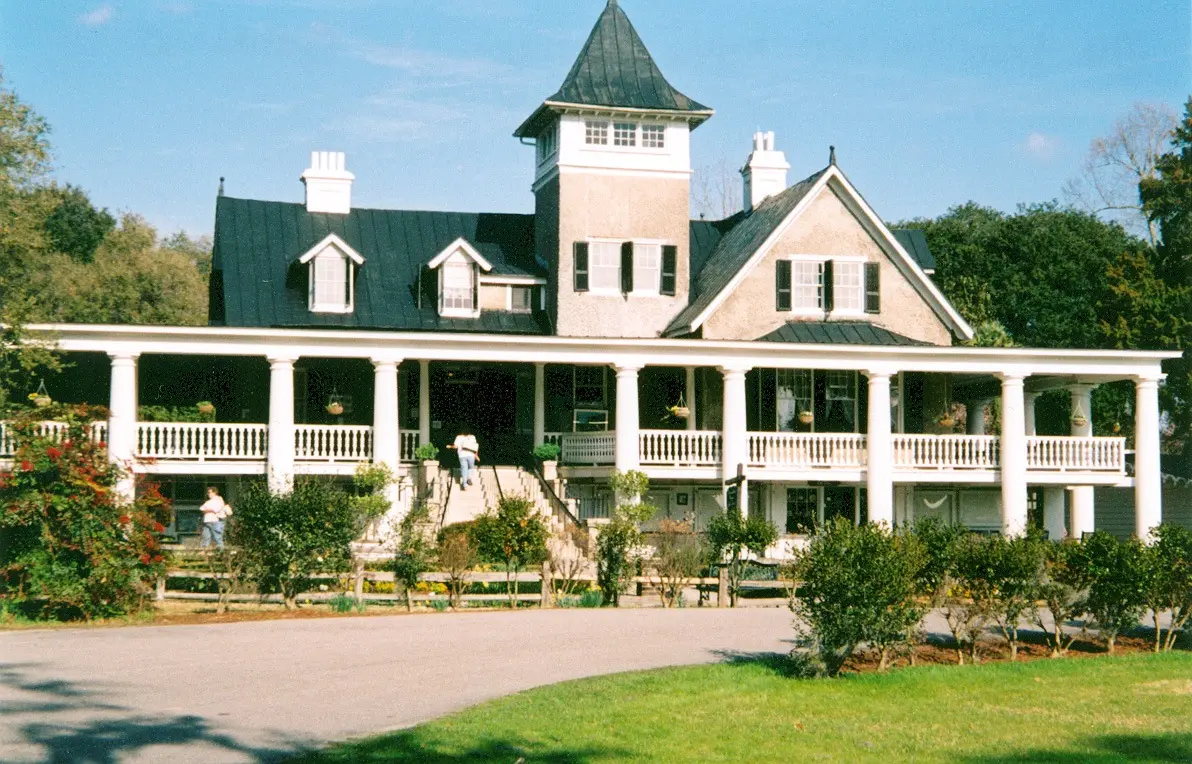
Ruined, Drayton sold all but 390 acres, leased land for phosphate mining, floated a pre-Revolutionary house down from Summerville on barges and set it on the burnt-out ground floor. Then he opened the garden and charged admission. Steamboats brought visitors up the Ashley, and — this is the detail that matters — the people who guided them were the people who had been enslaved there. Adam Bennett became the first garden superintendent; his son John, born at Magnolia in the late 1870s, shared the post until his father's death in 1910 and held it until his own in 1926. A woman recorded only as "Aunt Phoebe", believed to have been enslaved at Magnolia and to have stayed on after emancipation, was photographed sweeping a garden path by William Henry Jackson in 1900. Julia Drayton Hastie (1848–1920), the only woman ever to own Magnolia outright, inherited on her father's death in 1891 and doubled the four-room cottage into the tower-and-verandah house standing today.
The cabins are the reason this file exists. Four of the five surviving field structures date to about 1850 and the fifth to about 1900, and they were lived in continuously from slavery, through emancipation, into the late twentieth century. In March 2006 Magnolia announced their restoration at a press conference with Charleston mayor Joseph P. Riley, managing director Taylor Drayton Nelson and project manager Craig Hadley, each cabin to be interpreted at a different date: 1850 slave cabin, 1870 freedmen's home, 1900 and 1930 gardeners' homes, and the Leach family home as of 1969. A Phase I and II archaeological survey followed in 2009, recovering more than 400 sherds of colonoware — the hand-built earthenware made by enslaved potters in a West African idiom — and a colonoware spindle whorl, a find the plantation says has only one parallel, from Stono Ferry on Johns Island in the early 1970s. In 2010 Joseph McGill, then a Magnolia guide, slept in one of the cabins and began what became the Slave Dwelling Project; he later returned as Magnolia's history and culture coordinator and launched his book Sleeping with the Ancestors, written with the Charleston journalist Herb Frazier, at the cabins on 6 June 2023.
Timeline: the documented record of Magnolia Plantation and Gardens (Charleston, South Carolina)
- 1679 The plantation dates its own founding to this year, on land the site says Stephen Fox acquired on the Ashley River and passed to his son-in-law Thomas Drayton. The 1972 federal nomination describes the tract as the Drayton family's ancestral residence "for over ten generations"; the plantation's archived website said eleven; a later encyclopaedic account says fifteen. The generation count is a marketing figure, not a documented one.
- 1716 Thomas Drayton II dies. His widow Ann Fox Drayton, with four children and an eight-year-old heir, takes control of the 402-acre property, buys 260 more acres from John Cattell and runs four further plantations. Magnolia's own account of her estate counts roughly 100 enslaved people alongside 1,400 cattle and 112 horses.
- 1820 The earliest roll of enslaved people the plantation publishes dates from this year and preserves the trades: Driver Dick; carpenters Robert, Joe, Jim and Abraham; house servants George, Daniel, Sam, London and Kent; and Grace, Rose, Tinah, Hannah, Harriot, Holly, Binah and Bofa. The same page states an average of about forty-five enslaved people lived at Magnolia through the nineteenth century.
- 1836 (year disputed) Thomas Grimké Drayton is shot while riding down the oak avenue during a deer hunt and dies on the steps of the plantation house, according to the plantation's own archived history; his younger brother John inherits. The archived page gives no year and says John was 22, which does not fit the usual date of 1836, when he would have been 20. This death is the one the 2012 television investigation set out to address.
- 1843 and 1848 The federal nomination file dates John Grimké Drayton's plantings of imported Camellia japonica to 1843 and Azalea indica to 1848, and says that after developing tuberculosis he turned his whole effort to landscaping on medical advice. Magnolia's current text states flatly that the vision was his and the work was the enslaved people's.
- February–October 1865 Charleston surrenders on 18 February and the second plantation house burns. Who burned it is disputed: the plantation published a letter written to Drayton by his mother in October 1865 saying "It is believed your house was burned by your own negroes as well as some others", while standard reference accounts attribute the fire to Union troops. Drayton himself spent much of the war at Flat Rock, North Carolina.
- 1870, 1871 or 1872 Magnolia opens its gardens to paying visitors, who arrive by steamboat and are guided by people the family had until recently enslaved. The institution gives three different dates for this: its archived site said 1870, its current site says 1871 and its own 1972 federal nomination speaks of promotion "since 1872".
- 1891 John Grimké Drayton dies and Julia Drayton Hastie (1848–1920) inherits, becoming the only woman ever to own Magnolia outright. She doubles the four-room cottage into the Victorian house visitors photograph today; the large columns were added only in 1995.
- 1900 William Henry Jackson photographs six garden staff on Magnolia Walk. Only one is named — "Aunt Phoebe", believed to have been enslaved at Magnolia and to have stayed on as a free woman after the war, sweeping the paths each morning before visitors arrived. The identities of four of the six are still unknown.
- 1926 John Bennett dies as garden superintendent. He was born at Magnolia in the late 1870s to Adam Bennett, the first superintendent, and had shared the post with his father until Adam's death in 1910. Between them the Bennetts ran the gardens for roughly half a century.
- 11 December 1972 "Magnolia Gardens" is listed on the National Register of Historic Places (reference 72001198). The nomination, prepared by Elias B. Bull with Bernard Kearse, states that it "includes seven wooden slave cabins, the Drayton vault, and plantation house", then justifies the listing under agriculture, commerce, conservation, landscape architecture and horticulture — and admits the listing was sought to block a possible widening of Highway 61 and to exempt the gardens from the new state admissions tax. It is not a National Historic Landmark.
- December 2002 Owner J. Drayton Hastie Sr. dies. At his request his ashes are placed inside the trunk of a live oak said to have been planted around 1680, rather than in the family vault. The plantation's own website then wrote that the tree "became home to one of Magnolia's newest ghosts" — the only ghost claim on the entire pre-2013 site, and it concerns the owner. Its history page dates the death to 2003 instead.
- March 2006 At a press conference on the site of the cabins, Charleston mayor Joseph P. Riley, managing director Taylor Drayton Nelson and project manager Craig Hadley announce the restoration of five buildings, each interpreted at a different date: an 1850 slave cabin, an 1870 freedmen's home, gardeners' homes of 1900 and 1930, and the Leach family home as of 1969. The cabins had been inhabited continuously from slavery into the late twentieth century.
- 2009 A Phase I and II archaeological survey of the fields around and beneath the cabins recovers more than 400 sherds of colonoware and a rare hand-made colonoware spindle whorl. In the same year Tanya L. Shields takes the Magnolia tour that she will analyse in Souls in 2017 as a case of plantation nostalgia and "the erasure and containment of the site's horror".
- 2010 Joseph McGill, then a Magnolia guide, sleeps in one of the restored cabins and launches the Slave Dwelling Project. He later returns as Magnolia's history and culture coordinator; his book with Herb Frazier, Sleeping with the Ancestors, is launched at these same cabins on 6 June 2023.
- 10 October 2012 Syfy broadcasts Ghost Hunters episode 818, "Paranormal Politics", at 21:00 on a Wednesday. Its second half is filmed at Magnolia, with the stated aim of contacting the relative who died in the hunting accident. This broadcast is the earliest datable public appearance of a ghost story attached to the plantation's cabins, and it originates with a television crew, not with local tradition.
- 19 September 2023 Magnolia publishes "October in the Lowcountry", the only page on its entire website that mentions ghosts. It summarises the 2012 episode and then changes the subject to Lavinia Fisher and the ghost tours of downtown Charleston. There is no ghost tour, no night visit and no Halloween product at Magnolia itself.
Is there a rational explanation for Magnolia Plantation and Gardens (Charleston, South Carolina)?
Magnolia's ghost story is small, recent and traceable, and it leads back to a television programme.
On Wednesday 10 October 2012 Syfy broadcast episode 818 of Ghost Hunters, "Paranormal Politics" — number, title and date as The Futon Critic's listing gives them — and part of it was filmed at Magnolia. The plantation's own blog summarised the episode eleven years later, in a post published on 19 September 2023: the investigators "had several paranormal encounters at the Magnolia House and at the cabins while they tried to contact a relative who died in an accident on the property in the early 1800s", hearing music, a young girl's voice, a cough, "some kind of growling" and a woman's voice that seemed to ask "What are you doing?" The relative described fits the Drayton brother shot on the oak avenue during a deer hunt. That summary is the plantation's own account of the programme, written by the business that hosted the crew.
No source attributes Magnolia's ghosts to the enslaved. Neither the blog's summary nor the programme's premise attaches a single apparition to a named enslaved person; the cabins enter the story because a television crew carried equipment into them. This matters because the opposite pattern is the norm in the region. Tiya Miles's Tales from the Haunted South (University of North Carolina Press, 2015) sets out to explain how ghost tales function in southern tourism and "why portrayals of enslaved black specters have been on the rise", and argues that the tours appropriate and skew African American history for commercial gain while the realities of slavery stay off the itinerary. Her case studies are Savannah, the French Quarter and a Louisiana plantation. Her framework is the reason a plantation ghost story deserves to be checked before it is repeated.
The simplest test is whether Magnolia sells ghosts, and its website says it does not. A sweep of the plantation's entire current site on 8 October 2026 — the 1,032 pages listed in its own sitemap, about 233 MB — finds the word "ghost" on two pages (a single blog post and its tag index); "haunted", "apparition" and "paranormal" appear on that same post, "supernatural" on none, and the phrase "slave street" on none. The positive controls in the same sweep: "camellia" on 101 pages, "azalea" on 58, "Drayton" on 61, "enslaved" on 49, "cabin" on 36 and "From Slavery to Freedom" on 17. The words "Halloween" and "night tour" appear nowhere, and the one mention of ghost tours, in that 2023 post, points to the city centre: "Ghost tours and lore are aplenty downtown". The haunted reputation, on the plantation's own site, amounts to one seasonal post.
The archived version of the site points the same way. Across 174 pages recovered from snapshots taken up to 2013, the word "ghost" appears on exactly one: the page for the Drayton Oak, and the ghost is the owner's. "If you believe in ghosts, then surely this is the ghost of Magnolia's recently deceased owner, J. Drayton Hastie, Sr.", it read, explaining that Hastie had asked to be cremated and placed inside the trunk of the oak so that the tree would close over him, and that "Thomas Drayton's beautiful oak became home to one of Magnolia's newest ghosts." The plantation could not keep its own dates straight about him: the oak page says he died in December 2002, while its history page says he "passed away in 2003". Whatever else Magnolia's ghost lore is, it is a story the family told about itself.
What the site was doing in those same years is the sharper criticism, and it does not need a ghost. The archived history described John Grimké Drayton returning from seminary with "his apprehensive bride, who harbored an unreasonable fear of the slaves" — the plantation-nostalgia register, in the property's own words, since deleted. Tanya L. Shields took the Magnolia tour in 2009 and wrote it up in Souls in 2017, arguing that plantation tourism there ran on nostalgia for the nineteenth-century plantation and the Lost Cause, and that "the erasure and containment of the site's horror" was itself a product tour operators profit from. The 2007 pages and the 2026 ones show a genuine and documented change of register, and the dates put that change after the criticism.
One more caution about status, because Magnolia is easy to over-credit. It is listed on the National Register of Historic Places, as "Magnolia Gardens", since 11 December 1972 (reference 72001198), and it is a contributing property in the Ashley River Historic District. It is not a National Historic Landmark; its neighbours Drayton Hall and Middleton Place are. The 1972 nomination file states that it "includes seven wooden slave cabins, the Drayton vault, and plantation house" — and then justifies the listing under agriculture, commerce, conservation, landscape architecture and horticulture, with no heading for the people who lived in those seven cabins, and with the frank admission that listing was sought to fend off a widening of Highway 61 and to qualify the gardens for a new state exemption from the admissions tax. The word "ghost" is not in that file either.
Can you visit Magnolia Plantation and Gardens (Charleston, South Carolina)?
Magnolia Plantation and Gardens is a privately owned, ticketed attraction at 3550 Ashley River Road (Highway 61), Charleston, South Carolina 29414, about 18 km (11 miles) north-west of downtown Charleston in a straight line; telephone (843) 571-1266, [email protected]. Its tours page, read on 23 September 2026, gives the hours as 9 a.m. to 4 p.m. daily, closed on "Thanksgiving, Christmas, and New Year's Days". The FAQ adds that the last ticket is sold an hour before closing and that guests must be off the premises by 5 p.m. Parking is free, and the plantation runs no shuttle; its FAQ points to Uber, Lyft and local taxis.
Admission tickets are sold online through a separate ticketing site, tickets.magnoliaplantation.com, or at the Welcome Center on arrival. The FAQ says admission covers "over 200 acres of our grounds, 6 miles of walking and biking trails". Three 45-minute guided tours are included with admission, the Magnolia House Tour, the Discovery Tour and "From Slavery to Freedom", and the Audubon Swamp Garden is self-guided. The Nature Train (45 minutes) and the seasonal, weather-dependent Wildlife Boat (30 minutes) cost extra, and the tours page says supplemental tours are reserved at the Welcome Center on arrival. The house tour has a minimum age of 7; the slavery tour has none.
"From Slavery to Freedom" sets Magnolia within the history of slavery in Charleston and of the domestic slave trade, then turns to daily life on a rice plantation, after which visitors walk through the cabins on their own. The plantation's history page states that "four restored and preserved enslaved cabins are still present on the property". Its 2026 Juneteenth commemoration, "Living Legacies", held on Friday 19 June with the Slave Dwelling Project, included a reading of the names of the enslaved accompanied by a memorial bell.
According to the FAQ, the guided house tour "requires walking up the steps into the house" and is not accessible for wheelchairs or scooters, which are otherwise welcome on the 66 acres of gardens and grounds; many garden paths "are uneven, as they are made of dirt and gravel", and none are for rent on site. Leashed dogs, on a lead no longer than six feet, may use those 66 acres, the gardens and the Audubon Swamp Garden, but no dog goes on a tour except service dogs, and these are kept out of the Wildlife Center and out of the restored cabins during "From Slavery to Freedom".
Outside food and non-alcoholic drinks are permitted, and wine, beer and hard seltzer are sold at the Peacock Café and the gift shop. The Welcome Center can hold only small bags and carry-on luggage. The FAQ describes bug spray as "Highly recommended" because of the "extensive wetlands, swamps, and ponds", and suggests planning three to four hours. The same site sells "Weddings & Elopements", "Photoshoots & Proposals" and "Birthday Parties" on grounds that the 1972 National Register nomination (reference 72001198) described as including "seven wooden slave cabins, the Drayton vault, and plantation house" (ref. 0).
Sources consulted
- Elias B. Bull; Bernard Kearse, «Magnolia Gardens — National Register of Historic Places Inventory–Nomination Form (ref. 72001198)» — National Park Service / S.C. Department of Archives and History, 1972 report
- Magnolia Plantation & Gardens, «History — the Magnolia story» — magnoliaplantation.com, 2026 web
- Magnolia Plantation & Gardens, «October in the Lowcountry» — Magnolia Blog, 2023 web
- Magnolia Plantation & Gardens, «The Civil War Period, 1860–1865 (archived official website)» — Internet Archive Wayback Machine, capture of 12 October 2007, 2007 archive
- Magnolia Plantation & Gardens, «The Drayton Oak (archived official website)» — Internet Archive Wayback Machine, capture of 12 October 2007, 2007 archive
- Magnolia Plantation & Gardens, «Antebellum Magnolia, 1784–1859 (archived official website)» — Internet Archive Wayback Machine, capture of 12 October 2007, 2007 archive
- Magnolia Plantation & Gardens, «Slavery at Magnolia Plantation, 1676–1865 (archived official website)» — Internet Archive Wayback Machine, capture of 12 October 2007, 2007 archive
- Magnolia Plantation & Gardens, «Reconstruction and Early Tourism, 1866–1900 (archived official website)» — Internet Archive Wayback Machine, capture of 12 October 2007, 2007 archive
- Magnolia Plantation & Gardens, «From Slavery to Freedom — cabin restoration project (archived official website)» — Internet Archive Wayback Machine, capture of 29 June 2008, 2008 archive
- Tanya L. Shields, «Magnolia Longing: The Plantation Tour as Palimpsest» — Souls: A Critical Journal of Black Politics, Culture and Society, 19(1), 6–23, 2017 academic
- Tiya Miles, «Tales from the Haunted South: Dark Tourism and Memories of Slavery from the Civil War Era» — University of North Carolina Press, 2015 book
- Herb Frazier; Joseph McGill, «Sleeping with the Ancestors: How I Followed the Footprints of Slavery» — Hachette Books (ISBN 9780306829666), 2023 book
- Magnolia Plantation & Gardens, «Black History Month at Magnolia: Honoring those Who Created and Maintained the Gardens» — Magnolia Blog, 2024 web
- George McDaniel, «Women Shaped This Place» — Magnolia Blog, 2025 web
- The Futon Critic, «Ghost Hunters — episode listings (#818 "Paranormal Politics", Syfy, 10 October 2012)» — thefutoncritic.com, 2012 web
Reviewed by V. Serrano on 2026-08-12 · How we verify our content
💬 Field testimonies (0)
No testimonies yet. Add the first.
Add your testimony
🔒 Log in to add a testimony