👻 HAUNTED PLACE · EXP. Nº9477
ACTIVE
McRaven House
McRaven, in Vicksburg, Mississippi, sells itself as "the most haunted house in Mississippi" — a title it awarded itself, and has advertised on its own website since at least 2013.
Where is McRaven House?
- Location
- Mississippi, United States
- Type
- House / mansion
- Coordinates
- 32.346, -90.873
- Last updated
LOCATION
Why is McRaven House said to be haunted?
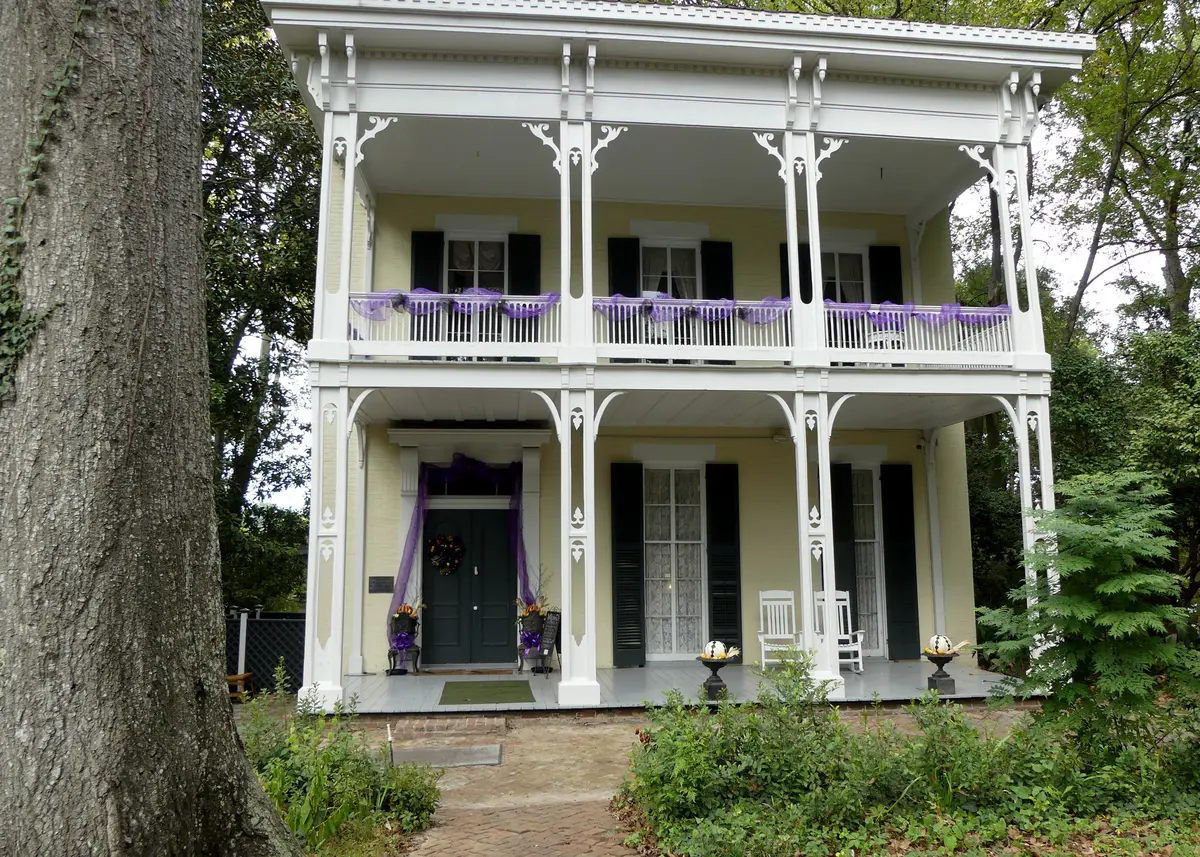
The documented house is stranger than the marketing. Its tour dates the oldest room to 1797 and credits a highwayman called Andrew Glass; the 1978 National Register nomination dates the earliest surviving fabric to about 1836 and names the original landowner Anthony Glass, an early settler, with no highway robbery attached. The nomination's chain of title contains no Sheriff Stephen Howard and no Mary Elizabeth Howard, the young wife the house calls its most active ghost. What it does contain is John H. Bobb, recorded in the 1860 census as a planter — a slaveholder — who bought the property in 1844 and paid for the Italianate front. A year after Vicksburg fell to Grant, in May 1864, Bobb quarrelled with Black US soldiers picking flowers in his garden, knocked a sergeant down with a brick, and was seized on his way home and shot dead. The house needs no ghost to be haunted.
What is the history of McRaven House?
There are two McRavens. One is the house the tour sells: a highwayman's hideout of 1797, a bride dead in childbirth, a Confederate field hospital, ghosts. The other is the house documented in the National Register of Historic Places nomination filed in 1978 — and the documented one is both later and far more brutal.
The nomination was prepared by Mary McCahon Shoemaker, an architectural historian at the Mississippi Department of Archives and History. She worked from Warren County deed books and the federal census, and she reached conclusions that the tour does not repeat. In her reading, the earliest surviving part of the house is not an 18th-century cabin but the rear ell, a two-storey brick block "constructed in two stages ca. 1836 in the conservative vernacular of the late Federal tradition". The grand part — the north wing with the double-tiered gallery that appears in every photograph of McRaven — she dates to the 1850s. That is the whole building: a ca. 1836 block and an 1850s wing. The property was listed as the Bobb House on 8 January 1979, reference number 79001337.
The land does have a Glass in it, but the nomination names him Anthony Glass, "an early settler in the area", and it says only that the ground the house stands on was once part of his extensive holdings, subdivided as the riverport of Vicksburg grew. It does not say he built anything, and it does not call him a highwayman.
The chain of title in the nomination runs like this. William Bobb bought the 6.3-acre house lot in 1837 (Warren County Deed Book J:479) and "may well have constructed the rear portion of the house" before selling the property — by then nearly eleven acres — to his brother John H. Bobb in 1844 for $5,000 (Deed Book U:598). Family tradition, collected by Shoemaker from Lucy Critchler, a great-niece of John H. Bobb, in an interview on 1 June 1978, holds that it was John who added the Italianate front. Sheriff Stephen Howard, whom the tour credits with the middle section, does not appear in the nomination's chain of title at all.
What John H. Bobb was is not in dispute. The nomination records him flatly as "Planter John H. Bobb (1808-1864)", citing the 1860 population schedule for Warren County. In Mississippi in 1860, planter was not a job description; it was a statement about who did the work. This was an elite slaveholding household on the edge of a river city whose wealth was cotton and the people forced to make it, and the plasterwork the visitor admires in the parlour was paid for out of that.
That is what makes the end of the story so exact. In the spring of 1863 Ulysses S. Grant closed on Vicksburg; after a siege the National Park Service counts at forty-seven days, the city surrendered on 4 July 1863 and was garrisoned — increasingly by regiments of Black US soldiers, many of them men who had been enslaved in that same countryside a year or two earlier. In May 1864 John Bobb found some of them in his garden.
The only account we have comes from the white Vicksburg press, reprinted across the Confederacy and quoted at length in 1916 by the Lost Cause historian J. S. McNeily. In that telling, Bobb ordered the soldiers out, was cursed, and knocked a sergeant down with a brick. The soldiers left vowing revenge. Bobb went straight to headquarters and was promised protection by Major General Henry W. Slocum. On his way home, fifteen or twenty soldiers led by a sergeant seized him and his companion Mattingly, marched them through the machine shops and about 150 rods down a bayou, and shot Bobb in the back and then in the face. Mattingly ran and escaped. Slocum sent a staff officer, who found Bobb dead and his wife over the body. Only the sergeant was arrested.
Slocum's response survives as General Orders No. 7, issued at Vicksburg that same month: "The recent murder of a citizen, by colored soldiers in open day in the streets of this city should arouse the attention of every officer serving with these troops to the absolute necessity of preventing their soldiers from attempting a redress of their own grievances." McNeily's verdict on what followed was blunt: beyond the order, "nothing seems to have been done."
The nomination calls Bobb "the first Vicksburg civilian killed as a result of tensions arising between residents and the occupying black Union forces". His widow Selina sold the property in 1869. William Murray, a local machinist and inventor, bought it in the early 1870s, and his unmarried daughters lived in it, increasingly alone and increasingly poor, until 1960. That year O. E. Bradway, Jr. bought the overgrown house and opened it for tours in 1961. It has been a paying attraction ever since.
Timeline: the documented record of McRaven House
- ca. 1836 The earliest surviving part of the house is built: a two-storey brick rear ell put up in two stages in the late Federal vernacular, according to the National Register nomination prepared by architectural historian Mary McCahon Shoemaker. The house's own tour instead dates its first section to 1797.
- 1837 William Bobb buys the 6.3-acre house lot, recorded in Warren County Deed Book J:479. The nomination judges that he may well have built the rear portion of the house.
- 1844 William Bobb sells the property, by then nearly eleven acres, to his brother John H. Bobb for $5,000 (Deed Book U:598). The 1860 census records John H. Bobb as a planter — that is, as a slaveholder.
- 4 July 1863 Vicksburg surrenders to Ulysses S. Grant after a siege the National Park Service counts at forty-seven days. The city is garrisoned by Union troops, increasingly regiments of Black US soldiers.
- May 1864 John H. Bobb is shot dead near his own house. According to the account in the Vicksburg Herald, reprinted across the Confederacy and quoted by historian J. S. McNeily in 1916, Bobb found Black US soldiers picking flowers in his yard, knocked a sergeant down with a brick, obtained a promise of protection from General Henry W. Slocum, and was seized on the way home by fifteen or twenty soldiers, marched down a bayou and shot in the back and the face.
- May 1864 (days later) General Slocum issues General Orders No. 7 from the headquarters of the District of Vicksburg: "The recent murder of a citizen, by colored soldiers in open day in the streets of this city should arouse the attention of every officer serving with these troops to the absolute necessity of preventing their soldiers from attempting a redress of their own grievances." Only the sergeant was reported arrested; McNeily wrote that beyond the order "nothing seems to have been done."
- 1869 Bobb's widow Selina sells the property. William Murray, a local machinist and inventor, acquires it in the early 1870s; his unmarried daughters live in the house until 1960.
- 1961 O. E. Bradway, Jr., who bought the overgrown house in 1960, opens it to the public for tours. It has been a commercial attraction ever since.
- 8 January 1979 The property is listed on the National Register of Historic Places as the Bobb House, reference number 79001337, for its Greek Revival plasterwork and as one of the most complete surviving antebellum residences in Vicksburg. The nomination mentions no ghosts.
- January 2013 A page on the house's own website headed "The Most Haunted House in Mississippi!" is captured by a web archive — the earliest dated evidence we located for the slogan the property still uses.
Is there a rational explanation for McRaven House?
McRaven's ghost stories are not neutral folklore. They are the product line of a business, and the business is the source for almost all of them.
The house has advertised itself as "the most haunted house in Mississippi" since at least January 2013, when a page under that headline was captured on its own website; today the front page still opens with "Named Mississippi's 'Most Haunted House'", in a passive voice that never says who did the naming. No independent body confers such a title. It is self-applied marketing, and it should be read as such.
The money follows the ghosts, not the history. As of 2026 the house's own price list charges $15 for the 45-minute history tour, $25 for the haunted tour and $75 a head for a monthly Ghost Hunt that runs until two in the morning. Private paranormal investigations are sold by phone. A house that earns five times as much per visitor from its ghosts as from its architecture has an obvious interest in the ghosts.
The specific claims also outrun the documents. The tour dates the first section to 1797 and attributes it to a highwayman named Andrew Glass; the National Register nomination dates the earliest surviving fabric to ca. 1836 and names the original landowner Anthony Glass, an early settler, with no mention of highway robbery. The tour credits the middle section to Sheriff Stephen Howard and makes his young wife Mary Elizabeth, dead after childbirth in 1836, "our most active spirit"; the nomination's chain of title runs from Anthony Glass's subdivided holdings to William Bobb in 1837 and John H. Bobb in 1844, with no Howard in it. We could not find Mary Elizabeth Howard in any record we were able to read. That does not prove she never existed — Warren County's 1830s records are thin and largely undigitised — but a woman described as the house's principal ghost ought to be traceable, and she is not.
The field hospital is the same kind of claim. The house says its grounds were "once a Confederate campsite and field hospital". The nomination, which reconstructs the building's history in detail, says nothing about it.
What is documented is a real killing, and the contrast is instructive. John H. Bobb's death in May 1864 is fixed by contemporary newspapers, by a general order issued from the district headquarters, and by the National Register nomination. It needs no ghost. The house sells it as "how he still strolls his balcony".
Can you visit McRaven House?
McRaven is a privately owned house museum shown on paid guided tours. The house gives its address as 1445 Harrison Street, Vicksburg, Mississippi 39180, with the telephone 601-501-1336; the 1978 National Register nomination prepared by Mary McCahon Shoemaker gives the address as 1503 Harrison Street.
The house's tour page, read on 24 September 2026, lists three regular tours. The History Tour lasts 45 minutes and costs $15 for adults and $10 for students aged 6 to 18, with children of five and under free; it runs from 10:00 to 17:00 Monday to Saturday and from 13:00 to 17:00 on Sunday. The Haunted Tour lasts an hour and a quarter at $25 for adults and students alike, on Friday and Saturday at 19:00 and 20:30. Its guide wears period costume and gives a short history of the families before turning to the ghost stories. A Combination Tour at $35 for adults and $30 for students covers both, on the same day or on separate days. The monthly Ghost Hunt costs $75 a head and is limited to 18 tickets; it starts with the 20:30 Haunted Tour and continues as late as 02:00 with the house's own equipment, with light refreshments around midnight. Private investigations are booked through [email protected] or the house telephone, and the events page offers candlelight tours on the last two weekends of October.
The 1978 nomination describes what the daytime tour walks through: a house of about 1836 with an 1850s wing whose rectangular gallery piers are "inlaid with decorative millwork panels". Its statement of significance opens by saying the house possesses "some of the finest and most distinctive Greek Revival decorative plasterwork in the Vicksburg area". Vicksburg National Military Park, which preserves the lines of the 1863 siege, is a separate visit, and the National Park Service gives its address as 3201 Clay Street.
Sources consulted
- Mary McCahon Shoemaker, «National Register of Historic Places Inventory — Nomination Form: Bobb House (McRaven), Vicksburg, Warren County, Mississippi (ref. 79001337)» — Mississippi Department of Archives and History / National Park Service, 1978 report
- J. S. McNeily, «From Organization to Overthrow of Mississippi's Provisional Government (quoting the Vicksburg Herald on the killing of John Bobb, pp. 51-52)» — Publications of the Mississippi Historical Society, Centenary Series, vol. 1, 1916 academic
- Unsigned correspondent, «Letter from Vicksburg, with the text of General Orders No. 7, Headquarters District of Vicksburg (page 1)» — Memphis Daily Appeal, 22 June 1864, 1864 newspaper archive
- McRaven Tour Home, «McRaven Tour Home — official site (history, tours, ghosts and events pages)» — Official visitor information, Vicksburg, Mississippi, 2026 archive
- Unsigned correspondent, «Correspondence from Vicksburg on the death of John Bobb (page 2)» — The Daily Clarion (Meridian, Mississippi), 10 June 1864, 1864 newspaper archive
- National Park Service, «History & Culture: The Siege of Vicksburg» — Vicksburg National Military Park, 2024 report
Reviewed by V. Serrano on 2026-08-11 · How we verify our content
💬 Field testimonies (0)
No testimonies yet. Add the first.
Add your testimony
🔒 Log in to add a testimony