👻 HAUNTED PLACE · EXP. Nº9478
ACTIVE
Merchant's House Museum
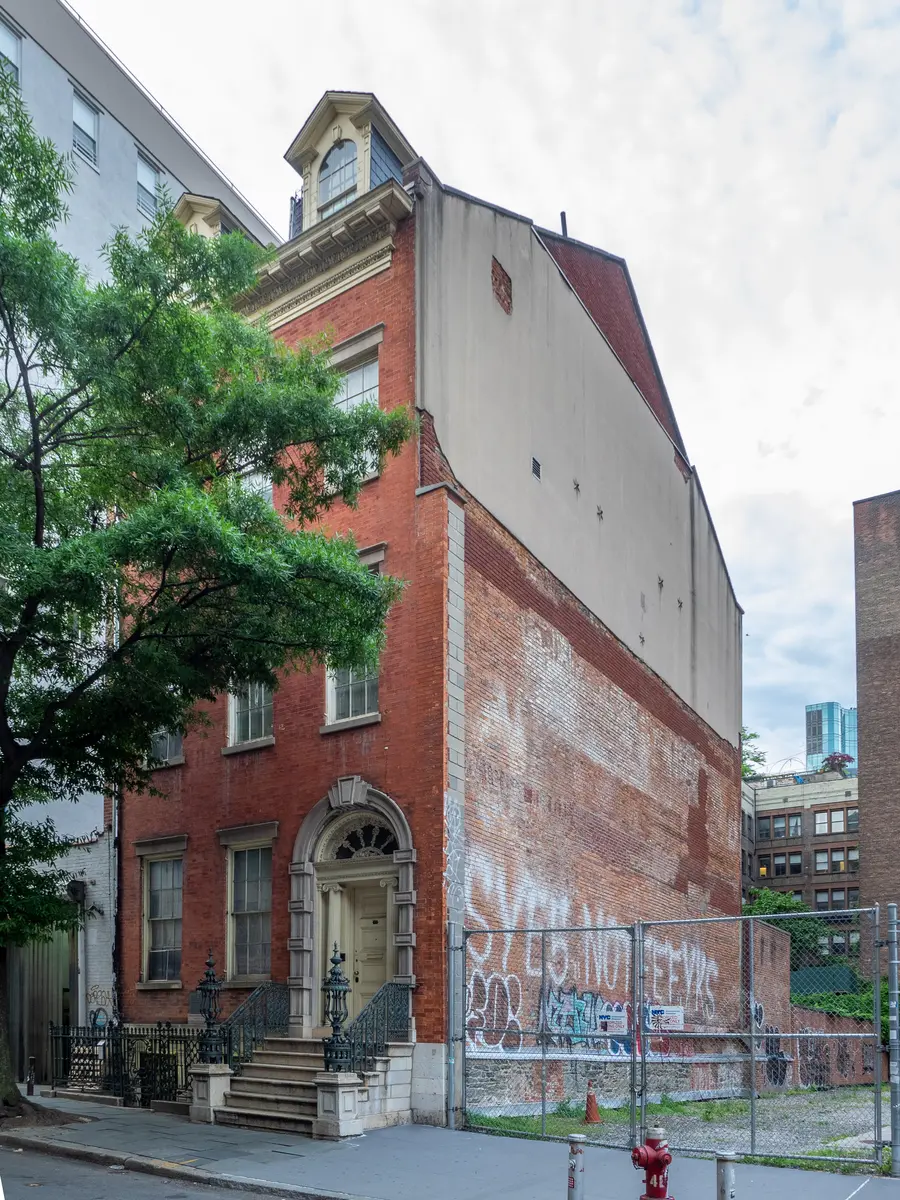
Number 29 East Fourth Street was one of six identical brick houses run up in 1831-32 by Joseph Brewster, a Broadway hatter.
Where is Merchant's House Museum?
- Location
- New York, United States
- Type
- House / mansion
- Coordinates
- 40.728, -73.992
- Last updated
LOCATION
Why is Merchant's House Museum said to be haunted?
In 1835 he sold it to the retiring hardware wholesaler Seabury Tredwell for $18,000, and the Tredwells stayed for almost a century. Gertrude, the eighth child, was born there in 1840 and died there in 1933 at ninety-three, in the same room and the same bed, the house mortgaged to the roof and its contents booked for auction. A great-nephew bought the lot at the eleventh hour and opened it as a museum in 1936; today it is a National Historic Landmark whose interior the city protects room by room. Staff, volunteers, visitors and passers-by have reported footsteps, scents, slamming doors and a small woman in a long brown dress ever since. The museum records the accounts, sells the tour, and has admitted that every investigation has been inconclusive — and the city's own 1981 designation report calls the tragic romance behind the ghost "something of a legend".
What is the history of Merchant's House Museum?
The house at 29 East Fourth Street was never meant to be remarkable. It was one of six identical brick dwellings raised in 1831 and 1832 at what was then the fashionable northern edge of New York, and at least two of them were built on speculation by Joseph Brewster, a prosperous hatter with two shops on lower Broadway.
For decades the city credited the design to the architect Minard Lafever. Its own 1965 landmark designation report says as much, and so does the National Historic Landmark nomination on file with the National Park Service. Sixteen years later the Landmarks Preservation Commission took it back. The 1981 interior designation report states flatly that "it has not been possible to attribute the design of The Old Merchant's House to any architect practicing in New York City in the 1830s", and explains where the Lafever idea came from: the architectural historian Talbot Hamlin had remarked on how closely the woodwork and plaster resembled plates Lafever published in 1829 in The Young Builder's General Instructor. In 1830s New York a rowhouse was normally assembled by a builder from mass-produced mantels, mouldings and plaster rosettes bought straight from manufacturers. The house is a catalogue purchase of extraordinary taste, not a work of authorship.
Brewster lived at No. 29 — then numbered 180 — for about two years and in 1835 sold it to Seabury Tredwell for $18,000, a high figure for the period and, the commission argued, proof that the house was already considered exceptional. Tredwell (1780-1865) was not a merchant in the vague sense the museum's name suggests. He was a wholesale hardware merchant, first listed in the city directories in 1804 at 233 Pearl Street, who took his cousin Joseph Kissam into partnership in 1813 and retired in 1835 at fifty-five — the same year he bought the house and moved his family uptown from Dey Street.
He had married Eliza Parker in 1820, when he was forty and she twenty-three. Seven children were born before the move. An eighth, Gertrude, arrived in the Fourth Street house in 1840. She never married and never really left. In 1933, at ninety-three, she died — in the words of the city's own report — "in the same room in the same bed in which she had been born". By then she had mortgaged the house and its contents heavily, and the whole lot was scheduled for auction.
What saved it was a telephone call. George Chapman, a New York lawyer and a great-nephew of Seabury Tredwell, later described the rescue in his own words: "At the eleventh hour, Charley Van Nostrand appealed to me to rescue the place. The sale was scheduled for the very next day … I long-distanced Lillie [Gertrude's niece and heir] at her summer home in Connecticut, made her an offer for the house and contents. She accepted it and promised to telephone the auctioneer." Chapman formed a non-profit, the Historic Landmark Society, and opened the house to the public in 1936 at fifty cents a head.
It almost failed anyway. A 1938 endowment appeal aiming at $100,000 raised $220. Chapman spent more than $50,000 of his own money and held the place together until his death in 1959. By 1970 the fabric had deteriorated so far that the building was declared unsafe and the museum closed. Ada Louise Huxtable's articles in The New York Times raised the alarm; from 1971 the New York University staff architect Joseph Roberto and his wife Carolyn ran a ten-year fundraising campaign that paid for a full restoration.
The honours arrived in between: National Historic Landmark on 23 June 1965, city landmark on 14 October 1965 (the museum says it was the first building designated in Manhattan), National Register on 15 October 1966, and protected interior on 22 December 1981, which by the museum's count makes it one of only about 120 buildings in the city landmarked inside and out. Ownership passed to the City of New York in 1997. In February 2026 the museum announced a further discovery: a concealed passageway about two feet square beneath a built-in chest of drawers, dropping fifteen feet to the ground floor, which two years of its own research attribute to Brewster as an abolitionist shelter for freedom-seekers. The claim is the museum's; the 1981 designation report knows Brewster only as a prosperous hatter.
Timeline: the documented record of Merchant's House Museum
- 1831–1832 Joseph Brewster, a hatter with two shops on lower Broadway, builds a row of six identical brick houses on East Fourth Street and moves into No. 29, then numbered 180. The city's 1981 interior designation report notes at least two were built on speculation.
- 1835 Seabury Tredwell, a retiring wholesale hardware merchant, buys the house for $18,000 — a high price that the Landmarks Preservation Commission would later cite as evidence the building was already regarded as exceptional.
- 1840 Gertrude Tredwell is born in the house, the eighth child of Seabury and Eliza and the only one born at this address.
- 7 March 1865 Seabury Tredwell dies at 85 of Bright's disease, a kidney complaint, leaving Eliza, their eight children and five grandchildren. His funeral is held four days later in the double parlour of the house. Gertrude was 25.
- 1933 Gertrude Tredwell dies at 93, having mortgaged the house and its contents heavily. The 1981 designation report records that she died "in the same room in the same bed in which she had been born"; the house and its furniture are scheduled for auction to settle the debts.
- 22 May 1934 George Chapman, a New York lawyer and great-nephew of Seabury Tredwell, writes to the family: "I do hope something can be done to preserve the old house. I will be very willing to make the effort if the family approve." The letter is in the museum's archive.
- May 1936 The Old Merchant's House opens to the public, admission 50 cents. The city's 1981 report gives the opening as 7 May; the museum's own anniversary exhibition gives 11 May. The Historic American Buildings Survey documents the house the same year.
- 14 October 1965 The Landmarks Preservation Commission designates the house a city landmark (report LP-0006), attributing the design to Minard Lafever. It had been made a National Historic Landmark on 23 June of the same year.
- 1970 Deterioration reaches the point where the building is declared unsafe and the museum is forced to close. Articles by the critic Ada Louise Huxtable in The New York Times draw public attention; from 1971 the architect Joseph Roberto and his wife Carolyn begin a ten-year campaign that funds the restoration.
- 22 December 1981 The interior is designated a landmark (LP-1244). The same report withdraws the Lafever attribution and labels the story of Gertrude's forbidden marriage "something of a legend" — the earliest sceptical note on the haunting comes from an official city document.
- 25 October 1998 The New York Times follows the self-described paranormal investigator David Umbria through the house. Executive director Margaret Halsey Gardiner tells the paper that visitors report a "cold, creepy feeling" in Gertrude's bedroom and that "for months, I just couldn't make it all the way up the stairs to turn the lights on in the morning". In the same piece, Patrice Keane of the American Society for Psychical Research dismisses the method outright.
- Summer 2005 The museum publishes the account it calls "Basement Ghost": during a nine-month restoration of the rear extension, a carpenter fetching tools in the cellar says he greeted what he took to be an electrician, looked up and saw "a slender, tiny woman in a long brown dress" at the far end, who turned and vanished. He refused to enter the cellar again. About a month later, the museum says, he saw a photograph of Gertrude Tredwell on a television programme and identified her.
- 27 August 2007 The New Yorker publishes "Skunked". Gardiner recounts a cast-iron stove seen shaking in the 1970s and a curator's computer that froze in the early 1990s whenever she typed "Tredwell" — "well, not every time, but three out of five". The investigator Dan Sturges works the house all night with EMF meters and a recorder and finds nothing.
- May 2012 The museum learns of a developer's plan for an eight-storey hotel next door, at 27 East Fourth Street, then a one-storey garage. It is the start of a fight still unresolved fourteen years later.
- 8 April 2014 After two years, one hearing and three public meetings, the Landmarks Preservation Commission approves the hotel by 6 votes to 1. The dissenting commissioner, Margery Perlmutter, calls the design "drab on so many levels" and adds: "I feel like we've been exhausted into saying yes to this proposal, so I'm saying no."
- September 2018 The New York City Council unanimously denies the developer's rezoning application, expressly citing the need to protect the Merchant's House. The developer sues the City, the Council and the museum in January 2019; the suit is dismissed in December 2022.
- 12 December 2023 The commission approves a second design and orders the developer to study the landmarked interior plaster. At the meeting the developer's own engineers concede they have no data on what vibration standards are appropriate for historic decorative plaster.
- 11 February 2026 The museum announces that a concealed passageway roughly two feet square beneath a built-in chest of drawers, dropping fifteen feet to the ground floor, is in its view the earliest known Underground Railroad site in New York City, built by Brewster as an abolitionist. In March the commission holds a hearing on the developer's third and taller design and takes no action.
Is there a rational explanation for Merchant's House Museum?
The most useful sceptic on this house is the City of New York. The romance that powers the whole legend — the father who forbade Gertrude to marry a young Roman Catholic physician, the daughter who withdrew from the world in consequence — appears in the Landmarks Preservation Commission's 1981 designation report with a warning label attached: "It is something of a legend that an estrangement developed between Gertrude and her father when he forbad her to marry a young physician who was a Roman Catholic. Whatever the reason, Gertrude did cut herself off from society and lived as a recluse." The withdrawal is documented. The reason for it is not, and a ghost story built on a motive nobody can source is a ghost story with no foundation.
The second sceptic is on the record in the same newspaper article that made the house famous. When The New York Times followed the self-described paranormal investigator David Umbria through the rooms in October 1998, it also called Patrice Keane, executive director of the American Society for Psychical Research — an organisation founded in 1885 to study exactly these claims. She had never heard of Umbria and was blunt about the method: "Someone walking around with a tape recorder, calling out, he could be picking up radio waves or radiation or radon in the ground." Of ghost-hunting generally she said "fraud is often the most practiced technique", and of the callers who ring her every October, "most of the time, they have squirrels in their attic."
The third is the outcome. In August 2007 The New Yorker sent a reporter to watch the museum's own investigator, Dan Sturges, work the house for a night with a thermocouple, two EMF meters and a tape recorder. He asked the empty rooms to knock, or to shake the chandelier. Nothing answered. The piece ran under the headline "Skunked", after Sturges's own line: "My dad was a fisherman. I tell people I go out fishing. You don't always catch something. Plenty of times, you get skunked." The museum's older ghost page said the same thing about every investigation before 2006: "their findings have always been inconclusive."
Then there is the building. This is a 192-year-old rowhouse whose lime plaster is keyed to wooden lath through gaps a quarter of an inch wide, which was declared unsafe in 1970, which has no air conditioning, which the museum itself says has "a decades-long history of damage from construction at adjoining and nearby properties", and which visitors climb by seventy-two internal steps of ageing timber. Doors that swing shut, floors that knock overhead and drafts that arrive from nowhere are what such a structure does — and since February 2026 there is a documented concealed shaft running fifteen feet down through it, which is a very good reason for sound to travel between floors in ways nobody expects. Even a New York City parks commissioner, Adrian Benepe, offered the press a theory in 2007 involving static electricity stored in a hairbrush, which is a fair measure of how loosely explanation gets attached here.
Finally, incentive. The candlelight ghost tours cost $45 to $70 a head and a private one $900, at a museum that says it has already spent more than a million dollars on lawyers and engineers fighting the development next door. That does not make the reports false — many come from staff with nothing to gain — but it belongs in the accounting.
Can you visit Merchant's House Museum?
The museum is at 29 East Fourth Street, New York, NY 10003, in NoHo; the block runs between Lafayette Street and the Bowery. While the restoration works last, the museum's hours page, read on 24 September 2026, sends visitors in through Manuel Plaza at 35 East 4th Street. Its directions page gives the N and R trains to 8th Street, the 6 to Astor Place and the B, D, F and M to Broadway–Lafayette, with the M103 bus to 4th Street and the M1, M2 and M3 to 4th Avenue and 8th Street. The museum has no parking of its own; the page names two commercial garages on Lafayette Street, at number 445 near Astor Place and number 375 near Great Jones Street.
Self-guided visits run from Wednesday to Sunday, 1 to 5 p.m., with last entry at 4.30 p.m., and the museum closes on major holidays. Tickets are bought at the door without reservation: $15.50 general and $10.50 for seniors over 65 and for students with identification; children under 12 and members go free, and each ticket paid in cash is 50 cents cheaper. The museum suggests 45 to 60 minutes for the self-guided visit. The guided tour, at 12 noon on the same five days, lasts 75 minutes, costs $20.50 and covers the rear garden and four floors of period rooms; the museum strongly recommends booking it. Both visits include the concealed passageway beneath a built-in chest of drawers on the second floor, which the museum announced on 11 February 2026 as an intact Underground Railroad site and attributes to the builder of the house, the abolitionist Joseph Brewster.
On access, the museum's accessibility page gives 7 steps to the front door and 72 more inside across the four floors on the tour, and states that there is no elevator. The hours page adds that the house, which has five floors reached by stairs, is not wheelchair-accessible and not air-conditioned. Modern chairs are provided in most rooms. For blind and partially sighted visitors there is a large-print self-guided booklet and docents who describe the rooms; sighted guides are admitted free and service dogs are welcome. For deaf and hard-of-hearing visitors the written self-guided tour is available at all times, docents answer questions in writing and sign-language interpreters are admitted free when working. Large bags must be checked at the admissions desk; smoking and pets are not allowed. Groups of ten or more must book a private visit at least two weeks ahead.
The museum advertises its ghost programme openly. For 2026 its ghost page lists candlelight tours of 50 minutes, every half hour from 6.30 to 9 p.m., on 16, 17, 23, 24, 29 and 30 October, at $45 ($35 for members), and a 90-minute "Super Spooky" tour with the paranormal investigator Dan Sturges starting at 9.30 p.m., at $70 ($60 for members). Private ghost tours cost a flat $900 for up to twenty people, on weekdays at 6, 6.30 or 7 p.m.; they are booked at least two weeks ahead with a non-refundable 50 per cent deposit, October availability is strictly limited, and none are offered in December.
The building next door is the museum's other concern. The Landmarks Preservation Commission approved a hotel at 27 East Fourth Street in 2014 and a larger building there in December 2023; in January 2026 the developer filed a third design, and the Commission heard testimony on it in March 2026 without taking a decision, according to the museum's own timeline. The museum states that if construction goes ahead it will have to close to the public for at least two years, move its collection of more than 3,000 objects off site and put up padded scaffolding to protect the plaster, at an estimated cost of nearly $5 million.
Sources consulted
- Landmarks Preservation Commission of the City of New York, «Old Merchant's House (Seabury Tredwell House), Interior Designation Report LP-1244» — City of New York, Designation List 151, 1981 report
- Landmarks Preservation Commission of the City of New York, «Old Merchant's House (Seabury Tredwell House), Designation Report LP-0006» — City of New York, Calendar No. 6, 1965 report
- Corey Kilgannon, «Making It Work; Tracking Gertrude Treadwell's Ghost» — The New York Times, 1998 newspaper archive
- Lizzie Widdicombe, «Wo-o-o Dept.: Skunked» — The New Yorker, 2007 newspaper archive
- Merchant's House Museum, «Our Ghosts — Occurrences: "Basement Ghost"» — merchantshouse.org (archived 14 November 2010), 2010 archive
- Merchant's House Museum, «Miracle on Fourth Street: The Early Years — George Chapman's correspondence, 1934-1938» — Virtual exhibition, 85 Years as a Museum, 2021 archive
- Merchant's House Museum, «The Tredwell Family» — merchantshouse.org, 2023 web
- Merchant's House Museum, «Landmarks Preservation Commission Approves Eight-Story Hotel Next Door» — merchantshouse.org, news, 2014 report
- Merchant's House Museum, «Save the Merchant's House — Fighting Development Since 2012: A Timeline» — merchantshouse.org, 2026 web
- Merchant's House Museum, «Merchant's House & the Underground Railroad — press release, 11 February 2026» — merchantshouse.org, 2026 report
- Merchant's House Museum, «Hours & Admission / Accessibility / Location & Directions / Our Ghosts» — merchantshouse.org, 2026 web
- United States Department of the Interior, National Park Service, «The Old Merchant's House — National Register of Historic Places / National Historic Landmark nomination, ref. 66000548 (form prepared by Richard Greenwood, 16 July 1975)» — NPGallery, 1975 archive
- Merchant's House Museum, «"Sacred to the Memory": The 150th Anniversary of the Death of Seabury Tredwell» — merchantshouse.org, news, 2015 web
- Merchant's House Museum, «Our Ghosts — 2026 candlelight ghost tours, Super Spooky tours with Dan Sturges and private ghost tours» — merchantshouse.org (consulted 24 September 2026), 2026 web
Reviewed by V. Serrano on 2026-08-11 · How we verify our content
💬 Field testimonies (0)
No testimonies yet. Add the first.
Add your testimony
🔒 Log in to add a testimony