👻 HAUNTED PLACE · EXP. Nº9478
ACTIVE
Moonville, Ohio
Moonville was a coal hamlet in Vinton County, Ohio, and it existed because a farmer named Samuel Coe let the Marietta and Cincinnati Railroad cross his land for nothing, on condition the track ran where his coal was.
Where is Moonville, Ohio?
- Location
- Ohio, United States
- Type
- Ruin / ancient site
- Coordinates
- 39.307, -82.322
- Last updated
LOCATION
Why is Moonville, Ohio said to be haunted?
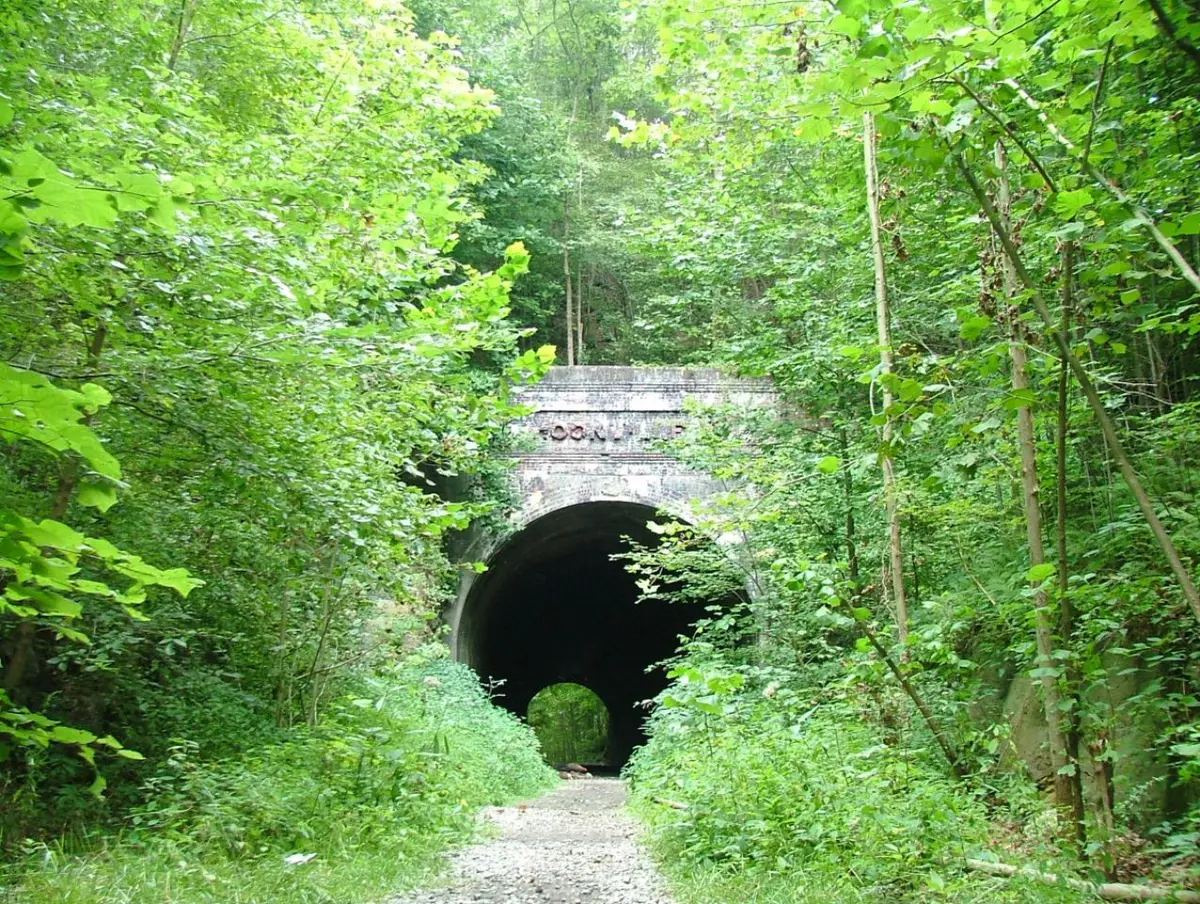
The last family left in 1947, the rails came up in 1988, and what survives is a short brick tunnel, a cemetery and a few foundation stones on what is now the Moonville Rail Trail. Since 22 March 2021 the tunnel has been on the National Register of Historic Places. The deaths behind its reputation are documented: a brakeman mangled by the wheels in March 1859, an unnamed fireman killed in a smash-up at Moonville in July 1874, and engineer Frank Lawhead and fireman Charles Krick killed head-on in November 1880. The ghost took longer to arrive. The oldest sighting anyone has pinned to a dated page ran in the Chillicothe Daily Gazette on 23 January 1895, when a freight crew stopped their train for a robed figure swinging a lantern. Nine months later the same paper's railroad reporter wrote that trainmen invented these stories for gullible reporters.
What is the history of Moonville, Ohio?
Moonville existed because a farmer drove a hard bargain.
In the mid-1850s the Marietta and Cincinnati Railroad was pushing west across the hills of southeastern Ohio and it was short of cash. A landowner named Samuel Coe offered its officials a saving: instead of building north around Hope Hollow, the M&C could cross his property for nothing — provided the line ran exactly where he wanted it. Coe had coal and clay under his ground and no road worth the name to move them. The railroad took the deal, Coe opened his mines, and the handful of houses that grew beside the new grade became Moonville. The engineers bored a short tunnel through a high hill on the Henry Ferguson property and threw trestles across the loops of Raccoon Creek. The tunnel dates from around 1856.
It was never a town in any ordinary sense. Kirk DePeel, who gathered the local railroad lore in 1993, put the peak population at fifty or sixty and worked from a map showing four buildings; there was a depot, a schoolhouse, a store, a post office and at least one saloon. Two families, the Coes and the Fergusons, made up most of the place, and the Coes also ran a gristmill and a sawmill on the creek. What mattered was not Moonville's size but its position. In a district whose roads flooded every season, the railroad grade was the only dry, straight, level path between Zaleski, Hope Furnace, Ingham Station, Kings Station and Mineral. Miners walked it to work, to the store and to the saloon.
That single fact drives everything that follows. The line was single track and "dark" — unsignalled — all the way from Parkersburg to Cincinnati, run on written train orders. The tunnel was barely fifty yards long, lined in brick to keep it cheap, and curved just enough that you could not see through it; by DePeel's account the walls stood only about three and a half yards clear of the track on either side. The trestles carried the rails and nothing else, so anyone caught halfway across chose between the drop and the locomotive. Crews called this the loneliest eight miles of track between St Louis and Parkersburg.
People were killed here, and the earliest of those deaths survive in print. The McArthur Democrat of 31 March 1859 reported that a brakeman had fallen from the cars near Cincinnati Furnace two days before, the wheels grinding "to a shapeless mass the greater part of one of his legs"; he was carried to Hamden, judged too weak for amputation, and the paper concluded that he was "probably dead ere this". The Vinton Record of 16 July 1874 recorded a smash-up of two freight trains at Moonville itself, eleven cars wrecked and a fireman killed "whose name we did not learn". And on 4 November 1880 two freights ran together on the single track near Moonville: the wire report carried by the Chicago Tribune two days later named the dead as engineer Frank Lawhead and fireman Charles Krick, with six of the crew hurt, and blamed a dispatcher who had failed to warn the eastbound train.
The mines were worked out by the early twentieth century and the place emptied slowly. The last family left in 1947; by the early 1960s the buildings were gone. The railroad outlived the town by a generation. It passed to the Baltimore and Ohio, and in 1973 into the Chessie System, which doubled traffic to as many as fourteen trains a day. In the spring of 1981 signals finally went up, one of them about 150 yards east of the tunnel, and crews were ordered not to put a train into emergency unless that signal showed red. In June 1985 CSX downgraded the St Louis line; the last scheduled freight passed Moonville on 31 August 1985, and around June 1988 thirty miles of rail west of Athens were pulled up.
What stands here today is therefore not an abandoned railway but a park. The Moonville Rail Trail Association was formed in April 2001 to build a trail on the old roadbed, the tunnel is now the centrepiece of a Vinton County Park District property, and on 22 March 2021 the National Park Service listed Moonville Tunnel on the National Register of Historic Places under reference SG100006291.
Timeline: the documented record of Moonville, Ohio
- c. 1856 The Marietta and Cincinnati Railroad bores the Moonville Tunnel through a hill on the Henry Ferguson property, after landowner Samuel Coe gives the cash-strapped company free right of way in exchange for a route that will serve his coal and clay.
- 29 March 1859 A brakeman on the Marietta and Cincinnati falls from the cars near Cincinnati Furnace and is mangled by the wheels. The McArthur Democrat reports it two days later without naming him and without confirming his death, blaming "a too free use of liquor". It is the earliest recorded fatality on this stretch of line — and it did not happen at the tunnel.
- 14 July 1874 Two freight trains smash together at Moonville: eleven cars wrecked and a fireman killed "whose name we did not learn", in the words of the Vinton Record of McArthur two days later.
- 4 November 1880 Two freights run together on the single track near Moonville. The wire story printed by the Chicago Tribune on 6 November names engineer Frank Lawhead and fireman Charles Krick as killed, with six of the crew hurt, and blames a dispatcher who failed to warn the eastbound train. This is the wreck the ghost story would later be hung on.
- 21 January 1895 Westbound fast freight No. 99, engine 226, is stopped near Moonville by a white-robed figure swinging a lantern, according to engineer William Washburn and conductor Charles Bazler. The Chillicothe Daily Gazette prints the account on 23 January — the oldest sighting of the Moonville ghost that can be fixed to a dated page, fifteen years after the Lawhead wreck — and already calls the ghost a returning regular.
- 17 October 1895 The same newspaper's railroad reporter dismisses the whole genre: B&O Southwestern trainmen "have, almost in general, a penchant for telling ghost stories… Of course, they don't see them, but they make a good story to tell the gullible looking reporter."
- 1947 The last family leaves Moonville. By the early 1960s every building has gone; the cemetery, the tunnel and some foundation stones are all that is left.
- Spring 1981 Block signals are installed on the line, one about 150 yards east of the tunnel, and crews are ordered not to make an emergency stop unless the signal shows red. Kirk DePeel was told the signal was for track workers who needed to stop a train without waving a light; he suspected the ghost had a hand in the rule.
- 31 August 1985 The last scheduled freight train passes through Moonville, three months after CSX stripped the St Louis line of main-line status.
- June 1988 Around thirty miles of track west of Athens, including the stretch through Moonville, are pulled up. The tunnel is left standing on an empty roadbed.
- April 2001 The Moonville Rail Trail Association is founded to build and maintain a muscle-powered trail on the abandoned roadbed. Reaching the tunnel had until then meant hiking through state forest or fording Raccoon Creek.
- 22 March 2021 The National Park Service lists Moonville Tunnel on the National Register of Historic Places, reference SG100006291, filed under Hope-Moonville Road, Zaleski vicinity, Vinton County.
Is there a rational explanation for Moonville, Ohio?
The story everybody tells at Moonville is the drunken brakeman with the lantern. It is the one part of the file the documents do not support.
Its supposed source is the 1859 item in the McArthur Democrat, and that item says something else. The accident happened near Cincinnati Furnace, not at the tunnel. The man fell from the cars; he was not walking the track waving a light, which is not what a brakeman aboard a moving train would be doing in the first place. He is not named, and the paper does not report his death, only that he was "probably dead ere this". The tunnel, the lantern and the burial in Moonville Cemetery were all added afterwards.
The 1880 collision is firmer but not firm. Kit Gentry, who assembled the newspaper record of the site, notes that the Chicago Tribune text of 6 November 1880 was reprinted almost word for word by papers in several states while Ohio papers of the moment appear not to have carried it at all, and that the Vinton Record had already described a strikingly similar two-train smash at Moonville in July 1874, with an unnamed fireman among the dead. Even the engineer's name has drifted: the press of 1880 called him Frank Lawhead, today's retellings call him Theodore.
More useful than any of this is to date the ghost rather than the deaths. The oldest sighting anyone has fixed to a page ran in the Chillicothe Daily Gazette of Wednesday 23 January 1895 and described an appearance two nights earlier in front of westbound fast freight No. 99, engine 226, driven by engineer William Washburn with Charles Bazler as conductor. The figure wore a white robe and a flowing beard, its eyes "glistened like balls of fire", it was ringed by "a halo of twinkling stars" and it swung a lantern across the track; Washburn whistled and stopped, and it stepped off among the rocks. That is fifteen years after the Lawhead wreck and thirty-six after the brakeman — and the paper treats the ghost as old news, "returned" after a year away. Worth adding: this famous article is cited all over the internet as 17 February 1895, a Sunday, an edition that cannot exist because the Gazette did not print on Sundays. Gentry found the piece on page four of the 23 January issue, on a page that misprints its own year as 1894.
The same newspaper supplies its own commentary. On 29 January 1895 it reported that Norfolk and Western men said they would "have to scare up a ghost somewhere", since it would not do to let the B&O Southwestern have all the glory along that line. On 17 October 1895 its railroad reporter was blunter: B&O SW trainmen "have, almost in general, a penchant for telling ghost stories… Of course, they don't see them, but they make a good story to tell the gullible looking reporter." And on 3 August 1895 the Gazette described a Chillicothe party at which a guest, Will Erdman, played the ghost using a bellows in his sleeve to blow magnesia through a tube onto alcohol lamps held in his hands, producing "ghastly lights and flashes" — a fair mechanical description of a halo of twinkling stars.
None of that proves nobody saw anything. It does show what the line looked like after dark: unsignalled single track, a curve inside a short tunnel, oncoming headlights, and men whose ordinary working language was a swung lantern. From 1981 there was even a rule about it — DePeel was told the new signal east of the tunnel existed so that track workers could stop a train without waving a light, though he suspected the ghost had something to do with it. In more than 130 years of accounts, nobody has produced a photograph.
Can you visit Moonville, Ohio?
Moonville is public land and the visit is free of charge. The Hocking Hills trail guide, consulted on 9 September 2026, gives the parking area as Hope-Moonville Road, McArthur, Ohio 45651, at 39.308286, -82.324418, and puts the tunnel 0.2 miles away "along maintained rail-trail path". The National Register listed the tunnel on 22 March 2021 under reference SG100006291; the file places it in the Zaleski vicinity.
The bore is brick-lined and curved, and Kirk DePeel's 1993 account of the line makes it barely fifty yards long; the walls stand about three and a half yards clear of the track on either side. The middle is dark and the brickwork is covered in spray paint. Paint added to it now goes on a structure listed on the National Register.
Beyond the tunnel the Moonville Rail Trail follows the old roadbed on wooden bridges rebuilt where the trestles stood, along the loops of Raccoon Creek. The Hocking Hills guide gives 2.7 miles one way to King Tunnel and 5.4 miles there and back. The route passes the sites of Ingham Station and Kings Station, and the guide describes King Tunnel as "built about 1855, by the Marietta & Cincinnati Railroad" and "made of wood". The Moonville Rail Trail Association, "established in April of 2001 in order to build and maintain the muscle-powered Moonville Rail Trail system", looks after the route. Moonville Cemetery lies on the hillside above the old townsite.
The site has no toilets; there is no drinking water and no lighting; nobody staffs it. Jannette Quackenbush runs moonvilletunnel.net and sells guided night hikes with ghost stories on these trails.
The deaths in this file happened on this alignment: the brakeman thrown from the cars near Cincinnati Furnace in March 1859; the freight collisions of July 1874 and November 1880. Several of them killed people who were walking a live single-track railroad in the dark.
Sources consulted
- Unsigned, «Untitled report of a brakeman fatally injured near Cincinnati Furnace» — The McArthur Democrat (McArthur, Ohio), 31 March 1859, 1859 newspaper archive
- Unsigned, «Smash-up of two freight trains at Moonville» — The Vinton Record (McArthur, Ohio), 16 July 1874, 1874 newspaper archive
- Associated wire report, «Two freight trains ran together on the Marietta and Cincinnati Railroad, near Moonville» — Chicago Tribune, 6 November 1880, 1880 newspaper archive
- Unsigned, «The Ghost of Moonville has returned and is again at its old pranks» — Chillicothe Daily Gazette, 23 January 1895, page 4, 1895 newspaper archive
- Unsigned, «B. & O. S. W. trainmen have, almost in general, a penchant for telling ghost stories» — Chillicothe Daily Gazette, 17 October 1895, 1895 newspaper archive
- Kit Gentry, «The Moonville Tunnel — spooklight research file with transcribed clippings» — Spooklights / The Sleepy Hollow Compendium, 2020 archive
- Kirk DePeel, «Ghost of Moonville» — W&H Main Yards (written October 1993), 1993 archive
- National Park Service, «Weekly List of Actions Taken on Properties: 3/22/2021 through 3/26/2021 (Moonville Tunnel, SG100006291, listed 3/22/2021)» — National Register of Historic Places, 2021 report
- Jannette Quackenbush, «Moonville Tunnel — history and ghost stories» — moonvilletunnel.net, 2026 web
- Hocking Hills regional trail guide, «Moonville Tunnel to Kings Station and King Tunnel — trail guide» — thehockinghills.org, 2026 web
Reviewed by V. Serrano on 2026-08-13 · How we verify our content
💬 Field testimonies (0)
No testimonies yet. Add the first.
Add your testimony
🔒 Log in to add a testimony