👻 HAUNTED PLACE · EXP. Nº9475
ACTIVE
Murphys Hotel
The Murphys Hotel opened in the summer of 1856 as the Sperry & Perry Hotel, built to lodge travellers on the road up to the giant sequoias of Calaveras.
Where is Murphys Hotel?
- Location
- Murphys, California, United States
- Type
- Hotel / inn
- Coordinates
- 38.137, -120.467
- Last updated
LOCATION
Why is Murphys Hotel said to be haunted?
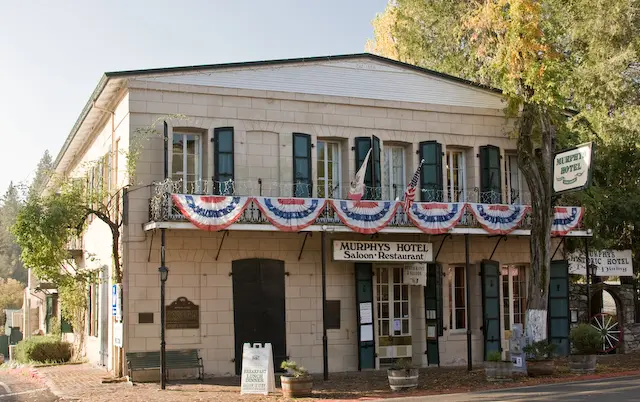
It burned with the rest of the town in 1859 and reopened the following spring with walls entirely of stone: that is the building on Main Street today, California Historical Landmark No. 267 — registered in 1937 under its older name, Mitchler Hotel — and on the National Register of Historic Places since 1971. Its fame rests on a guest register, displayed in copy in the lobby, whose original is held by the Calaveras County Museum. The 1971 National Register nomination transcribes the celebrated entries with years, and one of them cannot be right: it dates Mark Twain to 1877, a year he spent in Hartford, Bermuda, Elmira and Boston. His documented Calaveras winter was 1864-65, a few miles down the road at Vallecito and Angels Camp. The hotel's own website ran a Ghosts page in 2013 naming a maid, a prospector and a child; the site's archived home pages from 1998 to 2012 mention no ghosts at all.
What is the history of Murphys Hotel?
Murphys is a Gold Rush camp in the Sierra foothills of Calaveras County that found a second business when the placer gold thinned out: tourism. Up the mountain stood a grove of giant sequoias, and by the mid-1850s the road through Murphys was how you reached them. The National Register nomination filed in 1971 gives the reason for the building in a single line — it was a stage stop, and "the hotel was built to accomodate that traffic after the trees discovery".
James L. Sperry and John Perry opened it in the summer of 1856 as the Sperry & Perry Hotel. It was, in the words of that same nomination, "called a fire proof building": the front part was stone, with iron doors and iron shutters on both floors, and those doors separated it from a wooden dining room at the rear.
It was not fireproof. Murphys burned in 1859 and the hotel burned with it. Work started immediately on a new building, finished in time to open the following spring, and this time, the nomination records, "new walls were entirely of stone". That is the building standing today, and it earned its reputation afterwards rather than before: in the fire of 1874 the stone walls saved it, and in what the nomination calls a "tremendous explosion and fire" in 1893 it came through with nothing worse than warped iron doors and shutters.
That sequence is worth holding onto, because the hotel's own history page now tells 1859 differently. There the fire merely damaged the hotel, which was protected by its stone construction and iron shutters and was "restored and reopened in 1860". The stone that demonstrably saved the place in 1874 and 1893 has been quietly moved back to 1859 — the year when, by the nomination's account, there was still a wooden dining room to lose and a front to rebuild.
The ownership chain in the nomination is unusually complete. James Sperry sold to Henry Atwood in 1881; Atwood sold to Harvey Blood the same year; Blood sold to G. P. Mitchler in September 1882. It became the Mitchler Hotel, and that is still the name under which the State of California registered it as Historical Landmark No. 267 on 3 September 1937 — a detail that trips up anyone searching the state register for "Murphys Hotel". The Mitchler family ran it for some years, it closed for a period, and Mr and Mrs R. S. McKimmins bought it and held it until 1963, renaming it the Murphys Hotel in 1945. In 1963 thirty-five members of the Ale and Quail Club — former College of the Pacific students — bought it between them, and they were still running it when John P. Lemue of the Calaveras County Historical Society signed the nomination on 20 April 1971. The hotel was listed on the National Register on 23 November that year.
Dorian Faught acquired it in 2003. In November 2012 he sold the businesses but kept the building: "I'm not selling the property – instead, I'm selling the bar, restaurant and lodging businesses," he told the Calaveras Enterprise. The buyers were three men in their early thirties — Kevin Clerico, Joel Lacitignola and Brian Goss — and their stated plan was not to change much. "You don't change a good thing," Goss said. Some change arrived anyway: the hotel's own room page records that one of the historic rooms "was given a makeover on the TV show 'Hotel Hell'".
Then, in 2020, it stopped. Brian Goss told KQED on 8 May 2020 that California's shelter-in-place order had achieved what the fires never did: "To my knowledge, it has never been completely shut down and not operated in 164 years." He explained, in the same interview, why the fires had failed: "We've had a couple of big fires come through here, we didn't close — we had the bar open by candlelight and we were cooking food out on the barbecue."
The hotel reopened and is trading today. And the object at the centre of its fame is not the stone or the shutters. It is a book: the guest register, whose original is held at the Calaveras County Museum in San Andreas, with copies of the celebrated signatures displayed in the hotel lobby.
Timeline: the documented record of Murphys Hotel
- Summer 1856 James L. Sperry and John Perry open the Sperry & Perry Hotel in Murphys, built as a stage stop for the traffic heading up to the giant sequoia grove. The front is stone with iron doors and iron shutters on both floors, and is described as a fireproof building; behind it is a wooden dining room.
- 1859 Fire sweeps Murphys and the hotel burns with the town, despite the fireproof reputation. Work on a replacement starts at once and it opens the following spring with walls entirely of stone — the building that stands today. The hotel's current history page instead says the 1859 fire only damaged it and that the stone and iron shutters protected it.
- September 1882 After James Sperry sells to Henry Atwood and Atwood to Harvey Blood, both in 1881, the hotel passes to G. P. Mitchler and becomes the Mitchler Hotel. The McKimmins family renames it the Murphys Hotel in 1945.
- 1874 and 1893 The rebuilt hotel survives two more disasters. In the fire of 1874 the stone walls save it, and in a tremendous explosion and fire in 1893 it escapes with warped iron doors and shutters. These are the events that earned the fireproof reputation the 1856 building had only claimed.
- 3 September 1937 California registers the building as Historical Landmark No. 267 under the name Mitchler Hotel, which is still the official designation in the state register and not the name on the sign.
- 1963 Thirty-five members of the Ale and Quail Club, former College of the Pacific students, buy the hotel between them after a period in which it had been closed, and are still running it eight years later.
- 20 April 1971 John P. Lemue of the Calaveras County Historical Society signs the National Register nomination, which transcribes the guest register's celebrated entries with dates: Mark Twain 1877, Horatio Alger 1877, Henry Ward Beecher 1877, John Bidwell and wife 1877, John Jacob Astor 1878, John Hittell 1867, and Lipton, Grant and C. E. Bolton (Black Bart) in 1880. The hotel is listed on 23 November.
- 30 October and 2 November 2012 Lanee Lee publishes a first-hand account in Fathom quoting front-desk clerk Deanna Broglio on Eleanor as the hotel's primary ghost; three days later the Calaveras Enterprise reports that Dorian Faught has sold the bar, restaurant and lodging businesses, but not the building, to Kevin Clerico, Joel Lacitignola and Brian Goss.
- 16 January 2013 First archived capture of the hotel's own Hauntings page, which names three spirits — Eleonor, the Prospector and the Child — cites paranormal investigations of 2008 and 2009, and claims the tales date from the nineteenth century without offering a nineteenth-century source. The page returns 404 by September 2014. Earlier captures of the site's home page, from 1998 to 2012, contain no mention of ghosts at all.
- 8 May 2020 KQED reports the hotel closed completely for the first time in its history under California's COVID-19 shelter-in-place order. Owner Brian Goss says it has never been shut down in 164 years, and recalls keeping the bar open by candlelight through past wildfires. The hotel later reopened and is trading today.
Is there a rational explanation for Murphys Hotel?
The evidence this hotel offers is a book, and the book is real. What is not documented is the dates written beside the names.
Guidebooks have described the register on display here for decades. A full-text sweep of scanned books crossing the hotel's name with "register" and Twain returns about 274 volumes; among them Charles Moore's Mother Lode guide ("the famous on the old hotel register, including Mark Twain, U.S. Grant, and Horatio Alger"), two editions of Barbara Braasch's Gold Rush country ("Examining the old register, you find names of past travelers: Mark Twain, U.S. Grant, Henry Ward…"), Philip Varney's Ghost towns of Northern California and Bill Gleeson's Small hotels of California ("names like Grant, Black Bart, and Mark Twain"). Note what none of those snippets carries: a year.
The years come from one place. The 1971 nomination, signed by John P. Lemue of the Calaveras County Historical Society, transcribes the celebrated entries with dates: "Mark Twain - 1877, Horatio Alger - 1877, Thomas J. Lipton, U. S. Grant, and C. E. Bolton (Black Bart) - 1880, John Jacob Astor - 1878, Henry Ward Beecher - 1877, Josh. Billings, Bona [Lipscomb] (one of Napoleons Aides) and E. S. and M. A. Rothchild - 1880, John Hittell - 1867 and John Bidwell and wife - 1877."
Mark Twain's 1877 does not work. Albert Bigelow Paine's authorised biography of 1912 accounts for that year without a gap: Ah Sin opened at the National Theater in Washington on 7 May 1877 and Clemens could not attend because of bronchitis; on 16 May he sailed for Bermuda on what his notebook called "the first actual pleasure-trip" he had ever taken; he spent the summer at Quarry Farm in Elmira; on 17 December he gave the Whittier birthday speech at the Hotel Brunswick in Boston. There is no California in it. His documented Calaveras County time is twelve years earlier and a few miles down the road: with Jim Gillis he crossed into the county after Christmas 1864 and saw a lunar rainbow at Vallecito on New Year's night; later in January they went pocket-hunting near Angel's Camp, where his notebook logs "January 27. Same old diet — same old weather", and where he heard Ben Coon tell the jumping-frog story in the bar-room of the local tavern. Paine's biography runs to three megabytes of text; a search of the whole of it for "Murphy" returns two hits, one a New York retainer of Governor Nye and one a photograph caption. The control terms in the same sweep — Angel's Camp and Calaveras — return the passages quoted above. Twain was next door for weeks in 1865. He was not here in 1877.
The roster has also drifted. Set the 1971 transcription beside the hotel's present room list and seven of the documented names have gone — Alger, Beecher, Josh Billings, Bidwell, Hittell, Rothschild and, remarkably, Black Bart, the one name every guidebook mentions — while six that are not in the 1971 list have arrived: William Randolph Hearst, Susan B. Anthony, J. P. Morgan, "Samuel Pillsbury", John Wayne and "John Crocker". The 1867 slot kept its year and changed its occupant: John Hittell in the nomination, Pillsbury on the door. Two of the new entries answer themselves. Room 18 is dated 1973, which is not a Gold Rush register year by any reading. Room 9 dates Thomas Lipton to 1880 and then explains him by the tea business and the slogan "Directly from the tea gardens to the teapot" — the tea trade he built in the 1890s, not in 1880. Room 10 dates John Jacob Astor IV to 1878 and explains him by the Waldorf-Astoria, built fifteen years later. The room texts also demote Grant, giving his presidency as 1868–1876; he took office in 1869 and left in 1877.
The ghost story is younger than any of this, and its arrival can be dated on the hotel's own website. Archived captures of the front page from December 1998, March 2000, February 2005, June 2008, June 2012 and June 2016 contain no instance of ghost, haunted, spirit or paranormal. The control in the same sweep is the site's own body text, which came through intact in all six: every one of them names the Calaveras Big Trees, and the earliest carry the Sperry & Perry opening of 1856. The first ghost page in the archive is hauntings.html, captured between 16 January and 27 November 2013 and returning 404 by September 2014. It named three spirits: Eleonor, a maid who fell in love with an adventurer who never came back; the Prospector, who "fell" — the hotel's own quotation marks — from the front balcony and is seen hunched over the saloon bar; and the Child, said to be the most active, credited with moving merchandise and playing with the office doorknob. It also stated that "since the nineteenth century tales of paranormal encounters in the historic building of the hotel have been spoken by guests and staff alike", and offered nothing from the nineteenth century in support. The investigations it did cite are recent: California Haunts in 2008 and the American Paranormal Research Association in 2009.
The surviving claim on the current site is one sentence, present at least since June 2018: Room 9 "is reputed to be the most paranormally active room in the hotel". The fullest first-hand account is Lanee Lee's, published by Fathom on 30 October 2012, which quotes a named front-desk clerk, Deanna Broglio: "Eleanor is our primary ghost, but guests and staff have reported hearing children laughing and seeing a gentleman ghost." In print the gentleman acquires what the hotel's own page never gave him — a name, John, and a job, former manager.
As for mechanism, the hotel has published the mundane explanation itself. The historic rooms have no televisions and no telephones, several share bathrooms down the hallway, and the 2018 version of the same page warned that they "may get noisy as they are located over our lively saloon". On the nightstand of each is a log book, left there, in the hotel's words, "so guests and staff may record any occurances that happen in their presence". A book that collects only the nights when something seemed strange will fill up. The nights when nothing happened do not get written down.
Can you visit Murphys Hotel?
The hotel is open and taking bookings at 457 Main Street, on the corner of Algiers Street, Murphys, California 95247 — the address under which California registered it as Historical Landmark No. 267 on 3 September 1937, using its older name of Mitchler Hotel. The front desk answers on +1 209 728-3444 and reservations go through 1-800-532-7684 or [email protected]. On 9 September 2026 the hotel site gave the restaurant hours as 8 a.m. to 3 p.m. and 5 p.m. to 9 p.m. from Sunday to Thursday, closing at 9:30 p.m. on Friday and Saturday; the saloon runs from mid-morning until late.
The nine historic rooms in the 1860 stone building carry the numbers 9, 10, 11, 12, 14, 15, 16, 18, 19. The hotel's page says they "DO NOT have modern amenities such as TVs and telephones" and that all of them have been fitted with air conditioning. That page, on 9 September 2026, listed private bathrooms in rooms 10, 14, 15, 16, 19, with rooms 9, 11, 12, 18 sharing facilities down the hallway; it marks rooms 9, 11, 12, 18, 19 as sitting above the saloon. It publishes no figure for any of them: "Pricing varies by season and day of the week". The other grade of lodging is the modern rooms in the lodge, which have televisions.
Copies of the celebrated signatures hang in the lobby, which anyone can walk into; the original register is held at the Calaveras County Museum in San Andreas. Bronze plaques on the stone front record the two designations: Historical Landmark No. 267 and the National Register listing of 23 November 1971.
Each historic room keeps a log book on the nightstand. The hotel's wording for what it is doing there: "so guests and staff may record any occurances that happen in their presence". The entries in it were written by people who had already been told the hotel is haunted.
Murphys Main Street is walkable and lined with tasting rooms and galleries. Calaveras Big Trees State Park, the sequoia grove that put the hotel here in the first place, lies north-east up State Route 4.
Sources consulted
- John P. Lemue, Calaveras County Historical Society, «National Register of Historic Places Inventory – Nomination Form: Murphys Hotel (ref. 71000134)» — United States Department of the Interior, National Park Service, 1971 report
- California Office of Historic Preservation, «Mitchler Hotel — California Historical Landmark No. 267, 457 Main at Algiers St, Murphys, Calaveras County» — California Historical Resources, listed resources register, 1937 archive
- Albert Bigelow Paine, «Mark Twain: A Biography» — Harper & Brothers, 1912 book
- The Murphys Historic Hotel, «History» — Official hotel website, 2026 web
- The Murphys Historic Hotel, «Hauntings (archived hotel website)» — Internet Archive Wayback Machine, capture of 16 January 2013, 2013 archive
- Lanee Lee, «I Slept with Mark Twain's Ghost» — Fathom, 2012 newspaper archive
- Will McCarthy, «In Murphys, an Iconic Gold Rush Hotel Lies Silent For the First Time in 164 Years» — KQED, 2020 newspaper archive
- Joel Metzger, «Murphys Hotel business to be sold to three entrepreneurs» — Calaveras Enterprise, 2012 newspaper archive
- The Murphys Historic Hotel, «The Historic Rooms (rooms 9–19), with guest attributions and rates» — Official hotel website, 2026 web
- The Murphys Historic Hotel, «Rooms 9–19: The Historic Rooms (archived hotel website)» — Internet Archive Wayback Machine, capture of 24 June 2018, 2018 archive
- Internet Archive / Open Library, «Full-text search of scanned books for "Murphys Hotel" and its guest register» — Open Library search inside, 2026 archive
Reviewed by V. Serrano on 2026-08-13 · How we verify our content
💬 Field testimonies (0)
No testimonies yet. Add the first.
Add your testimony
🔒 Log in to add a testimony