👻 HAUNTED PLACE · EXP. Nº9478
ACTIVE
New York State Capitol
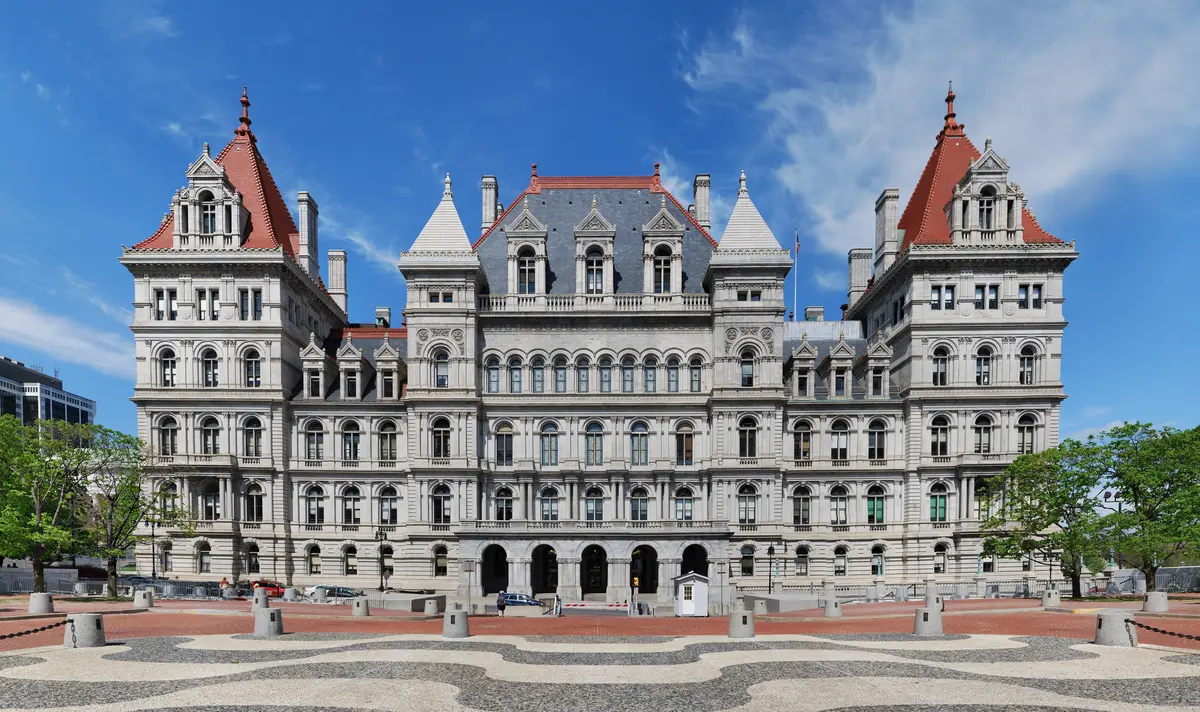
The New York State Capitol took more than thirty years, five architects and, by the reckoning of the New York press of the day, over 27 million dollars — the most expensive government building in the country.
Where is New York State Capitol?
- Location
- New York, United States
- Type
- Public building
- Coordinates
- 42.653, -73.757
- Last updated
LOCATION
Why is New York State Capitol said to be haunted?
Its Great Western Staircase, the Million Dollar Staircase, carries seventy-seven identifiable carved faces, from Lincoln to Susan B. Anthony, and many more unidentified faces, cut by hand from Scottish sandstone. On the morning of 29 March 1911 fire broke out at the west end of the third floor and destroyed the State Library, which had occupied the wing since 1883. It burned until after eleven; the building had no alarm, no hose and no buckets anywhere inside it. One person died: Samuel J. Abbott, seventy-seven, a Civil War veteran working as the library's night watchman, whose body was not recovered for several days. Since the 1980s the Capitol has had a reputation for phantom smoke and footsteps attributed to Abbott. In Arthur Myers's 1986 account, it was an Albany psychic, Ann Fisher, who identified the ghost with Abbott in 1981.
What is the history of New York State Capitol?
New York argued about how its Capitol should look for more than thirty years, and the argument is still visible in the walls.
The legislature authorised the building in 1865, broke ground in 1867 and appointed Thomas Fuller as architect in 1868. The cornerstone was laid in 1871. By 1875, according to the National Park Service nomination, the exterior walls had reached the top of the second storey and the original appropriation had been spent, and that year an advisory board of Frederick Law Olmsted, Leopold Eidlitz and Henry Hobson Richardson was appointed to make a "critical review" of Fuller's work. In 1876 Fuller was replaced by Eidlitz and Richardson, and the style was altered. When the legislature insisted in 1877 that the Capitol be completed in Italian Renaissance, Richardson wrote privately to Olmsted that the building "can be well finished in Francois I or Louis XIV which come under the head of Renaissance" — a letter the National Park Service nomination quotes at length. Isaac G. Perry became Commissioner of the Capitol in 1883 and saw the work through; Governor Theodore Roosevelt declared the building complete in 1899. The Evening World's front page of 29 March 1911 put its cost at 27 million dollars.
Richardson's share of the interior included the Western Stair. The National Register nomination, quoting James F. O'Gorman's 1974 catalogue of Richardson's drawings, says that Perry began it in 1884 and embellished it with sculpture not shown on any of Richardson's drawings. The stone of the Great Western Staircase is Corsehill sandstone imported from Scotland, chosen because it is soft when fresh from the quarry and takes fine carving; every carving was cut in place with mallet and chisel, and, in the words of the state's own account, "not even the smallest of decorative themes or faces was used twice". The carvers — most of them from England, Ireland, Scotland and Wales — were paid up to five dollars for a ten-hour day, twice a labourer's wage. They cut the seventy-seven famous faces from plaster models made by a sculptor in New York City, among them Abraham Lincoln, Walt Whitman, Frederick Douglass and Susan B. Anthony, and filled out the ornament with many unidentified faces, some of them probably friends and relatives, and with smaller whimsical heads among the foliage. The staircase was completed in 1897 with the installation of its skylight.
Fourteen years later it was burning. At about a quarter to three on the morning of 29 March 1911, fire broke out at the western end of the third floor, in or near the Assembly library and the rooms behind the Assembly Judiciary Committee. It ran through the State Library, which had occupied the west wing since 1883, and was not under control until after eleven. The blaze lit the sky for miles; the legislature moved into Albany City Hall the same afternoon. The Evening World reported that six hundred thousand volumes had gone, and that the Capitol had no fire alarm, no hose, no buckets and no grenades anywhere inside it — a plan for fire protection had been floated after a smaller Capitol fire three years earlier and dropped. The state carried its own insurance, so it carried the whole loss. Governor John A. Dix called it "an appalling disaster" and the destruction of the State Library "a national loss", adding that the state's copy of the Emancipation Proclamation and Washington's farewell address had been moved out to a safe in Commissioner Draper's office not long before.
One man died. The Sun of 30 March 1911 named him: Samuel J. Abbott, seventy-seven years old, a Civil War veteran employed as night watchman in the State Library. The New-York Tribune reported the same day that he had been missing since the fire began and was believed to be buried under the stone and iron that fell from the roof to the fourth floor, and that the west end was too dangerous to search. Paul Mercer and Vicki Weiss, in their 2011 book on the fire, record that he was its one fatality and that his body was not recovered until several days later.
The State Library did not return. It reopened in 1913 in the new State Education Building across the street, where its successor collections still hold fire-scorched survivors: the Van Rensselaer manor papers, a burnt-edged 1793 constitution of the New York City fire department. The Capitol was rebuilt at the west end under State Architect Lewis F. Pilcher. It was listed on the National Register of Historic Places in 1971 and designated a National Historic Landmark on 29 January 1979.
Timeline: the documented record of New York State Capitol
- 1865 The legislature passes the act authorising a new Capitol. Ground is broken in 1867, Thomas Fuller is appointed architect in 1868 and the cornerstone is laid in 1871.
- 1876 With the walls up to the second storey and the original appropriation spent, an advisory board of Olmsted, Eidlitz and Richardson, appointed in 1875, reviews Fuller's work. Fuller is dropped and the building is finished in a different style.
- 1883 Isaac G. Perry becomes Commissioner of the Capitol. The same year the New York State Library moves into the building's west wing.
- 1897 The Great Western Staircase is completed with the installation of its skylight, thirteen years after Perry began it. Governor Theodore Roosevelt declares the whole Capitol complete in 1899.
- 29 March 1911, about 02:45 Fire breaks out at the west end of the third floor, near the Assembly library. It is not under control until after eleven. The Evening World reports the same day that six hundred thousand volumes are gone and that the Capitol had no fire alarm, hose, buckets or grenades anywhere inside it.
- 29 March 1911, evening Governor John A. Dix calls the fire “an appalling disaster” and the loss of the State Library “a national loss”, noting that the state's copy of the Emancipation Proclamation and Washington's farewell address had been moved to a safe in Commissioner Draper's office shortly before.
- 30 March 1911 The Sun names the missing man: Samuel J. Abbott, seventy-seven, a Civil War veteran employed as night watchman in the State Library. The New-York Tribune reports that he is believed buried under the stone and iron that fell from the roof to the fourth floor, and that the west end is too dangerous to search.
- Early April 1911 Abbott's body is recovered several days after the fire. Paul Mercer and Vicki Weiss, in their 2011 book on the fire, record him as its one fatality.
- 1913 The State Library reopens across the street in the new State Education Building. Fire-damaged survivors, including the Van Rensselaer manor papers, remain in its collections.
- 29 January 1979 The Capitol is designated a National Historic Landmark, eight years after being listed on the National Register of Historic Places in 1971.
- 1986 Arthur Myers publishes The Ghostly Register, whose chapter forty-five, “The Night Watchman Who Kept on Watching”, deals with the Albany Capitol and begins in 1981, when the Albany station WNYT was making a series on hauntings and the psychic Ann Fisher concluded that the ghost was a night watchman who died in the 1911 fire. Its data were submitted by Lawrence Cortesi.
- 2002 and 2006 The skylight and laylight over the Great Western Staircase are restored, and four years later the conservation cleaning of its masonry and ornamental light fixtures is completed.
Is there a rational explanation for New York State Capitol?
Samuel J. Abbott is in the record of 1911. The Sun named him on 30 March as "supposed to have perished in the flames", adding that "his body has not been found"; the New-York Tribune reported the same day that he was believed to be buried under the stone and iron that had fallen from the roof, and Paul Mercer and Vicki Weiss, in their 2011 book on the fire, record that he was its one fatality and that his body was not recovered until several days later.
The ghost has a documented origin as well, seventy years later. Arthur Myers's The Ghostly Register (1986) gives the Capitol its chapter forty-five, "The Night Watchman Who Kept on Watching". Myers's account begins in 1981, when the Albany television station WNYT was making a series on hauntings, and the series led to a séance with Ann Fisher, a professional psychic living in Albany. According to Myers, Fisher, after doing research in the Albany Times-Union, felt that the ghost was a night watchman who had died in the Capitol fire of 1911, and said she had contacted the spirit, whom she found puzzled. The chapter's information was submitted by Lawrence Cortesi, who had written an article on the case. On Myers's own account, the name Abbott was attached to the haunting by a psychic who had been reading about the fire, and his entry closes with Fisher's opinion that Sam Abbott "has shaken the dust of Albany".
The specific claims have ordinary explanations. The Great Western Staircase rises inside a building whose main block, in the National Park Service nomination, has five storeys plus a basement and an attic, and it is capped by a skylight installed in 1897; warm air rising through an open stairwell draws cooler air in below. The smell of smoke is reported in a building whose best-known story is a fire. Footsteps are reported in a building that houses the Assembly, Senate and Executive chambers and runs public tours on weekdays at ten, twelve and two.
Can you visit New York State Capitol?
The Capitol, the working seat of New York's state government, stands at the head of State Street in Albany at the north end of the Empire State Plaza. It has been a National Historic Landmark since 29 January 1979. The Office of General Services, which runs visits, publishes its hours as Monday to Friday from 7am to 7pm, closed on Saturdays, Sundays and state and federal holidays; this and the details below were read on its Empire State Plaza website on 24 September 2026.
Walk-in tours are free and leave from the information desk in the Capitol's State Street lobby at 10am, noon and 2pm on weekdays. They last 50 to 60 minutes and need no booking for parties of fewer than ten; an extra public tour at 11am was listed for 16 September 2026. Groups of ten or more reserve at least two weeks ahead, for weekday tours on the hour from 9am to 3pm with a maximum of 40 people a tour, through the Visitor Center on +1 518-474-2418.
The state also runs its own ghost tour, the Capitol Hauntings Tour, which is free and can be booked online from 14 September 2026 by parties of ten or fewer. It runs at 5pm and 6pm on 1 October and then on weekdays until 30 October 2026 (Wednesday to Friday up to 23 October, Monday to Friday from 26 October), with no tours on 12 October; on 2 October, a First Friday, it becomes a self-guided open house at 5pm. The office's description asks: "Does the night watchman who died in the Capitol Fire of 1911 still make his rounds?" Its news release of 16 September 2025 already called the tours an "annual return".
Every visitor passes through a metal detector and has bags X-rayed. The list of refused items covers sharp objects such as pocketknives and nail clippers, weapons, and "nuisance devices, such as whistles and noisemakers".
The State Street entrance of the Capitol is one of the two points of the complex that the office lists as not accessible, the other being the Concourse tunnel to the Swan Street Building. Step-free entry is by the street-level elevator entrance on Madison Avenue (daily from 6am to 11pm) or from State Street by the outdoor walkway at the north-east corner of the Abrams Building to a Concourse door (weekdays from 6am to 4.30pm); the Plaza Manager's Office answers on +1 518-474-8860. The outdoor Plaza closes from 1 December to 31 March except for the ice rink.
Of the four visitor car parks, the V-Lot under the Plaza, reached from the Empire State Plaza exit of I-787, charges a flat 10 dollars on weekdays and 5 at weekends, with no charge for stays of 90 minutes or less. The Madison Avenue, Grand Street and Elk Street lots charge 10 dollars on weekdays (nothing after 4pm) and are free at weekends, when cars must be gone by 6.30am; all four take cards only. The Plaza Visitor Center and gift shop, on the North Concourse, opens on weekdays from 8.30am to 3pm.
Sources consulted
- Albany correspondent, «State Capitol Wrecked by Fire: Entire Western End of the Building Practically in Ruins» — The Sun (New York), 30 March 1911, p. 1, 1911 newspaper archive
- Albany correspondent, «Report on the Albany Capitol fire, naming Samuel J. Abbott» — New-York Tribune, 30 March 1911, p. 1, 1911 newspaper archive
- Evening World Albany correspondent, «$27,000,000 N. Y. State Capitol Swept by Fire: Records Burned» — The Evening World (New York), 29 March 1911, p. 1, 1911 newspaper archive
- Carolyn Pitts, «National Register of Historic Places Inventory–Nomination Form: New York State Capitol (ref. 71000519)» — National Park Service, Office of Archeology and Historic Preservation, 1979 report
- Paul Mercer and Vicki Weiss, «The New York State Capitol and the Great Fire of 1911» — Arcadia Publishing, 2011 book
- New York State Office of General Services, «The Capitol's History & Architecture, and Timeline: History of the New York State Capitol» — empirestateplaza.ny.gov, 2026 web
- New York State Office of General Services, «Capitol Walk-In Tours, Group Tours, Friday Evening Tours, Hours of Operation, Parking and Access for People with Disabilities» — empirestateplaza.ny.gov, 2026 web
- Arthur Myers, «The Ghostly Register: Haunted Dwellings, Active Spirits — chapter 45, “The Night Watchman Who Kept on Watching”» — Contemporary Books, 1986 book
- National Park Service, «List of National Historic Landmarks by State: New York» — nps.gov, 2026 web
- New York State Library, «New York State Library 200-year timeline, and the online exhibit The Capitol Fire of March 29, 1911» — nysl.nysed.gov, 2018 web
Reviewed by V. Serrano on 2026-08-11 · How we verify our content
💬 Field testimonies (0)
No testimonies yet. Add the first.
Add your testimony
🔒 Log in to add a testimony