👻 HAUNTED PLACE · EXP. Nº9475
ACTIVE
Norwich State Hospital
Norwich State Hospital opened on the Preston bank of the Thames River in October 1904 with 95 patients in a single building, and closed in October 1996 with its last patients transferred to the very hospital it had been built to relieve.
Where is Norwich State Hospital?
- Location
- Connecticut, United States
- Type
- Hospital / asylum
- Coordinates
- 41.489, -72.073
- Last updated
LOCATION
Why is Norwich State Hospital said to be haunted?
In between it grew to more than thirty buildings across some 900 acres, linked by concrete tunnels, and held over 3,000 people at its peak in the late 1950s. Its documented history is harsher than its ghost stories: the 1987 National Register nomination records that operations frequently performed in the Lippitt Building included sterilisations and lobotomies, and a state commission found in 1939 that there were 2,904 patients in a hospital rated for 2,450, with one physician for every 200 of them. The abandoned campus became a landmark of urban exploration and was investigated on television in 2010, but it has almost gone: demolition began in 2011 and by 2023 only five of its fifty-six buildings were still standing. The site is fenced, patrolled and closed to the public.
What is the history of Norwich State Hospital?
Norwich State Hospital was the second asylum built by the state of Connecticut, and it exists because the first one was full. The National Register nomination is explicit about it: the hospital "grew directly out of a perceived need to relieve crowding" at Connecticut Valley Hospital in Middletown. The state bought the land in 1903, on the Preston bank of the Thames River opposite what is now Mohegan Sun, and the doors opened in October 1904 with 95 patients in a single building. The name over that door was Norwich State Hospital for the Insane, and the first superintendent, Dr Henry M. Pollock, resented it — the nomination records that he preferred the less pejorative "Norwich State Hospital". The word came off the name in 1926; in 1961 the place became simply Norwich Hospital.
The plan was an argument about psychiatry rendered in brick. Cudworth & Woodworth of Norwich, advised by Dr N. Emmons Paine of Massachusetts and H. G. Noble of Connecticut Valley Hospital, built a compromise between the two competing models of the day: Thomas Kirkbride's single vast building, and the newer preference for small separate pavilions. Norwich got separate ward buildings in concentric rings around the administration building, tied to it by a system of concrete tunnels — built for pipes and cables, and used to move patients from one ward to another. There was no wall around the complex, a deliberate break with nineteenth-century practice, and the surveyors noted that "bars and other signs of restraint were minimized". Patients were sorted by sex and by diagnosis into paired, identical buildings: Gallup and Mitchell for the well behaved, Earle and Butler for people with epilepsy, Kirkbride and Ray for the elderly. Men considered violent went into Stribling; men found not guilty by reason of insanity went into Salmon.
One building needs saying out loud. Lippitt, opened in 1920, was a psychopathic hospital built only eight years after the first of its kind in the country, at Boston State, with X-ray diagnosis, hydrotherapy and an operating theatre. The federal nomination form, written in March 1987 by Bruce Clouette and Matthew Roth, describes what went on there in one flat sentence: "Frequently performed operations included sterilization and lobotomies." That is not a rumour attached to an abandoned building. It is the National Register's own account of what the state of Connecticut did in that room.
The population went from 95 in 1904 to 998 in 1913, past 2,400 by 1930 and over 3,000 by the late 1950s, in more than thirty buildings spread over some 900 acres. The nomination is equally blunt about the distance between the design and the reality: the curative goals were "more of an ideal than actual practice", because "throughout its history, inadequate funding plagued the hospital, resulting in overcrowding, understaffing, and limited pursuit of curative therapies."
In June 1939 the Connecticut legislature created the Commission on the Treatment and Care of People Afflicted with Physical or Mental Disabilities, chaired by Dr Creighton Barker, after State Senator Joseph B. Downes told the chamber that conditions at Norwich "stink to high heaven". Norwich was the first institution it investigated. Julianne Mangin, who read the report and the trustees' rebuttal at the Connecticut State Library, sets out the findings: 2,904 patients in a hospital rated for 2,450, one physician for every 200 patients where the American Psychiatric Association asked for one per 150, only two of the fourteen physicians board-certified, and clinical records that were "inadequate", with intervals between physical examinations "too long, and often indefinite". The trustees answered that they had asked the legislature repeatedly for more doctors, nurses, attendants and social workers and had been refused every time, and produced a letter from the US Public Health Service stating that of the 171 state mental hospitals in the country, five met the physician standard.
The war emptied the wards of staff, and superintendent Dr William A. Bryan filled them with the two groups nobody else counted. From 1942 selected patients were put to work as "patient attendants". From March 1943 to August 1946 the campus hosted Civilian Public Service Unit No. 68, run by the Brethren Service Committee: conscientious objectors, most of them working as ward attendants. The Brethren Historical Library and Archives holds two photographs taken at Norwich on 23 May 1945 showing Major Havens injecting Dean C. Hoefle and G. Fred Trombley with material bearing infectious mononucleosis agents. Medical experiments did happen on this campus. They happened to volunteers, and they are photographed, named and dated.
Then deinstitutionalisation emptied it of patients. By the early 1970s only seven of the original buildings were still in use; a review requirement and a threatened strike pushed the hospital out of many more in 1979; by 1994 there were 649 beds left. It closed in October 1996, and the remaining patients were transferred to Connecticut Valley Hospital in Middletown — the hospital Norwich had been built to relieve, ninety-two years earlier.
Timeline: the documented record of Norwich State Hospital
- 1903 Connecticut buys land on the Thames River in Preston for a second state asylum, intended to relieve overcrowding at Connecticut Valley Hospital in Middletown.
- October 1904 Norwich State Hospital for the Insane opens with 95 patients in a single building. Its first superintendent, Dr Henry M. Pollock, objects to the name and prefers the less pejorative "Norwich State Hospital".
- 1920 The Lippitt Building opens as a psychopathic hospital with X-ray, hydrotherapy and an operating theatre. The federal nomination form records that "frequently performed operations included sterilization and lobotomies".
- June 1939 State Senator Joseph B. Downes tells the Connecticut legislature that conditions at Norwich "stink to high heaven". The legislature creates the commission chaired by Dr Creighton Barker, and Norwich is the first institution it investigates.
- 15 August – 15 November 1939 The Barker Commission's study of Norwich counts 2,904 patients in a hospital rated for 2,450, one physician for every 200 patients, only two of fourteen doctors board-certified, and clinical records it calls "inadequate". The trustees reply that every request for staff had been refused by the legislature.
- March 1943 – August 1946 Civilian Public Service Unit No. 68, run by the Brethren Service Committee, operates at Norwich. Most of the conscientious objectors assigned to it work as ward attendants, filling posts the hospital could not otherwise staff.
- 23 May 1945 Two photographs held by the Brethren Historical Library and Archives record Major Havens injecting the conscientious objectors Dean C. Hoefle and G. Fred Trombley with material bearing infectious mononucleosis agents at the Norwich unit.
- 22 January 1988 The Norwich Hospital district is listed on the National Register of Historic Places: 40 contributing buildings and two contributing structures — the tunnel system and the road system — across some 70 acres.
- 2009 Preston buys around 390 acres of the closed hospital from the state for one dollar, taking on the environmental clean-up in exchange. Demolition begins two years later.
- 5 May 2010 Syfy's Ghost Hunters broadcasts its sixth-season finale from Norwich. Per the network's own recap the team reports shadows, moaning, a dragging sound and a door that opens, in the research, Earle, administration and Salmon buildings and the tunnels, and concludes the site is haunted.
- 1 March 2018 The Mohegan Tribe lights a ceremonial fire on the cleared grounds. Chief Lynn "Many Hearts" Malerba smudges the thirty or so attendees with sage; Julianne Mangin walks the four points of the circle naming the four relatives who were patients here.
- June 2023 The Day reports that all but five of the site's 56 buildings have been demolished. The 1908 administration building is kept; Gallup, Mitchell, Ray and the chiller building are left standing as decontaminated shells.
- 5 July 2025 Firefighters from several departments are called to a blaze on the former hospital grounds in Preston and part of Route 12 is closed. No injuries are reported and the cause is left under investigation.
Is there a rational explanation for Norwich State Hospital?
Norwich has no ticket office and never had one, and that changes how its reputation must be read. The land belongs to the town of Preston and is being handed over to the Mohegan Tribe; there is no gift shop, no night tour, nobody selling the story at the gate. What built the fame was trespassing photography and television.
The televised part can be dated. Two episodes of the first season of VH1's Celebrity Paranormal Project were shot here and renamed the place "Warson Asylum for the Criminally Insane" — an invented name, which is itself a measure of how the reputation was manufactured. Syfy's Ghost Hunters investigated for its sixth-season finale, broadcast on 5 May 2010: according to the broadcaster's own recap the team worked in the research building, the Earle Building, the administration building, the tunnels and Salmon, and reported moving shadows, moaning and whimpering, a dragging noise and a door that opened, before concluding that the site was haunted. That is the whole of the televised evidence.
Several details that circulate about Norwich do not survive contact with the sources. There is no recorded child's voice and no children's psychiatric floor: the word "children" appears in the hospital's building history exactly once, for the employees' daycare fitted out in the chapel in 1996 and never opened, and by 1939 a quarter of admissions were people aged sixty or over. Nobody documents handprints or scratch marks in the Seymour Building — Seymour was a 1939 medical infirmary later used for intensive geriatric care, and the National Register surveyors deliberately left it out of the historic district because the face it turned to the old campus was loading docks. And the tunnels where cold spots are described were utility tunnels that no longer exist: the contractor that cleared the site lists the "connecting underground tunnel systems" among what it removed.
The honest counterweight is that the documented history of Norwich is worse than the invented one, and it has names. Sterilisations and lobotomies in Lippitt, recorded by the federal government. One doctor for every 200 patients in 1939. A hospital that put its own patients to work as attendants because it could not hire anyone else. Julianne Mangin, whose great-grandmother, grandmother and two aunts were patients here, obtained their records and published what she found — her great-grandmother and a great-aunt died on the campus, and her grandmother, once discharged, was employed on the wards. Unsourced atrocity lists also circulate about Norwich: beatings, starvation, patients packed in ice. They are repeated without a document behind them, while the Barker Commission's actual findings, which sit on paper in the Connecticut State Library, are almost never quoted.
Can you visit Norwich State Hospital?
The 393-acre property straddling the Norwich–Preston line is closed to the public and fenced, with a private security firm hired by the town of Preston patrolling it; trespassers are removed and can be arrested. The Damned Connecticut team drove onto the grounds in April 2010 and had two guards standing beside them within five minutes.
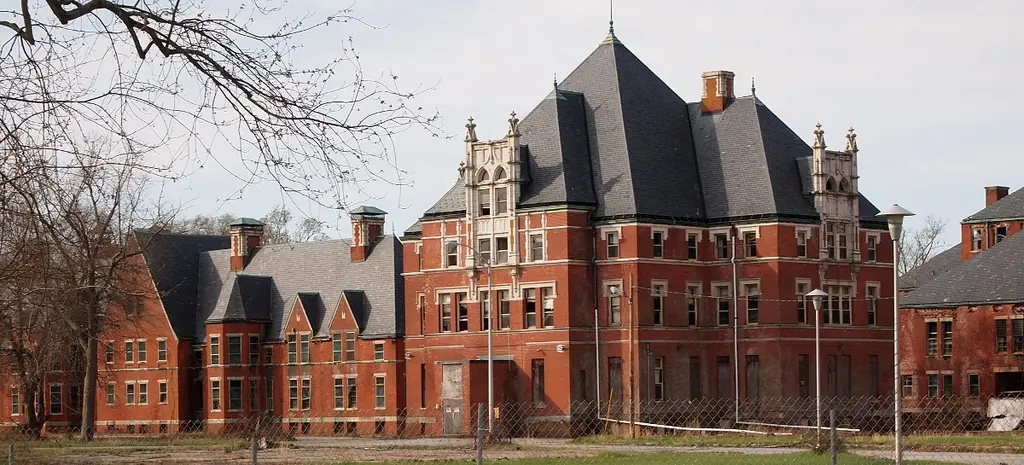
Little of the hospital is left to trespass on. Demolition began in 2011 and, according to The Day, by June 2023 all but five of the 56 buildings had come down; the contractor Manafort Brothers records roughly 1.4 million square feet of buildings removed together with the connecting tunnel system and more than 200,000 cubic yards of contaminated and clean fill. Still standing is the 1908 administration building — sealed and weatherized, awarded a state preservation grant, the one structure the Mohegan Tribe has said it will keep — alongside the decontaminated shells of the Gallup, Mitchell and Ray buildings and the chiller building, earmarked as a staging area. Fire crews from several departments were called to the grounds on the morning of Saturday 5 July 2025 and part of Route 12 was closed. A second fire broke out in a two-storey vacant building on the site early on Tuesday 7 October 2025.
The transfer of the land from Preston to the Mohegan Tribe, agreed in May 2016 for the mixed-use Preston Riverwalk development, was due under the revised agreement to be conveyed by January 2025; a search on 10 September 2026 turned up no report of the closing having taken place.
The administration building can be seen from Route 12 and from the commuter lot next door; the photograph on this page was taken from Route 12, looking south, on 22 April 2011, the same spring the demolition began. The 1987 National Register nomination, reference 87002424, is online in full; it describes every building that stood there. Julianne Mangin has published her family's records from inside it.
Sources consulted
- Bruce Clouette and Matthew Roth, edited by John Herzan, «National Register of Historic Places Inventory/Nomination Form: Norwich Hospital (ref. 87002424)» — National Park Service / Connecticut Historical Commission, 1987 report
- Julianne Mangin, «Norwich State Hospital Under Investigation» — Research on the Barker Commission report and the trustees' rebuttal, Connecticut State Library, 2018 archive
- Julianne Mangin, «Cleansing the Spirits at Norwich State Hospital» — juliannemangin.com, 2018 archive
- Julianne Mangin, «Norwich State Hospital During World War II» — juliannemangin.com, 2018 archive
- Brethren Historical Library and Archives / Mennonite Central Committee, «CPS Camp Number 068 — Norwich, Connecticut (with photographs of 23 May 1945)» — The Civilian Public Service Story, 1945 archive
- Syfy, «Episode Recap: Norwich State (Ghost Hunters, season 6)» — Syfy, 2010 web
- Damned Connecticut, «Norwich State Hospital, Preston» — damnedct.com, 2010 web
- The Day, New London, «End in sight for former Norwich Hospital cleanup» — The Day, 2023 newspaper archive
- Anna Stansfield and Abigail Murillo Villacorta, «Firefighters work to put out fire at former Norwich State Hospital» — WFSB Eyewitness News, 2025 newspaper archive
- Manafort Brothers Inc., «Norwich State Hospital Complex Decommissioning & Demolition» — Contractor project record, 2021 web
Reviewed by V. Serrano on 2026-08-18 · How we verify our content
💬 Field testimonies (0)
No testimonies yet. Add the first.
Add your testimony
🔒 Log in to add a testimony