👻 HAUNTED PLACE · EXP. Nº9477
ACTIVE
Old State House (Hartford, Connecticut)
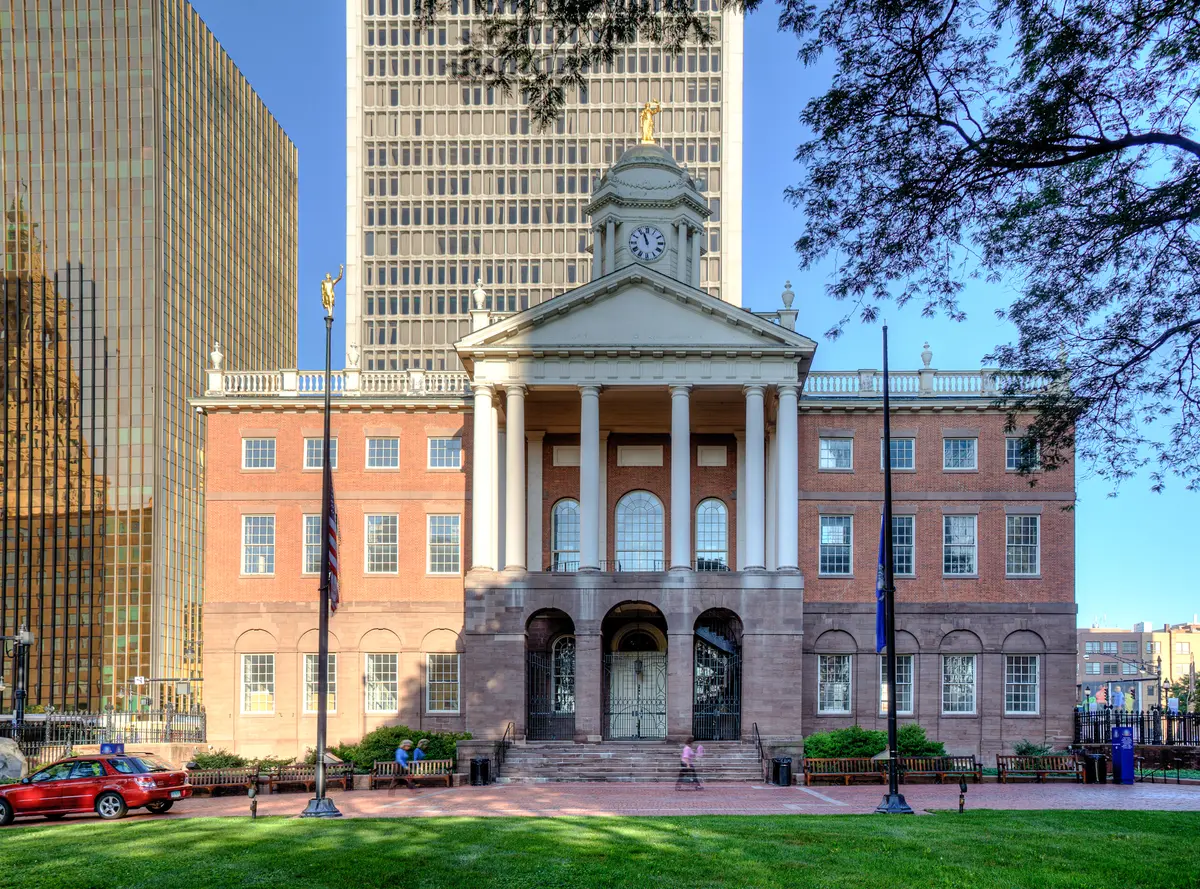
Connecticut's Old State House at 800 Main Street, Hartford, was designed by Charles Bulfinch and first occupied by the General Assembly in May 1796.
Where is Old State House (Hartford, Connecticut)?
- Location
- Connecticut, United States
- Type
- Museum
- Coordinates
- 41.766, -72.673
- Last updated
LOCATION
Why is Old State House (Hartford, Connecticut) said to be haunted?
It stands on the old meeting-house yard, the square where colonial Hartford worshipped, held its courts and set its stocks and pillory. Two stories are usually told here, and they are not the same age. On 26 May 1647 Alse Young of Windsor was hanged at Hartford, the first execution for witchcraft recorded in the English colonies of North America — 149 years before this building existed, and at a spot that no seventeenth-century record locates; the town's historian William DeLoss Love put the colonial gallows outside the town-plot altogether. The ghost usually attached to the building is Joseph Steward, the ailing minister who took a third-floor room in 1796 to paint portraits and announced his museum of natural curiosities in January 1797. The oldest dated appearance of that haunting that can be fixed is a television broadcast, Ghost Hunters, 9 December 2009. The museum itself has never published a word about it.
What is the history of Old State House (Hartford, Connecticut)?
Hartford's founders set aside a public square at the head of what is now State Street and called it, in the deeds of the lots around it, "meeting house land", "meeting house lot" or "the meeting house yard". The first meeting house was probably begun in the spring of 1636, in the south-eastern corner of that square; the second, whose weathercock carried the date 1638, stood — in words of Charles J. Hoadly quoted by William DeLoss Love — "upon a little rising ground on the east side of the present state house square". Everything colonial Hartford did in public, it did around that yard: worship, town meetings, courts and punishment. Near the church stood the stocks, the pillory and the whipping-post.
In 1719 the colony voted a building for the square. The design approved by the Council in March specified a house "of seventy-two feet long, thirty broad", with "two chambers of thirty foot long at each end, one for the Council and another for Representatives". It went up in 1719-20, lost its cupola to a fire in 1783 set off by the illumination or the fireworks of the peace celebration, and came to be known simply as the Court House. In 1796 it was sold to make room for its successor and carted off behind Christ Church, where it served in turn as a tenement, a school, a shop where Charles Hosmer printed an edition of Scott's Bible, a Methodist meeting place and a carriage factory, before being pulled down in 1910 for the telephone company.
Its replacement is the building that stands today. In May 1792 the General Assembly named a committee — John Chester, John Caldwell, John Trumbull, Noadiah Hooker and John Morgan — "to superintend the Businefs of erecting and finishing a large Convenient State House in the Town of Hartford". Chester travelled to Boston that September and charged the state "To Journey & expences to Boston for a plan of faid State House, $31.60"; on 30 September John Trumbull wrote to Oliver Wolcott that "A new State House is to be built here next year upon a Design of Mr. Bulfinch, which I think is worth executing in the best materials". Charles Bulfinch was in his twenties and this was his first public building. A state lottery failed, the work stopped, and the Assembly finished it by trading its claim on the Gore Lands at Lake Erie to Jeremiah Halsey and Andrew Ward, who took their deed on 25 July 1795. The Hartford builder Joseph Woodbridge ran the site. The Assembly first sat in the new rooms in May 1796; the building is said to have cost $52,480.
Most of what gives it its outline came afterwards. The roof balustrade was added in 1815; the cupola was ordered in 1822 and raised by John Stanwood in 1827, carrying the gilded Justice that still turns above Main Street. Lafayette was received on the east front on 4 September 1824 by eight hundred schoolchildren whose badges said, in French, that they loved him. In 1839 the first hearing for the captives of the schooner Amistad was held in the courtroom. The legislature met here for the last time in March 1878; the city took possession on 13 March 1879, removed Asher Benjamin's spiral staircase, refitted the Senate chamber for the Board of Aldermen and dedicated the building to municipal use on 22 October 1879.
Joseph Steward arrived at the beginning of all that. A minister whose health would not let him keep a pulpit, he asked the state for a room on the third floor and used it to paint portraits. On 30 January 1797 he dated a newspaper notice which the Old State House itself later reproduced on its website: "MUSEUM. JOSEPH STEWARD. Takes the liberty to inform the public that he proposes, as soon as it can be accomplished, to make such a collection of natural curiosities and paintings as he hopes will gratify the curious." Donations came: a two-headed calf, a two-headed pig, wax figures of famous politicians at election time. By 1808 the collection had outgrown the building and moved into premises of its own. Steward died in 1822 and the museum wound up in 1840. A recreation of it occupies the third floor today.
Timeline: the documented record of Old State House (Hartford, Connecticut)
- c. 1636 Hartford's settlers reserve a public square and call it, in the deeds of the surrounding lots, the "meeting house yard". The first meeting house is probably begun that spring in its south-eastern corner; the second, dated 1638 on its weathercock, stands on rising ground on the east side of what Love calls the present state house square.
- 26 May 1647 Alse Young of Windsor is hanged at Hartford, the first execution for witchcraft recorded in the English colonies of North America. Winthrop's journal leaves her name blank; the name comes from the cover of Matthew Grant's Windsor diary. No record gives the place within Hartford.
- 10 March 1711-12 A Hartford land deed describes a tract "near the houfe lately built by Joseph Butler, near where the Gallows ufed to stand", on what is now the north side of Albany Avenue. It is the evidence on which Love places the colonial gallows outside the town-plot, and not on the meeting-house square.
- 30 September 1792 John Trumbull writes to Oliver Wolcott: "A new State House is to be built here next year upon a Design of Mr. Bulfinch, which I think is worth executing in the best materials." John Chester had gone to Boston that month and billed the state $31.60 for the journey and the plan.
- May 1796 The General Assembly sits for the first time in the finished building, said to have cost $52,480 and built under the Hartford builder Joseph Woodbridge. The 1719 court house it replaced is sold and carted off behind Christ Church.
- 30 January 1797 Joseph Steward dates his newspaper notice announcing that he proposes "to make such a collection of natural curiosities and paintings as he hopes will gratify the curious" in his third-floor room. The museum is therefore a plan of 1797, not of 1796, the year he obtained the room to paint portraits in.
- 1839 The first hearing for the captives of the schooner Amistad is held in the building's courtroom; the judge rules that the Africans were born free and had been illegally seized.
- 13 March 1879 A year after the legislature's last session here, the City of Hartford takes possession. Asher Benjamin's spiral staircase is removed, the Senate chamber is refitted for the Board of Aldermen and the building is dedicated to municipal use on 22 October.
- 1914 William DeLoss Love publishes The Colonial History of Hartford. He prints the Alse Young record, notes that "the court records give us no information concerning her trial", and argues that the witches were executed outside the town-plot — while the meeting-house yard held only the stocks, pillory and whipping-post.
- 9 December 2009 The TAPS team investigates the building for Ghost Hunters, season five, episode 524, "Unexplained Phenomena", on the Sci Fi Channel. They report audio of a doorknob-like sound in the Senate room and of a woman sighing in the Steward museum room, plus footsteps and an unconfirmed shadow, and leave the case open. This is the oldest dated appearance of the haunting I have been able to fix.
- 2016 The Old State House closes to the public in a state budget crisis, its appropriation cut from $500,000 to $400,000. The loaned collections return to the Connecticut Historical Society, the Wadsworth Atheneum and the State Library. It reopened later; the closure is the reason not to assume the doors are open.
- 25 May 2023 The Connecticut General Assembly adopts House Joint Resolution 34, which exonerates the twelve convicted and names the eleven executed one by one — Alice Young, Mary Johnson, Joan and John Carrington, Goodwife Bassett, Goodwife Knapp, Lydia Gilbert, Mary Sanford, Nathaniel and Rebecca Greensmith and Mary Barnes — lists twenty-two more who were indicted, and apologises to their descendants.
Is there a rational explanation for Old State House (Hartford, Connecticut)?
Two claims travel with this address, and they fail in different ways.
The first is that Alse Young was hanged where the building now stands. What the seventeenth century actually left is very thin. John Winthrop's journal, under 1647, records only this: "One [blank] of Windsor arraigned and executed at Hartford for a witch." Winthrop did not have her name. The name survives because J. Hammond Trumbull found it written on the cover of Matthew Grant's Windsor diary — "May 26. 47 Alse Young was hanged" — and William DeLoss Love, printing both in 1914, added that "the court records give us no information concerning her trial". James Savage, editing Winthrop in 1825, footnoted the entry with Benjamin Trumbull's admission that "after the most careful researches, no indictment of any person for that crime, nor any process relative to that affair can be found". Nothing in any of it gives a spot inside Hartford.
Love did go looking for the spot, and he did not land on this square. Writing about the executions of 1662-63 he concluded that it "seems probable that the witches were executed outside of the town-plot, on the road from the Cow Pasture into the Country. There the gallows of early times was located", and he anchored that with a deed of 10 March 1711-12 describing land "near the houfe lately built by Joseph Butler, near where the Gallows ufed to stand" — the north side of what is now Albany Avenue. What the meeting-house yard held, in his account, was the machinery of minor punishment: stocks, pillory, whipping-post. The sentence that circulates today, "hanged at Meeting House Square in Hartford, now the site of the Old State House", is repeated without a source attached. It may be right; the courts certainly sat on this ground. But it is not documented, and the building it points at is 149 years younger than the hanging.
The second claim is the haunting itself. The oldest dated appearance of it I have been able to fix is a broadcast: Ghost Hunters, season five, episode 524, "Unexplained Phenomena", shown on the Sci Fi Channel on 9 December 2009. Syfy's own recap of it says the TAPS team recorded a sound like a doorknob being turned and a sound like a woman sighing, that members heard footsteps, that one investigator saw a shadow he could not confirm, and that the case was left open. That is the evidentiary high-water mark of this address: audio of two noises in a downtown building.
The attribution to Joseph Steward is later and vaguer. Commercial haunted-places directories describe a shadowy figure in the windows of his old museum and footsteps near it; none that I read names a witness, a date or an occasion. This entry previously stated that staff and visitors trace the activity to Steward, and that has been withdrawn: it is a claim about people nobody quotes.
A negative needs a control, so here is one. I read 214 KB of the museum's own website as archived between 2007 and 2014, the years either side of the broadcast: the words ghost, haunted, witch and Halloween appear zero times in it, while Steward appears thirty-five. The 123 pages listed in the current site's sitemap in August 2026 include no ghost, haunted, witch or Halloween page either, although they do include Amistad, Rochambeau Day and an election-cake bake-off. The institution has never sold this story and does not sell it now. The closest it has come is a 2016 Connecticut Public programme that called the building "thought to be inhabited by ghosts from our state's history" — in an hour about why it had just closed its doors.
Can you visit Old State House (Hartford, Connecticut)?
Connecticut's Old State House stands at 800 Main Street, Hartford, Connecticut 06103. It is run in partnership by the Connecticut General Assembly and the Connecticut Democracy Center, which is why the museum's website sits on the legislature's own server. The telephone given there on 9 September 2026 was 860-240-5340.
The hours published that day were Tuesday to Saturday, 12pm to 5pm. Sunday is closed; Mondays and weekday mornings are held for school and group reservations. The same page adds that the last ticket is sold an hour before closing. Parties of ten or more are asked to reserve. The museum does not open for tours on the 2026 state holidays. No admission price appeared on the visitor pages on that date.
Parking is recommended in the State House Square garage at 75 Market Street, "capped at $10 with a validated ticket" stamped at the Visitor Services desk. On-street parking is free after 6pm and at weekends. CTtransit buses reach the block; so do CTfastrak and the trains into Union Station. Access to the 1796 building is by ramp entrance with lift service to every floor, and the museum offers seating at each stop of a guided tour.
The opening is not guaranteed from one budget to the next. In 2016 the museum closed to the public with its appropriation cut from $500,000 to $400,000 against the $800,000 to $900,000 that the environment commissioner Robert Klee reckoned proper management needed. The borrowed collections went back to their lenders, Mark Twain's high-wheel bicycle among them.
Alse Young has no marker here, and the eleven people Connecticut hanged are named one by one in House Joint Resolution 34 of 2023.
Sources consulted
- William DeLoss Love, «The Colonial History of Hartford, Gathered from the Original Records» — Published by the author, Hartford, 1914 book
- John Winthrop, ed. James Savage, «The History of New England from 1630 to 1649, vol. II (entry for 1647 and editor's note)» — Phelps and Farnham, Boston, 1825 book
- Connecticut General Assembly, «House Joint Resolution No. 34: Resolution Concerning Certain Witchcraft Convictions in Colonial Connecticut» — January Session, 2023, LCO No. 3692, 2023 report
- Joseph Steward, «"MUSEUM. JOSEPH STEWARD." — newspaper notice dated Hartford, 30 January 1797, reproduced on the Old State House website (archived copy, 22 June 2013)» — Wayback Machine, 1797 archive
- Connecticut General Assembly and Connecticut Democracy Center, «Connecticut's Old State House — official website: Visit, The Building, Museum of Curiosities» — wp.cga.ct.gov/osh, 2026 web
- Syfy, «Episode Recap: Unexplained Phenomena (Ghost Hunters, season 5, episode 524)» — Syfy / Sci Fi Channel, 2009 web
- The Connecticut Mirror, «Old State House will lose historical memorabilia — for now» — CT Mirror, 27 July 2016, 2016 newspaper archive
- Connecticut Public (WNPR), «Closed But Not Forgotten: The History and Future of Connecticut's Old State House» — ctpublic.org, 1 August 2016, 2016 web
- Connecticut History / CT Humanities, «Alse Young Executed for Witchcraft — Today in History: May 26» — connecticuthistory.org, 2020 web
- Elizabeth Correia, «Where It All Happened: Connecticut's Old State House» — Connecticut History / CT Humanities, 9 March 2020, 2020 web
Reviewed by V. Serrano on 2026-08-13 · How we verify our content
💬 Field testimonies (0)
No testimonies yet. Add the first.
Add your testimony
🔒 Log in to add a testimony