👻 HAUNTED PLACE · EXP. Nº9478
ACTIVE
Olivewood Cemetery
Olivewood is the oldest incorporated African American cemetery in Houston: six acres in a bend of White Oak Bayou, laid out in 1875, ten years after emancipation reached Texas, by a burial association owned and run by Black Houstonians.
Where is Olivewood Cemetery?
- Location
- Texas, United States
- Type
- Cemetery
- Coordinates
- 29.774, -95.392
- Last updated
LOCATION
Why is Olivewood Cemetery said to be haunted?
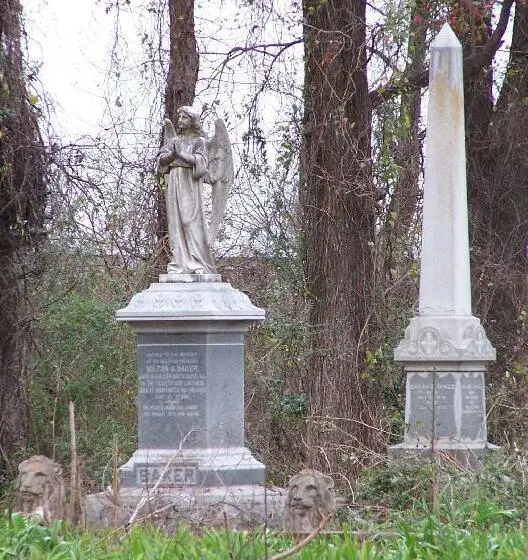
Some four thousand people are buried here — preachers, teachers, doctors, lawyers, shopkeepers, veterans and freed people whose graves were never marked — and the stones themselves are evidence, carrying practices with West African roots: ocean shells set on graves, upright pipes, lettering carved in reverse. Development landlocked the cemetery in the 1940s, the flood control district bought its northern edge in 1958 to rechannel the bayou, burials stopped in the 1960s, and the place was left to the water and the brush. What brought it back was not a ghost hunt but a descendant: Margott Williams found her grandfather's plot swallowed by vines in 1999 and started clearing it with her own lawn mower. Olivewood does appear on lists of haunted Texas sites, on the strength of one investigator's claims since 1999; the descendant who leads its restoration spent Halloween night 2004 there and saw two field mice, and the damage on record comes from erosion and floods. It was listed on the National Register of Historic Places on 6 August 2026.
What is the history of Olivewood Cemetery?
Olivewood begins with an act of incorporation and a surveyed plat.
In 1875, ten years after emancipation reached Texas, a group of Black Houstonians incorporated a cemetery association to own and run a burial ground of their own. The incorporators were Ed. P. Turner, Edward Williams, David Osborne and George Hooper, and the ground they chose sat in a bend of White Oak Bayou, northwest of downtown, in an area then known as Chaneyville. The plat they drew up — "Map of Olivewood Cemetery, Houston, April 1877" — laid out five and a half acres with more than four hundred family plots around an elliptical drive that began at an ornate gate. When the map was finally recorded on 4 May 1881, seventeen stockholders held twenty-one of its twenty-two shares. In the most literal sense, this was property owned by people who had recently been property.
The ground is probably older than the association. Two headstones date from 1869 and 1871, and the historian Debra Blacklock-Sloan, who wrote the Handbook of Texas entry on the site, notes that Olivewood may have been used for the burial of enslaved people before it was ever platted. The name wandered for decades: incorporated as "Olive Wood", it appears on old maps and in city directories as "Hollow Wood" and "Hollywood". The 1897–98 Houston city directory lists it as "Hollywood Cemetery (Colored)", a quarter of a mile northwest of Chaney Junction, with Jack Calloway as sexton.
Who lies there is the point of the place. Rev. David Elias Dibble, the first ordained African American minister of Trinity Methodist Episcopal Church — Houston's oldest Black congregation — held two lots and is buried at Olivewood; the fact that he owned land there is probably the origin of the persistent error that the church owned the cemetery. So are Richard Brock, one of Houston's first Black aldermen and, as Texas Monthly puts it, a co-founder of Emancipation Park; the attorney J. Vance Lewis; the physician Russell F. Ferrill; the dentist Charles B. Johnson, remembered as "the singing dentist" and author of the 1927 song "Houston is a Grand Old Town"; the educator James D. Ryan; and the businessmen Frank Vance and James B. Bell. The stone of Rev. A. F. Jackson records, in capitals, that he was murdered at Dallas on 12 December 1889. Around four thousand burials are recorded in all, most of them shopkeepers, seamstresses, labourers, soldiers, mothers and children whose names survive only because volunteers have been transcribing them.
The stones themselves are evidence. The Handbook of Texas describes upright pipes set as grave features, ocean shells used as grave ornament, at least six markers carved with inverted or reversed lettering, and burials laid out in the Christian west–east orientation with a number of deliberate east–west exceptions. David E. Bruner, an anthropologist at Lone Star College–CyFair who devoted his 2007 doctoral dissertation to mortuary practice in Harris and Montgomery counties, told Texas Monthly in 2021 that these are expressions of West African tradition, and that he and his students helped Olivewood be recognised by UNESCO as part of its Slave Route project. "That's why I refer to the Olivewood Cemetery as Harris County's most important cultural resource," he said, "because it does express this window into our knowledge about African American history in a very unique way."
Then the city closed in. In the 1940s commercial and residential development landlocked the cemetery: businesses including The Schumacher Company and Grocers Supply blocked the ways in. On 26 September 1950 the association appealed to Mayor Oscar Holcombe, and the city council voted to quitclaim a lot so that funerals could reach the graves. In 1958 the northern section was sold to the Harris County Flood Control District so that White Oak Bayou could be rechannelled. The last known marked burial in the oldest section took place in the 1960s, and by the 1970s Olivewood was recorded as abandoned.
What brought it back was a descendant. Margott Williams visited in 1999, after her grandmother died, and found her grandfather's plot buried under trees and vines. She began clearing it alone with her own lawn mower and sickle. In 2003 she founded Descendants of Olivewood to take guardianship of the site; in 2004 the county historical commission put her in touch with Charles Cook, who had first hacked his way in with a machete in 1993 looking for a great-grandmother's grave. The Texas Historical Commission granted Olivewood a Historic Texas Cemetery designation in 2005 and approved an official state marker in 2006, erected in 2008 — the same year a Harris County judge awarded the descendants' organisation guardianship of the cemetery and a fence finally went up.
Timeline: the documented record of Olivewood Cemetery
- 1875 Ten years after emancipation reaches Texas, Ed. P. Turner, Edward Williams, David Osborne and George Hooper incorporate the cemetery association that will run Olivewood — a burial ground owned and managed by Black Houstonians.
- April 1877 The original plat, "Map of Olivewood Cemetery, Houston, April 1877", lays out 5.5 acres with more than 400 family plots around an elliptical drive starting at an ornate gate. It is recorded on 4 May 1881, when seventeen stockholders hold twenty-one of its twenty-two shares.
- 12 December 1889 Rev. A. F. Jackson is buried at Olivewood. His headstone records the circumstance in capitals: "MURDERED AT DALLAS TEX Dec. 12, 1889". It remains one of the most photographed markers on the site.
- 1897–98 The Houston city directory lists the site as "Hollywood Cemetery (Colored)", a quarter of a mile northwest of Chaney Junction on the Washington road, with Jack Calloway as sexton — one of several names the cemetery carried before Olivewood stuck.
- 26 September 1950 Landlocked since the 1940s by commercial development, the cemetery association appeals to Mayor Oscar Holcombe. The city council votes to quitclaim a lot so that funeral processions can reach the graves again.
- 1958 The northern section of the cemetery is sold to the Harris County Flood Control District so that White Oak Bayou can be rechannelled — the first formal loss of ground at Olivewood.
- 1960s The last known marked burial takes place in the oldest section. Within a decade the cemetery is recorded as abandoned, and successive attempts by individuals and groups to maintain it all prove short-lived.
- 1993 Charles Cook, looking for a great-grandmother's grave, cuts his way into Olivewood with a machete through what he describes as a junglelike maze. There is no fence and no path; the angel statue at the centre is what he remembers.
- 1999 Cathi Bunn, a paranormal investigator, begins exploring Olivewood. She later tells the City of Houston magazine City Savvy that one moonlit midnight she videotaped the ghost of Mary White, buried in 1888, hovering above her headstone. Her account is the only named paranormal claim on record for the site.
- 2003 Margott Williams, who found her grandfather's plot swallowed by brush in 1999 and had been clearing it alone with her own lawn mower, founds Descendants of Olivewood to take guardianship of the cemetery. Charles Cook joins her in 2004.
- Halloween 2004 Intrigued by the ghost anecdotes, Williams stays at the cemetery late on Halloween night to see for herself. "Only haunting I saw were from two big field mice," she tells City Savvy.
- 2008 The official Texas Historical Marker approved in 2006 is erected — Olivewood had received Historic Texas Cemetery designation in 2005 — and a Harris County judge awards Descendants of Olivewood guardianship of the site. A fence goes up shortly afterwards.
- May 2010 The Houston Chronicle reports that erosion in the inaccessible back half has exposed human remains. Robert Marcom, of the Community Archaeology Research Institute, describes "daunting problems"; the group asks for $7,000 to recover and rebury remains.
- July 2021 Descendants of Olivewood receives a $50,000 grant from the National Trust for Historic Preservation's African American Cultural Heritage Action Fund, to commission a master drainage plan after Hurricane Harvey flooding and runoff from surrounding development.
- 6 August 2026 Olivewood Cemetery is listed on the National Register of Historic Places, reference SG100013306, in the National Park Service's weekly list of actions for 3–6 August 2026 — 151 years after its association was incorporated.
Is there a rational explanation for Olivewood Cemetery?
Olivewood's place on lists of haunted Texas sites goes back to one paranormal investigator, Cathi Bunn, who called herself the Ghastly Ghost Hunter. The oldest dated account is a Houston Chronicle feature by Daniel J. Vargas, published on 29 July 2001, which followed Bunn and two companions on a night round of Houston cemeteries. Olivewood was the last stop: Bunn "stomps her way to Mary White's headstone. Mary always gives Bunn something good to photograph, she says. Alas, nothing."
Bunn's own website gives the origin of the claim. In 1999, she writes, she located the cemetery with satellite imagery found by a co-worker, and on the first visit "made contact with an entity that referred to herself as Mary White", who "graced my camera with beautiful ectoplasmic energies". The page, captured by the Wayback Machine on 10 April 2005, illustrates this with three photographs and says nothing of a video. Later that year John Perry, writing in City Savvy, the City of Houston's own magazine, reported that "over the years, there have been numerous reports of mysterious after-dark sightings and strange movements within the graveyard" without naming a witness, a date or an incident, and that Bunn said she had videotaped the ghost of Mary White, buried in 1888, hovering above her headstone one moonlit midnight.
The same article carries the answer. Louis Aulbach, a city division manager then finishing a book on Buffalo Bayou, had heard the stories and did not buy them: "But I remain skeptical. It seems people think a cemetery should be haunted, so they make it so. But if they want to scare themselves silly with stories, it's up to them." And Margott Williams, the descendant who founded the restoration group, tested it herself. Intrigued by the anecdotes, she stayed at Olivewood late on Halloween night in 2004. "Only haunting I saw were from two big field mice," she told Perry.
The conditions that produce this kind of talk are on record. The Handbook of Texas records the cemetery as abandoned in the 1970s, and Bunn's own page describes six-foot overgrowth and sunken graves she fell into at night. When the Houston Chronicle reported on the site in May 2010, J. R. Gonzales described a back half of the cemetery that was inaccessible "except to the homeless, vandals and the water that flows through ravines", with erosion in places having exposed human remains. Perry had already found in 2005 that "granite angels and lions stand proud but broken" and that headstones "tilt sideways". Since 2008 the cemetery has been fenced and in the guardianship of Descendants of Olivewood, awarded by a Harris County judge, and the stones Perry described as broken are the ones a night visit puts at risk.
What the documents record at Olivewood is damage by water. Its northern edge was sold off to rechannel the bayou in 1958; runoff from surrounding development cuts ravines through the graves; Hurricane Harvey put parts of it, by the estimate of the volunteer Paul Jennings, fifteen to twenty feet under. Texas Monthly reported in 2021 that some burial plots "have been permanently damaged or lost forever", and in 2022 the National Trust for Historic Preservation named Olivewood one of the eleven most endangered historic places in the United States.
Can you visit Olivewood Cemetery?
The Handbook of Texas places Olivewood Cemetery at the end of Court Street between Hicks and East Second Street, in a bend of White Oak Bayou, and the National Register gives its address as 1300 Court Street, Houston. That is about 2.7 km (1.7 miles) north-west of Houston City Hall, in what the guardian organisation calls the historic First Ward. The National Park Service's weekly list records the cemetery as listed in the National Register of Historic Places on 6 August 2026, reference SG100013306. The Texas Historical Commission had designated it a Historic Texas Cemetery in 2005 and granted it a state historical marker in 2006, which went up in 2008.
The cemetery is in the care of Descendants of Olivewood, Inc., a 501(c)(3) nonprofit to which a Harris County judge awarded guardianship in 2008. Its About page, read on 24 September 2026, states that Olivewood "is open by appointment only during daylight hours". The contact page gives [email protected], (713) 364-5377 and a postal address at PO Box 70644, Houston, Texas 77270. Guided tours on the history and symbolism of the graves are given by appointment, and the events page says they can be arranged for "schools, churches, libraries, and community organizations".
Volunteer clean-up days are held on the first and third Saturday of each month, and the About page says visitors are welcome to join them. The volunteer page explains why they recur: on the bayou bank "vegetation quickly overtakes the land", and "in the summer months, weeks of growth can undo months of work". The donations page takes gifts through PayPal or by text ("olivewoodcemetery" to 855-735-2437), gives the group's Kroger Community Rewards number as 83900, and sells a Historic Olivewood shirt whose proceeds go to "the next phase of erosion rehabilitation and mitigation". The organisation's searchable database covers what it describes as more than 4,000 burials.
The ground floods. Margott Williams, who began clearing the site in 2003, told Houstonia in June 2026 of "I-10 overflow events—water floods [that are] 10, 20 feet high", and the same article reports that Hurricane Beryl in 2024 brought down trees and brush over areas volunteers had already cleared.
Sources consulted
- John Perry, «Grave undertaking: efforts to preserve earliest black cemetery» — City Savvy (City of Houston), Fall 2005, 2005 newspaper archive
- Debra Blacklock-Sloan, «Olivewood Cemetery» — Handbook of Texas Online, Texas State Historical Association (published 2013, revised 2020), 2013 academic
- Brooke Lewis, «Houston's First Black Cemetery Was Neglected For Decades. One Group Is Leading Its Rejuvenation.» — Texas Monthly, 2021 newspaper archive
- J. R. Gonzales, «Help needed to rescue threatened graves near downtown» — Houston Chronicle, Bayou City History, 2010 newspaper archive
- National Park Service, «Weekly List of Actions Taken on Properties: 8/3/2026 through 8/6/2026» — National Register of Historic Places, U.S. Department of the Interior, 2026 report
- Descendants of Olivewood, Inc., «About Us, Volunteer, Events and Contact pages» — Official website of the cemetery's guardian organisation, 2026 web
- Miranda Williamson, «The Fight to Save Houston's Oldest Black Cemetery Started with a Sickle — Margott Williams on I-10 overflow floods and Hurricane Beryl (2024)» — Houstonia Magazine, 25 June 2026 (Fall 2026 issue), 2026 newspaper archive
- Daniel J. Vargas, «Houston ghost hunter is devoted to afterlife — Cathi Bunn's night visit to Olivewood and Mary White's headstone ("Alas, nothing.")» — Houston Chronicle, 29 July 2001, 2001 newspaper archive
- Cathi Bunn, «Historic and Haunted Olivewood Cemetery — the investigator's own account of her 1999 visits and three photographs» — Ghastly Ghost Hunter (ghastlyghosthunter.com), Wayback Machine capture of 10 April 2005, 2005 web
Reviewed by V. Serrano on 2026-08-11 · How we verify our content
💬 Field testimonies (0)
No testimonies yet. Add the first.
Add your testimony
🔒 Log in to add a testimony