👻 HAUNTED PLACE · EXP. Nº9478
ACTIVE
Orpheum Theatre (Memphis)
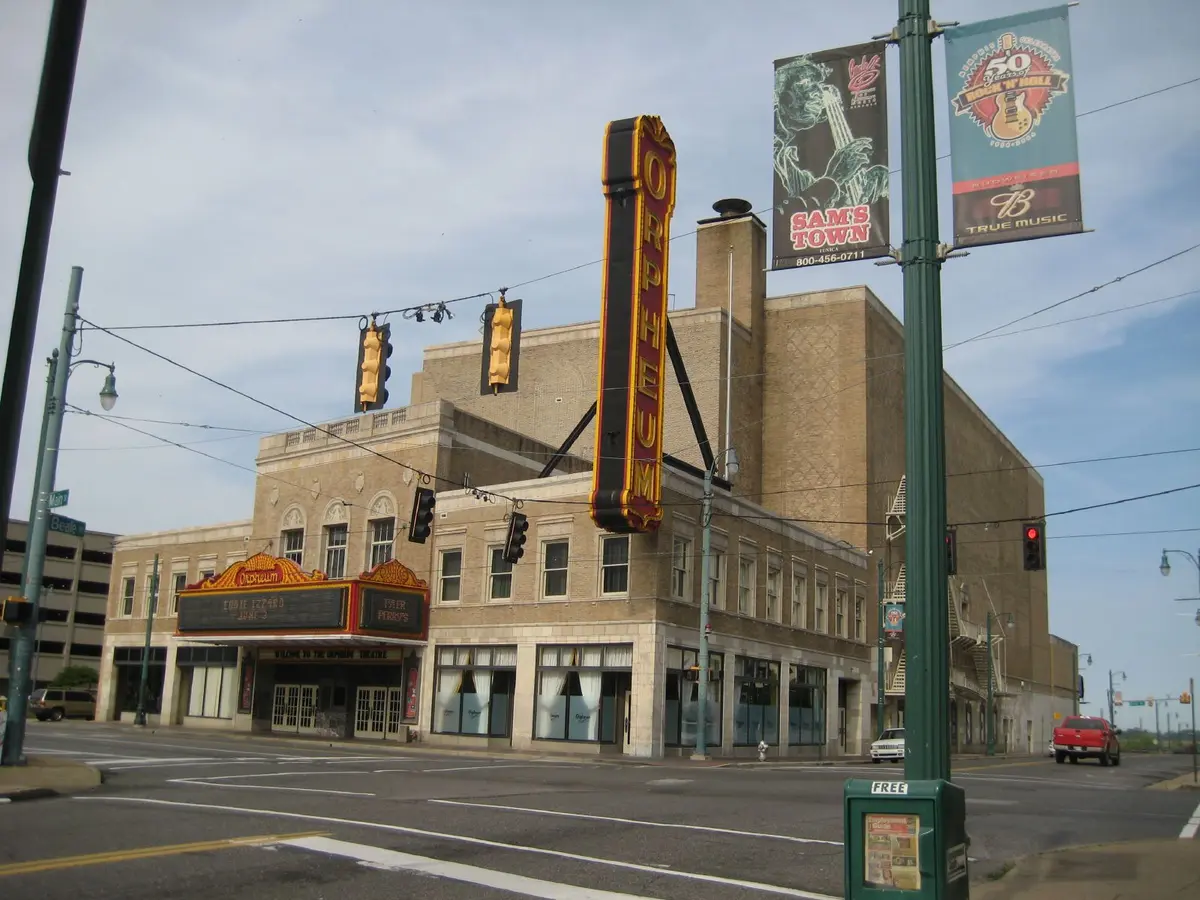
The Orpheum stands at Main and Beale, on a plot that has held a theatre since the Grand Opera House opened there in 1890.
Where is Orpheum Theatre (Memphis)?
- Location
- Tennessee, United States
- Type
- Theater
- Coordinates
- 35.14, -90.055
- Last updated
LOCATION
Why is Orpheum Theatre (Memphis) said to be haunted?
That house joined the Orpheum Circuit in 1907 and burned down on the night of 16 October 1923; the 2,800-seat movie palace that replaced it, designed by Rapp and Rapp of Chicago, opened in 1928 and still runs today as a non-profit. Its ghost is a girl called Mary, and her paperwork is worth reading carefully. Until 1979 she was said to have died in the 1923 fire. That year a parapsychology class from Memphis State University worked the auditorium with a Ouija board and séances and reported instead that she had died in 1921 in a fall unconnected with the theatre and simply wandered in afterwards. The earliest printed accounts, in 1981 and 1999, put her in one particular seat, C-5 — not, as often repeated, kept empty for her. No death record, inquest or newspaper report has ever been produced to confirm that Mary existed at all. The theatre, for its part, sells the story: its daytime tour promises visitors the truth about "our sweet and mischievous little ghost".
What is the history of Orpheum Theatre (Memphis)?
The Orpheum stands where Main Street meets Beale, and that corner explains most of what the building is.
A theatre has occupied the plot since 1890, when the Grand Opera House opened there — a house the present management still describes as "the classiest theatre outside of New York City". In 1907 it joined the Orpheum Circuit, the national vaudeville chain, and took the name it has carried, with one long interruption, ever since. That first building did not survive. On the night of Tuesday 16 October 1923, after a bill headlined by the singer Blossom Seeley, fire destroyed it; the Orpheum's own published history says the cause was never established and that the blaze most likely began on the third floor, which was occupied by a women's clothier.
What replaced it is documented in unusual detail, because the nomination that put the building on the National Register was filed in January 1977 by a Memphis architect, James Floyd Williamson Jr., and it survives in full. Construction began in 1927 on a 2,800-seat house for the Keith-Albee-Orpheum Circuit, designed by the Chicago firm of C. W. and George L. Rapp — the practice behind the Paramount in New York and the Uptown and Tivoli in Chicago — at a cost of $1.6 million. Williamson describes an auditorium 110 feet wide and 96 feet deep, four cantilevered balcony levels each with its own foyer and lounges, twin loges three storeys high, two-thousand-pound crystal chandeliers, and a plaster ceiling suspended from steel roof trusses hidden above it. In the pit sat a Wurlitzer style 240, thirteen-rank organ, opus 1956, the largest theatre organ in Memphis, mounted on its own lift so the organist could rise into view. Opening night in 1928 began with an address by Mayor Watkins Overton, an organ recital and an orchestral overture, ran a bill of vaudeville acts, and closed with the film The Outcast, starring Corinne Griffith.
The same document records, in a single flat sentence, something the theatre spent decades not saying out loud: "Originally a second entrance and box office were located on the Beale Street side with a separate stairway to the uppermost gallery." That was the segregated entrance. Black Memphians bought tickets at a different window, climbed a different staircase and watched from the top of the house — in a building standing at the head of the street that had made the city's music, and on a stage that through the 1930s carried Louis Armstrong, Duke Ellington and the Mills Brothers alongside Eddie Cantor, the Folies Bergère and Sally Rand. In 2023 the Orpheum opened the Balcony Project, a permanent public exhibit built around that doorway.
Vaudeville died and the house followed the century down. Renamed the Malco in 1935 under new management, it ran as a first-run cinema into the 1970s, with occasional live bookings — Hair and No, No, Nanette in 1972. In 1976 the Memphis Development Foundation bought it as part of an attempt to revive the south end of downtown and restored the Orpheum name; it was listed on the National Register on 15 August 1977, among the first buildings in Memphis to be. A $5 million restoration between 1982 and 1984 returned the interior to its 1928 condition while modernising everything behind the plasterwork. The Halloran Centre, an education and performance building next door, opened in 2015. The theatre is run today as a non-profit by the Orpheum Theatre Group, and its Broadway season is the reason most Memphians go inside.
Timeline: the documented record of Orpheum Theatre (Memphis)
- 1890 The Grand Opera House opens on the south-west corner of Main and Beale. The theatre's own history still describes it as the classiest house outside New York City.
- 1907 The house joins the Orpheum Circuit of vaudeville and takes the Orpheum name. This is the date our earlier entry wrongly gave as the year the building was built.
- 16 October 1923 Fire destroys the theatre on the night of Tuesday 16 October, after a bill headlined by singer Blossom Seeley. The Orpheum's history states the cause was never established and that the fire probably began on the third floor, occupied by a women's clothier.
- 1928 The new 2,800-seat Orpheum opens, designed by C. W. and George L. Rapp of Chicago at a cost of $1.6 million. Opening night runs an address by Mayor Watkins Overton, a Wurlitzer recital, an orchestral overture, vaudeville acts and the film The Outcast.
- 1935 Under new management the theatre is renamed the Malco and runs mainly as a first-run cinema for four decades, with occasional live bookings such as Hair and No, No, Nanette in 1972.
- 1976 The Memphis Development Foundation buys the building as part of a plan to revive the south end of downtown and restores the Orpheum name, halting a slide towards demolition.
- 15 August 1977 The Orpheum is listed on the National Register of Historic Places (ref. 77001289) on a nomination prepared that January by the Memphis architect James Floyd Williamson Jr., which records the separate Beale Street entrance and stairway to the uppermost gallery — the segregated way in.
- 1977 The touring New York company of Fiddler on the Roof becomes convinced the building is haunted and holds a séance in the balcony after its opening performance — the first dated paranormal session recorded in the theatre.
- 1979 A parapsychology class from Memphis State University (today the University of Memphis) tries to contact the ghost with a Ouija board and séances. The class reports afterwards that she called herself Mary and had died in 1921 in a fall unconnected with the theatre — replacing, rather than confirming, the older story that she died in the 1923 fire.
- 1979 In interviews with the writer Richard Winer, the couple carrying out repairs during the rescue of the building say they asked the ghosts to help with the restoration and got nothing, and admit that they worked in the theatre only in daylight, never at night.
- 1981 Richard Winer and Nancy Osborn Ishmael publish the Memphis State findings in More Haunted Houses, describing Mary in a glowing white dress gliding down the aisle to "her favorite seat, C-5". This is the earliest printed appearance of the seat number we have been able to read.
- 1982-1984 A $5 million restoration returns the interior to its 1928 opulence while modernising the systems behind it; the theatre reopens as a performing arts house rather than a cinema.
- 1999 Peter Underwood repeats the seat detail in a British guide — "she has been seen to occupy one particular seat, C5" — carrying a Memphis backstage anecdote into international ghost literature.
- 2023 The Orpheum unveils the Balcony Project, a free permanent exhibit built around the former Black-only balcony entrance on Beale Street, addressing the segregated history the 1977 nomination had recorded in a single sentence.
Is there a rational explanation for Orpheum Theatre (Memphis)?
There is no record of Mary. That is the single most important thing to say about her, and the printed sources say it themselves.
Her name, her age and her manner of death do not come from a death certificate, a coroner's report or a newspaper. They come from a Ouija board. Alan Brown, writing for the University Press of Mississippi in 2002, sets out the sequence plainly: in 1977 the touring New York company of Fiddler on the Roof became convinced the building had a ghost and held a séance in the balcony after their opening performance, and two years later a parapsychology class from Memphis State University "tried to make contact with Mary's ghost using a Ouija board and seances". What the class reported afterwards was not a confirmation of the story already circulating in the building — it was a replacement for it. Until 1979 the ghost was said to be a girl killed in the 1923 fire. After 1979 she was a girl who had died in 1921 in a fall "totally unrelated" to the theatre, and who had simply wandered in afterwards and stayed. Richard Winer, who published the same account in 1981, frames it identically: "It was long thought that Mary was the ghost of a young girl who was killed in a 1923 fire in downtown Memphis. However… she was killed in 1921 in some sort of falling accident not too far from the theatre itself."
Neither of the two earliest printed versions contains a streetcar. The story now repeated across the internet — a twelve-year-old run over by a tram in front of the old theatre in 1921 — is a third variant, later than both, and nobody has produced the accident report, the inquest or the burial record that would settle it.
Seat C-5 has drifted the same way. In Winer's 1981 telling it is simply where Mary is seen: her faint footsteps are heard "as she glides down the aisle to her favorite seat, C-5". Peter Underwood repeated it in a British guide in 1999 — "she has been seen to occupy one particular seat, C5" — which is how a Memphis backstage anecdote became an internationally quoted fact. The custom of leaving that seat empty during rehearsals as a courtesy appears in neither book, and the Orpheum's own visitor material does not mention it.
Then there is the building itself. Williamson's 1977 survey describes a hall 110 by 96 feet with four balcony levels, a plaster ceiling hung off steel trusses, organ chambers above the loges, twin boilers in the basement and a working fly grid overhead. A structure of that size, heated and cooled and then left empty overnight, expands, ticks and moves air. Footsteps and cold spots in an unlit 2,800-seat auditorium are what such a building produces on its own.
What is documented, and worth keeping, is the behaviour rather than the ghost. Brown records that the couple who worked on repairs during the late-1970s rescue told Winer in a 1979 interview that they had asked the ghosts to lend a hand with the restoration and got nothing; and that, for all their stated fearlessness, they worked on the building only in daylight, never at night. That is a real, dated, attributable fact about people in an empty theatre.
Finally, the incentive is not hidden. The Orpheum sells Mary. Her name is on the page for its $10 daytime tour, where docents promise to tell visitors "how much you really know about Mary, our sweet and mischievous little ghost". That is honest marketing by a non-profit that needs the door revenue — and it is also why the story gets retold every October without anyone checking it.
Can you visit Orpheum Theatre (Memphis)?
The Orpheum is a working theatre and the ordinary way in is with a ticket to something. It stands at 203 South Main Street, Memphis, Tennessee 38103. The corner is Main and Beale, at the north end of the South Main district. The box office is on 901-525-3000, open weekdays from 9 a.m. to 5 p.m. and two hours before show time at weekends; general enquiries go to 901-525-7800. The programme is built around a Broadway touring season, with concerts, comedy and a summer film series.
The cheapest daylight look at the interior is the Theatre Campus Tour: about 60 minutes, $10 a head, free for children under five with a reservation, at 10 a.m. and noon from Monday to Wednesday as availability allows, with registration opening roughly four weeks ahead. Arrival is asked for 15 minutes beforehand, in the Orpheum lobby outside the box office. It covers the 1928 theatre and the Halloran Centre next door. The backstage murals are on the route, as is the story of how the building escaped demolition in the late 1970s, and the docents talk about Mary. Private groups of twenty or more book through Joy Truly Brown on 901-529-4234 at least a week ahead. The Balcony Project, the exhibit on the segregated Beale Street entrance, is free to the public.
Accessibility is documented in unusual detail for a building of this age. Accessible seating is on the orchestra level of the theatre and on every level of the Halloran Centre; those seats and their companion seats go on public sale 48 hours before curtain, earlier if the house sells out. They measure 19 to 21 inches between armrests. Lifts serve the orchestra and mezzanine levels and the balcony. For anyone on the stairs the theatre publishes the counts: none to the orchestra; up to 24 steps to the mezzanine; up to 41 to the grand tier; up to 58 to the balcony; up to 77 to the gallery. At the Halloran Centre it is up to 19 steps within the orchestra and 35 to the mezzanine.
Assistive listening devices are free in both venues, and sign language interpretation needs two weeks' notice on 901-525-7800. Closed captioning and audio description come through the GalaPro app on selected Broadway performances, over the venues' free Wi-Fi. Accessible parking is at the MLGW garage and the Downtown Mobility Center, with curbside drop-off at both buildings.
The Orpheum runs no ghost hunts and no night vigils, and there is no way to be alone in the auditorium. Mary belongs to the daytime tour, which is the whole of the offer.
Sources consulted
- James Floyd Williamson Jr., «National Register of Historic Places Inventory–Nomination Form: Orpheum Theatre (The Malco), Memphis, Tennessee — reference 77001289» — United States Department of the Interior, National Park Service, 1977 archive
- Alan Brown, «Haunted Places in the American South (chapter: The Orpheum Theater, Memphis)» — University Press of Mississippi, 2002 book
- Richard Winer and Nancy Osborn Ishmael, «More Haunted Houses» — Bantam Books, 1981 book
- Peter Underwood, «Peter Underwood's Guide to Ghosts & Haunted Places» — Piatkus, 1999 book
- Orpheum Theatre Group, «History of the Orpheum Theatre» — orpheum-memphis.com, 2026 web
- Orpheum Theatre Group, «Theatre Campus Tours and Accessibility information» — orpheum-memphis.com, 2026 web
Reviewed by V. Serrano on 2026-08-11 · How we verify our content
💬 Field testimonies (0)
No testimonies yet. Add the first.
Add your testimony
🔒 Log in to add a testimony