👻 HAUNTED PLACE · EXP. Nº9478
ACTIVE
Palace Theatre (New York City)
The Palace opened at Broadway and 47th Street on 24 March 1913, built for the vaudeville impresario Martin Beck to designs by Kirchhoff & Rose, and it quickly became the stage every variety performer wanted: to have played the Palace was to have arrived.
Where is Palace Theatre (New York City)?
- Location
- New York, United States
- Type
- Theater
- Coordinates
- 40.759, -73.985
- Last updated
LOCATION
Why is Palace Theatre (New York City) said to be haunted?
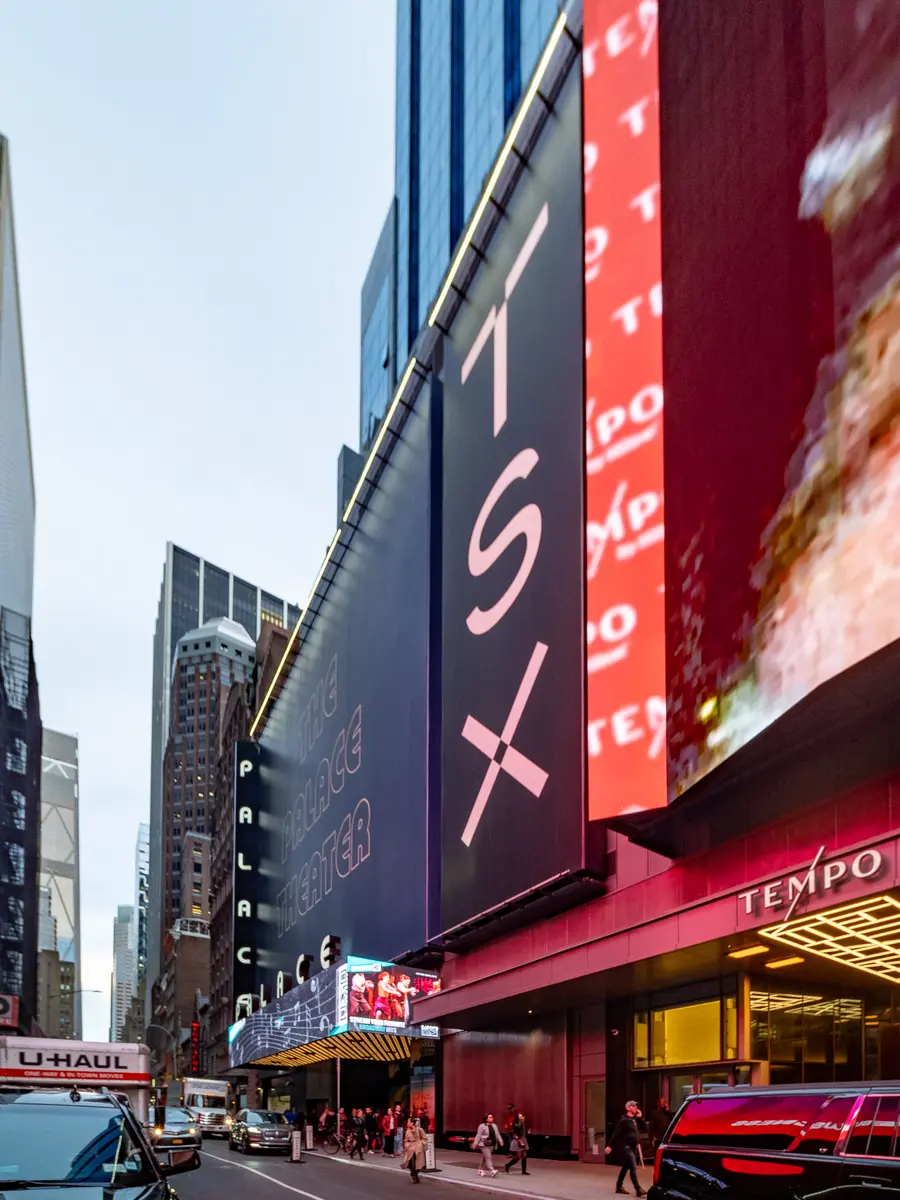
Its ghost story belongs to that era, and it is usually told wrong. On 27 August 1935, before an audience of 800, the acrobat Louis Borsalino of the Four Casting Pearls missed a catch and was thrown eighteen feet to the stage; the New York Times reported it the next morning under the headline Acrobat Plunges to Palace Stage; Badly Hurt. From the late 1960s, stagehands are said to have seen a white-costumed figure swinging above the stage before vanishing with a scream, a story kept in circulation today by the Ghostlight Tour of Broadway Up Close Walking Tours. The detail that usually falls out is the one that matters: Borsalino survived, and died 28 years later in Pennsylvania. The building fared worse. In 2022 the landmarked auditorium was jacked 31 feet, about nine and a half metres, into the air so that shops could be built underneath it, and the Palace reopened in 2024 three storeys above where it started.
What is the history of Palace Theatre (New York City)?
The Palace was built to settle an argument about who owned vaudeville, and it ended up outliving vaudeville, its own architects, and two buildings wrapped around it.
West Coast impresario Martin Beck put it up in 1912-13 at 1564-1566 Broadway, at 47th Street, to designs by the Milwaukee firm of Kirchhoff & Rose. The plan was an L: an eleven-storey office wing facing Broadway, holding the entrance lobby and the booking offices that ran the vaudeville industry, with the brick auditorium behind it running east along West 47th Street. That awkward shape was not a whim. City construction codes of the period forbade building over an auditorium, so theatre and office block had to sit side by side.
It opened on 24 March 1913, and The New York Times announced that morning that the new house seated 1,800 and would run "a policy patterned after that of the English music halls". It was, at first, a flop: a two-dollar top price, long acts, ferocious competition from the nearby Victoria, and reviews that praised the building and shrugged at the bill. The Landmarks Preservation Commission's later account fixes the turn precisely — Sarah Bernhardt appeared on the stage on 5 May 1913, and from that night the Palace was the theatre every variety performer wanted. Beck built it, but his rival E. F. Albee of the Keith-Albee circuit ran it, and Albee ran it his way: two shows a day, nine-act balanced bills, family entertainment, and a list of forbidden words posted backstage that included hell, devil, cockroach and spit.
What played there is the reason the phrase survives. Jack Benny, Bob Hope, Sophie Tucker, Eddie Cantor, the Marx Brothers, W. C. Fields, Houdini, Mae West, Will Rogers, Bill Robinson. Helen Keller and Anne Sullivan took a two-week engagement in 1920. Odiva, the Plunging Samoan Nymph, performed feats of grace in a tank full of sea lions.
The competition that ended its reign came from the picture palaces: the 3,500-seat Paramount opened four blocks south in 1926, and the even larger Roxy followed the next year. On 7 July 1932 the Palace surrendered to a mixed film-and-vaudeville bill; the policy then flipped at least eight times before October 1935, when the theatre settled into fourteen straight years of feature films. Vaudeville came back only in nostalgic bursts. On 16 October 1951, after a two-week refit, the new "A Night With…" format opened with Judy Garland — a record-breaking nineteen-week engagement, and the first two-a-day at the Palace in nearly eighteen years.
The Nederlander Organization bought the theatre in 1965 and spent half a million dollars turning it back into a legitimate house. Designer Ralph Alswang tore out the plastic and plywood of the movie years, found a cache of crystal chandeliers in the basement, enlarged the pit for thirty musicians, and — a detail that matters later — extended and levelled the raked vaudeville stage. Sweet Charity opened in January 1966 and ran 608 performances.
On 14 July 1987 the Landmarks Preservation Commission designated the Palace: the interior only, LP-1367. Landmark status for the exterior was denied, and that distinction decided the building's future: the theatre closed late in 1987 after the last performance of La Cage aux Folles, the office wing was demolished except for the lobby, and a forty-three-storey Embassy Suites hotel was built around the protected auditorium, which reopened in 1991.
Then it happened again, on a scale nobody had attempted. From 2018 the Palace went dark for the $2.5 billion TSX Broadway redevelopment, and in January 2022 the entire landmarked auditorium was jacked roughly thirty feet into the air so that ground-floor retail could be excavated beneath it.
Timeline: the documented record of Palace Theatre (New York City)
- 24 March 1913 The Palace opens at Broadway and 47th Street. The New York Times reports that morning that the house seats 1,800 and will follow "a policy patterned after that of the English music halls".
- 5 May 1913 Sarah Bernhardt appears on the Palace stage. The Landmarks Preservation Commission's designation report dates the start of the Palace's twenty-year reign as the premier variety house in the world to this night.
- 7 July 1932 Beaten by the Paramount and the Roxy, the Palace abandons straight vaudeville for a combined film and variety bill. The policy will flip at least eight more times before the theatre settles into fourteen years of feature films in October 1935.
- 27 August 1935 Louis Borsalino, 31, of the acrobatic act The Four Casting Pearls, misses a cast before an audience of 800 and is thrown eighteen feet to the stage. The New York Times reports it the next morning on page 13 under the headline "Acrobat Plunges to Palace Stage; Badly Hurt". He is injured, not killed.
- 16 October 1951 After a two-week refit, the Palace launches its "A Night With…" format with Judy Garland. Her record-breaking nineteen-week engagement is the first two-a-day vaudeville at the theatre in nearly eighteen years.
- 1963 Louis Borsalino dies in Pennsylvania, twenty-eight years after his fall, according to the account Broadway Up Close Walking Tours gave to NY1 in 2017.
- 1965-66 The Nederlanders buy the Palace and spend half a million dollars on it. Designer Ralph Alswang strips out the cinema-era panelling, enlarges the pit for thirty musicians and extends and levels the raked vaudeville stage — the floor Borsalino had landed on. Sweet Charity opens in January 1966 and runs 608 performances.
- Late 1960s Stagehands are said to begin reporting a white-costumed figure swinging above the stage, vanishing and leaving a scream behind it. The account, told by Broadway Up Close Walking Tours, places the first sightings more than thirty years after the accident; further sightings are claimed in the 1970s and 1980s and then stop.
- 14 July 1987 The Landmarks Preservation Commission designates the Palace as an interior landmark, LP-1367, covering the auditorium, stage and both balconies. Protection for the exterior is denied — the decision that allows the surrounding building to be demolished and rebuilt twice over the next thirty-five years.
- 7 January 2022 The lift begins. Thirty-four custom-made lifting posts, hybrids of shoring post and hydraulic jack from Urban Foundation/Engineering, with a five-foot-thick concrete cushion beneath the theatre, start raising the entire landmarked auditorium about thirty feet, at a quarter of an inch an hour. L&L's Robert Israel put the weight at roughly five million pounds; engineers on site told the Observer it was nearer 7,080 tons.
- March 2022 Engineering News-Record reports the theatre has reached the seventeen-foot mark and the lift has paused while steel crews install the permanent frame beneath it. Eric McGovern, of the construction manager Pavarini McGovern, tells the magazine the biggest hurdle was the start: "breaking the existing theater free from its foundations that it's been on for 100 years".
- 2024 The Palace reopens after six years dark, three storeys above where it spent its first 109 years, with the Ben Platt: Live at the Palace residency on sale through the Nederlander box office.
Is there a rational explanation for Palace Theatre (New York City)?
The people who tell the Palace ghost story for a living also say that the man in it survived.
The canonical version is the one NY1 published in October 2017 in a feature on the Ghostlight Tour run by Tim Dolan, owner of Broadway Up Close Walking Tours. In it, the acrobat Louis Bossalina of the Four Casting Pearls was launched from his partner's hands, missed the catch and fell eighteen feet to the stage in front of a half-full house of 800. The same text then adds: "Luckily, he survived the incident, and after a lifetime of performing, he died 28 years later in Pennsylvania." The contemporary record agrees with that ending: The New York Times reported the accident the next morning under the headline "Acrobat Plunges to Palace Stage; Badly Hurt", naming Louis Borsalino, aged 31, thrown eighteen feet after missing a cast. Broadway's most famous ghost is a man who did not die in the building.
The details also shift from one telling to the next. The Times spelled him Borsalino, while the tour and the retellings that follow it spell him Bossalina. The tour describes a partner hanging by his legs from a trapeze, and the Times described a "cast" between fixed towers, with the acrobats thrown from one to the other. The hospital, the fractured pelvis and the internal bleeding are details of the tour's version.
The strongest objection is the gap in time: the fall happened on 27 August 1935, and the earliest sightings in the tour's account are from the late 1960s, more than thirty years later and within a few years of the Nederlanders' reopening of the Palace as a legitimate theatre in 1966. The same account places a few more sightings in the 1970s and 1980s, after which, it says, "Bossalina disappeared for good."
The physical setting of the story has also changed several times since 1935. Ralph Alswang extended and levelled the raked vaudeville stage in 1965-66. After 1987 the office wing in front of the auditorium was demolished except for its lobby, and a hotel tower was built over the theatre; that tower was itself taken down from late 2018. Before the 2022 lift, crews installed the primary structure for a new stage, which braced the auditorium while it rose, and Engineering News-Record gave the theatre's final position as 31 feet higher than before, about 9.4 metres above the level of the floor on which Borsalino landed.
The Palace was also known for how well it carried sound. The Landmarks Preservation Commission's designation report quotes the critic Robert Sylvester, speaking some forty years after the opening, recalling that from the rear of the auditorium he heard "every whisper just as plainly as [if he] were in the first row". Sound travels the same paths in both directions, so a hall that carries a whisper from the stage to the back wall also carries a noise made at the back of the house, or in the wings, to the stage.
Can you visit Palace Theatre (New York City)?
The Palace is a working Broadway theatre, and the way inside is a ticket to the current production. The operator's page on Broadway Direct, as captured by the Internet Archive on 31 August 2026, is the source for what follows; that day it listed The Lost Boys. The theatre is one of the Nederlander Organization's nine Broadway houses and is co-owned with Stewart F. Lane. The operator gives the address as 160 West 47th Street, New York, NY 10036. Its stated capacity is 1,648 seats. The entrance moved from Broadway to 47th Street in the rebuild that lifted the auditorium about 30 feet (9 metres) inside the TSX Broadway tower from January 2022; the Landmarks Preservation Commission's 1987 designation of the interior, LP-1367, describes the building at 1564-1566 Broadway. The box office telephone is 212-730-8200, and the counter opens from 10:00 to 20:00 Monday to Saturday and from 12:00 to 18:00 on Sunday.
The operator's subway directions are the C or E to 50th Street, the N, Q, R, W, 1, 2, 3 or 7 to Times Square, and the A, C or E to Port Authority; advance parking is sold through SpotHero. Its policies state that there is no dress code, that everyone entering needs a ticket regardless of age, that children under five are not admitted and that tickets are not refunded or exchanged. Bags are inspected and luggage is refused, as is any bag larger than 20 by 14 by 9 inches, and the prohibited list includes weapons, outside food and drink, large professional cameras, flashlights and laser pointers.
The accessibility page places wheelchair locations in the orchestra, rear mezzanine and balcony, sold as one wheelchair space with up to three companion seats per order. It lists aisle transfer seats with folding armrests by seat number on all three levels and groups the seats for patrons with low vision or hearing loss in orchestra rows C to H. Barrier-free restrooms are on floors two to six, and a passenger elevator connects every level. Sound-augmentation headsets are free against a form with the patron's contact details, which the theatre says it deletes once the headset is returned. Staff meet patrons with disabilities in the lobby to take them to their places, and guide dogs and service animals are admitted.
The ghost story is told on the street. A 2017 NY1 report on the Ghostlight Tour of Broadway Up Close Walking Tours, written from material the company supplied, included the Palace. On 24 September 2026 the tour's own page listed departures on Wednesday and Saturday at 11:00 from in front of 1411 Broadway, just south of 40th Street, at $43 for adults, without naming the theatres on the route.
Sources consulted
- The New York Times, «Acrobat Plunges to Palace Stage; Badly Hurt When He Misses Partner's Hands After a Double Somersault» — The New York Times, 28 August 1935, Amusements, p. 13, 1935 newspaper archive
- New York City Landmarks Preservation Commission, «Palace Theater Interior — Designation Report, LP-1367» — Designation List 190, 1987 report
- The New York Times, «Palace Opens To-Day.; New Broadway Vaudeville Theatre Will Seat 1,800 Persons» — The New York Times, 24 March 1913, p. 11, 1913 newspaper archive
- Frank DiLella, «Touring Broadway's Haunted Past (account supplied by Broadway Up Close Walking Tours)» — NY1 / Spectrum News, 2017 newspaper archive
- Tom Stabile, «TSX Broadway Joins Old to New in Times Square» — Engineering News-Record, 2022 report
- Helen Holmes, «Broadway's Palace Theatre Has Begun Its 8 Week, 30 Foot Ascent» — Observer, 2022 newspaper archive
- Lauren Glassberg, «Iconic Palace Theatre being lifted 30 feet above Times Square» — ABC7 New York (WABC-TV), 2022 newspaper archive
- The Nederlander Organization, «Palace Theatre — theatre information, patron services, accessibility and history» — Broadway Direct (official operator information), 2026 web
Reviewed by V. Serrano on 2026-08-11 · How we verify our content
💬 Field testimonies (0)
No testimonies yet. Add the first.
Add your testimony
🔒 Log in to add a testimony